

Why Owners Tune Out When They Hear "It Feels Faster"
"Does bringing in AI really cut costs?" I have been asked this well over a hundred times. I usually answer with a question: "What are your current costs?" Eight out of ten shops cannot answer. They only say things like "sales is swamped, revisions are exhausting, shipments are always being chased."
All of that is true, but none of it is a number. No baseline means no savings. No savings means no return on investment. What this article gives you is the table that turns "feeling" into "money."
The cost model has only four parts: software subscription fees, labor hours saved, waste reduction from better quality, and revenue gained from faster turnaround. Do not rush into picking tools yet. Get these four parts on the table first. Miss one, and the whole model tilts
How Do You Lay Out Your Current Costs?
Before bringing in AI, spend one week recording the following four metrics. This is not for writing a report. It is so every "saving" later has something to compare against
・Revision rounds: from the time a client sends in a file to the point it is ready for print, how many back-and-forth rounds happen on average? Based on what we have seen while advising small and midsize print shops at MINDS (MS), the usual range is 3 to 5 rounds
・Quote turnaround time: from receiving a request to sending a formal quote, how many hours does sales spend on average?
・Missing-file frequency: out of every hundred orders, how many are sent back because fonts, images, or specifications are missing?
・Waste rate: the scrap rate across printing and finishing. This is the cost most easily buried inside gross margin
Add these four metrics together, and you have your current "hidden cost." Most owners look only at paper, ink, and payroll. They miss the labor behind five revision rounds, the paper wasted on rework, and the overtime burned on rush jobs
For example, take a midsize design and output company with about 200 orders per month, an average of 4 revision rounds per order, 25 minutes per revision, and a designer hourly rate of NT$600. Revisions alone eat up 200 × 4 × 25 / 60 × 600 = about NT$200,000 per month. That still does not include the client relationship cost of chasing missing materials back and forth
Once the numbers are laid out, calculating AI payback starts to mean something
Which Costs Does AI Affect, and How Should You Estimate Them?
After mapping the current state, the next step is defining where AI can actually have an impact. AI is not a magic fix. It can only move a few cost lines, so evaluate them in this order:
・Directly measurable labor time: revisions, quote calculations, and file checks. These three are the easiest entry points for AI
・Waste reduction from better quality: AI preflight can catch basic errors such as ink overflow, insufficient resolution, and missing bleed. In the past, many of these problems were only found after the job reached the press
・Revenue gained from faster turnaround: when quotes go from half a day to 5 minutes, or proofing goes from 3 days to 1 day, that time gap lets sales take more orders
・Customer retention from a better experience: this is the hardest to quantify, but the repeat-order rate can work as a proxy metric
The conservative method is simple: cut every estimated benefit above in half first. Why? Because early adoption always comes with a learning curve, staff resistance, and a few process gaps. If the project can still hold up at half the expected benefit, it is worth doing
Hidden Costs Are What Break the Payback Period
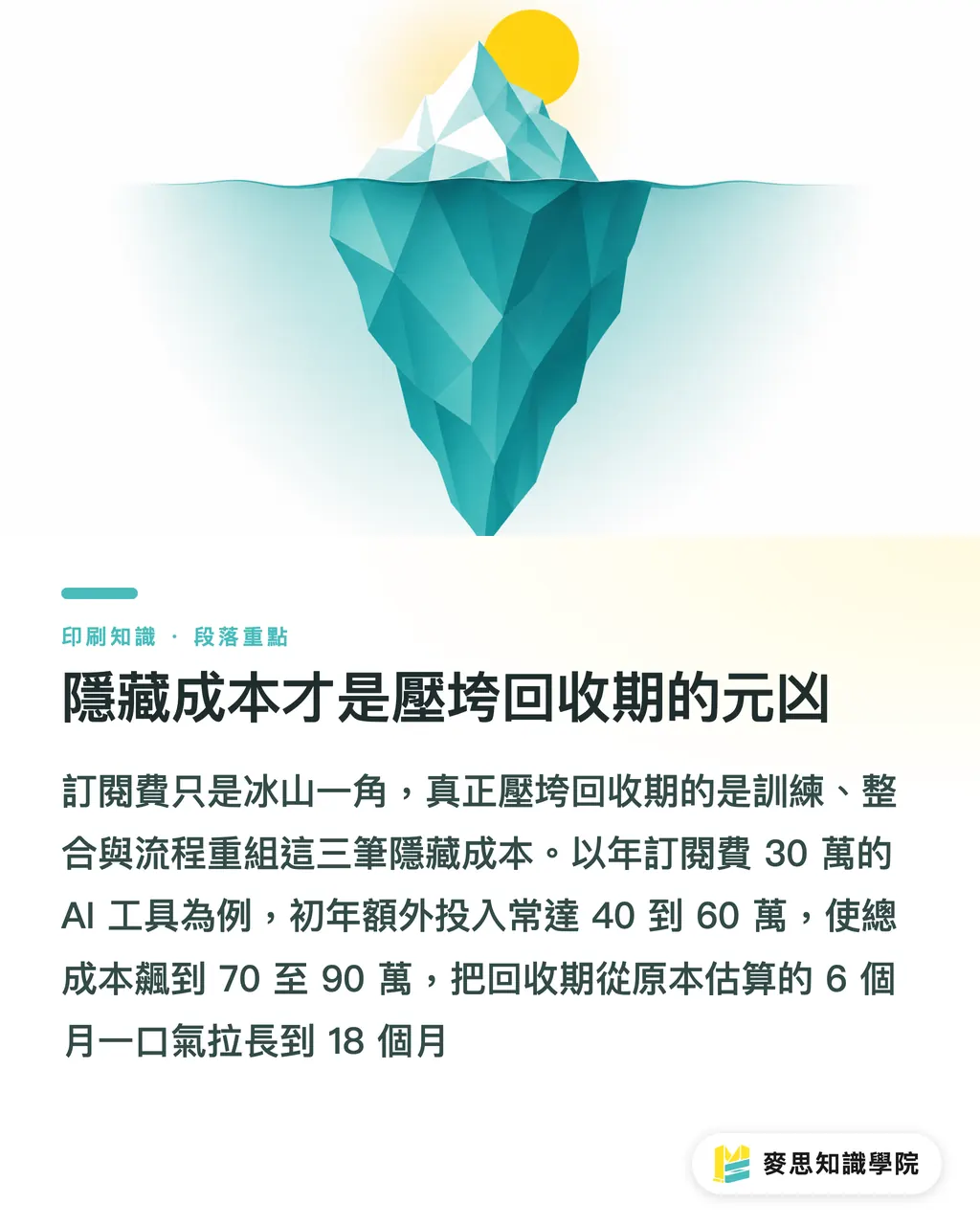
Many owners look only at subscription fees and miss three hidden bills. Leave these out, and a payback period that looked like 6 months can turn into 18 months
・Training cost: not training the AI, but training your people to use AI. I suggest budgeting for an intensive 2- to 4-week rollout period
・System integration cost: the AI tool needs to read your quote sheets and match your production schedule. This part is often underestimated
・Process redesign cost: bringing in AI forces you to redraw existing workflows. The productivity dip during this transition period has to be counted
Concrete numbers: for an AI tool with an annual subscription fee of NT$300,000, it is common to budget another NT$400,000 to NT$600,000 in the first year for training, integration, and process redesign. That NT$700,000 to NT$900,000 is your total investment
How Do You Calculate the Payback Period? A Formula You Can Use
Payback period (months) = total investment ÷ monthly net benefit
Monthly net benefit = (labor savings + waste reduction + contribution from new revenue) - AI subscription fee
Extending the previous example: monthly revision cost is NT$200,000. After AI adoption, cut the benefit estimate in half, so it becomes NT$100,000, saving NT$100,000 per month. Estimated waste reduction is NT$30,000 per month. New revenue contribution is conservatively set at NT$50,000 per month. Monthly subscription allocation NT$25,000. Monthly net benefit = 10 + 3 + 5 - 2.5 = NT$155,000. Total investment: NT$900,000
Payback period = 90 ÷ 15.5 ≈ 5.8 months
That is a healthy number. If the result is over 18 months, I would suggest narrowing the scenario first. Start with one pain point, such as quote calculation, instead of rolling it out too broadly at once
MINDS (MS) Three Print-Ready Gates: Three Checkpoints Before You Decide
Before deciding to adopt AI, use the "MINDS (MS) Three Print-Ready Gates" as a self-check. Each gate needs a concrete answer. If you do not have one, do not move yet
・Gate 1: pain-point priority: list the three most painful cost items. AI can solve only one first. Which one do you choose?
・Gate 2: data readiness: are your historical quotes, revision records, and customer data structured? If not, digital cleanup comes first
・Gate 3: exit mechanism: if the results fall short after three months, can you stop using the tool? Is the contract locked in?
Pass these three gates, then talk about which tool to choose. Reverse the order, and the money burns fast
If you need more detailed financial modeling and rollout planning, you can work through it with the Mai Strategy Knowledge Academy consulting team. If you need high-end, fully customized commercial printing and want to understand the actual quality and turnaround performance after adoption, the production process at MINDS is the benchmark I often use for comparison
Which Metrics Should You Keep Tracking? Do Not Look at Just One Month
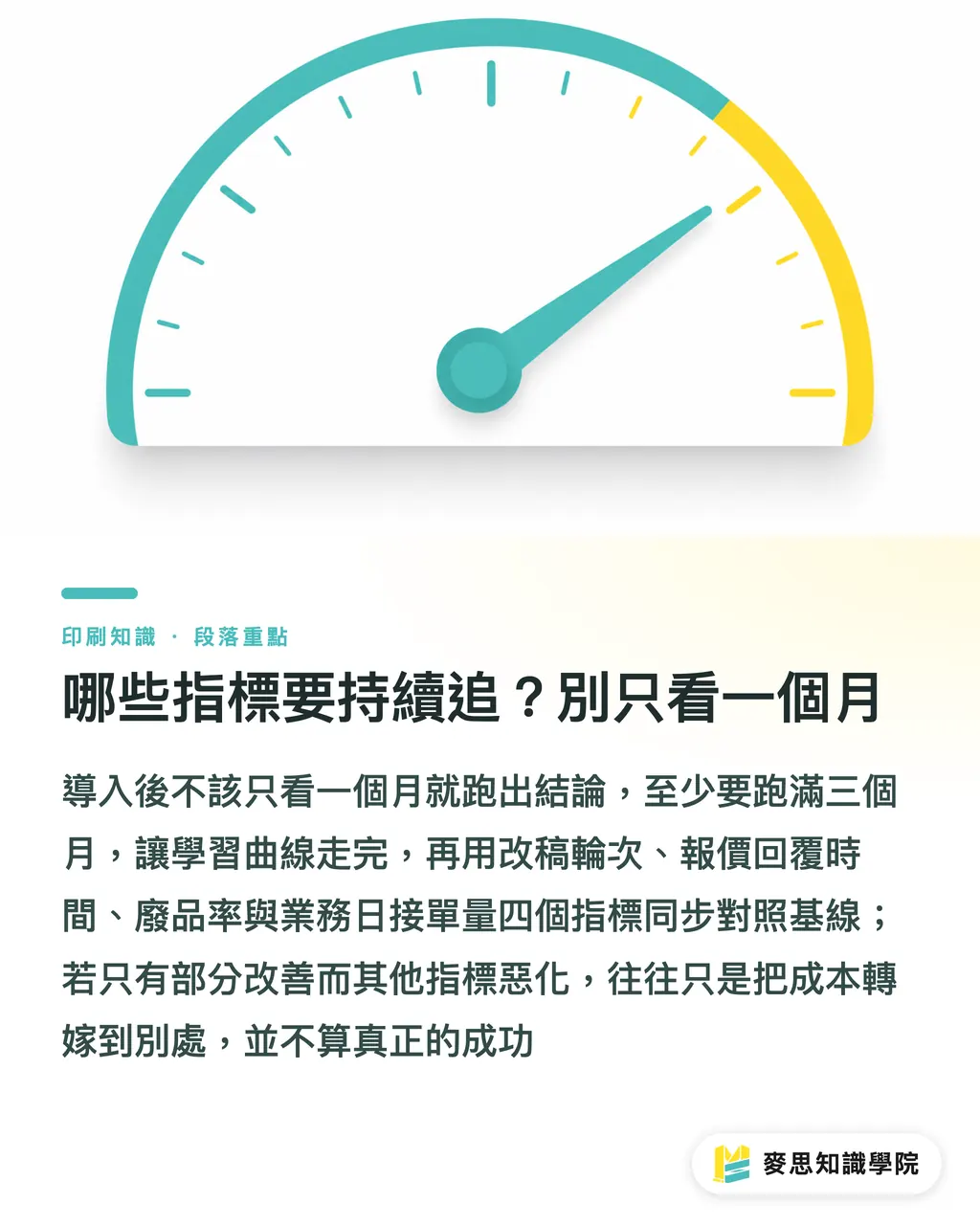
The first month after adoption is the easiest time to misread the results because the learning curve is not over yet. I suggest running for at least three full months before drawing conclusions, while tracking these four metrics together:
・Target revision rounds: compared with the pre-adoption baseline, aim for a 30% to 50% reduction
・Quote response time: compared with the baseline, aim for a reduction of more than 60%
・Waste rate: compared with the baseline, aim for at least a 20% reduction
・Daily order volume per salesperson: this is the real validation on the revenue side
The project only counts as a real success when all four metrics improve together. If only one or two improve, the cost may simply have been pushed somewhere else. For example, fewer revisions but more customer complaints is not saving money. It is burning customers
Key Takeaways
No baseline means no savings. Turn your current costs into numbers first
Estimate AI benefits at half value first. If the project still works at half, it is a good investment
Hidden costs are often twice the subscription fee. Do not look only at the sticker price
If the payback period is over 18 months, narrow the scenario and start with one pain point
Track four metrics together. A single-point improvement may just be cost shifting
Further Thinking
For print manufacturing: treat AI as an excuse to redesign processes, not as buying another tool. During adoption, you will be forced to audit the quotes, revision records, and customer data that nobody wanted to clean up before. Those are the real assets
For design teams: AI preflight can block 70% of basic errors, but the "feel" the client wants still depends on people. Put the saved time into deepening design value, not cutting prices to win orders
For AI application and SaaS providers: clients do not want the magic of a demo. They want a concrete number like "payback in five months." An ROI calculator and a pre-adoption baseline audit tool will hit harder than a feature list
Suggested next step: pick the most painful scenario first, usually quote calculation or revision preflight. Run a small two-week trial, record the actual numbers, then decide whether to expand. That is more useful than any white paper
Further Reading
・Mai Strategy Knowledge Academy consulting team (practical perspectives and advisory cases)
・MINDS MS high-end fully customized commercial printing (production-process benchmark)
FAQ
- What is a reasonable payback period for bringing AI into a print workflow?
- For small and midsize businesses, a payback period of 4 to 8 months is healthy. If it goes beyond 12 months, revisit the pain-point definition and hidden costs. Over 18 months usually means the scenario was chosen poorly, and the scope should be narrowed to a single pain point first
- Can AI really reduce print waste?
- Yes, but only at the stage where errors can be caught before going on press, such as missing bleed, insufficient resolution, or the wrong color mode. These mistakes used to be found during proofing or after reaching the press, making them one of the heaviest hidden costs. In practice, after introducing a preflight mechanism, a 20% reduction in waste is a reasonable target
- What is the minimum initial budget a small or midsize business should prepare for AI printing tools?
- Using a tool with an annual subscription fee around NT$300,000 as an example, a practical first-year total investment, including training, integration, and process redesign, would be NT$700,000 to NT$900,000. If the budget is under NT$500,000, start with free or lower-tier tools for a single-point trial instead of trying to do everything at once
- How can you tell whether AI adoption is truly working or just feels faster?
- Look for improvement across four metrics: revision rounds, quote response time, waste rate, and daily order volume per salesperson. If only one or two improve, the cost may have been shifted elsewhere. For example, fewer revisions but more customer complaints is not saving money. Run it for at least three full months before making the call
- Are AI customer service tools or automated quoting bots suitable for every print shop?
- Not necessarily. If your customers need heavy customization, have high order values, and require multiple specification checks, AI customer service can damage the experience. In these cases, AI is better used as an internal assistant for calculations and preflight checks, not as a direct customer-facing tool
Related articles





The Print × AI weekly
The print and AI know-how designers, brands and enterprises can use before they commit — one email, every week
MINDS Free Tools
AI background removal, brand stamping, and a LINE sticker maker — free design tools, right in your browser, no upload.
MINDS Group
Need actual printing or gifting services?
From premium printing to online ordering and festive gifts — the MINDS Group sister brands take it from here.