

Overview
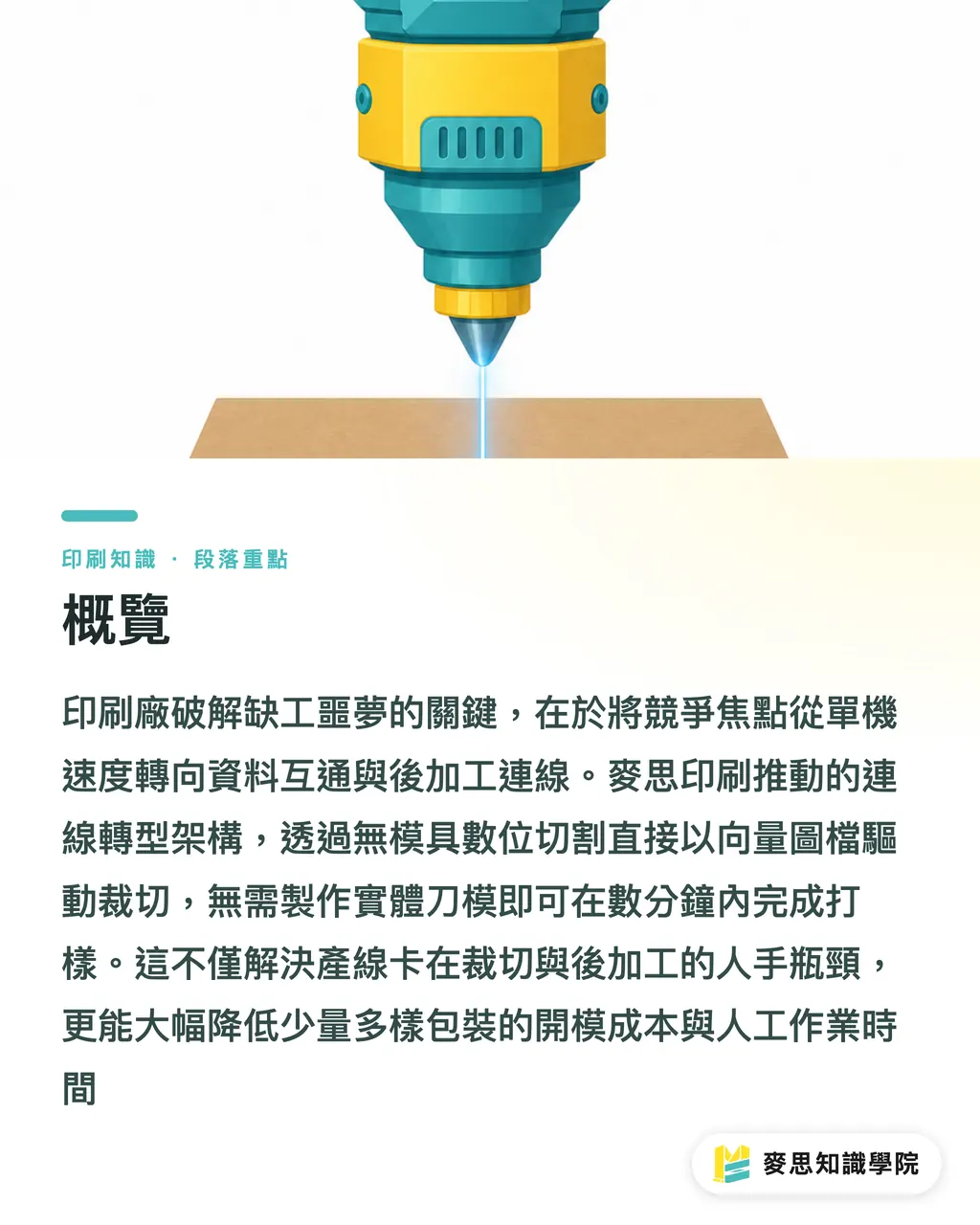
Die-less digital cutting: vector files drive the blade directly, no physical die-making required, samples in minutes, and the die-making cost and manual labour for short-run packaging drops hard
The real lever for breaking the labour-shortage nightmare is moving the competitive focus from single-machine speed to data interoperability and post-press connectivity. That's the backbone of the "MINDS (MS, mid-to-high-end fully custom commercial printing) Connected Transformation Trilogy" that the MINDS team pushes on the front line
Print shops don't fear a lack of orders. They fear the next order landing and having no one left to fire up the press
I've watched too many shops blow the budget on a high-speed press, only to bottleneck downstream at finishing and cutting because hands are short
Why throwing money at a high-speed press still doesn't fix the labour shortage
Packaging shops used to lean hard on veteran operators for makeready, colour approval, and die calibration
Throw in tightening paper supply and a steady stream of retirees, and the old six-shift rotation model collapses fast
Scotland-based KennedySmith brought in a KBA Rapida 106 automated press, and the whole point was to cut its dependence on seasoned hands and slash changeover downtime
A lot of plant managers think the fastest press will solve everything
Reality on the floor: the press flies, but the die-cutting and sample area piles up with semi-finished stock waiting for someone to move it
KennedySmith's real numbers show automated makeready and process tuning squeezed what used to run on six shifts into three shifts with no output loss
・KBA Rapida 106 automated press: changeover times compressed, far less reliance on veteran operators
・Capacity rebuild on the ground: from a six-shift rotation down to three shifts, same output, half the people
・Pre-press vs. post-press gap: no matter how fast the press runs, if downstream still depends on manual handling and hand-cranked die alignment, the whole line jams
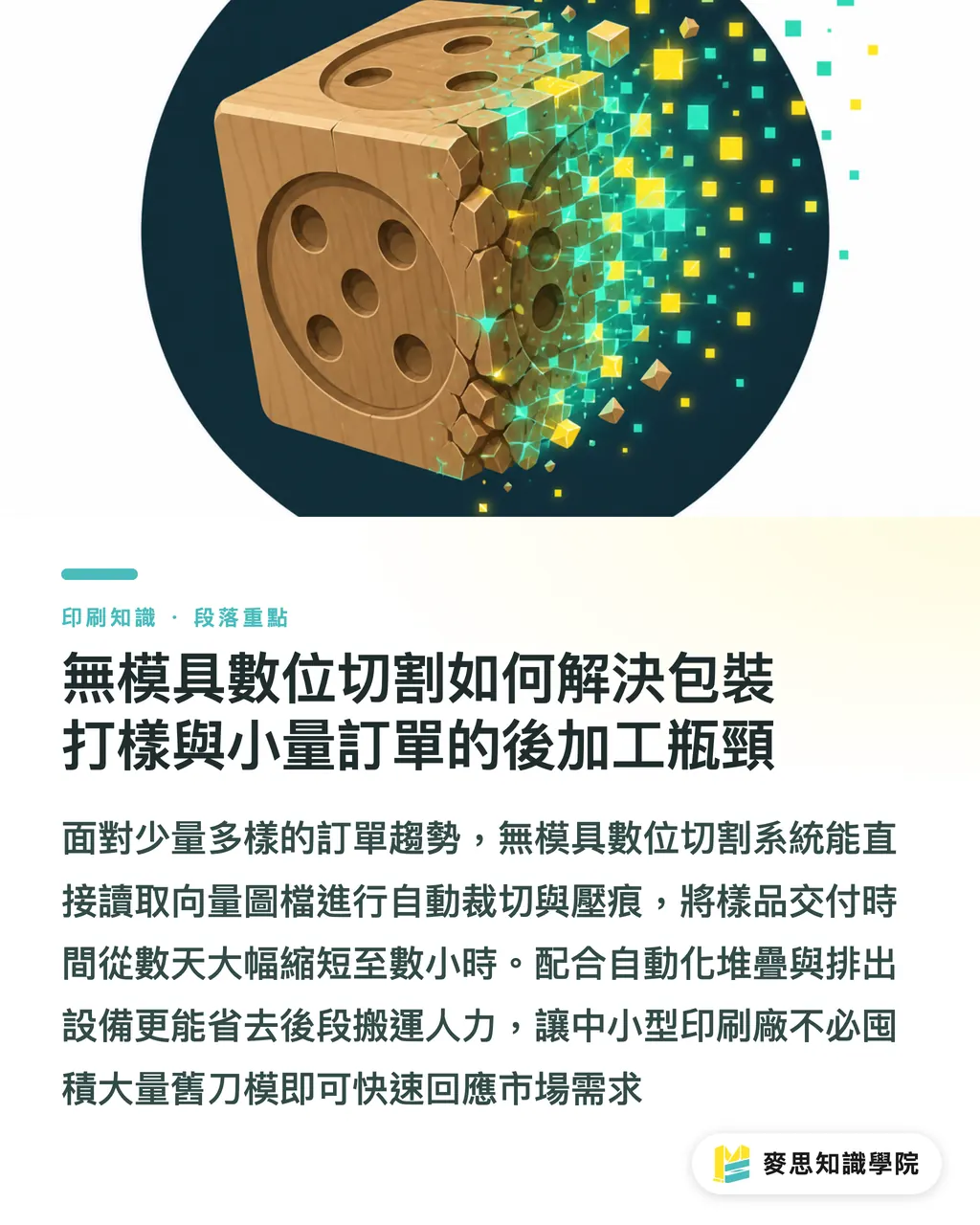
How die-less digital cutting clears the post-press bottleneck for packaging samples and short runs
Low-volume, high-mix is the new default for brand clients, and it's the profit killer for traditional print shops
Every new box style means a physical wooden die, pricey to make, and days lost just waiting for it
Ireland's Boxen brought in an Elitron Kombo TAV die-less digital cutting system and wiped out the time cost of sampling entirely
Die-less cutting reads the vector file straight from the computer, and the machine handles feeding, cutting, creasing, and stripping on its own
Pair it with Thacker's high-speed corrugated stacking and auto-eject setup, and nobody needs to babysit the output end
For Taiwan's small and mid-sized print shops, this is a practical answer: fast response to clients, and no warehouse full of thousands of old dies
・Boxen brought in the Elitron Kombo TAV: creasing and cutting without a physical die, far more processing flexibility
・Auto-eject for corrugated and carton board: paired with Thacker's high-speed corrugated stacking and auto-eject gear, the labour gap in downstream handling is gone
・Low-volume, high-mix ready: from order to sample drops from days to hours, and the die-storage room is no longer needed
How connected automated production actually halves the shifts without losing output
Connected packaging is already standard kit for the big international players
Ireland's Colorman laid it out in a Packaging Insights packaging machinery automation report — they brought in BOBST smart-connected equipment, and the competitive axis shifted from single-machine speed to data flowing across the whole plant
Automate 2026 made one signal crystal clear: physical AI and robotics are pushing into packaging lines faster than people expect
With machine vision paired to robotic arms, picking and inspection both run on autopilot
From what I've seen on the floor, the way to hold steady output with half the people, the way the big plants do it, comes down to the "MINDS (MS) Connected Transformation Trilogy": ① Pre-press files and job tickets auto-linked, no manual re-entry, no typo outages. ② Press and post-press cutting equipment push live status back in real time, cutting downtime waiting for material. ③ Robotic arms and vision inspection handle picking and stripping, freeing up the floor crew
It's that simple
With this setup, the plant manager doesn't need to chase operators for progress, every job status and machine state is right there on the screen
How small and mid-sized print shops and brand clients actually roll out the MINDS (MS) Connected Transformation Trilogy
You don't need to rip out the whole plant on day one
Small and mid-sized print shops can start at the worst post-press choke point, say, swap small-batch physical dies for digital cutting first
At the same time, get a hands-on diagnosis from the Mai Strategy Knowledge Academy consulting team to map out the current job-data flow
Don't rush it
If brand clients can design within the print shop's connected production specs from the start, standardised box geometries, digital cutting settings, they get faster delivery and cheaper samples
The print shop and the brand client aren't just buyer and seller anymore. They run as one efficient production unit through a digital interface
・Pinpoint the post-press bottleneck: move the most labour-hungry job, sampling and short runs, onto die-less digital cutting first
・Break the data silos: make sure the press and die-cutting equipment speak a common data protocol, so nobody buys a disconnected island machine
・Brand clients in early: bake connected production limits into the design phase, so oddball structures don't trip up the machine

Key takeaways
The competitive focus for print shops has shifted from single-machine speed to data interoperability and connected post-press production
KennedySmith used an automated press upgrade to compress six shifts of output into three, with no efficiency loss
Boxen brought in the Elitron Kombo TAV die-less cutting system, cutting sample time and die-making cost way down
Colorman brought in BOBST smart-connected equipment, proving plant-wide data integration is the real answer to the labour-shortage nightmare
Small and mid-sized shops should start where the hands are most stretched, sampling and small-batch post-press, and build out connected production from there
Further thinking
For print manufacturers, the labour shortage isn't a temporary pain, it's a structural shift that won't reverse
Within the next three years, die-less digital cutting and smart-connected equipment will be the bidding baseline for mid-to-high-end commercial printing
Graphic designers and brand procurement need to retrain their instincts too: design with digital cutting and automation limits in mind, and the lead time and quality both come out better
For teams building AI apps and SaaS services, the software angle the printing industry is desperate for right now is easy integration of pre-press file handling, job scheduling, and machine-connection APIs
Further reading
FAQ
- If a traditional print shop has a tight budget, should it buy a high-speed press or automated post-press equipment first?
- Put the money into post-press and digital cutting first. The bottleneck in a modern print shop is rarely the press speed, it's the labour-hungry downstream work: cutting, creasing, and stripping
- Can die-less digital cutting really replace traditional wooden die creasing entirely?
- For low-volume, high-mix, fast sampling, and short-run packaging jobs, die-less digital cutting finishes in minutes and saves the die-making cost and lead time. But for runs of tens of thousands or more, traditional physical dies still win on cost for pure die-cutting speed
- What design adjustments do brand designers need to make for connected automated production?
- Designers should align with the print shop on the digital cutting line specs early in the design phase, cut back on overly complex structures that aren't necessary, and use standardised box geometries. Sampling speeds up and production errors drop
- Does bringing in smart-connected equipment mean scrapping all the old machines in the factory?
- No need to scrap everything. The transformation can roll out in phases, start with pre-press data automation and downstream digital cutting connectivity, then gradually fold the older presses' output data into the overall production dashboard
Related articles

The Print × AI weekly
The print and AI know-how designers, brands and enterprises can use before they commit — one email, every week
MINDS Free Tools
AI background removal, brand stamping, and a LINE sticker maker — free design tools, right in your browser, no upload.
MINDS Group
Need actual printing or gifting services?
From premium printing to online ordering and festive gifts — the MINDS Group sister brands take it from here.