

Overview
When American luxury cartons need to hit peak visual punch without blowing the budget, the game comes down to integrating prepress registration with in-line finishing. The 'Three Gates of Luxury Carton Construction' framework that the Mai Strategy Knowledge Academy consulting team has built maps the full workflow from prepress file registration and foil selection to 3D embossing pressure, so brands can deliver boutique-grade rigid-box feel without a massive budget bump
Cold foiling is a finishing technique that uses UV adhesive and a printing plate to transfer metallic foil onto paper at room temperature. No dies, no heat, and it runs in sync with the color pass, which makes it perfect for high-precision metallic lines and gradient color
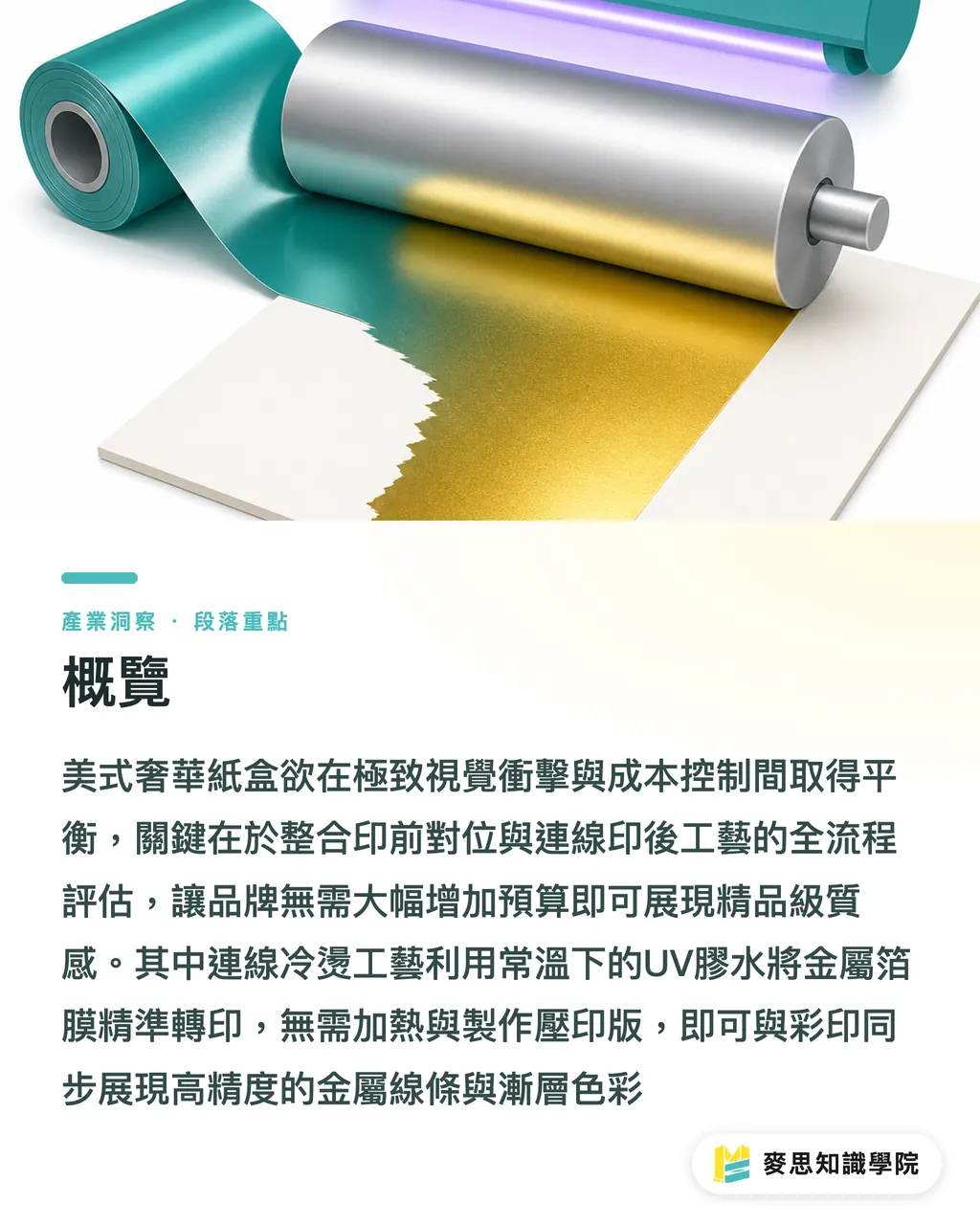
How can luxury cartons balance feel and cost with in-line finishing?
These past few months, while coaching a handful of Taiwanese brands through packaging upgrades, the same wall kept coming up: everyone wants that European big-house metallic flash and dimensional tactility, but the sticker shock from multiple offline finishing steps sends them running
Long-running American packaging house Diamond Packaging took home hardware at the 63rd annual GDUSA American Inhouse Design Awards with its 2026 10th Anniversary Grandfather Clock Calendar, a piece that sends a pretty blunt message to fellow printers: luxury visuals don't need to be propped up by stacking one offline finishing pass after another
The ten-year anniversary clock calendar hinges on a combo of in-line cold foiling, optical coatings, and sculptural embossing. Traditional hot foil stamping requires a full color pass first, then a trip to the stamping press for high-temperature metal-die transfer. Hit a complex line pattern and the second-pass registration alone will burn through a meaningful scrap rate. In-line cold foiling transfers the foil right on the press, then color and coating follow immediately, print and metallic feel done in one shot
Hold on
This workflow pays off massively in the Consumer Packaged Goods (CPG) space, because it nails metallic gradients, hairline detail, and broad coverage in normal post-press timeframes, production speed is several times faster than traditional offline hot foil
What are the technical differences between cold foiling and traditional hot foil stamping in high-end packaging?
Designers asking me at handoff whether cold foil can fully replace hot foil, honestly, it depends on whether your packaging play is dimensional relief or fine composite detail
From years of press-floor testing and equipment tuning, here's how these two finishing techniques split the work in terms of structure and production behavior:
・Cold foiling: UV adhesive transfers foil at room temperature; great for hairline detail and gradient color; you can run four-color process directly on the foil for rich metallic tones; no impression dent
・Traditional hot foil stamping: heat and high pressure transfer the foil; metal gloss saturation and mirror-like reflectivity are top-tier; records deep impressions on thick or textured stocks; the right call for large flat gold areas
・Specialty coatings: pair matte, gloss, and tactile varnishes in localized zones over the cold foil layer to dial up an etched-metal look
Short version
If your packaging features intricate botanical patterns, fine geometric lines, or multi-color metallic gradients, opting for cold foil with inline color printing can significantly cut plate costs and production time; however, if top-tier spirits boxes or high-end skincare require an intensely brilliant and substantial single gold finish, traditional hot foil stamping paired with zinc die embossing still delivers an irreplaceable tactile quality

How can Taiwan's small and mid-sized printers respond to global tariffs and sustainability rules?
Tariff volatility and tightening Extended Producer Responsibility (EPR) rules in Europe and the US are pushing paper and foil material costs higher. Taiwan's small and mid printers still competing on price for a single print run are going to see margins get thinner and thinner
Diamond Packaging's award-winning piece makes it obvious: European and American packaging heavyweights have already pivoted to high-value 'structural plus composite finishing' solutions. Brand clients don't care how many steps you ran, they care whether the package grabs a shopper's eye in the first second on shelf, and whether it checks the carbon-reduction and recyclability boxes
Taiwan's small and mid shops can start leveling up in three steps:
・Step one: push digital prepress prototyping. Use 3D simulation software at the prepress stage to nail foil and embossing zones precisely, so you don't blow a plate and discover registration errors on press
・Step two: standardize in-line finishing. Evaluate bringing in in-line cold foil and spot UV coating equipment to compress what used to be three passes into one, less energy, less paper waste
・Step three: offer brand clients material alternatives. Stock FSC-certified papers and detachable foils to help export brands clear European entry requirements on packaging waste reduction
If your brand needs high-end fully custom commercial printing and specialty carton development, you can lean on MINDS for first-line process evaluation and press-side registration testing, making sure the design blueprint survives translation into mass production
How can designers avoid foil and embossing registration drift during file prep?
Prepress is where luxury packaging lives or dies. On the actual press, even a 0.3mm registration miss turns a gorgeous emboss into an ugly defect
The thing press teams dread most is receiving files with unclear black-art callouts and overprint settings gone wrong. To make sure the artwork lines up with finishing precisely, run three checks at file prep:
・One, set up independent K100 vector layers. Build dedicated spot-color layers for hot foil, cold foil, and emboss zones, clearly labeled with the process name and finishing sequence
・Two, build in paper stretch compensation. Large embossing areas cause localized paper stretch, so the emboss zone should be shrunk slightly versus the foil zone 0.1mm to 0.2mm, so that under high pressure the gold edge wraps the dimensional edge cleanly
・Three, verify with black sample and digital proof overlay. Before opening plates for mass production, run a physical black-sample press test to confirm the paper weight and coating thickness won't tear the paper fiber under high pressure
Get these details right at prepress and your design intent actually makes it to the press floor intact, while saving the shop from burning budget on repeat makereadies

Key Takeaways
・Cold foil paired with in-line color gets foil transfer and color overlay done in a single pass, drastically cutting scrap rate and time cost from multi-step finishing
・The visual depth in luxury packaging comes from layering cold foil, spot specialty coatings, and sculptural embossing, not from piling on a single technique
・Prepress needs to shrink the emboss zone slightly relative to the foil zone to offset physical stretch under high pressure, preventing edge exposure and registration white-out
・Taiwan's printers should pivot toward in-line finishing and digital simulation to counter the margin squeeze from tariffs and raw material inflation
Further Thoughts
With global tariffs and sustainability rules both tightening, luxury packaging is no longer just a contest of premium materials, it's a test of fine-grained management in prepress and production efficiency. Taiwan's packaging industry should accelerate adoption of in-line post-press finishing and digital prepress registration, turning the human-experience-based finishing workflow of the past into standardized production data. On the brand side, bring a print consultant into structural and process evaluation from day one of the design, only then can you control production budget while building a boutique-grade visual experience with real international market competitiveness
Further Reading
FAQ
- What's the main difference between cold foil and traditional hot foil stamping?
- Cold foil uses UV adhesive to transfer foil at room temperature and can run in-line with color, ideal for hairline detail and metallic gradients. Traditional hot foil stamping uses a metal die under heat and pressure; the metallic gloss is more saturated and can record deep impressions on thick paper
- Why does in-line cold foil effectively cut production cost for luxury cartons?
- In-line cold foil gets foil transfer, four-color printing, and coating done on a single press in one pass, eliminating the multiple makereadies and offline finishing trips that eat time, so scrap rate and labor cost on mass production drop significantly
- What should I watch for when combining sculpted embossing with foil stamping?
- At file prep, shrink the emboss zone slightly, about 0.1mm to 0.2mm, relative to the foil boundary, so paper stretch under pressure doesn't cause the foil edge to lift or produce registration white-out defects
- How do I keep metallic feel while hitting sustainability targets?
- Use thin-film cold foil technology with FSC-certified substrates and water-based specialty coatings to reduce foil thickness and solvent usage, making de-inking and fiber separation easier during paper recycling
Related articles



The Print × AI weekly
The print and AI know-how designers, brands and enterprises can use before they commit — one email, every week
MINDS Free Tools
Spine width and imposition calculators — skip the manual math, free in your browser.
MINDS Group
Need actual printing or gifting services?
From premium printing to online ordering and festive gifts — the MINDS Group sister brands take it from here.