

Can bio-based PS really be swapped in without pain?
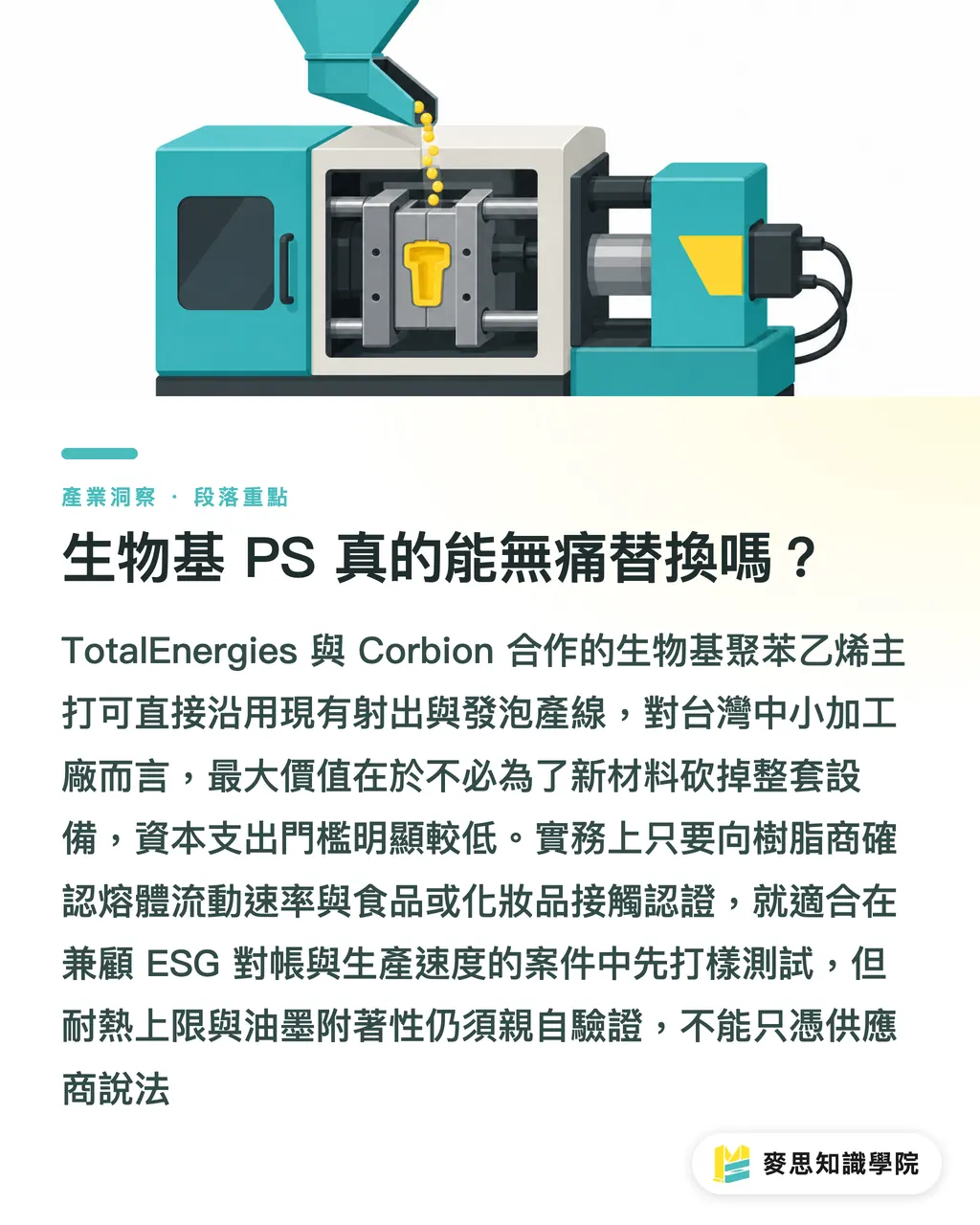
The bio-based polystyrene (PS) alternative from TotalEnergies and Corbion's partnership has one detail that Taiwanese processors should care about most: it claims to run on existing injection and foam lines. That means your existing molds, thermoforming machines, and processing conditions don't need a major overhaul, and on this point alone it's a lot more realistic than most 'lab-stage' materials
For Taiwan's small and mid-sized plants serving cosmetics packaging, electronic dunnage, and food trays, the value of this thread isn't how green the material is, it's the low capital expenditure (CapEx) threshold. You don't have to scrap an entire production line to try a new material; you just need to ask your resin supplier two things: where does the melt flow index (MFI) sit, and do they already hold food-contact or cosmetics-contact certifications
In practice here's how I'd judge it: for projects where the client has ESG disclosure pressure but the material appearance and line speed can't move, bio-based PS is worth sending out for samples. The real things to watch are its heat-resistance ceiling and downstream ink adhesion, those two need your own testing, not just the supplier's slide deck
Pumpkin-peel film extends fruit shelf life, sounds romantic, but is it production-ready?
This research is the one of the six I'd keep the coolest head about. Pumpkin-peel extract films can slow fruit moisture loss and oxidation under lab conditions, fine. But between 'research confirms' and 'commercial-scale production' there's still a long road: cost, extraction consistency, water resistance, compatibility with existing packaging lines
The reality I've seen on production floors these past months: food industry buyers care about one thing, how much can shelf life stretch, and can return rates drop. If you supply ready-to-eat meals, cut fruit, or salad packs, treat pumpkin-peel film as a watch-list item and see if any production-scale chemical company (not an academic lab) picks it up next
A small operational tip: ask your food packaging supplier for an 'active film' roadmap and see who already has a commercially available version. Rather than evaluating pumpkin peel from zero, choosing off an existing supplier's development pipeline will save you a lot of time
Yom Beauty's lip mask uses Sulapac, three signals for the design side
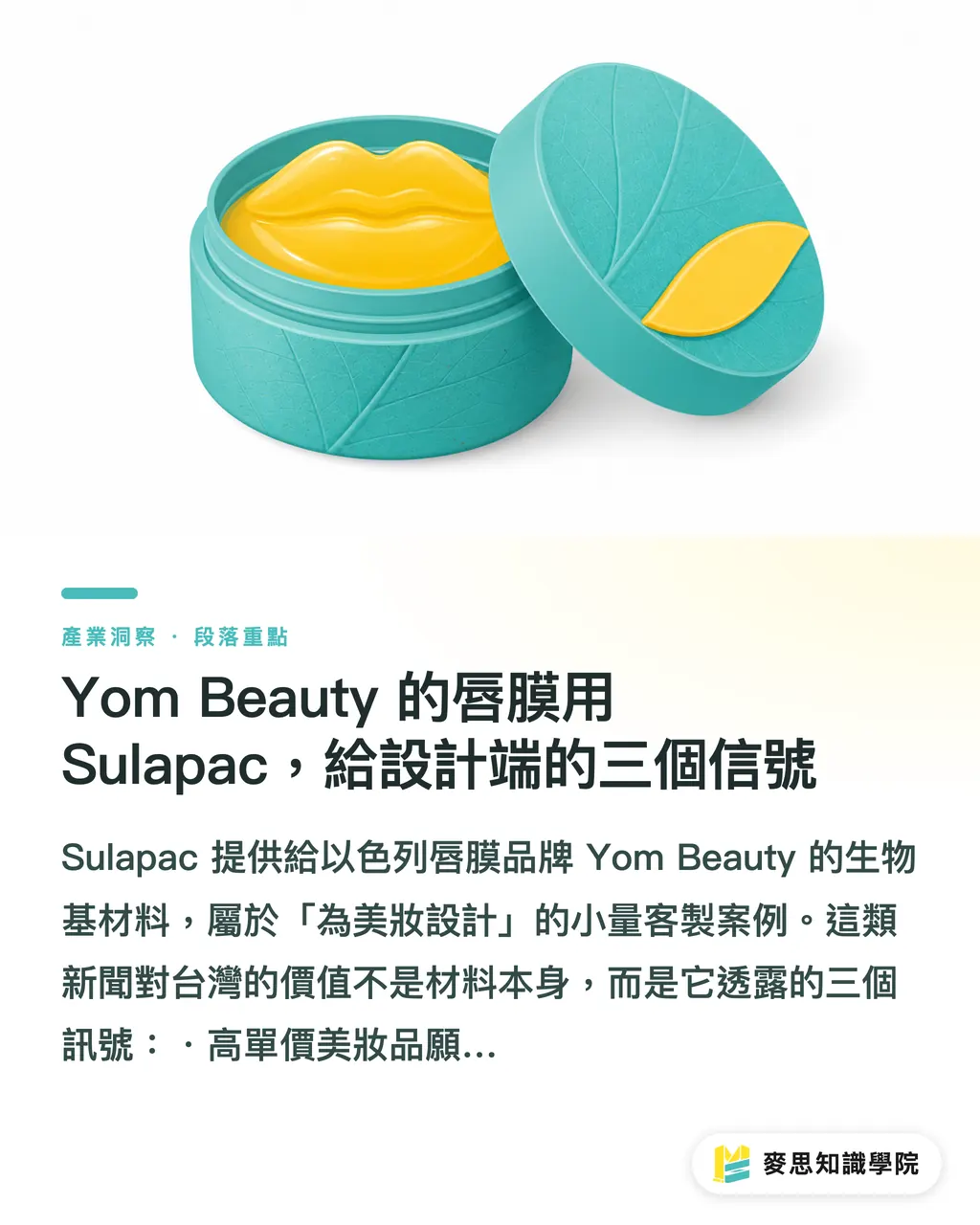
The bio-based material Sulapac supplied to Israeli lip-mask brand Yom Beauty is a small-batch, custom case 'designed for cosmetics.' The value of this kind of news for Taiwan isn't the material itself, it's the three signals it leaks:
・High-end cosmetics are willing to pay a design premium for 'compostable, biodegradable'
・The material's look and feel has to come close to plastic before design can sell it to PM
・Structural parts (caps, pumps, liners) need matching bio-based options at the same time; swapping only the shell doesn't work
For brand clients and design studios this means 'material selection' is no longer a late-stage procurement decision, it's the first page of the design brief. I'd suggest designers add a new field to their brief template: 'target material type / estimated carbon footprint / recycling or composting path,' so material decisions enter the process earlier
Dessert packaging moves to resealable, recyclable structures, the point isn't material, it's structure
Dessert packaging's new resealable direction is really a structural response to EU PPWR and US EPR pressure. Notice one thing: this kind of news talks less about 'material' and more about 'structure.' That reflects a reality:
Brands hit a wall swapping materials, then realized 'structure' is where the real plastic reduction happens
Resealable means the consumer uses one pack all the way through, halving waste; recyclable means mono-material priority, fewer laminate layers. For Taiwan's packaging design side this points one clear direction: instead of chasing new materials, optimize existing PE/PP structures to enter current recycling streams. On the printing side, plate choice, ink sequence, and heat-seal temperature all need to be re-set around mono-material, those are costs you need to flag with the client early
Curaçao's tourism plastic, what lesson does it hold for Taiwan's offshore islands and tourism venues?
For an island economy like Curaçao, getting a tourism plastic ban to land is all about Design for Recycling thresholds. What this story means most for Taiwan's mid-sized printers:
Taiwan has offshore islands, tourism zones, and tons of single-use packaging too
If you serve hotel amenities, souvenirs, or offshore-island agricultural gift boxes, now is the time to make 'recyclable structure' a standard line on your quote sheet. Building a recyclable version early, before the Tourism Bureau or county government comes knocking, gives you much more pricing room. Practically you can start with three things:
・Strip existing multi-layer laminates and switch to mono-PE or mono-PP
・Move ink systems from solvent-based to water-based or UV to remove recyclate harmful-substance concerns
・List structural parts (handles, buckles, stickers) under the same material declaration
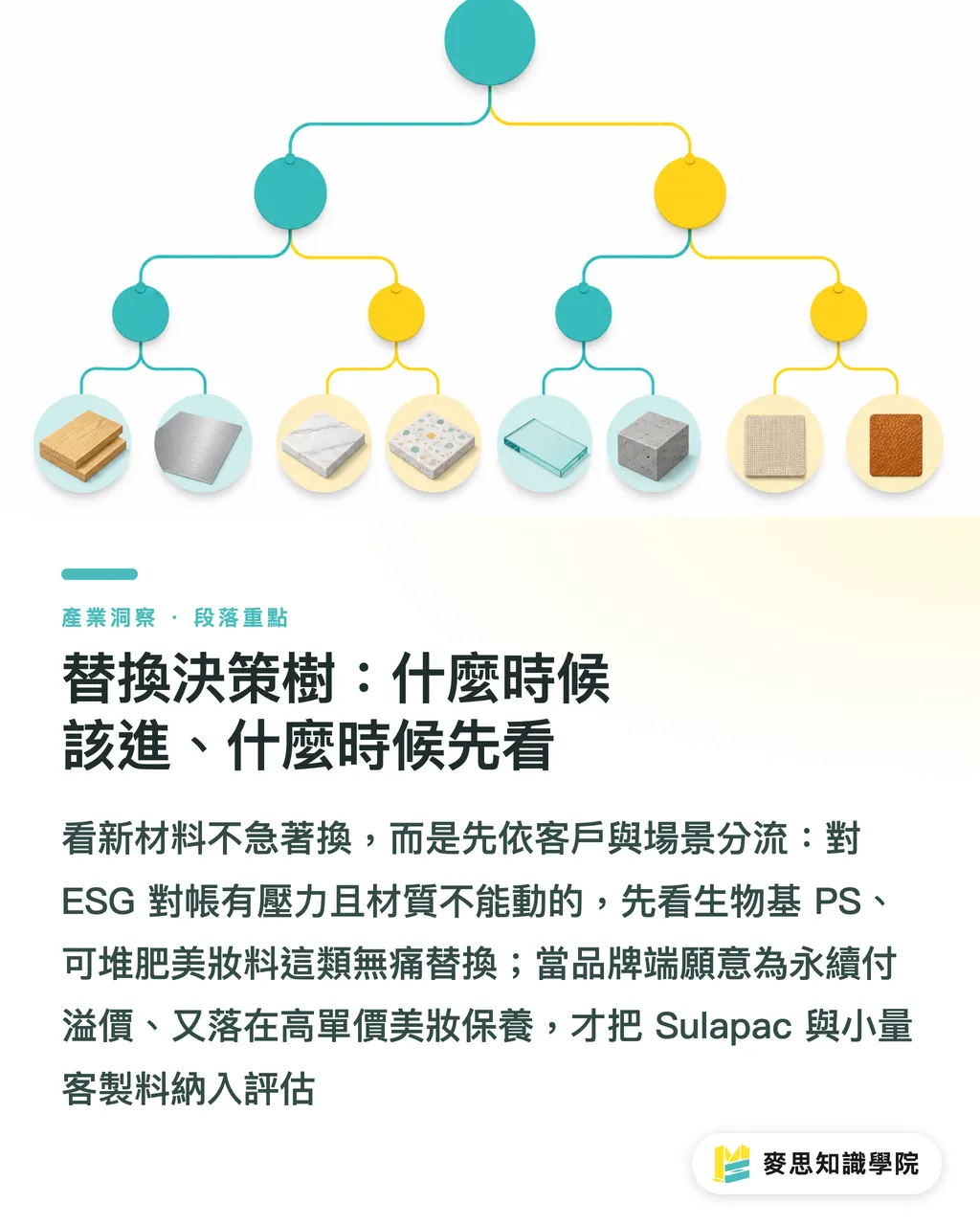
Replacement decision tree: when to go in, when to watch
Stack these six stories together and the most common mistake is 'see new material, want to switch.' From on-the-ground industry judgment, I'd read it like this:
・Client has ESG disclosure pressure and material can't change: evaluate 'painless swap' options like bio-based PS or compostable cosmetic-grade materials first
・Brand is willing to pay a sustainability premium and the category is high-end beauty/skincare: Sulapac and similar small-batch custom materials can enter evaluation
・Heavy food-freshness demand and return-rate sensitivity: treat functional film as a watch item, don't bet on lab-stage material yet
・Structural parts can cut plastic significantly and the client has scale: resealable and recyclable structures often outrank material swaps in priority
・Tourism, offshore islands, hotel amenity scenarios: make mono-material and water-based ink the default on quotes right now
Key takeaways
・'Painless swap' is the most realistic 2026 bio-packaging route; no need to scrap existing lines for new materials
・Research-stage materials like pumpkin-peel film are far from mass production; following supplier roadmaps is the more practical move
・Cosmetics, desserts, and offshore-island tourism are the three scenarios where new materials are most likely to land first
・Structural optimization (resealable, mono-material) often outranks material swap in priority
・Quotes should add three fields, material type, carbon estimate, recycling path, to push sustainability decisions upstream into the design brief
Further thinking
Stack these six stories together and the deeper signal is that European and US regulation (PPWR, EPR, recycling labeling) is starting to actually bite into product-side cost structures. For Taiwan's mid-sized printers, the most important homework in the first half of 2026 isn't chasing some star material, it's cleaning up your own material database, certification list, and recyclable structure templates once
Concrete next steps:
・For each PE, PP, PET, PS and ink combination you commonly use, tag whether it can enter existing Taiwan and EU/US recycling streams
・Set up a sample-trial workflow with at least two resin suppliers for bio-based PS and bio-based PE, and keep the trial records
・Add 'recycling path' and 'carbon estimate' fields to your quote template
・For high-end cosmetics, offshore-island tourism, and fresh-food delivery clients, proactively prepare a 'structural reduction vs. material swap' comparison
If you have a batch of new jobs going through material evaluation right now, having MINDS (MS)'s custom team sit with you to review material options, structural optimization, and print-side compatibility at the same time is steadier than price-shopping alone. For a fuller industry judgment framework or material-selection consulting, Mai Strategy Knowledge Academy's consultant team can also step in
Further reading
FAQ
- Does bio-based PS differ from conventional PS in look and printability?
- In theory they're close; in practice you need to test. Bio-based PS MFI, heat resistance, and surface polarity all affect ink adhesion and heat-seal temperature, and those need your own run-throughs
- Can pumpkin-peel film really be used at scale in food packaging?
- It's still at the research stage. From lab to mass production there are three gates to clear: cost, extraction consistency, and line compatibility. Food-industry clients should first watch whether any supplier has plans to take it to production scale
- Should Taiwan printers proactively push recyclable packaging now?
- Yes. Especially for clients serving offshore islands, tourism, hotel amenities, and delivery meal boxes, these are the ones regulatory recycling and ESG pressure will hit first
- Why are cosmetics brands willing to pay more for bio-based materials?
- Because high-end cosmetics have room for a design premium, and consumers are willing to buy into a sustainability image. For mass-market fast movers that premium room is much thinner
- Between switching to new materials and optimizing structure, which comes first?
- Structure optimization first. Resealable and mono-material can directly halve waste volume and recycling difficulty, and the cost-effectiveness is often higher than switching to new materials
Related articles
The Print × AI weekly
The print and AI know-how designers, brands and enterprises can use before they commit — one email, every week
MINDS Free Tools
AI background removal, a LINE sticker maker, spine & imposition calculators — all free, right in your browser, no upload.
MINDS Group
Need actual printing or gifting services?
From premium printing to online ordering and festive gifts — the MINDS Group sister brands take it from here.