
Ask the Right Question Before You Pick a Material
"Is PLA or paper more eco-friendly?" That's the material question MINDS printing consultants get asked most often, and a straight answer is pointless. The right call depends entirely on what the container holds, how hot that contents is, and who handles it at the end
Each material has clear use cases: PLA works for cold food and short-life clear containers; paper boxes cover a wider range depending on the coating type, but the recycling path is equally tangled. What actually trips up buyers is treating "looks eco-friendly" as "actually eco-friendly," or tossing different materials into the same waste bin
Let's get the reality of each material straight first, then talk about how to choose
Can PLA Actually Decompose?
It can, but the conditions are strict, and most people don't know that
PLA needs an industrial composting setup: sustained temperatures above 55°C, the right humidity, and specific microbial communities. Full breakdown typically takes 3 to 6 months. Toss it in a regular landfill, an outdoor environment, or a home kitchen waste bin, and PLA breaks down about as fast as ordinary plastic
Taiwan doesn't have widespread PLA-specific collection bins right now. Where there's a partner composting facility (some event venues or schools, for example), PLA can be sent to the right place. But in most counties, the reality is this: without composting collection, PLA tableware ends up as general waste and gets incinerated
Heat resistance is another practical limit. Standard PLA's heat deflection temperature sits around 50-60°C, so hot coffee or hot soup will soften and deform it. Modified CPLA (crystallized PLA) holds up to roughly 80°C, but costs noticeably more than standard PLA. The most common buyer mistake here: the spec sheet just says "PLA material" without naming a heat-resistance grade, so what arrives might be completely wrong for the job
PLA genuinely fits cold drink cups, salad boxes, cold-food lids. It's see-through and does carry more eco-credibility than standard clear plastic. The catch: you need composting infrastructure on the back end. Without it, the whole thing is just window dressing
Coated Paper Boxes: PE, PBS, or Water-Based, Which One's Actually Compliant?
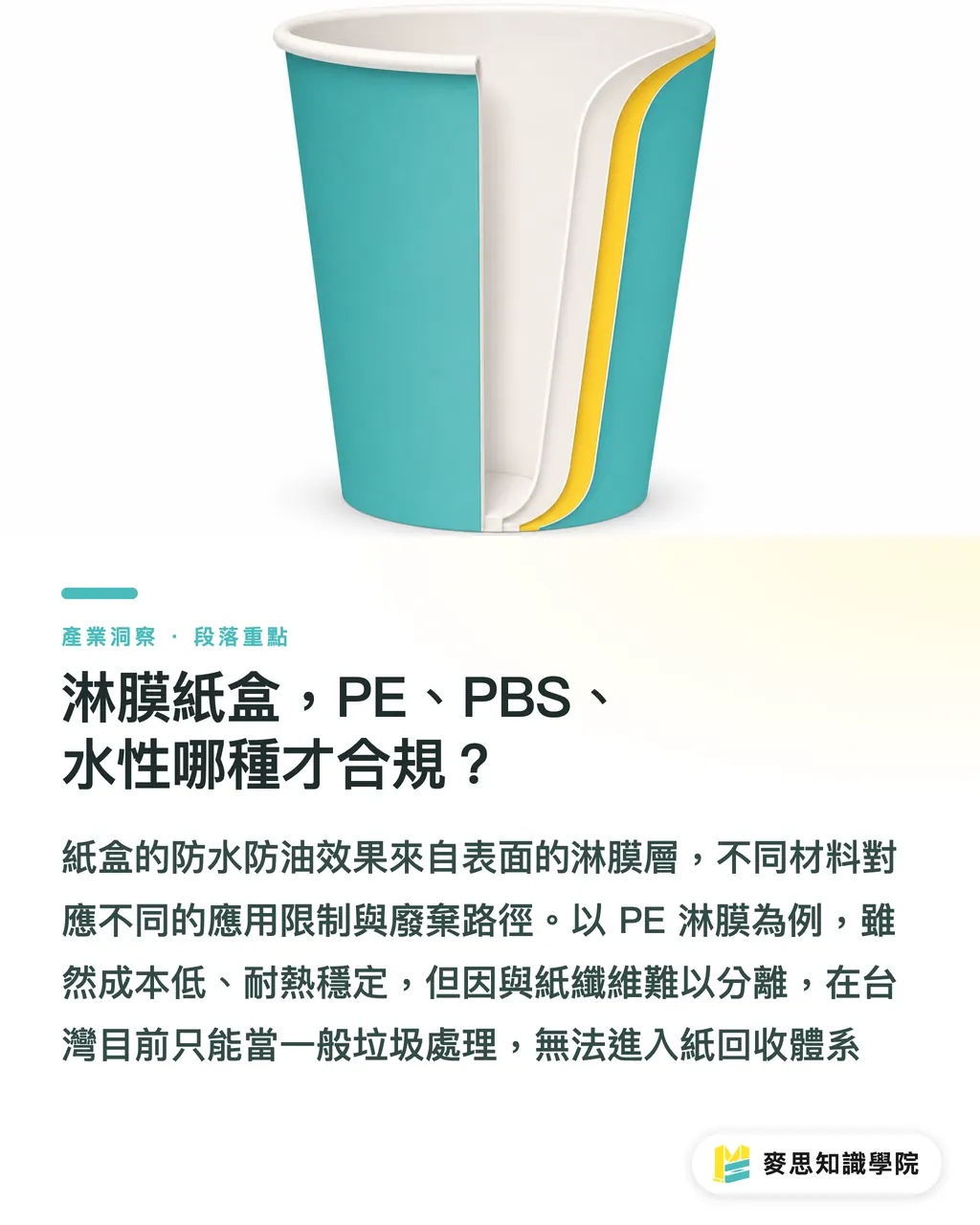
Paper boxes stay water- and oil-resistant thanks to a surface coating layer. Different coating materials come with very different application limits and end-of-life paths
・PE coating: The most common pick on the market. Lowest cost, stable water and oil resistance, heat tolerance usually 90-100°C, no problem with hot bento, soup, or fried food. The drawback: once PE bonds with paper fiber, separating them is practically impossible. Taiwan's paper recycling facilities don't run a standard separation process for this, so these containers go to general waste
・PBS coating: A biodegradable material that breaks down under industrial composting. Oil resistance is a bit weaker than PE, so it's better suited to lower-fat foods. Costs more than PE, but where there's a composting collection system, it's a more honest alternative path
・Water-based coating: No plastic content at all. Some grades can go into paper recycling streams (check your local recycler's acceptance criteria). Oil resistance is the weakest, fine for baked goods, snacks, dry food, but fried items or butter-heavy products need an oil-resistance test first, don't assume it'll hold
Food-contact safety rules can't be skipped either. Taiwan's FDA has clear standards for food-contact packaging, including heavy-metal migration limits and controls on fluorescent whitening agents. Ask suppliers for material test reports; "food-grade" on its own, or just looking the part, isn't enough
What Does Taiwan's Recycling System Actually Say?
The EPA sets the bar for "biodegradable" labeling; a manufacturer's own claim doesn't count
Under CNS 15234 and related EPA rules, if you want "biodegradable," "compostable," or similar wording on packaging, you need certification from an accredited third-party body, commonly TÜV Austria's OK Compost series or BPI. The testing standard usually requires breakdown to a specified ratio within 180 days under set composting conditions. Claiming eco-friendliness without certification carries legal risk under false advertising rules
Current sorting reality:
・PLA products: Most counties have no PLA-specific collection. Without composting channels, they go to general waste. Do not put them in plastic or paper recycling bins
・PE-coated paper boxes: Not paper-recyclable. General waste
・Water-based coated paper boxes: Some can enter paper recycling, but check local facility acceptance
・PBS-coated paper boxes: Industrial composting facilities where conditions allow, but availability in Taiwan is still limited
I've seen plenty of takeaway brands over the past few years: beautifully designed packaging with big green-leaf graphics, "eco-friendly paper packaging" in the description, but ask about the material and nine out of ten are PE-coated paper boxes. Consumers see paper and toss it in the paper recycling. The PE contamination ruins the whole batch, and the paper mill has to scrap it. Eco-claims pointed the wrong way are a real burden on the recycling system
Two common communication landmines: calling PLA "recyclable" (Taiwan's recycling system doesn't include a PLA category), and labeling PE-coated paper boxes as "eco-friendly paper" (it isn't). Without accurate disposal instructions on the package, consumers can't do the right thing
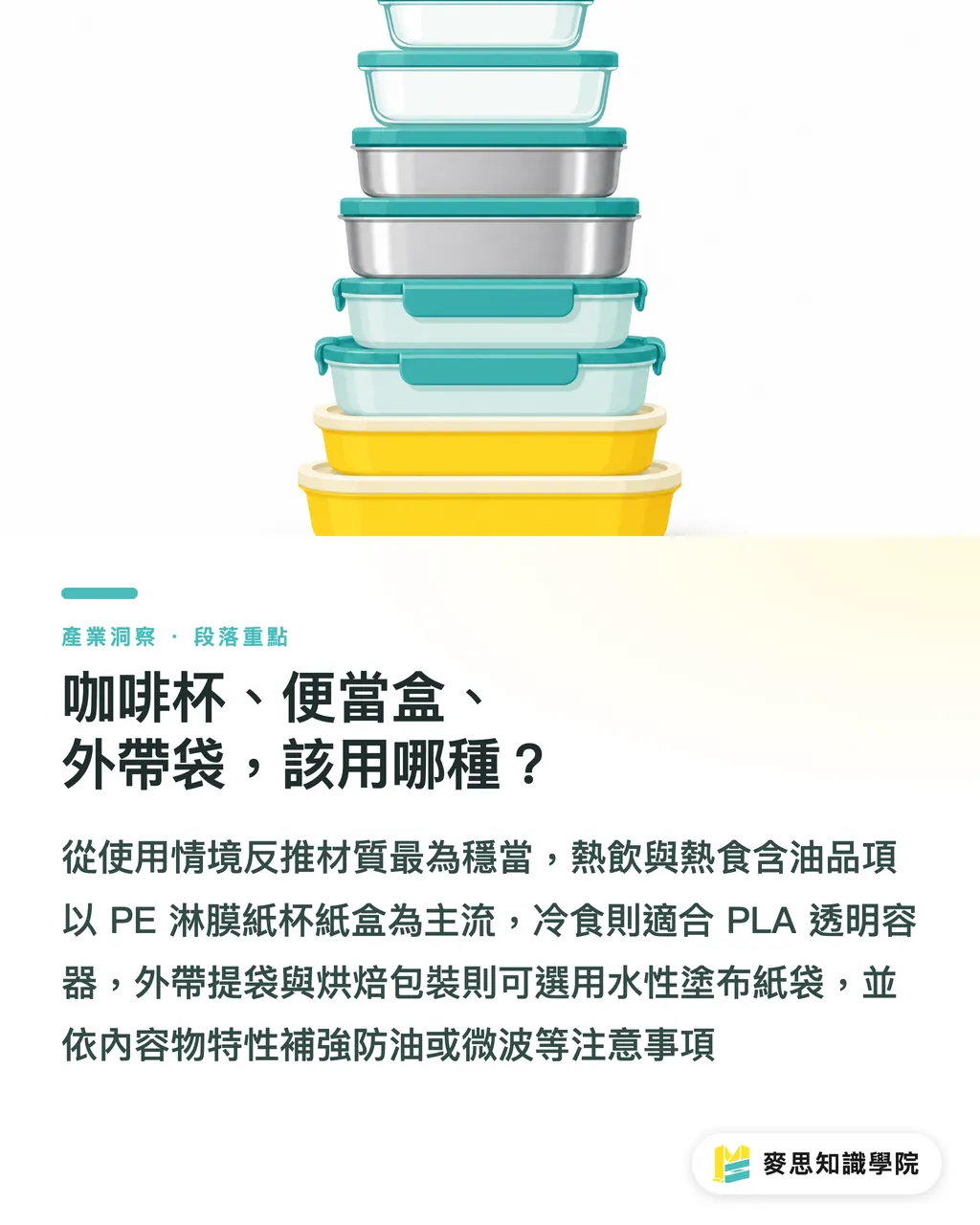
Coffee Cups, Bento Boxes, Takeaway Bags: Which Material for Which?
Working backward from the use case to the material is more reliable than the other way around
Coffee cups (mostly hot drinks):
・Standard PLA is out, heat tolerance isn't there. PE-coated paper cups remain the most reliable mainstream option
・If you want some eco-credibility, PE-coated paper cups with CPLA lids work; the lid can carry compost certification, and at least your customer-facing messaging stays accurate
Cold drink cups, salad boxes, cold-food takeaway containers:
・PLA clear containers fit here, and they look good
・Packaging needs a clear "compostable, do not put in standard recycling" label, otherwise consumers default to the plastic bin
Bento boxes (hot food, with oil):
・PE-coated paper boxes give the most stable heat and oil resistance at a manageable cost
・If your brand has eco messaging, PBS coating is worth evaluating, but get the supplier's oil-resistance test data first. Don't skip this step for high-fat items
・When customers need to microwave, PE coating isn't suitable for direct microwaving. Clear warnings on the package are necessary
Takeaway bags, bakery packaging (mostly dry food):
・Water-based coated paper bags are the cleanest option, with a paper-recycling path on the back end
・High-fat items (fried chicken, butter cake) need an oil-resistance test, water-based coating doesn't always hold up
If you're not sure which category your product falls into, MINDS consultants can work backward from your contents specs to the right material and printing method, so you don't find out you picked wrong after sampling
Key Takeaways
・PLA in most of Taiwan goes to general waste. Its eco-impact depends entirely on whether composting collection is in place
・Standard PLA's heat ceiling is roughly 50-60°C. For hot food or drinks, always confirm CPLA or switch materials; the material name alone isn't enough
・PE-coated paper boxes aren't paper-recyclable. Water-based coated paper boxes only enter paper recycling when conditions line up
・Labeling packaging "biodegradable" in Taiwan requires CNS 15234 compliance and third-party certification. Self-claimed eco-claims have no legal protection
・Choosing materials by "what's inside, how hot, who disposes of it" saves a lot of detours versus starting from "which one looks greener"
Wider Implications
From design to manufacturing, one problem keeps coming up: eco claims are usually decided by marketing first, with materials chosen to fit afterward, and by the time samples come back, the heat tolerance is wrong, the oil resistance fails, or the supplier can't produce certification docs. Flip the order: confirm the use case and regulatory requirements first, pick the material next, then design the visuals. It cuts a lot of back-and-forth sampling cost and communication time
For designers: when you take on food packaging work, ask up front about the oil content and temperature of the contents. Those two numbers drive material choice directly, and they also affect print method (water-based ink color behavior on water-based coating is nothing like on PE coating)
For smaller food and beverage brands working with limited budgets, you don't have to replace every package at once. Start with the one SKU where you can clearly explain the end destination. Building that credibility beats covering everything in green graphics and not being able to explain why. If you need help planning material selection and certification label placement, the Mai Strategy Knowledge Academy consulting team offers related advisory services as well
FAQ
- Can PLA cornstarch food containers go in Taiwan's recycling bin?
- No. Taiwan's recycling sorting system doesn't include processing equipment for PLA. PLA should be sent to an accredited industrial composting facility. Without composting collection, it goes to general waste, not plastic or paper recycling bins
- Can PE-coated paper boxes go in paper recycling?
- No. Once PE coating bonds with paper fiber, it can't be effectively separated. PE contamination ruins an entire paper recycling batch and makes the material unusable for the mill. PE-coated paper boxes should be treated as general waste
- What's required to legally label packaging "biodegradable" in Taiwan?
- Compliance with CNS 15234 testing standards plus certification from an accredited third party like TÜV Austria OK Compost or BPI. Labeling a package "biodegradable" or "compostable" without certification may qualify as false advertising
- Can PLA hold hot drinks?
- Standard PLA's heat ceiling is roughly 50-60°C, so it's not suitable for hot coffee or soup. If you need around 80°C tolerance, go with modified CPLA (crystallized PLA) and confirm specs before ordering. "PLA" as a material name alone isn't enough to go on
- PE coating or PBS coating for bento boxes?
- For hot food or oily bento boxes, PE coating gives the most reliable heat and oil resistance at the most stable cost. PBS coating breaks down under industrial composting and suits items where the brand has eco-credibility goals and the contents is lower in fat. Confirm the supplier's oil-resistance test data before purchasing
Related articles
The Print × AI weekly
The print and AI know-how designers, brands and enterprises can use before they commit — one email, every week
MINDS Free Tools
AI background removal, a LINE sticker maker, spine & imposition calculators — all free, right in your browser, no upload.
MINDS Group
Need actual printing or gifting services?
From premium printing to online ordering and festive gifts — the MINDS Group sister brands take it from here.