
How to Print Legal and Compliant Food Labels?
・The core principle for printing legal food labels is to select paper materials and inks that meet indirect contact safety standards, and to strictly adhere to local health authorities' layout and font size restrictions for nutritional labeling
・In my years on the front lines, I've seen too many manufacturers discover their labels had fonts too small or incorrect formats just before product launch, forcing a complete reprint
・In practice, Taiwanese regulations explicitly require that the font width and height for nutritional information and ingredient declarations must not be less than 2 mm
・Beyond layout compliance, international regulations on chemical substances in food packaging are rapidly tightening. For example, the recent PFAS (per- and polyfluoroalkyl substances) ban proposed in the US for packaging materials means that when choosing sticker surface coatings, we must proactively consider non-toxic and environmentally friendly standards

How to Choose Sticker Materials for Refrigerated or Room-Temperature Foods?
・Many clients often ask me why their stickers wrinkle or peel off easily once they're in the refrigerator
・The choice of food label material is entirely dependent on the product's storage temperature and surface humidity
・Without matching the appropriate surface treatment and adhesive to the end-use environment, even the most beautiful design will be ruined during logistics
・You can refer to the following common temperature zones to grasp the key material considerations:
・Room-temperature dry goods packaging: Choose coated paper with a gloss or matte laminate. This is the most cost-effective option with good color reproduction, more than sufficient for general indoor shelf life
・Refrigerated and frozen foods: Must switch to pearlized paper or synthetic paper, which are waterproof and tear-resistant, to withstand the moisture generated by temperature fluctuations when moving in and out of the refrigerator
・Microwave and high-temperature sterilization: Requires specially designated high-temperature resistant PET material and specialized adhesive to prevent the sticker from delaminating or releasing harmful substances under high heat
Why Does the Adhesive on Grading Labels Often Leave Residue?
・Besides nutritional labels, various grading labels and expiry date stickers are commonly used on production lines
・The biggest pain point with these stickers is that they leave adhesive residue when peeled off, ruining the original texture of the packaging box or glass bottle
・Encountering such a need for short-term labeling that requires clean removal, the key is to specify the use of R-adhesive (removable adhesive)
・Unlike general high-tack adhesives, R-adhesive can maintain good peelability for 6 to 12 months after application, allowing end-users or consumers to easily remove labels without leaving a trace
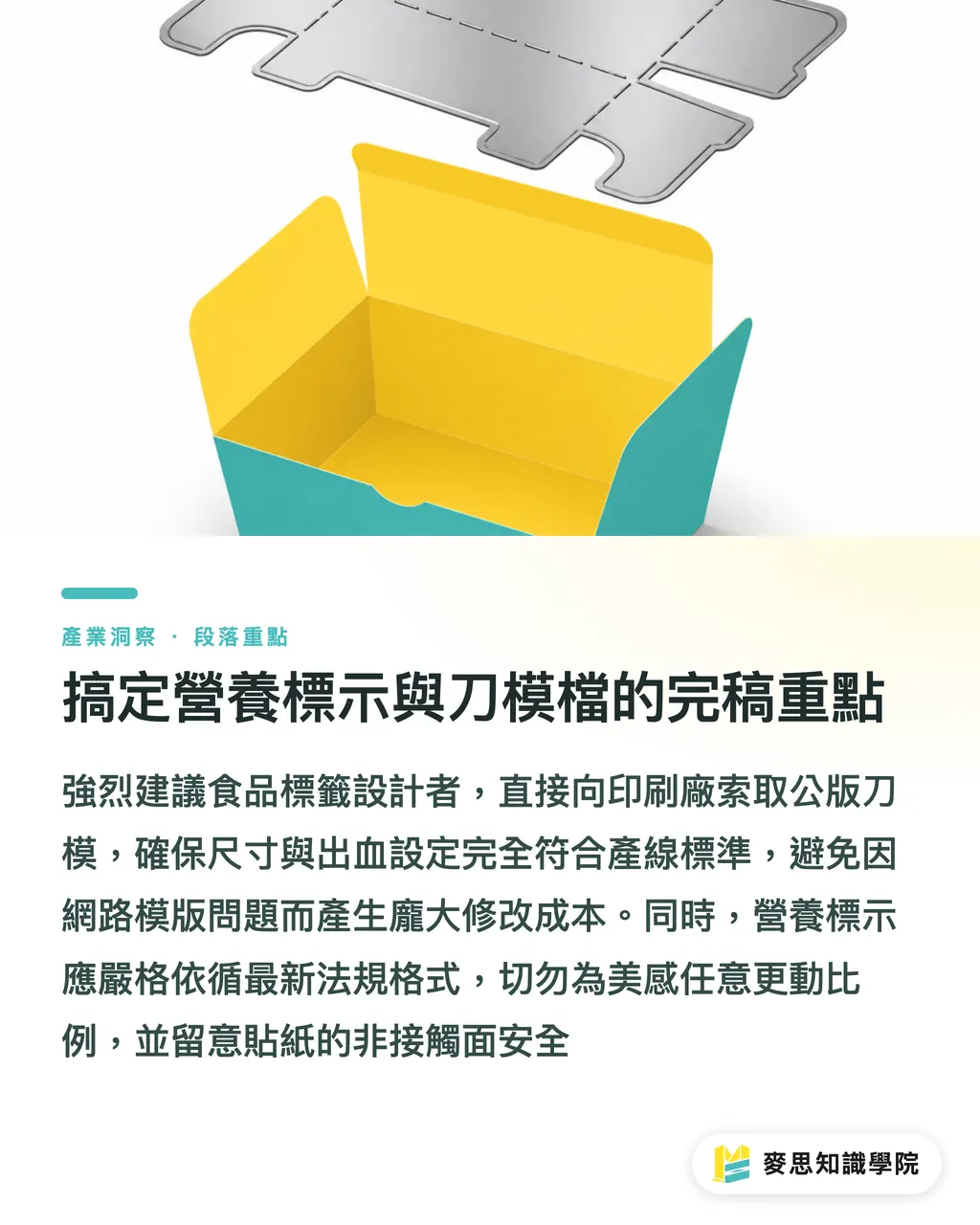
Key Points for Finalizing Nutritional Information and Die-Cut Files
・Designing a safe and compliant food label is more challenging than it seems
・Many designers, in their haste, randomly download die-cut label templates online. This is actually the biggest pitfall in pre-press
・These files often lack correct bleed settings and processing layer indications, or are even completely incompatible with the printing factory's machine specifications
・To save significant communication and revision costs, I strongly recommend the following practices:
・Directly request standard die-cut templates from your partnered printing factory: This is the safest and most effective method to ensure dimensions, bleed, and resolution perfectly match production line standards
・Apply official standard formats: The nutritional information border and content order must comply with the latest regulatory announcements; do not arbitrarily alter proportions for aesthetic design
・Confirm non-contact surface safety: Choose eco-friendly inks like soy ink, and ensure the sticker's placement does not directly contact the food itself
Key Takeaways
・The first step to compliant food labeling is to confirm storage temperature, which determines the type of waterproof material and adhesive needed
・Nutritional labeling font size and border proportions are strictly regulated by law; always cross-reference the latest standards before finalizing
・In the face of increasingly stringent packaging regulations, avoiding coatings containing toxic chemicals like PFAS is a defense line for protecting your brand
・Discard randomly downloaded online materials; obtaining standard die-cut templates directly from your printing factory can save significant proofing and revision time
Further Considerations
・When handling food label printing, you cannot just look at the unit price on the quote; labels must be viewed as an integral part of food safety and regulatory compliance
・Confirming material characteristics and processing limitations with the printing factory from the initial design stage can significantly reduce the actual risk of audits or returns after product launch
・For teams like MINDS Printing that offer integrated services, proactively helping clients clarify these packaging pain points and providing concrete suggestions is the best opportunity to demonstrate advisory value and create a competitive advantage
FAQ
- Are there specific regulations for the font size on nutritional information stickers?
- Yes, Taiwanese regulations typically require that the font width and height for nutritional information and ingredient details must not be less than 2 mm, ensuring consumers can read them clearly
- Can I directly use general coated paper stickers for frozen dumpling packaging?
- No, the low temperature and moisture in a freezer will cause general paper to crack and soften. You must switch to waterproof pearlized paper or synthetic paper with freezer-specific adhesive
- Where is the safest place to download standard die-cut templates for labels?
- The fastest and most error-free method is to directly request standard die-cut templates from your partnered printing factory, which ensures that the bleed area and machine production line specifications are perfectly matched
Related articles



The Print × AI weekly
The print and AI know-how designers, brands and enterprises can use before they commit — one email, every week
MINDS Free Tools
Spine width and imposition calculators — skip the manual math, free in your browser.
MINDS Group
Need actual printing or gifting services?
From premium printing to online ordering and festive gifts — the MINDS Group sister brands take it from here.