
Overview
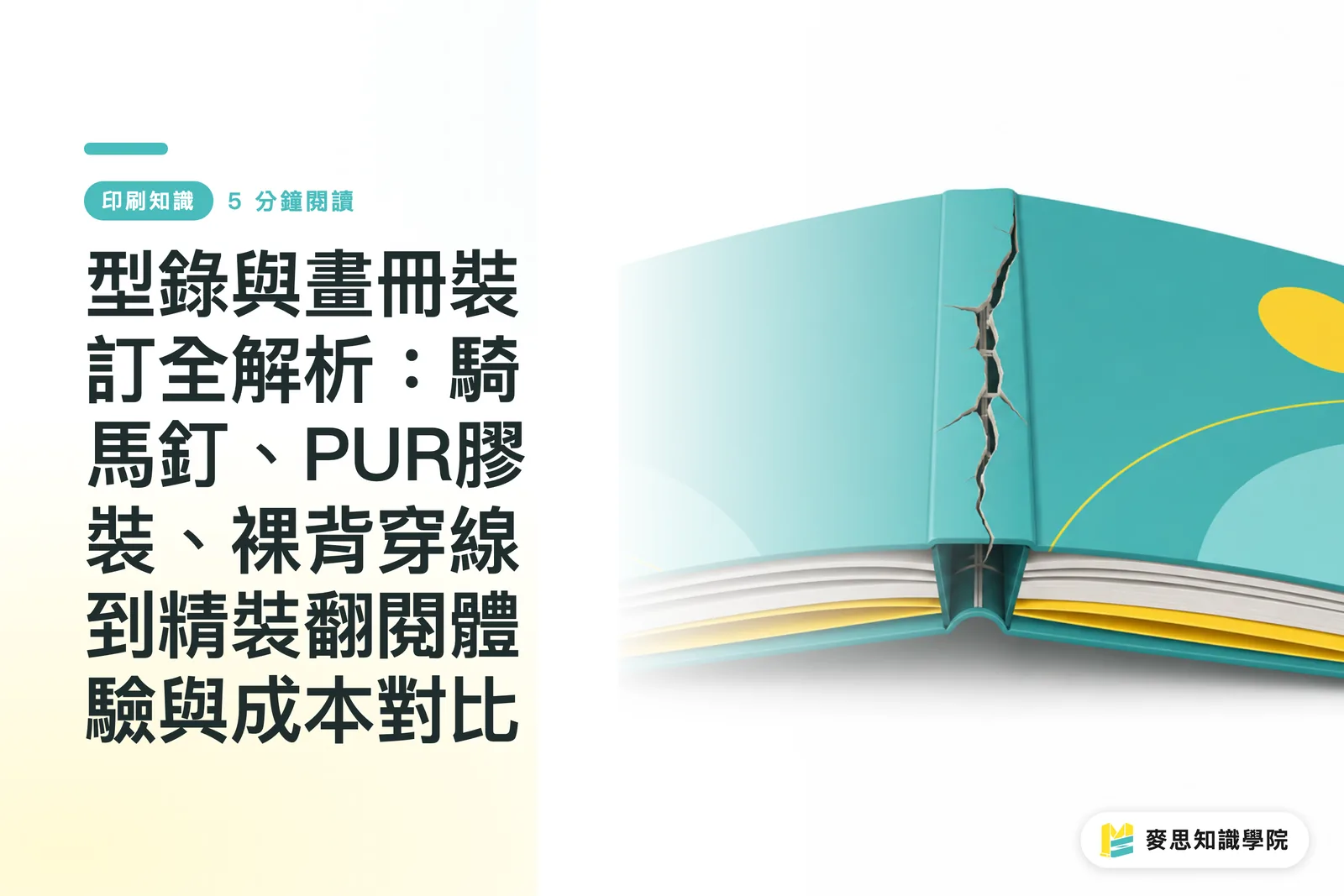
The right binding for brand catalogs and art books comes down to four core metrics: page count, lay-flat needs, paper weight, and budget. For thin booklets (64P or under), saddle stitching is the top choice. For total lay-flat capability and a premium feel, exposed spine sewing or Swiss binding is ideal. For thick books (96P and up) meant for long-term archiving, go with hardcover binding. When evaluating your binding options, walk through the 'MINDS (MS, mid-to-high-end fully customized commercial printing) Three-Step Pre-flight Audit': (1) calculate page count and signatures, (2) reserve safe distances for spreads and gutters, and (3) estimate paper weight and spine thickness
Binding is the post-press finishing process that joins printed sheets or folded signatures into a book using staples, glue, thread, or hardboard covers. The binding method determines a book's structural strength, how flat it opens, and how the spine looks
Saddle Stitching, Perfect Binding, or Hardcover? Four Main Binding Methods & Cost Breakdown
After working on the production floor for over a decade, I often see designers show up with gorgeous files they're excited to send off to print, only to get back books that won't lay open, have artwork swallowed by the gutter, or fall apart after being flipped through a few times
Choosing the right binding for your catalog or art book hinges on page count, paper thickness, and how the book will be used
Here's how the four most common binding methods compare in practice:
・Saddle Stitching: Best for thin booklets between 8–64P. It's the cheapest option, and the center staples allow pages to lay flat at 180 degrees, perfect for brochures and monthly magazines
・Paperback Perfect Binding (EVA): Suitable for 32–200P. Cost-effective, but the spine adhesive bond is weaker, making the glue prone to cracking under low temperatures or heavy reading
・Paperback Perfect Binding (PUR): Suitable for 32–300P heavy paper. Its adhesive strength is triple that of EVA, handles temperature changes well, and improves lay-flat readability significantly
・Hardcover: Ideal for premium brand art books of 48P or more. Built with a 2–3mm grayboard hard shell, it offers high protection and collectible value, costing 30%–50% more than perfect binding
If you still have questions about picking the right method, consult the Mai Strategy Knowledge Academy Consulting Team directly for hands-on guidance on paper and binding
Why Do Spreads Keep Eating Text? Gutter Biting and Inner Margin Math
Layout isn't something you hand off to binding after it's drawn. The binding method alters your page counts, two-page spreads, and inner safe margins right from the start
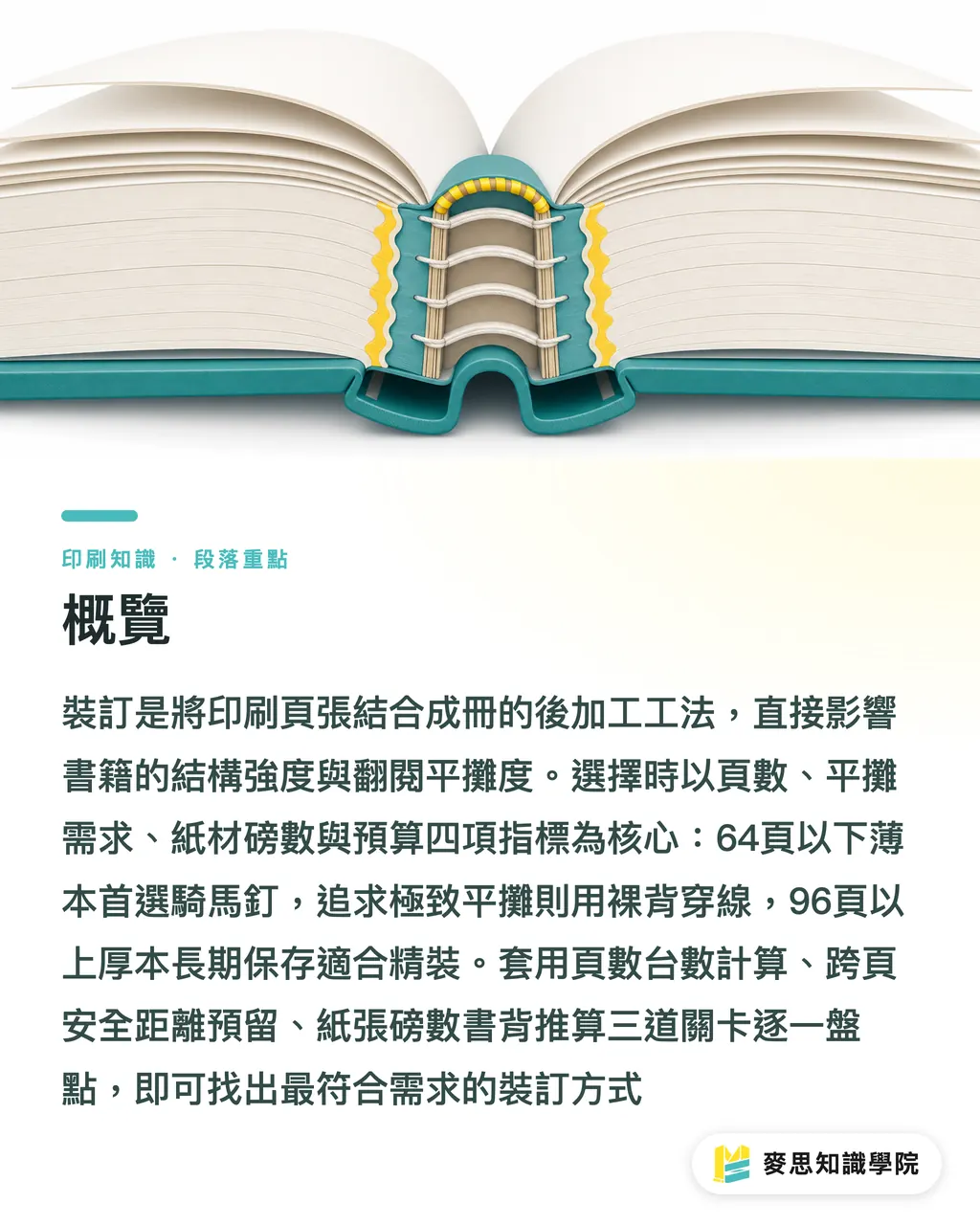
Because of spine glue thickness and creasing, perfect-bound books have a 5–8mm dead zone at the spine that cannot lay completely flat. That glued-down strip is what we call 'gutter biting.'
If you place a wide image or text across a spread right over the center line, the words will distort or disappear completely when readers open the book
When prepping final files for perfect binding or hardcover, keep these design details in mind:
・Inner Safe Distance: Leave an inner margin of at least 10–12mm for perfect binding so essential copy doesn't sit too close to the gutter
・Spread Image Alignment Compensation: Shift the artwork 2–3mm away from the center seam on both left and right sides. Once offset and printed, the visual spread will look seamless when opened
・Spine Thickness Estimation: Multiply sheet count by single sheet thickness (caliper), then add the glue layer. A 100P book on 150gsm coated paper has a spine thickness of roughly 5.5mm
It's that simple
Paper doesn't lie
How to Count Pages & Signatures Without Rejection: Production Pre-flight Tricks
When requesting quotes, beginners frequently mix up 'sheets' and 'pages (P-count).'
One sheet of paper has a front and back, which counts as 2P in printing terms. Printing presses run jobs by 'signatures,' usually in 16P or 8P units
That means your file's total page count must be a multiple of 4. Otherwise, the line has to insert blank pages or combine signatures manually, driving up print costs
Three file check-points on the production floor:
・Saddle Stitch Creep (Trim) Calculation: Beyond 48P, inner sheets push outward by about 1.5–3mm. Trimming will narrow outer margins, so push your layout inward
・Gutter & Signature Allocation: If your total page count is a multiple of 16P, folding and pin alignment run smoothest, saving factory hours on signature splitting
・Spine Glue Contact Area: Don't print full-bleed background colors on inner pages right next to the spine. Leave a 3mm blank strip so the glue can bite directly into the paper fibers
Run these checks before ordering to get through file review smoothly and order fast on MINDS
Which Methods Achieve Full 180-Degree Lay-Flat? Exposed Spine Sewing & Swiss Binding
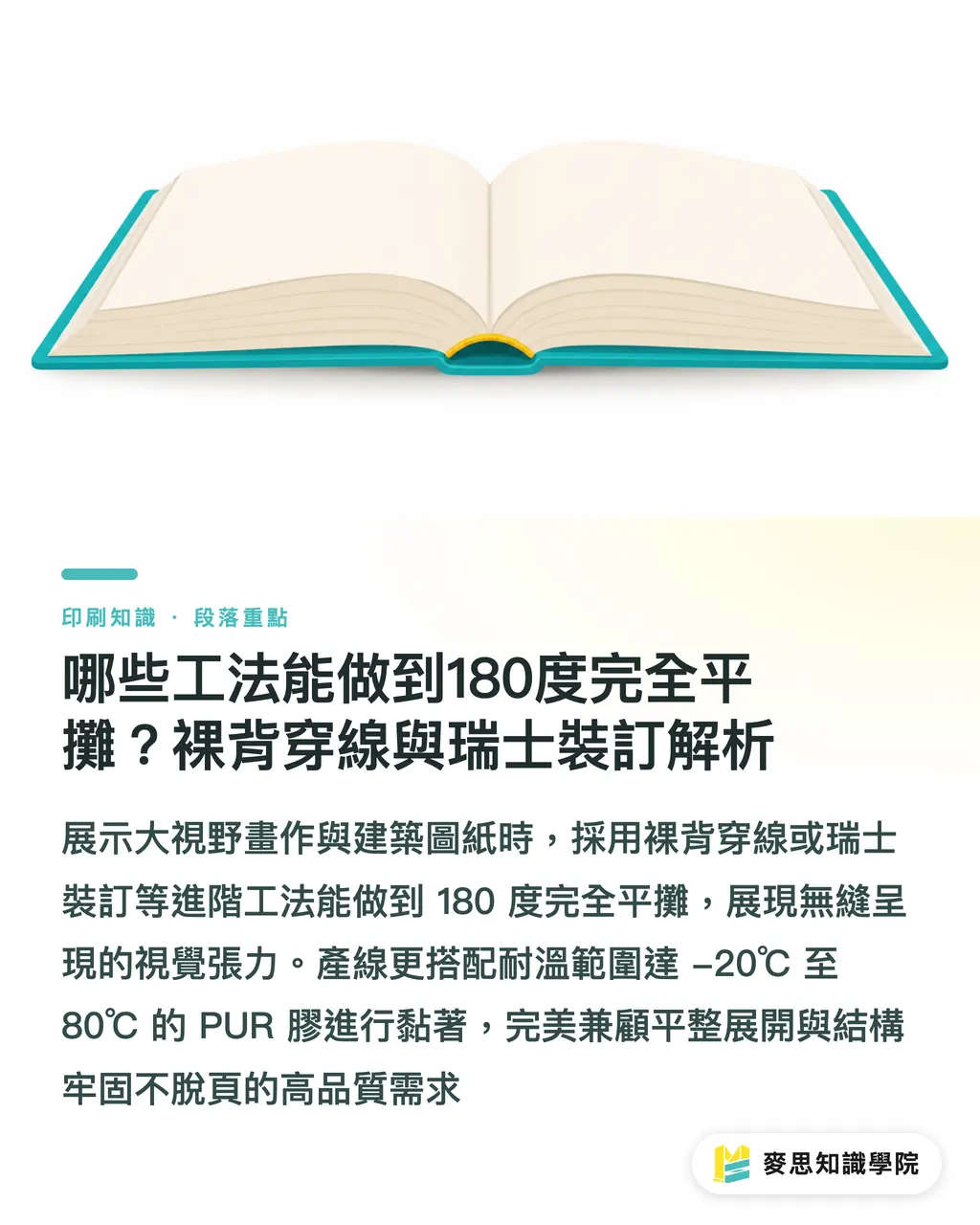
If high-end brand catalogs or portfolios need to showcase large artwork, architectural drawings, or panoramic photos, 180-degree flat opening is a non-negotiable requirement
Standard paperback perfect binding can't do it. In those cases, I recommend these advanced lay-flat techniques:
・Exposed Spine Sewing: Inner signatures are punched and thread-sewn together without attaching a rigid paper spine. Showing the exposed threads and adhesive, it lies completely flat at 180 degrees with a raw industrial aesthetic
・Swiss Binding: The inner block's spine attaches only to the inside back cover, leaving the outer spine detached. When opened, pages rest flat naturally without being pulled by the cover
Exposed spine methods demand strict paper and thread standards. If paper grain direction runs wrong, the spine will warp over time
Using PUR glue on the line provides a temperature range of -20°C to 80°C, ensuring pages lay completely flat without falling out
Key Takeaways
・Saddle stitching works best for thin booklets under 64P, offering lay-flat pages and fast turnaround
・Keep an inner margin of 10–12mm for perfect binding to prevent text from getting eaten by gutter biting
・Keep total page count a multiple of 4 for smoother signature planning and lower production costs
・Exposed spine sewing and Swiss binding are top choices for high-end brand catalogs requiring a full 180-degree lay-flat experience
Further Considerations
From the factory line perspective, binding isn't just the last finishing step, it's the first variable when setting up a design
When graphic designers layout pages and choose paper, factoring in grain direction, signatures, and glue characteristics early cuts down back-and-forth revision friction
As AI-driven pre-flight checks take over, calculating spine thickness and gutter compensation automatically will become standard practice. Still, fine-tuning paper textures and how a book feels in hand will always rely on an experienced print team
Further Reading
・Mai Strategy Knowledge Academy Binding Decision Guide
FAQ
- Why does a perfect-bound catalog get stuck in the middle and refuse to lay flat?
- Traditional EVA glue hardens into a rigid layer on the spine, and the 5–8mm glue contact area inside restricts the pages. If you need total lay-flat performance, switch to PUR perfect binding or exposed spine sewing
- What happens if the total page count isn't a multiple of 4?
- Printers operate on double-sided printing and folding signatures (8P or 16P). If your page count isn't divisible by 4, the production line can't fold and bind smoothly, forcing them to add blank pages or split signatures by hand, raising your printing costs
- What is the maximum page count for saddle stitching?
- We recommend staying under 64P and avoiding overly heavy paper. If a saddle-stitched booklet is too thick, the center will bulge heavily and cause obvious creep, risking content getting trimmed off at the edges
- Do pages fall out easily with exposed spine sewn binding?
- No. Exposed spine sewing uses cotton thread to lock each signature tightly, reinforced with high-strength PUR glue along the spine. Its structure is stronger than standard paperback perfect binding, keeping pages intact even with frequent reading
Related articles

The Print × AI weekly
The print and AI know-how designers, brands and enterprises can use before they commit — one email, every week
MINDS Free Tools
Spine width and imposition calculators — skip the manual math, free in your browser.
MINDS Group
Need actual printing or gifting services?
From premium printing to online ordering and festive gifts — the MINDS Group sister brands take it from here.