

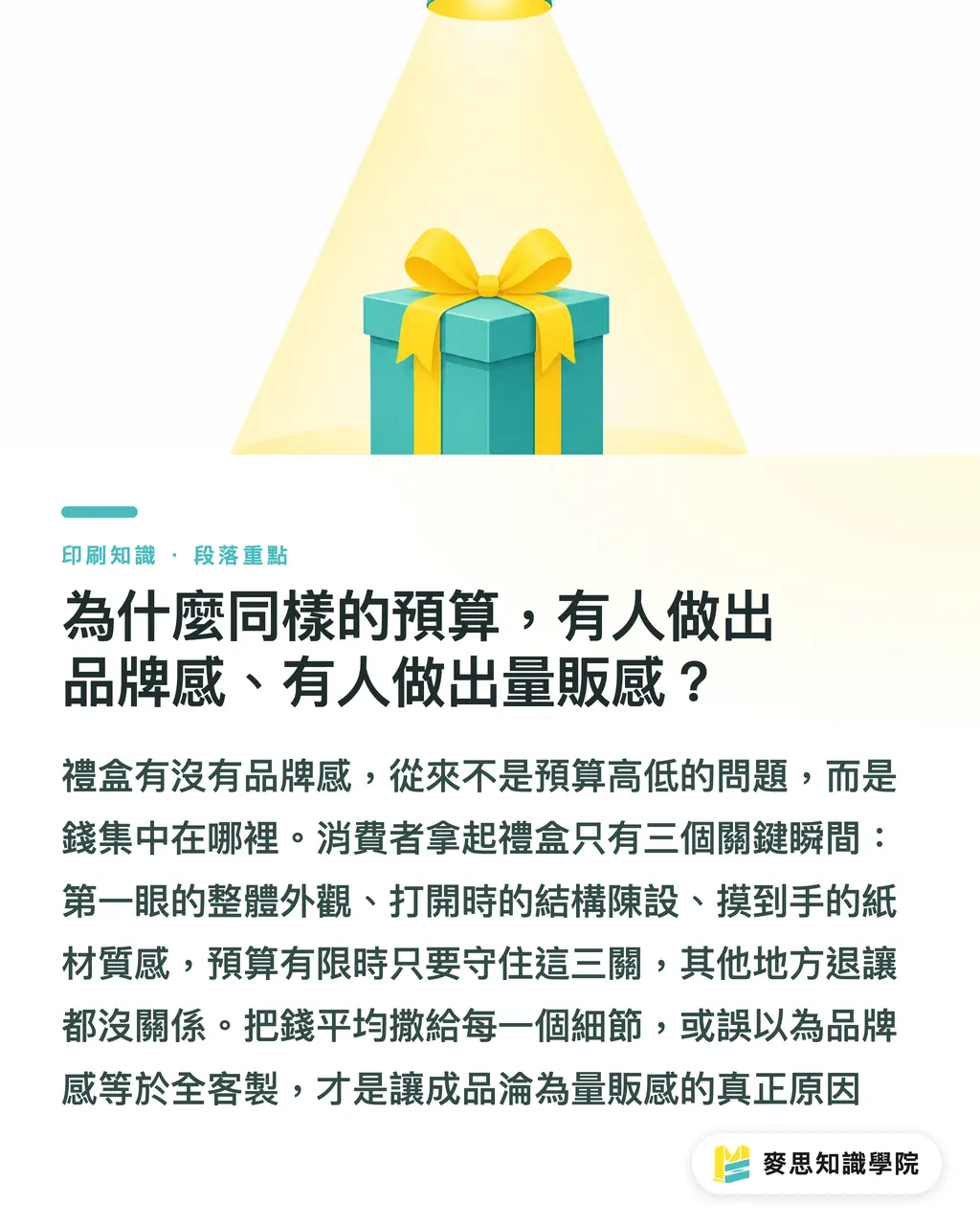
Why Do Identical Budgets Yield Premium Brand Appeal for Some, but Cheap Mass-Market Looks for Others?
In my years working with corporate procurement, bad gift boxes almost always stem from one mistake: spreading the budget evenly across every detail. The result is a series of compromises that make the final product look like a random convenience store bundle
The key isn't how big your budget is, but where you concentrate your spending. When people receive a gift box, their attention settles on three key moments: the initial look upon picking it up (the overall appearance and carrier bag), the reveal upon opening (the structure and internal layout), and the tactile feel in their hands (paper stock and post-press finishing). On a limited budget, protect these three moments first. You can compromise elsewhere
Another common misconception is that building brand presence requires full customization. For small orders, this logic breaks down completely. A huge portion of fully custom costs goes into tooling fees and minimum order quantities. If you sink your budget into fixed costs that can't be diluted, you leave even less money for visible aesthetics
---
For Small Volumes, How Can Modified Stock Packaging Quickly Establish Brand Identity?
The low-volume strategy I have recommended in recent years centers on a layered approach: stock box structures paired with custom brand elements
Ready-made stock boxes offer clear perks. No tooling costs, low minimum order quantities (some vendors accept orders as small as 50 sets or fewer), and quick turnarounds. The downside is that stock boxes lack brand identity. You can bridge this gap using the following layers:
・ Belly bands: This is the cheapest and most effective customization layer. A single sleeve covers the middle section of the box, displaying your brand colors, logo, and key visuals. It delivers strong visual impact at the cost of a simple offset-printed paper sheet
・ Custom stickers: Sealing stickers, QR code labels, and logo decals die-cut into custom shapes. Applied to the stock box lid or sides, they create a crisp brand identity
・ Branded tote bags: A gift box feels like a complete gifting experience only when paired with its bag. Minimum print runs for custom bags usually start in the hundreds, keeping the cost per unit low while significantly upgrading the overall presentation
・ Inner padding and hang tags: Tissue paper, corrugated paper, or tinted fluting used as box lining, paired with a punched tag carrying your brand message. Costs stay low while highlighting attention to detail
This combination suits companies ordering 50 to 300 gift sets per season. You avoid burning cash on molds while securing a clear brand identity
---
Only When Volume Is High Enough Does Fully Custom Tooling Make Sense?
Fully custom packaging offers one clear advantage: it belongs to you from the structure up. Box styles, dimensions, lid-and-base setups, magnetic closures, and specialty paper stocks are tailored specifically to your product and brand specs, delivering a level of visual and tactile polish stock packaging cannot match
Yet one ironclad condition applies: your order volume must be high enough to dilute fixed costs
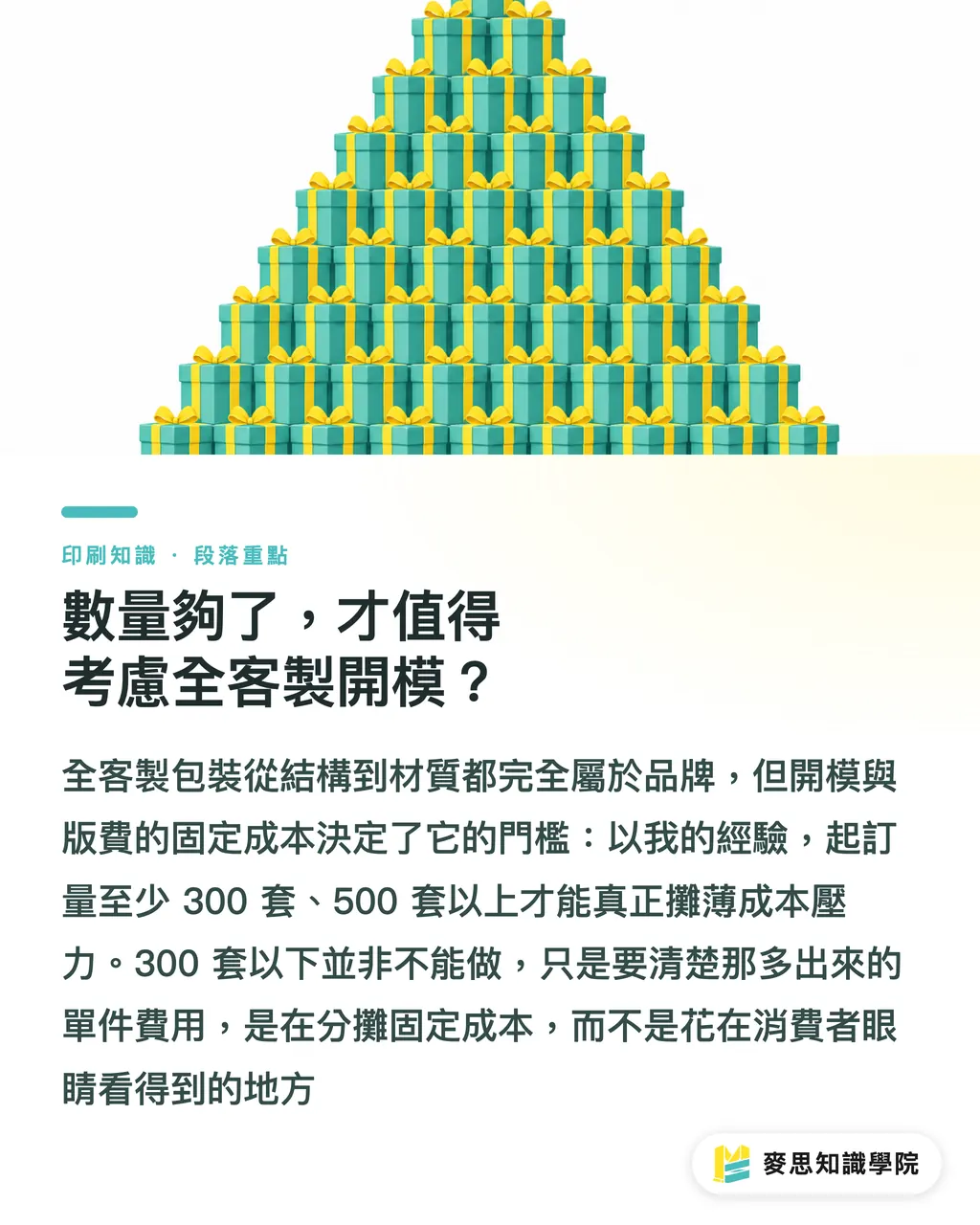
Tooling for a custom packaging structure ranges from thousands to tens of thousands of NTD, depending on structural complexity. Add specialized finishing (foil stamping, spot UV, embossing), and plate and proofing fees stack up quickly. Based on my experience, keeping unit costs reasonable on fully custom boxes requires a minimum order of at least 300 sets, with 500 sets or more needed to truly ease fixed cost pressure
That doesn't mean you can't go fully custom under 300 sets. Just realize that unit costs will run much higher than stock solutions, and that extra spend goes into paying off setup expenses, not into visible aesthetics your customer sees
Fully custom options fit specific scenarios: high-volume annual orders (500+ holiday boxes), plans to reuse the same packaging framework across multiple occasions, or luxury brand positioning that requires custom structures to convey value
---
How to Allocate Different Budgets: A Decision Framework
Here is the tiered logic I rely on in consulting work. It offers no single right answer, because gift packaging has no set rules, only structural choices:
・ 50 to 200 sets, budget under NT$200 per set: Stock box + belly band + brand sticker. Focus your budget on belly band design, printed in four-color offset. Get the specs right and it works reliable wonders
・ 200 to 500 sets, budget NT$200–500 per set: Upgrade the paper stock on stock boxes to specialty paper, paired with custom tote bags and foil-stamped belly bands. Alternatively, add an embossed logo to a stock box to immediately elevate visual depth
・ 500+ sets, budget NT$500+ per set: Evaluate fully custom structures. At this volume, you can discuss end-to-end solutions with manufacturers like MINDS that handle custom orders, planning everything from structural prototyping to post-press finishing under one roof to avoid sizing or color mismatches caused by split sourcing
・ High-ticket products with reusable packaging: Fully custom + premium finishing (foil stamping, soft-touch film, screen printing). These projects usually follow an annual procurement cycle, using one design year-round. Spreading tooling fees across total annual volume brings real cost-efficiency back into play
If you aren't sure about your volume or budget, reach out to the consulting team at Mai Strategy Knowledge Academy for an initial assessment. A single session usually clarifies your procurement direction
---
Where Are You Spending Money That Customers Never Notice?
Here are the most common pitfalls I see corporate buyers fall into:
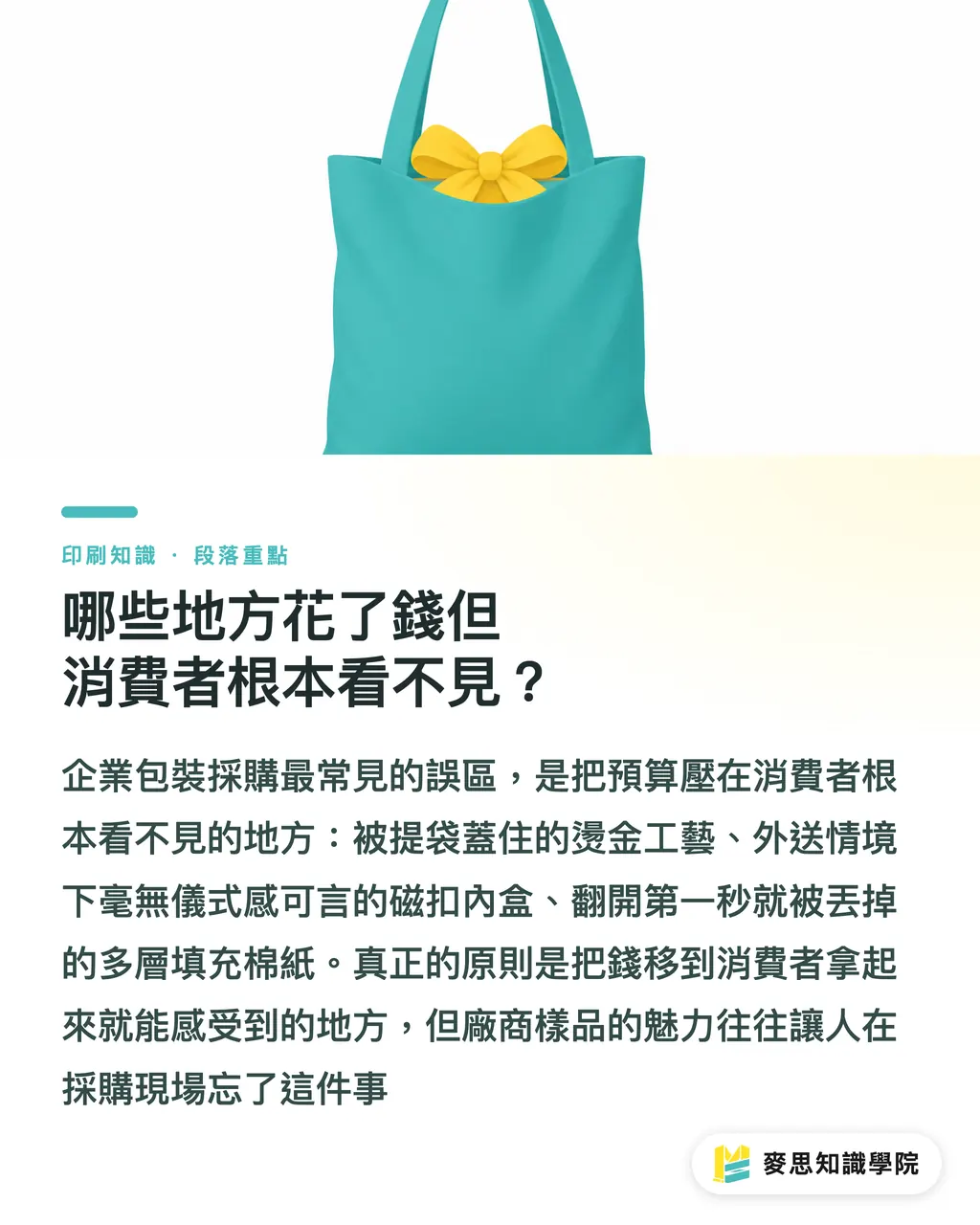
・ Overly intricate interior box structures: Telescoping lids or magnetic flap boxes look stunning when opened. But if the gift is ultimately handed off inside a tote bag, the recipient misses out on an unboxing experience entirely, making this a poor use of budget
・ Stacking heavy print finishes across the entire box: Combining full-bleed CMYK print, spot UV, and foil stamping drives costs sky-high. If the box sits inside a tote bag, much of that finishing work gets hidden anyway
・ Excessively thick and rigid paper stock: Ultra-thick chipboard feels great, but extra weight increases shipping costs. For large-scale courier deliveries, those extra costs pile up fast
・ Too many varieties of inner filler: Mixing multi-colored tissue papers and layering corrugated padding looks lush, but recipients discard it seconds after opening. Simplify to a single-color liner instead, and reallocate those savings to the belly band or tote bag
Shifting money from details customers miss to moments they feel when holding the box sounds simple enough, but on-site buyers often get swayed by impressive vendor samples
Key Takeaways
・ On a budget, combining belly bands, custom stickers, and branded tote bags offers the highest ROI for stock packaging customization, delivering sharp brand identity without tooling fees
・ Fully custom tooling carries a fixed cost barrier. Aim for at least 300 sets before going custom; otherwise, setup fees won't dilute properly
・ Customer attention focuses on three moments: picking up, opening, and touching the box. Protect spending in these three areas and compromise elsewhere
・ Heavy finishes (full-bleed print + foil stamping + spot UV) yield poor returns when obscured by a tote bag, representing a frequent waste of budget
・ Stock box customization doesn't mean cheap. Paired with thoughtful design and paper selection, its visual polish can rival fully custom packaging
Further Reflections
In recent years, timelines for corporate gift boxes have shrunk. Procurement decisions routinely run into hard limits around lead times and minimum order quantities. No matter how great a design is, low volume means it won't get produced. Corporate buyers should start holiday box planning by the end of Q3 rather than waiting until November. Ample lead time gives you room to compare modified stock options against fully custom solutions, allowing designers to execute details properly
For designers, the key takeaway is simple: ask about procurement volume ranges before proposing designs. Packaging solutions for 50 sets differ completely from those for 500 sets. Design directions should align with the right manufacturing process from day one, instead of leaving you stranded after design completion when printing proves impossible or budget explodes
As for AI tools and SaaS applications: the biggest pain point in corporate procurement is unclear specifications. Organizing event goals, target recipients, quantities, lead times, and budgets is precisely where AI integration tools speed up workflows most. Rather than jumping straight to AI-generated packaging designs, using AI to structure requirements before briefing designers and vendors proves far more effective
FAQ
- Our corporate gift box order is only 100 sets. Can we still customize them?
- Yes, but stick to modified stock packaging. Skip tooling and use custom belly bands, brand stickers, and tote bags for identity. Most vendors accept 100-unit runs, keeping costs far lower than full customization
- Do belly bands and stickers look significantly worse than fully custom boxes?
- With solid design work, the gap is smaller than most expect. The key lies in selecting the right belly band paper stock (such as specialty paper or foil-stamped bands) and maintaining clear layout hierarchy. First impressions can easily rival fully custom quality
- When is it actually worth making custom tooling for fully custom gift boxes?
- We recommend a minimum run of 300 sets, ideally 500 or more. Tooling fees represent fixed costs, so higher volume lowers unit expenses. Reusing the same structure throughout the year further maximizes tooling ROI
- Where do corporate gift procurement budgets get wasted most often?
- Most budget waste occurs when spending money on print finishes hidden inside tote bags (like full-bleed foil stamping) or excessively heavy chipboard structures. Recipients rarely notice these details, yielding very low ROI
- How can I quickly evaluate which gift box option fits my needs best?
- Check three factors first: order quantity, per-unit budget, and reuse plans. For runs under 300 sets without reuse plans, modified stock packaging works best. Above 300 sets with clear brand showcase needs, evaluate fully custom options. Reach out to the consulting team at Mai Strategy Knowledge Academy for a quick initial assessment
Related articles

The Print × AI weekly
The print and AI know-how designers, brands and enterprises can use before they commit — one email, every week
MINDS Free Tools
AI background removal, a LINE sticker maker, spine & imposition calculators — all free, right in your browser, no upload.
MINDS Group
Need actual printing or gifting services?
From premium printing to online ordering and festive gifts — the MINDS Group sister brands take it from here.