

Overview
Designers and brand buyers often ask me: If we want text on packaging to have a shiny metallic luster and a raised embossed texture, can foil stamping and embossing be done in a single step? The answer is yes. The secret lies in 3D hot stamping
In the hands-on experience at MINDS, using 3D CNC-engraved metal dies for single-pass 3D hot stamping directly solves the misregistration and high paper waste caused by traditional two-step processing
3D Hot Stamping is an advanced post-press technique. It uses CNC machining to create matching male and female metal dies. During a single heated press stroke, it transfers metal foil and creates raised relief patterns on paper at the exact same time
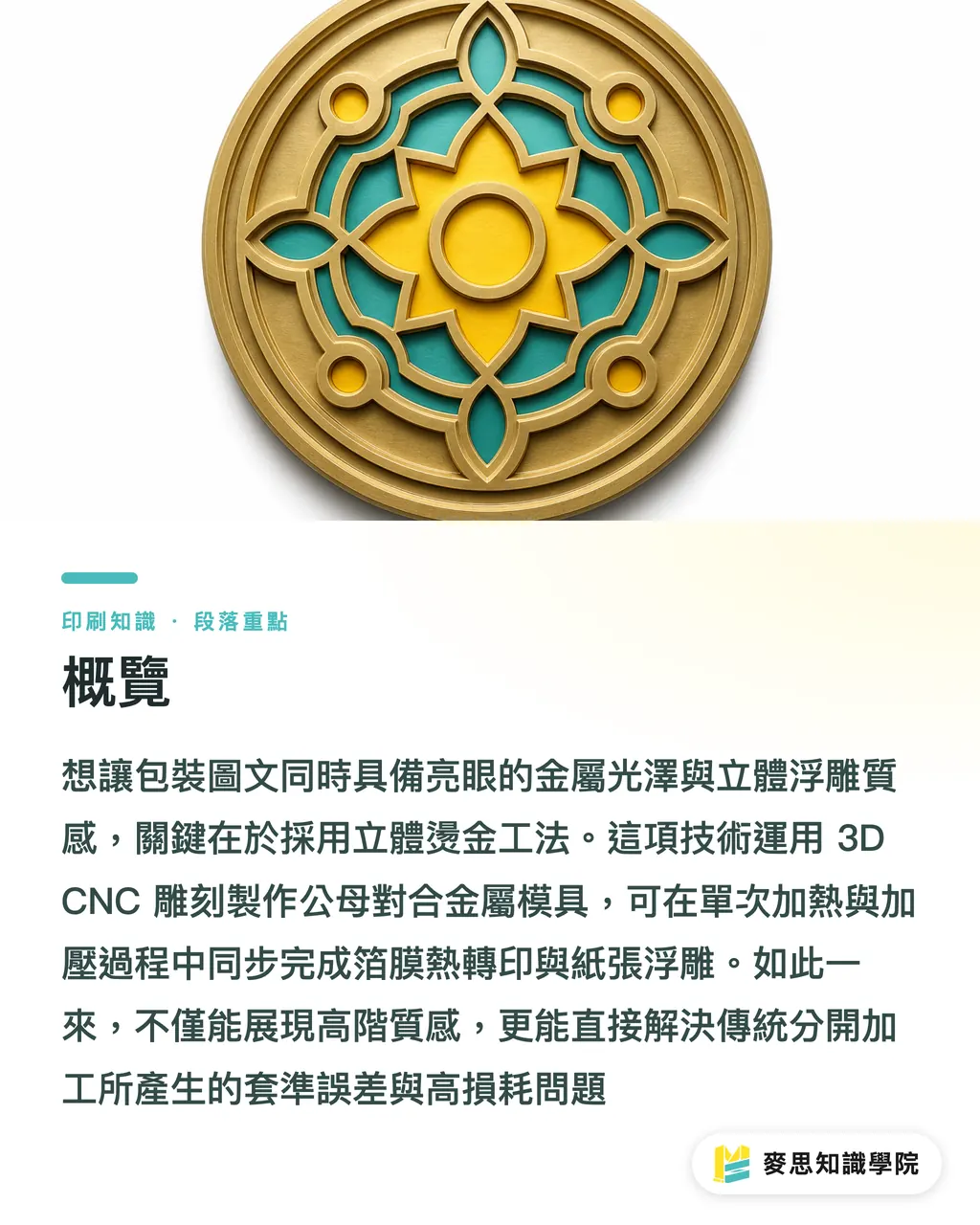
Foil-Then-Emboss vs. 3D Hot Stamping: Precision and Waste Math for Two-Pass vs. Single-Pass
Traditional metallic relief work usually relies on a two-step process: foil stamping first, embossing second
Not so fast
This approach seems cheaper on die costs upfront, zinc plates or etched copper plates run around NT$800 to NT$1,500 each. But running paper through the press twice doubles press setup fees and waste
The main production line bottlenecks of two-pass processing:
・Misregistration cannot be eliminated: After the first heated foil pass, paper fibers lose moisture and shrink slightly. On the second embossing pass, alignment errors usually fall between 0.3mm to 0.5mm, easily causing paper gap flash or double imagery on fine patterns
・Foil adhesion is put to the test: The physical stretching of the second embossing pass forces the already transferred foil apart. If the paper has spot UV or gloss lamination, up to 10% of finished pieces suffer foil flaking or cracking along relief edges
・High production waste rates: Press setup waste and shift drift over two runs push total scrap rates to 8%–12%
By contrast, single-pass 3D hot stamping uses CNC-engraved male and female copper dies. Foil transfer and paper stretching happen in the exact same millisecond
Since no second registration is needed, alignment errors drop close to 0, and waste stays under 2%. Initial die costs are higher, but total costs end up lower on medium-to-high runs
Zinc, Etched Copper, or 3D CNC Dies: Which Material Prevents Paper Cracking?
On the press floor, the nightmare scenario is a customer holding a torn sample and asking why the paper cracked. The answer usually lies in the metal structure of the die material
Practical logic for picking die materials:
・Zinc dies: Made via chemical etching, the metal is soft, and edges degrade under stamping pressure. Press life is usually capped at around 5,000 impressions. They cannot produce multi-level relief, making them fit only for low-budget, short-run basic business cards
・Etched copper dies: Harder than zinc, but chemical etching leaves steep, sheer sidewalls with no bevel relief. If paper fiber elongation isn't high enough during pressing, edges easily slice through paper fibers and tear
・3D CNC-engraved copper dies: Multi-axis CNC tools carve micro-bevels, rounded radii, and multi-tier channels directly into thick copper stock. Matched with precise counter-dies, they give paper fibers room to stretch gradually, drastically reducing paper tearing
Picking the right die material isn't enough; you also need to evaluate paper fiber traits
I recommend 250gsm to 400gsm long-fiber cardstock. Pay close attention to paper grain direction during sheeting, align primary fold lines or large embossed areas parallel to the grain for maximum relief height
Pre-Press Artwork for 3D CNC Copper Dies: Grayscale Tones and Channel Depth Rules
3D hot stamping dies rely entirely on CNC toolpaths reading your files. Artwork accuracy directly decides whether your final product succeeds or fails
Physical constraint rules designers must follow when prepping artwork:
・Vector files only: You must build files in vector software like Illustrator. Never export raster images; otherwise, the CNC engraver will cut jagged edges into the metal
・Grayscale gradients represent relief height: Use K100% for the deepest channels and highest relief points. Use K20% to K80% grayscale gradients to define bevel slopes and secondary layers, keeping tonal transitions smooth
・Line width and channel spacing: Minimum stroke width for foil stamping should be no less than 0.25mm. Leave a channel gap between two relief edges of at least 0.3mm to 0.5mm to give foil physical room to stretch into place. Failing to do so causes blurry, filled-in edges
If you have doubts about prepress specs for complex graphics or specialty papers, consult the Mai Strategy Knowledge Academy Advisory Team for pre-flight file checks
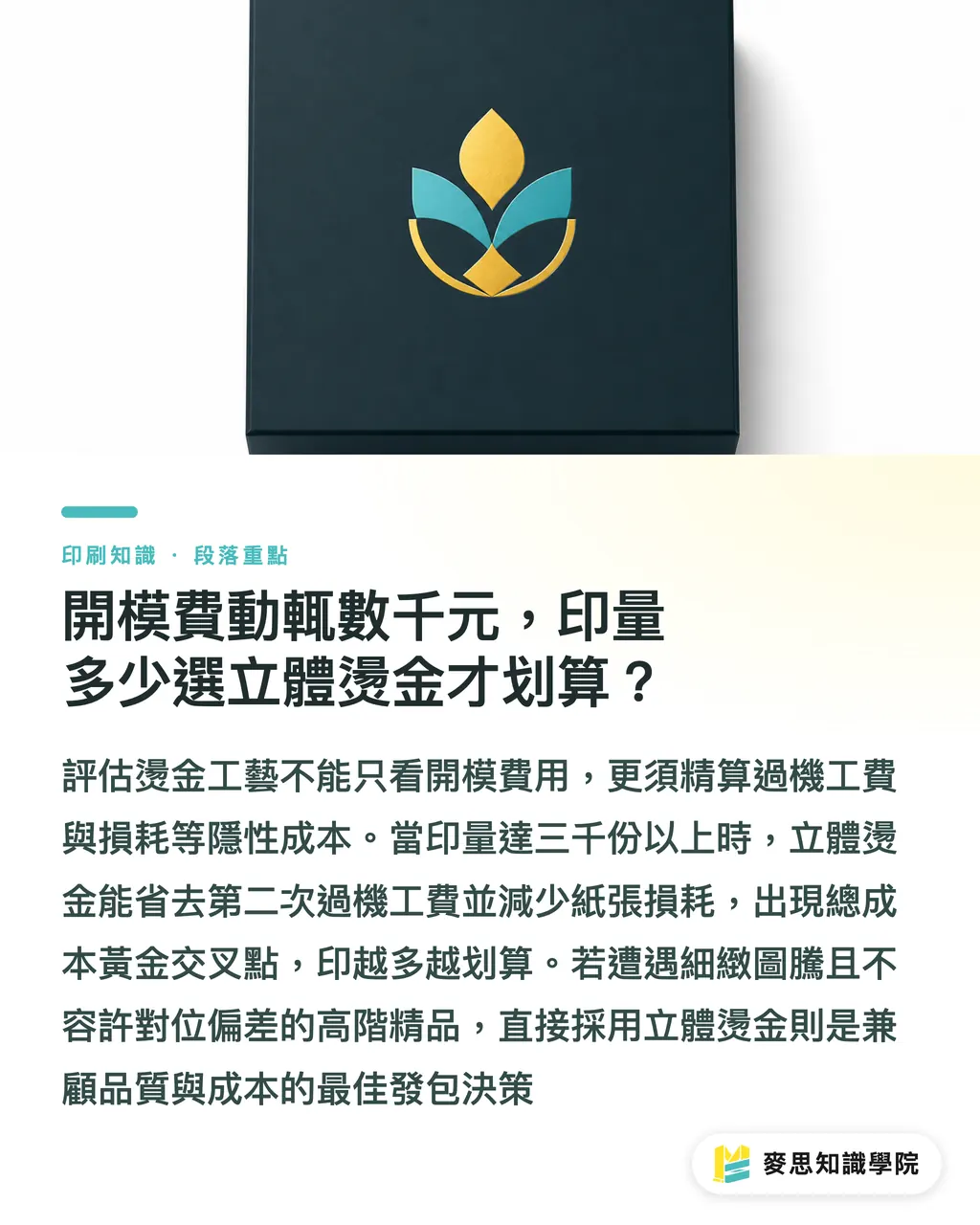
Die Costs Run into Thousands: At What Volume Does 3D Hot Stamping Pay Off?
Do the math
Many buyers back off when seeing 3D copper die tooling costs of NT$3,500 to NT$8,000, missing the hidden costs that stack up across two passes
Use this evaluation logic when running numbers:
・Short runs under 500 pcs (business cards or test proofs): Two-pass foil-then-emboss wins on price. Die fees stay around NT$1,500, and even paying press charges twice keeps the total bill under NT$4,000
・Runs over 2,000 pcs (folding cartons or hardcover invitations): A 3D die costs NT$5,000, but skipping the second press run saves NT$800–$1,200 per thousand sheets in labor, plus cuts paper waste by 8%. Total costs hit a tipping point around 3,000 units, the larger the run, the more you save
・High-end packaging with fine logos and patterns: Regardless of volume, if your design leaves zero margin for alignment errors, jumping straight to 3D hot stamping is the only job-out decision that guarantees quality without eating profits
Key Takeaways
・Single-pass 3D hot stamping uses 3D CNC-engraved copper dies to complete foil transfer and embossing in one go, avoiding up to 0.5mm misregistration and 12% paper waste from two-pass operations
・Preventing paper cracking requires 3D CNC copper dies with bevel angle cushioning, paired with 250gsm+ long-fiber cardstock aligned parallel to paper grain
・Prepress artwork must use vector grayscale gradients to indicate relief depth. Minimum stroke width for metallic stamping is no less than 0.25mm, with a channel gap of at least 0.3mm
・Outsourcing cost calculations depend on run length. For volume orders above 3,000 units, 3D hot stamping flips total costs in your favor by eliminating second-pass labor and paper scrap
Further Considerations
Moving from traditional print manufacturing to modern procurement management, standardized communication of post-press specs is essential to cut complaints and keep costs down. As designers demand richer visual depth, printers and brand buyers cannot look solely at upfront die price tags. They must build full-process waste evaluation models. Integrating digital prepress checks with AI die toolpath previews will further shrink communication cycles before and after die making, ensuring every dollar of your finishing budget goes where it matters most
Further Reading
FAQ
- Can foil stamping and embossing be done in a single step?
- Yes. Using CNC-engraved male and female 3D copper dies, you can transfer metallic foil and create raised relief in a single heated press stroke
- Why does foil flaking occur when foil stamping is done before embossing?
- The physical stretching of the second embossing pass forces the transferred foil apart. If the paper has spot UV or gloss lamination, edges easily crack or lose adhesion
- How should artwork indicate relief depth and height for 3D hot stamping?
- Use vector Illustrator files. Set K100% for the deepest channels and highest points, and use K20% to K80% grayscale gradients to mark bevel slopes and secondary heights
- At what run volume does 3D hot stamping become cheaper than separate processing?
- Generally at 2,000 to 3,000 units or more. Savings from skipping second-pass press labor and cutting paper waste by over 8% easily offset the higher tooling fee
Related articles




The Print × AI weekly
The print and AI know-how designers, brands and enterprises can use before they commit — one email, every week
MINDS Free Tools
Spine width and imposition calculators — skip the manual math, free in your browser.
MINDS Group
Need actual printing or gifting services?
From premium printing to online ordering and festive gifts — the MINDS Group sister brands take it from here.