
Why Do ESG Commitments Fail Printing Audits?
Corporate sustainable printing is a standard operating specification designed to cut carbon emissions and preserve recycling efficiency across the entire lifecycle of print procurement, paper production, printing, finishing, and waste disposal by adopting low-carbon inks, high-recycled-fiber paper, and film-free finishing, while building traceable supply chain certificates and disposal records
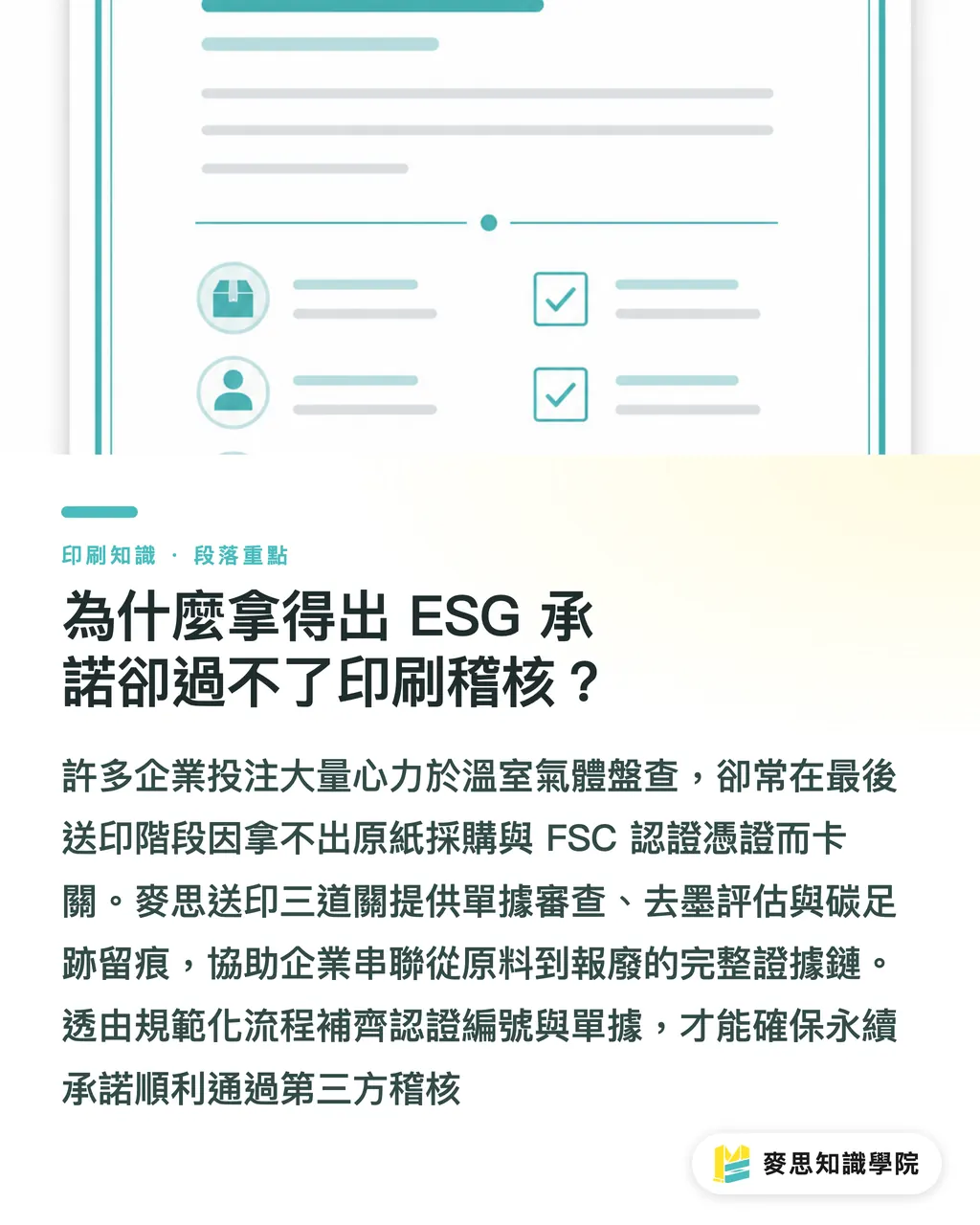
When drafting annual reports, many corporate sustainability teams pour 90% of their effort into upstream greenhouse gas inventories and GRI reporting, only to drop the ball at the final printing stage
During contract reviews or third-party audits of packaging and reports, companies often get flagged for risk simply because they cannot produce proof of raw paper procurement
To prevent this predicament, the MINDS Three-Gate Print Pre-Check framework (MS, mid-to-high-end fully custom commercial printing) provides companies with a defense structure spanning verification, finishing, and shop-floor documentation
The MINDS (MS) Three-Gate Print Pre-Check includes the following execution dimensions:
・① Document Audit: Verifying FSC CoC chain of custody certificates and itemized raw paper purchase invoices
・② Deinking Assessment: Filtering out plastic films and chemical varnishes that cannot decompose during mill deinking
・③ Carbon Footprint Tracking: Gathering a complete chain of evidence from quotes and work orders to disposal logs
Over 80% of international brands explicitly write carbon footprint and FSC certification into supply chain contracts, disqualifying vendors without matching documentation on the spot
On the shop floor, it is common to see companies spend heavily on carbon accounting, only to lose audit points over a print invoice missing a certification number
When stuck on procurement specs or documentation, consult the Mai Strategy Knowledge Academy Consulting Team to help set up a compliant verification process
How to Choose Paper for ESG Reports Without Falling into Greenwashing Traps?
Paper selection is the most direct carbon reduction metric in sustainability report printing, yet it is also the easiest area to stumble
Eco-friendly papers flood the market, but without checking FSC certification types and recycled fiber ratios, your choice can easily trigger greenwashing allegations
Key metrics and indicators to focus on when selecting paper include:
・FSC Recycled certification: Uses 100% post-consumer waste paper, minimizing virgin wood pulp usage
・FSC Mix certification: Blends FSC-certified virgin pulp with controlled fibers, balancing print strength and environmental standards
・PCW (Post-Consumer Waste) content: Prioritize papers with over 30% PCW to ensure actual support for waste paper recycling
・Soy and water-based inks: Volatile organic compound (VOC) content below 2%, far outperforming traditional mineral inks at 25% to 35%
Hold on a second
Virgin pulp paper has a carbon footprint of around 900 to 1,200 kg CO2e per metric ton, whereas switching to recycled paper with 100% PCW reduces the carbon footprint by about 30% to 40%
Buyers cannot rely on a green leaf logo on the sample sheet; you must demand a CoC chain of custody certificate with an FSC-C license number from your vendor
Gate one of the MINDS (MS) Three-Gate Print Pre-Check requires matching invoice certification numbers with delivery batch numbers to ensure full traceability for every sheet
Why Is Deep Embossing Easier to Pass Recycling Audits Than Spot UV?
Traditional printing often relies on spot UV, gloss lamination, or foil stamping to enhance cover texture
During waste paper recycling, these chemical treatments turn into contaminants that are difficult to separate
The impact of different finishing methods on waste paper deinking and recycling is as follows:
・Plastic lamination (OPP/PET): Film creates microplastics during pulping, causing deinking recycling rates to plunge below 40%
・Spot UV varnish: Chemical varnish bonds tightly with paper fibers, making separation impossible for mill deinking equipment
・Blind embossing and blind debossing: Alters paper fiber structure using pressure alone, requiring zero chemical films
・Water-based varnish: Offers basic scratch protection while dissolving naturally during pulping
Here is the harsh reality
Many reports branded as eco-friendly feature spot UV and composite metal film on the cover, which paper mills view as unrecyclable trash
In contrast, physical blind embossing allows fiber recovery rates exceeding 95% under standard deinking equipment
If you need mid-to-high-end fully custom commercial printing and physical finishing verification, evaluate low-carbon craftsmanship solutions from MINDS to balance visual appeal with recyclability

What Ten Key Items Should You Ask in a Print Supplier ESG Audit?
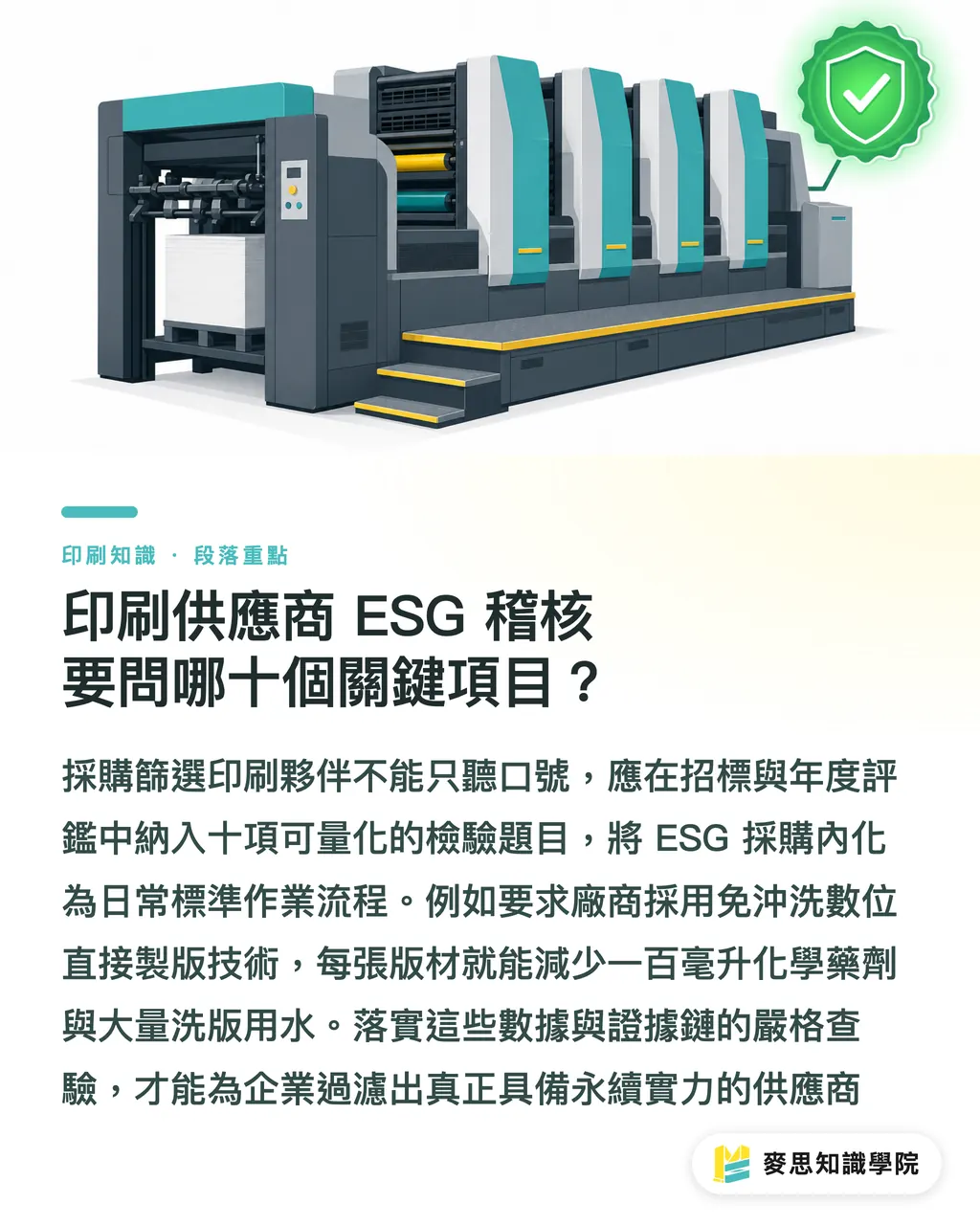
When vetting printing partners, move beyond slogans by presenting quantifiable check items during contracting and bidding
These ten must-ask items give procurement teams confidence and filter out vendors unable to produce data
Ten practical audit items for procurement when screening printing suppliers:
・Item 1: Does the facility hold a valid FSC CoC chain of custody certification number?
・Item 2: Do all production lines exclusively use low-VOC soy or water-based inks?
・Item 3: Are plates and liquid waste generated during printing backed by legal waste disposal manifests?
・Item 4: Does the finishing process offer plastic-free alternatives like blind embossing or water-based varnishes?
・Item 5: Do quotes and delivery slips clearly display certification numbers for each paper batch?
・Item 6: Does the facility conduct energy audits and provide baseline carbon emissions data per thousand prints?
・Item 7: Are plates made using processless computer-to-plate (Processless CTP) technology?
・Item 8: Is production make-ready waste controlled within a reasonable 3% to 5% low-waste window?
・Item 9: Are paper offcuts and trim waste 100% routed into dedicated sorting and recycling systems?
・Item 10: Can the vendor supply a complete supply chain carbon footprint chain of evidence for third-party audit spot checks?
Using processless CTP plates saves 100 ml of chemical developer per plate alongside massive amounts of plate-washing water, while lowering make-ready waste from a traditional 8% down to 3% cuts raw paper waste upfront
Integrating these ten items into annual supplier evaluations turns ESG print procurement from ad-hoc decisions into standard daily operating procedures
Key Takeaways
・Failing to produce documents is the biggest failure in sustainability report printing; build a complete chain of evidence from purchase quotes to disposal manifests
・Look for FSC CoC numbers and high PCW content when selecting paper to effectively cut paper carbon footprint by over 30%
・Ditch chemical finishing like OPP film and spot UV in favor of blind embossing or debossing to boost paper deinking recycling rates above 95%
・Use soy inks and processless CTP plate technology to control VOC emissions and chemical liquid waste at the source
・Apply the MINDS (MS) Three-Gate Print Pre-Check review mechanism to help print procurement breeze through third-party ESG audits
Further Thoughts
While carbon data collection is now highly automated thanks to AI tools and digital management, carbon reduction in physical printing supply chains still relies on shop-floor process control and paperwork tracking. Print manufacturers and designers must collaborate closely from early design stages, writing easy deinking and low-carbon physical finishing directly into specs. Only by introducing systematic procurement audits and chain-of-evidence preservation can corporate ESG commitments take root on every printed page
Further Reading
FAQ
- If an ESG report cover is completely unlaminated, won't it scratch or smudge easily?
- You can use water-based anti-scratch varnish as an alternative to traditional OPP plastic film. It offers basic protection while dissolving and separating completely during mill pulping, maintaining paper deinking recycling rates above 95%
- If a vendor claims to use eco-friendly soy ink, how can procurement verify it?
- Request the printing plant's ink Safety Data Sheet (SDS) and SGS test reports to confirm VOC content stays below 2%, then cross-check ink requisition logs on shop-floor work orders
- Why is purchasing FSC-certified paper not enough on its own without the printing plant holding CoC certification?
- FSC CoC chain of custody requires end-to-end traceability. If the printing plant lacks CoC certification, non-certified paper might get mixed in during printing and finishing, rendering the final product ineligible for FSC labeling
- How should print volume and page count be strictly managed for an ESG report?
- We suggest releasing the digital version first while restricting physical copies to shareholder meetings and key institutional investors. Keep page counts in multiples of 4 for signature imposition and hold make-ready waste within 3% to 5%
Related articles


The Print × AI weekly
The print and AI know-how designers, brands and enterprises can use before they commit — one email, every week
MINDS Free Tools
AI background removal, a LINE sticker maker, spine & imposition calculators — all free, right in your browser, no upload.
MINDS Group
Need actual printing or gifting services?
From premium printing to online ordering and festive gifts — the MINDS Group sister brands take it from here.