

Why Does Gold Foil Disappear on Dark Paper?
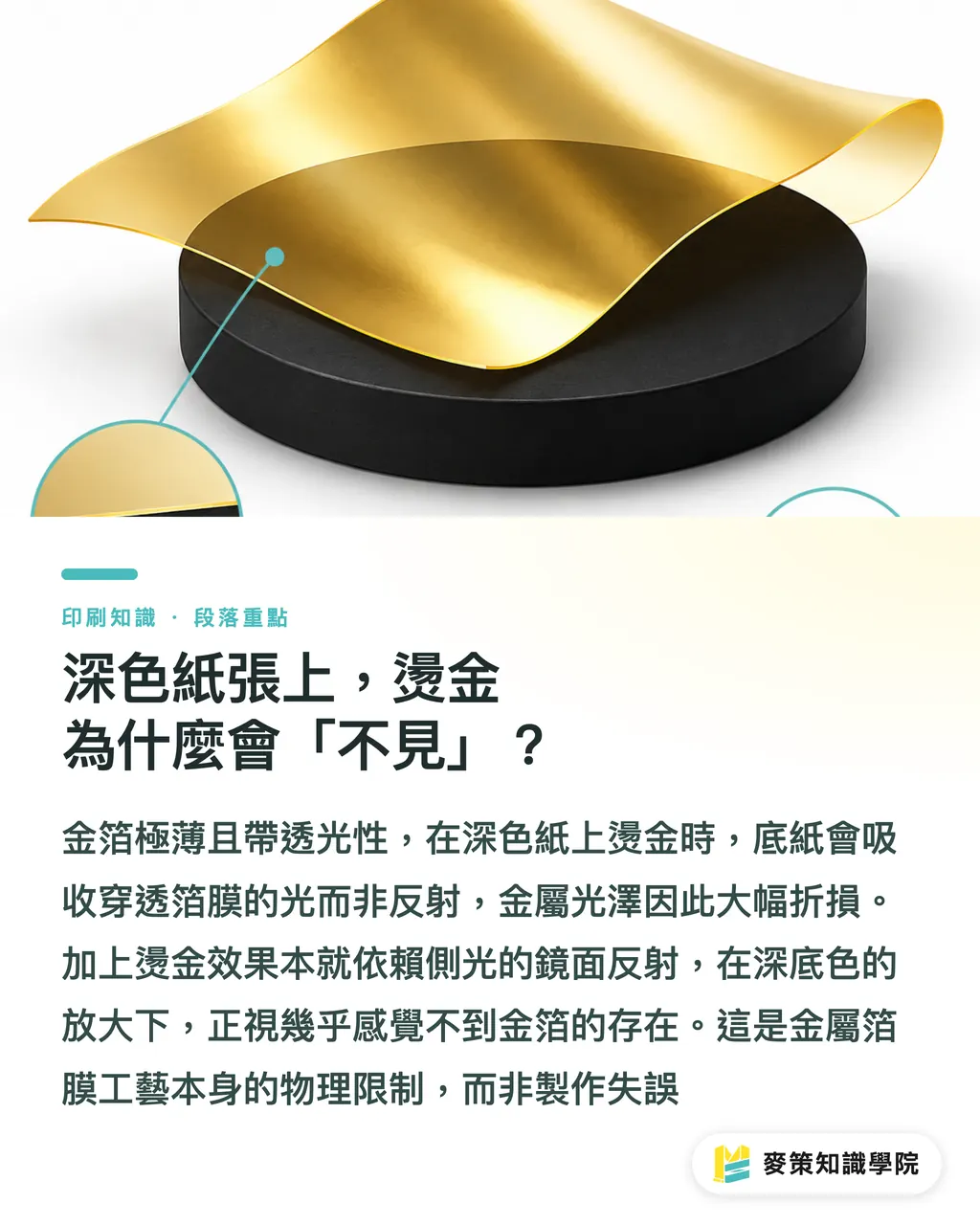
Gold foil is not an opaque sheet of solid metal. It is an extremely thin metallic film, roughly 0.012 to 0.025 microns thick, and it actually lets some light through. When you stamp on white paper, the white substrate bounces back the light passing through the foil, making the gold look rich and bright. Switch to black or dark specialty paper, and the background absorbs that reflected light completely, dulling most of the metallic shine
Viewing angles make things worse. Hot stamping relies heavily on specular reflection. You only really see it under raking light from the side, while looking straight on makes it blend right into the background. A dark base magnifies this issue several times over, to the point where looking straight at the sheet reveals almost no trace of foil
This is not the printer cutting corners, nor is it a design flaw. It is a physical limitation of metallic foil stamping. Once you understand that, you can pick the right fix
Fix 1: Laser Engraving to Reveal the White Paper Core
Laser engraving burns away the paper surface to expose the white core beneath the dark exterior. There is no foil involved, relying entirely on the paper core's natural white to create contrast
Best for:
・Minimalist, understated designs that skip the metallic look but need crisp text or lines on dark paper
・Larger type sizes (8pt or above is generally safe) and lines with adequate weight
・Tighter budgets, since laser engraving skips the material cost of foil
Keep in mind that the revealed color depends entirely on the paper core. It might not be pure white. Some specialty stocks have off-white, cream, or light gray cores, so always check physical sample sheets before committing
Black Foil, Spot UV, or Gold Leaf: Three Distinct Paths
Methods two through four follow different logic. Before picking one, ask yourself: do you need it to be legible, tactile, or genuinely gold?
Black Foil Stamping (Black Hot Foil)
Black foil is not meant to make text stand out visually. Instead, it adds a subtle embossed texture and sheen over dark paper. Looking straight at it shows very little, but glance from the side or touch it with your fingers, and you notice the raised gloss. It is an intentional choice for understated luxury. Best for:
・High-end business cards and luxury packaging aiming for quiet tactile presence
・Designers who intentionally prioritize texture over high contrast legibility
・Clients comfortable with an effect discovered primarily by touch
On cost, black foil rolls run slightly cheaper than gold foil, but plate making costs are identical, so total savings remain modest
Spot UV with Gold Ink
This technique prints metallic gold ink (a Pantone spot gold) on dark paper first, then coats it with spot UV varnish for extra gloss. Unlike foil's mirror reflection, gold ink is a printed color rather than a metallic film. Its shine is softer, but its visibility on dark stock is far more reliable than hot foil
Best for:
・Tiny typography, fine linework, or intricate details that a stamping die struggles to register cleanly
・Budgets below gold leaf application that still need a distinct golden appearance on dark paper
・Short runs where paying for a hot stamping die does not make financial sense
The downside is a less metallic look compared to real foil. Seasoned pros can tell immediately, though everyday consumers rarely notice the difference
Gold Leafing (Foil Gilding)
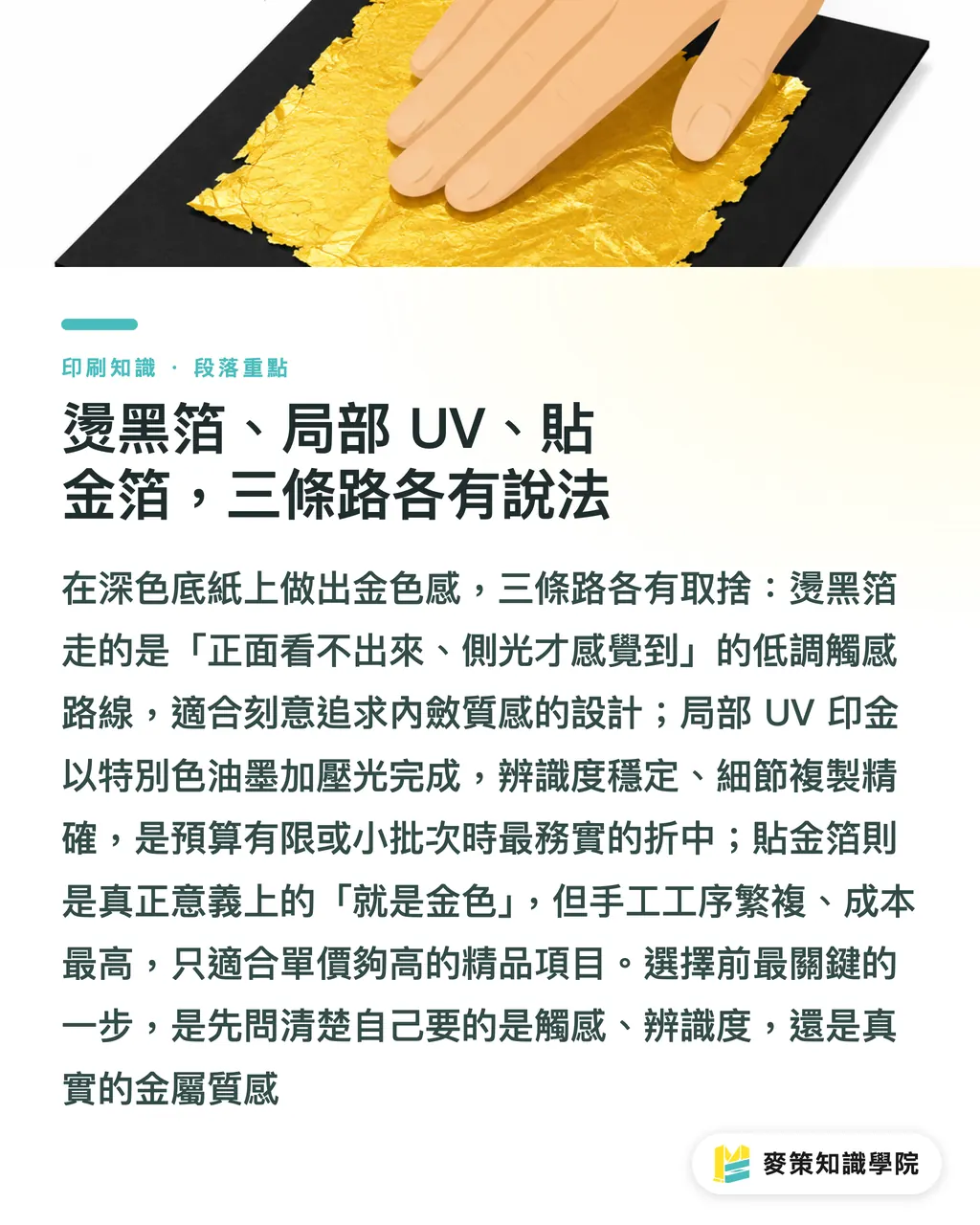
Gold leafing applies genuine foil sheets onto paper using acrylic adhesive or hot-melt glue. It is much thicker than hot stamping foil, offering superior opacity, so dark substrates cannot dull the gold. Among all four options, this delivers the purest gold appearance on dark paper
The tradeoff is price. Manual leafing involves labor-intensive steps, making it suited for luxury packaging and limited-edition memorabilia with high unit values. High-volume production is simply not practical. For business cards, it only makes sense for flagship branding projects
How to Choose Between These Four Options
From what I have seen on press runs, the most common pitfall is locking in hot foil before remembering the paper is dark. By the time physical proofs show up, swapping methods means extra costs and tight deadlines
Key decision points:
・You want visible gold on a budget: Spot UV with gold ink is the most practical pick
・You need authentic metallic foil for low runs with high unit budgets: Go with gold leafing
・You want tactile depth without color contrast: Black foil stamping
・You want clear white outlines or copy on dark paper and drop gold entirely: Laser engraving
When handling post-press finishing on dark paper, MINDS typically starts by asking clients: 'From what distance do you want people to notice the effect?' Viewing it from 30 centimeters away versus catching it across a conference table calls for completely different solutions
On the design side, write clearly in the production notes: 'Dark stock used, please confirm foil stamping visibility.' Giving your print partner a heads-up before proofing saves far more back-and-forth than ordering a second round of proofs
If your design direction is still taking shape, the Mai Strategy Knowledge Academy consulting team offers prepress advisory support. Aligning early is always cheaper than fixing issues after production begins

Key Takeaways
・Foil disappearing on dark paper stems from the foil's physical translucency, not a printing error
・Laser engraving suits projects needing crisp outlines without shine, using the paper's white core for contrast
・Black foil swaps visual pop for tactile texture, built for understated luxury designs
・Spot UV with gold ink offers dependable contrast at a moderate cost, making it the most sensible substitute on dark stock
・Gold leafing comes closest to genuine gold shine, though labor and costs run the highest
Further Thoughts
Pairing dark paper with gold finishing has become a go-to choice in luxury packaging, but designers and printers often envision 'gold' differently. A designer pictures a swatch from a Pantone book or a gold fill in Illustrator, while a printer evaluates the physical reflection of the foil film. Without aligning before sending files to press, you are almost guaranteed a second proofing cycle
A smarter approach: the moment you choose a dark stock during the design stage, decide on your finishing method right then, rather than finalizing the art and asking the printer later if foil stamping will work. Shifting that sequence saves not just money, but the intense schedule pressure between press run and delivery
FAQ
- I stamped gold foil on dark business cards, but the proof shows almost no gold. Is that normal?
- Yes. It comes down to how metallic foil behaves, not a press defect. Gold foil lets light through, and dark paper absorbs most of the metallic reflection, almost completely wiping out the effect. Switching to spot UV with gold ink or gold leafing guarantees far better visibility
- What is the difference between black foil and gold foil stamping?
- Gold foil applies a gold metallic film focused on visual shine. Black foil applies a black metallic film that emphasizes tactile texture rather than color. On dark paper, you only catch its raised sheen under side lighting with barely any color contrast, making it a deliberate choice for low-key styling
- How does spot UV with gold ink compare to hot foil stamping?
- Spot UV with gold ink prints metallic ink coated with gloss varnish, which has less sheen than actual metal foil. Hot stamping uses metallic film with an unmistakable mirror finish. While professionals can tell the difference instantly, regular consumers rarely notice it on dark paper, and spot UV actually provides much more reliable visibility on dark stock
- Is gold leafing expensive? Does it make sense for business cards?
- Gold leafing requires hand application, so costs run substantially higher than hot stamping. It works best on luxury packaging and high-ticket gifts. Using it on business cards is rare in practice, justified only for premier executive branding or small limited editions. For everyday cards needing gold on dark paper, spot UV with gold ink delivers much better value
- Is black fine paper suitable for hot foil stamping, or should I change stocks?
- Black paper is inherently a poor fit for direct hot foil stamping. If having gold elements on dark stock is central to your design, plan your finishing method (like gold leafing or spot UV) from the very start, rather than applying the logic of stamping on white paper to black stock
Related articles





The Print × AI weekly
The print and AI know-how designers, brands and enterprises can use before they commit — one email, every week
MINDS Free Tools
Spine width and imposition calculators — skip the manual math, free in your browser.
MINDS Group
Need actual printing or gifting services?
From premium printing to online ordering and festive gifts — the MINDS Group sister brands take it from here.