

Overview
Food packaging ink is decided by whether the food can actually touch the ink, then by substrate structure, then by compliance documents. The MINDS food-pack ink three-gate check is the order I fall back on: ① contact face, ② material layer, ③ documentary proof. Run those three first, then talk color, cost, and lead time
Most food packaging wrecks aren't a printer who can't run the job. They're a team that treated "looks fine on the outside" as "fine for food safety."
Ink drying doesn't mean the risk is gone. Stacked packs, heat sealing, cold storage, and greasy food contact can all push small molecules toward the food side
The sentence I dread most on the floor: "We've always done it this way."
Food packaging buying doesn't survive on habit. It survives on end use, structure, and paperwork
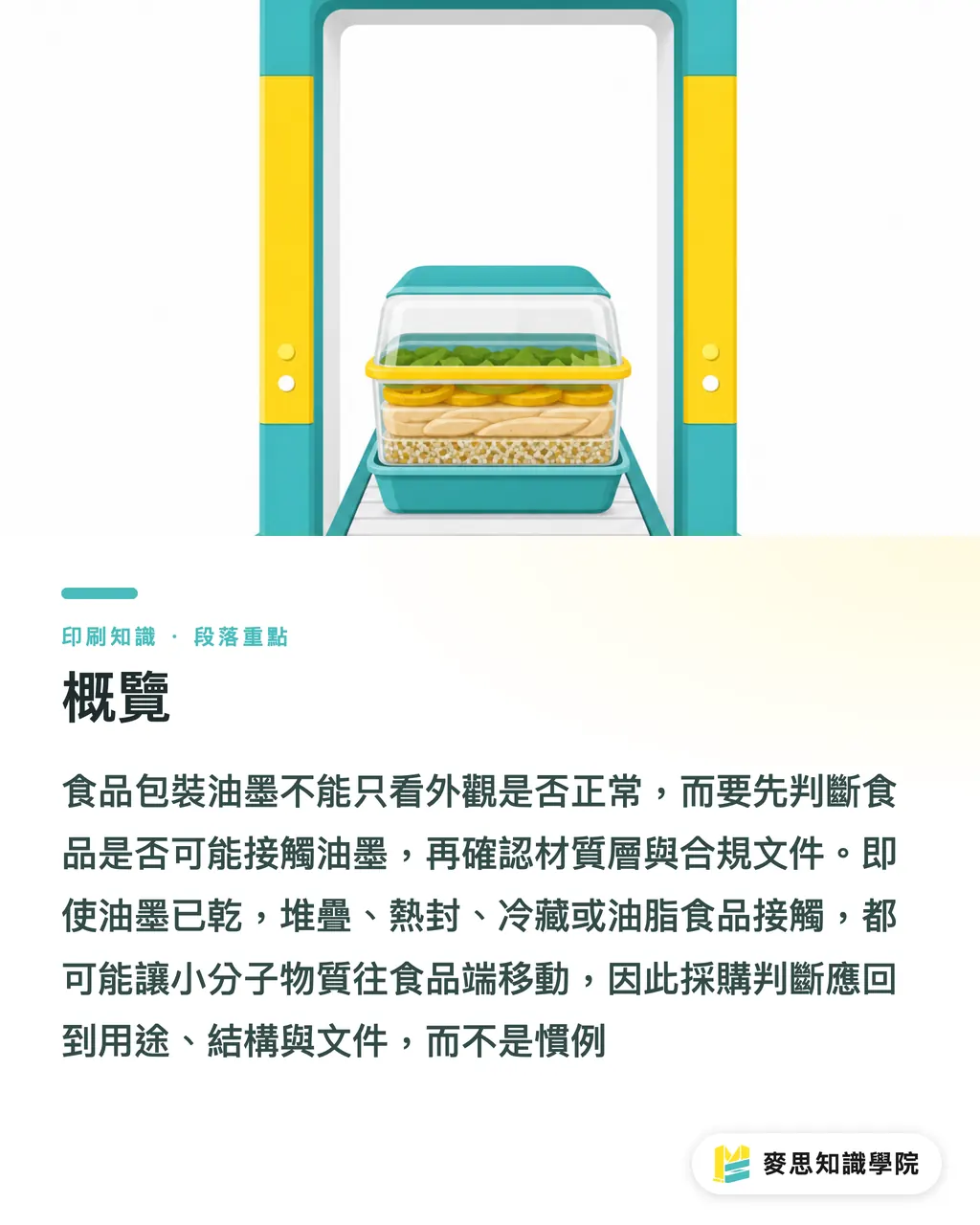
So what risks does food packaging ink actually need to control?
The one to control is ink migration: components from the print layer, via permeation, volatilization, set-off, or substrate contact, ending up in the food or on the food-contact face. Buying decisions have to weigh food type, storage temperature, layer count, and ink compliance files. Whether the color dries or the smell lingers is the wrong question
Working definition of ink migration: the phenomenon where low-molecular-weight substances, residual solvents, or photoinitiators from the printing ink move through the substrate, transfer under stack pressure, condense from vapor, or get absorbed by food oils, and end up in the food or on the food-contact face. Food packaging buying has to judge ink and structure against migration risk
Food packaging splits into two scenes, and this split matters more than the ink name
・Direct contact face: the ink may touch the food. Printing usually should be avoided, or replaced with materials and processes confirmed for the contact condition
・Non-contact face: ink sits on the outer layer. Permeation, set-off, and heating still have to be evaluated. "It's printed on the outside" is not a free pass
Taiwan's Act Governing Food Safety and Sanitation and the EU's Regulation 10/2011 both push food-contact material safety into the compliance responsibility. What buying needs to take from it is the direction: food packaging safety isn't just "the finished product can't be toxic." Substrate, coating, ink, and converting conditions all shape the final result
EU 10/2011 is written mainly for plastic food-contact materials, but multi-layer laminates almost always involve plastic film, adhesive, and print layers. In Taiwan's supply chain, export and OEM brand work gets held to this language as a baseline check
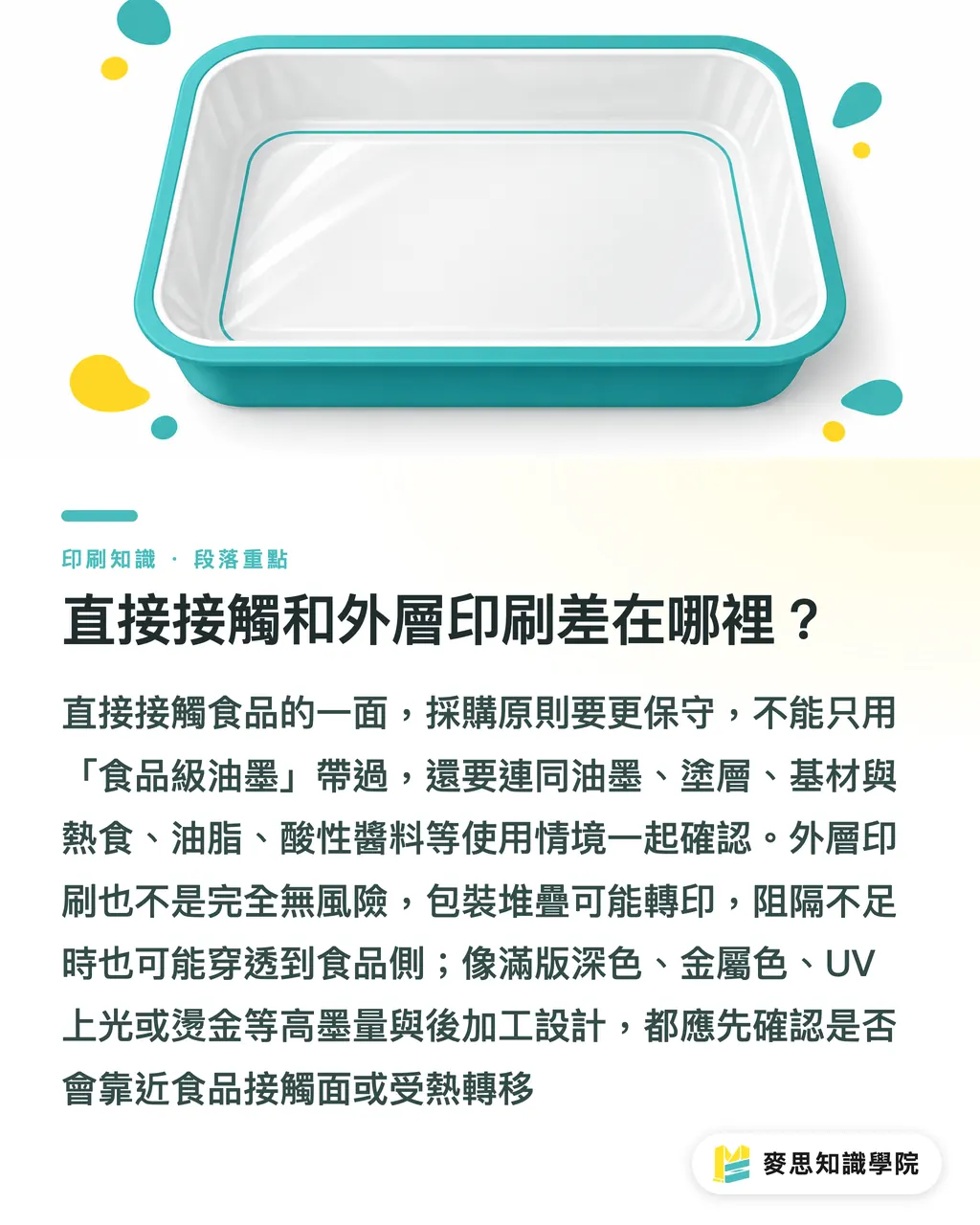
How is direct-contact print different from outer-surface print?
Buy conservative on the side that touches the food. If you can leave it unprinted, leave it unprinted. If you can't, get ink, coating, substrate, and use condition confirmed together
Things like the inside of a lunchbox, the inside of a cup lid, the inside of a food tray, "food-grade ink" is not a complete answer. Hot food, grease, acidic sauces, and freeze-thaw all change the migration picture
Outer-surface print has two risks that get glossed over
・In a stack, outer ink can set off onto the food-contact face of another pack
・If a monolayer paper or film has poor barrier, outer-ink components can migrate through to the food side
Designers should watch out for full-bleed dark areas, large metallic coverage, spot UV, varnish, and foil stamping
These look great, but food packaging buying has to ask first: is the finishing layer close to the food-contact face, will it see heat, will it transfer during stacking or rewinding?
I've seen plenty of jobs where pulling the coverage back 20% worked better than swapping in an expensive material. Risk usually comes from big ink film weight plus finishing stacked on top
If a food pack needs to land both visual and food safety, the brand can hand the structure to an experienced printer for joint review. For mid-to-high-end full-custom commercial print, MINDS Printing can talk through substrate, ink, and finishing order. For standard-spec boxes or stickers, Mind Print can confirm available substrates and print limits first
What 5 questions should you ask when buying food-safe ink?
Food-safe ink buying can't stop at "do you have a cert." It has to reach the use boundary. The same ink on a dry-goods outer box, a refrigerated greasy product, and a microwaveable lunch tray is not the same risk
I open cases with five questions and I want the answers in writing, on the quote, the sample log, or the supplier reply
・Is this ink rated for direct food contact, or only for non-contact outer-surface print?
・Does this ink come with a food-packaging statement of use, test data, or supplier compliance documents?
・Is this substrate a monolayer paper, a plastic film, or a multi-layer laminate, and where is the barrier layer?
・Will the finished product see high-fat, acidic, alcoholic, hot, frozen, or microwave conditions?
・After printing, is there varnishing, laminating, heat sealing, bonding, foil stamping, or UV work, and do those materials also come with paperwork?
Food-safe ink paperwork has to line up on at least three points
・A statement of use or compliance statement from the ink supplier
・A process note from the printer covering the substrate structure and the print position
・A use-condition description for the finished pack covering food type, temperature, and storage
The easiest trap in buying: treating "low odor," "eco ink," "soy ink," or "water-based ink" as food safety
Those words each carry their own environmental or process meaning. Food packaging is judged on migration, contact conditions, and documents. A sustainability line is not a safety proof
Is monolayer paper safer than multi-layer laminate?
Monolayer paper's problem is limited barrier. Even with the ink on the outside, permeation and stack set-off still need evaluation
Packaging like burger wraps, snack boxes, toast bags, if the food has oil or heat, the paper fiber can absorb grease, and ink and varnish can't be judged by surface adhesion alone
Multi-layer laminate looks safer because it might have PET, PE, aluminum foil, or other barrier layers. But more layers means more adhesive, more heat-seal conditions, and more supplier documents
In flexible laminate jobs, the thing I chase hardest isn't the ink name. It's which layer the ink is printed on
Ink reverse-printed on the inside of the film, then a laminate layer separating it from the food, versus surface-printed on the outside and wound into a reel, the risk paths are completely different
Buyers can use four material anchors to judge quickly
・Monolayer paper: watch for oil absorption, permeation, and stack set-off. Suitable for dry or low-risk food, but still check the coating
・PE-coated paper: check whether the PE or other coating is on the food-contact face, and write the heat-resistance condition down
・Laminate film: map the relative position of the ink layer, adhesive layer, barrier layer, and heat-seal layer
・Sticker labels: check whether the adhesive, face stock, and ink are suited for chilled, frozen, humid, or greasy conditions
Don't wait until the artwork is locked to call a printer in for damage control
The MINDS food-pack ink three-gate check works at the design stage: mark the food-contact face, draw out the material layers, then fill in the documentation for ink, varnish, laminate, and adhesive one by one
It doesn't take long, and it saves a round of sampling rework
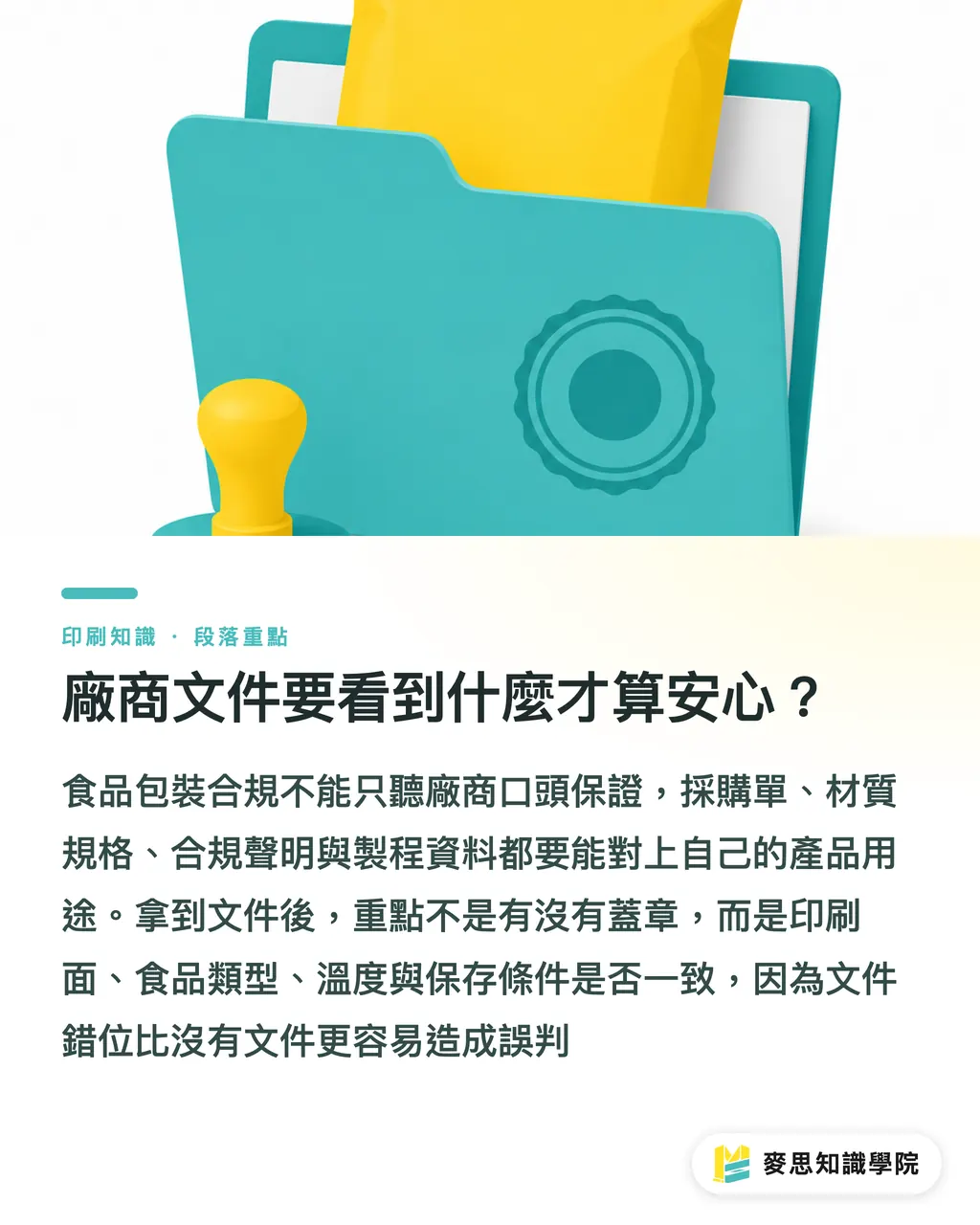
What level of vendor paperwork is actually reassuring?
Food packaging compliance isn't a verbal assurance. It leaves traceable documents. The PO, the quote, the sample log, the compliance statement, and the material spec have to line up with each other
If a vendor's only reply is "lots of our food customers do it this way," I treat that as a sales story, not a compliance proof
Five document types to request from the printer or material supplier
・Ink statement of use: states which print positions and limits the ink is rated for in food packaging
・Material specification sheet: lists the basic composition of paper, film, coating, laminate, or coating layer
・Compliance statement or test data: aligned with food-contact material requirements, migration risk, or client-specified standards
・Process note: covers which face the ink is printed on, drying method, and the order of laminating or varnishing
・Finished product use conditions: food type, temperature, shelf time, microwave or frozen use
When the documents arrive, don't just check for a stamp. Check whether the content actually maps to your product
A paper file for a dry-biscuit box can't be used to defend a hot-soup cup. A statement for outer-surface print can't be used to defend a direct-contact inner face
This is the most realistic part of buying responsibility. Misaligned documents are worse than missing documents, they're how teams get the wrong answer with confidence
For SMEs, a practical first move is an internal checklist with six fixed columns: food-contact face, material layer count, print face, food type, storage temperature, and supplier documents
When you're ready for custom food boxes, lunchboxes, food stickers, or gift packaging, bring that table to MINDS Printing or a qualified printer. The conversation moves faster and the responsibility gets clearer
Key takeaways
・Decide the contact face first, then talk ink type. Get the order wrong and you buy the wrong ink
・"Eco ink" is not "food-safe ink." Food safety is migration, use conditions, and documents
・Monolayer paper worries about permeation and set-off. Multi-layer laminate worries about layers and documents not matching up
・Buyers need to ask five questions. Direct contact, documents, material layer, food conditions, and finishing, none optional
・Compliance isn't a printer's verbal guarantee. The documents have to match the finished product's use
What to build on top of this
Stable food packaging work means the print side pulls ink, coating, adhesive, and heat-seal conditions into traceable records. The design side marks the food-contact face and finishing positions before final artwork. AI and SaaS teams can turn "contact face, material layer, documents" into a pre-press checklist so sales, design, buying, and the printer all work off the same list. Less memory, more record
FAQ
- Does food packaging always need food-grade ink?
- Food packaging is decided by whether the ink can reach the food. Direct-contact faces usually shouldn't be printed at all. Outer-surface print still needs migration, stack set-off, and substrate barrier reviewed. "Food-grade ink" alone is not a judgment
- Can soy ink or water-based ink be used on food packaging?
- Soy ink and water-based ink are not the same as food-safe ink. Buying has to check the food-contact position, use temperature, fat content, and the supplier's compliance documents. Environmental claims don't replace food safety judgment
- If the outer layer isn't touching the food, do we still need food-safety documents?
- Yes, it still needs review. Outer-surface ink can reach the food-contact face through monolayer paper permeation, stack set-off, or laminate reel transfer. Outer-surface food packaging should still keep ink and material documents on file
- What documents should a food packaging buyer request from the printer?
- At minimum: ink statement of use, material specification sheet, compliance statement or test data, process note, and finished product use-condition record. The document content has to match the buyer's food type and pack structure
- Is monolayer paper safer than multi-layer laminate?
- Layer count alone doesn't decide safety. Monolayer paper needs permeation and oil absorption reviewed. Multi-layer laminate needs the ink, barrier, adhesive, and heat-seal layer positions checked. What actually matters is whether the material structure and the documents agree
Related articles


The Print × AI weekly
The print and AI know-how designers, brands and enterprises can use before they commit — one email, every week
MINDS Free Tools
Spine width and imposition calculators — skip the manual math, free in your browser.
MINDS Group
Need actual printing or gifting services?
From premium printing to online ordering and festive gifts — the MINDS Group sister brands take it from here.