
What's the Difference Between FSC Mix and FSC Credit?
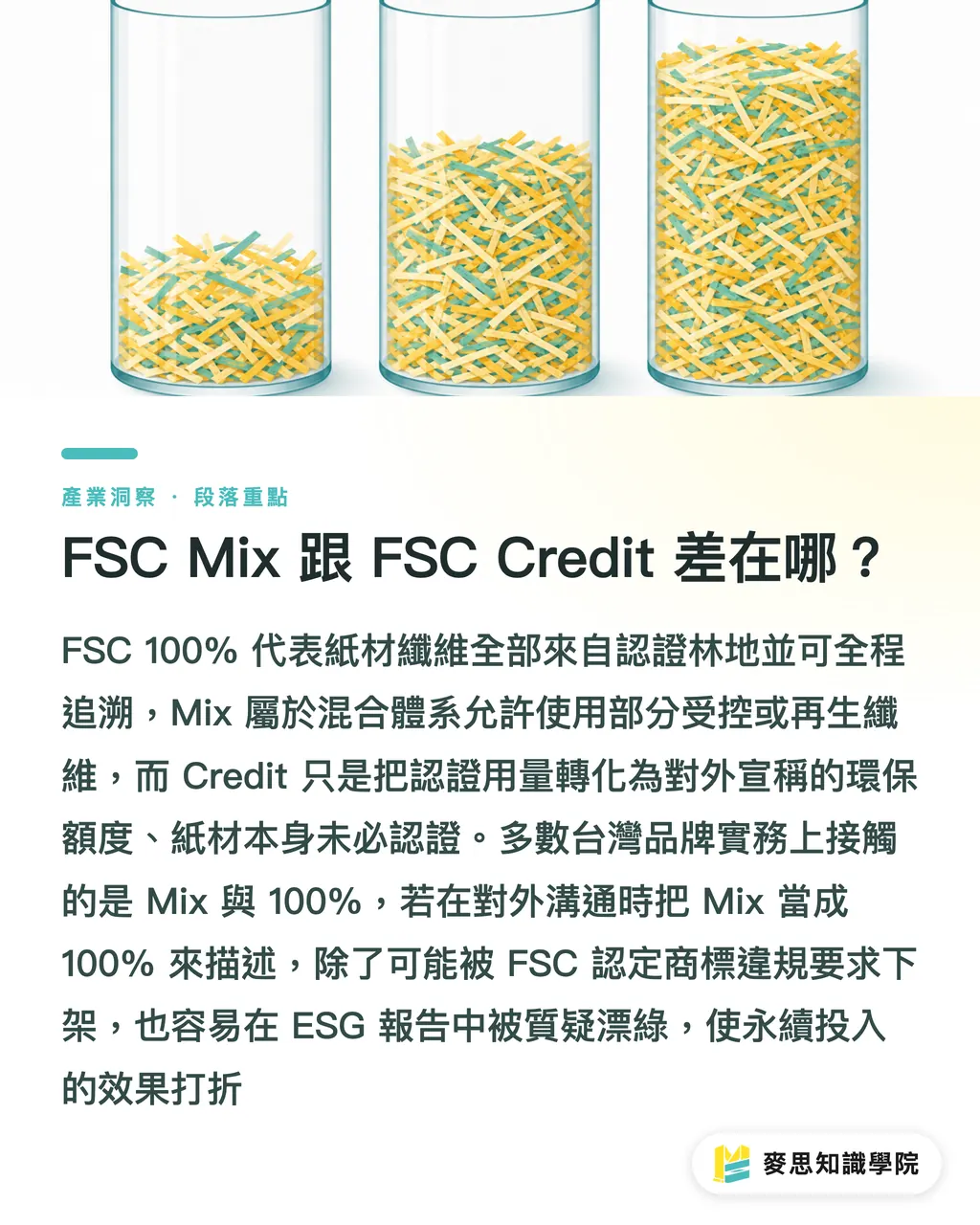
In simple terms, FSC 100% means all fibers in this paper stock come from FSC-certified forests, with full-chain traceability. FSC Mix means some fibers come from FSC forests, while others come from controlled sources or recycled materials. It can carry the FSC label, but it belongs to a mixed system. FSC Credit means the amount of certified paper stock used in the market is converted into an environmental contribution credit that can be claimed externally. The paper stock itself is not necessarily certified
For most Taiwanese brands, the labels they deal with most often are Mix and 100%. Credit has relatively low practical visibility in Asian markets. Choosing the wrong one has two levels of consequences. First, FSC may rule the trademark use noncompliant and require the item to be taken down. Second, ESG reports or external communications may be questioned as greenwashing, which weakens the value of the sustainability work. In cases MINDS (MS, mid- to high-end fully customized commercial printing) has handled for clients, the most common mistake is buying Mix paper but using 100% language in external claims
Next, we will break down the three certificates, then look at how brands should choose
How Do the Three FSC Certificates Actually Work?
The FSC certificate system has several layers. Clarify a few key terms first, or procurement meetings can quickly turn into crossed wires
・FSC 100%: all wood fibers in the product come from FSC-certified forests. The required proportion is strictly 100%, with no mixing or controlled sources accepted
・FSC Mix: some fibers in the product come from FSC-certified forests, while some come from "controlled sources" or recycled materials. CoC (Chain of Custody) verification ensures the mixed ratio complies with the rules
・FSC Credit: similar to the idea of "carbon credits." A company buys credits from certified forestry to support sustainable forestry, but the paper stock actually used may not be certified
A few details are often confused, so let's sort them out:
・FM (Forest Management) certification: this certificate is for "forest managers." It proves that a forest area is managed sustainably. It is separate from product-side 100%, Mix, or Credit, but raw materials for 100% must come from forests with FM certification
・CoC Chain of Custody: this verification is for the "processing and trade chain." It ensures every step from forest to paper mill to print shop can be traced. Without CoC, even if a paper mill buys certified pulp, it cannot claim the product is FSC
・Controlled Wood: this does not come from certified forests, but it must meet FSC's five risk assessment requirements, including whether harvesting is legal and whether high conservation value forests are involved. The "non-FSC" portion of Mix paper stock belongs to this category
The logic of this system is simple: FM at the forest end, CoC at the processing end, and the label at the product end. All three layers are required. Brands often assume that getting FSC paper from a paper mill means they also have the right to use the FSC label. In reality, the print shop also needs CoC verification, otherwise the entire print run cannot carry the FSC label
What Are the Common FSC Label Use Cases for Taiwanese Brands?
Based on the client cases I have handled over the past few years, Taiwanese brands usually encounter FSC labels in three types of situations. Each has different expectations for certificate level
Packaging and printed materials exported to the EU or North America
The EU Deforestation Regulation (EUDR), which took effect in 2023, mainly regulates agricultural and forestry products such as beef, coffee, and cocoa, but supply chain due diligence requirements for packaging materials will only get stricter. If a brand ships to Europe, it is normal for retailers or buyers to request FSC certificates. In this situation, Mix is usually enough, but only if the print shop's CoC verification is still valid and invoices and delivery notes can be traced
ESG reports or sustainability communication materials
Annual reports, sustainability reports, and external communication materials such as brand story brochures fall into this category. If these documents need to carry an FSC label on the front or back cover, procurement and design teams must confirm one thing: whether the paper stock used for the printed piece is truly FSC-certified, and whether the certificate number can be found in the official FSC database at info.fsc.org. Choosing 100% or Mix depends on how strong the brand wants its external message to be
Channel procurement rules or client contract requirements
Retail channels and international brand clients often write in procurement contracts that "packaging materials must comply with FSC Mix or equivalent standards." In that case, Mix is the most commonly cited benchmark. If the contract says "FSC-certified paper stock is required" but does not specify the level, both sides need to clarify before signing whether it means 100%, Mix, or Credit, so the shipment is not rejected later
One reminder here: FSC Credit has relatively low visibility in the Taiwanese market. In practice, Asian printing companies mostly deal with Mix and 100%. If your supplier suddenly pushes "Credit" as something you can buy, ask clearly how the Credit amount is calculated and what external claims it can support, because Credit communication rules differ from Mix and 100%. Mixing them up is risky
How Should Brands Decide: Is Mix Enough, or Is 100% Required?
There is no single standard answer, but there is a clear decision logic. From a production consultant's experience, I would suggest brands ask themselves three questions before deciding the certificate level
Question one: how strong is the external commitment this printed piece is meant to communicate?
If it is the cover of an annual report, an ESG communication brochure, or a brand statement saying "we use 100% sustainable forestry materials," then choose 100%. The value of these documents lies in the strength of the message. Using Mix may invite questions about why the brand did not simply choose the highest level. If it is product packaging, an event booklet, or a shipping carton, where function matters more than communication, Mix is usually enough
Question two: has the channel or client specified a level?
If the contract clearly requires FSC Mix certification, follow the contract. Do not upgrade to 100% on your own and raise costs. If the contract only says "FSC-certified" without specifying the level, confirm with the other party and record the reason behind the choice, so there is a basis for future checks
Question three: is the print shop's CoC status and certificate validity clean?
This is where projects most often fail in practice. Certified paper stock does not mean the print shop can put the label on your job. The print shop must have valid CoC verification, and the verification scope must cover the production method you are commissioning, such as offset printing, digital printing, or post-processing. If the print shop's CoC has expired or its scope does not match the job, the printed piece cannot carry the label even if the paper stock is truly FSC
When the Mai Strategy Knowledge Academy consulting team helps clients make procurement decisions, we often use this framework:
・Use 100% for: brand annual sustainability report covers, limited-edition commemorative items, communication materials with a strong public commitment
・Use Mix for: product packaging, internal corporate publications, event booklets, and channel contracts that require FSC without specifying a level
・Use Credit for: companies that want to support sustainable forestry by "buying FSC credits," but do not plan to put a label on the product, such as for internal ESG calculations
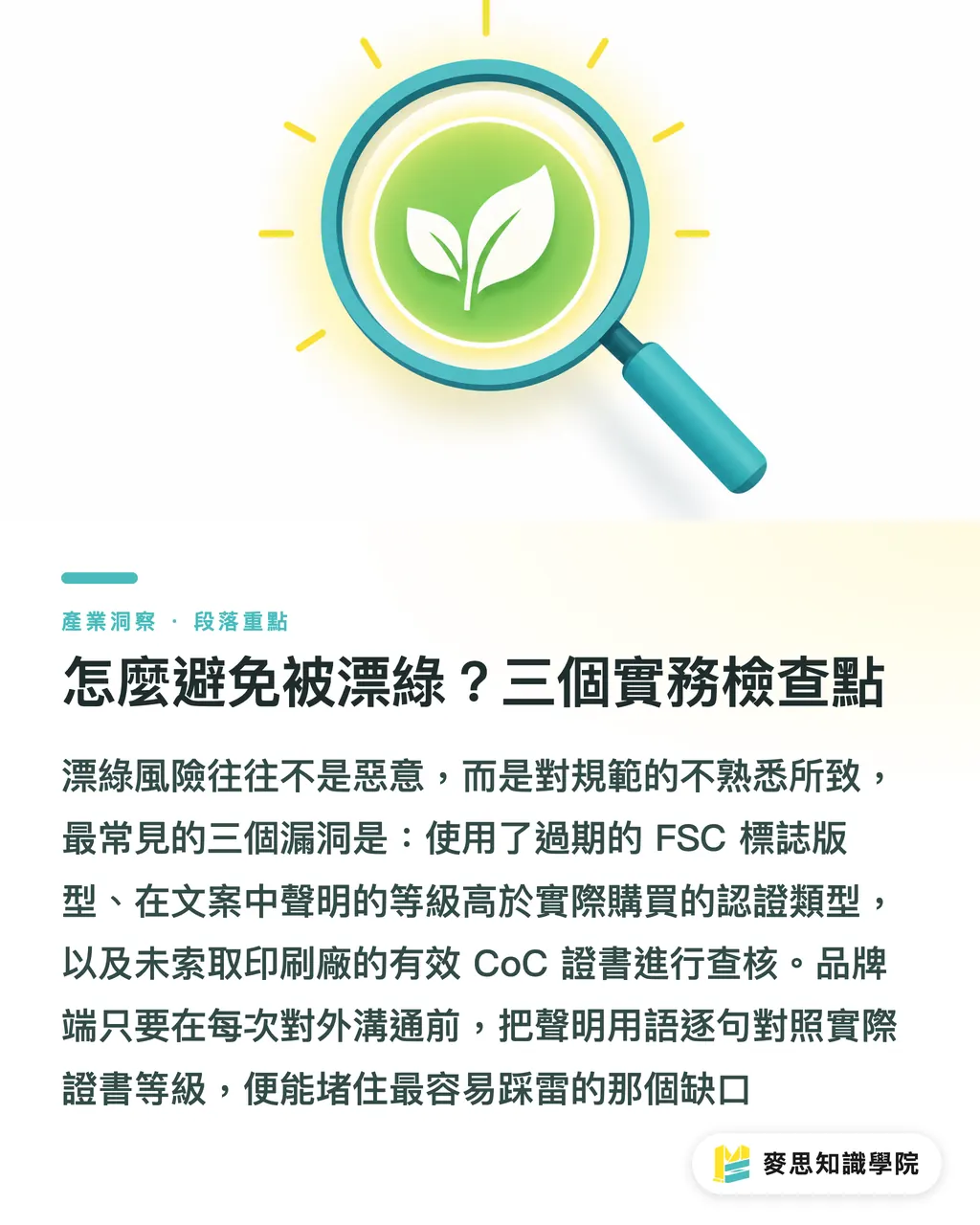
How to Avoid Greenwashing? Three Practical Checks
Greenwashing risk is not always intentional. More often, it comes from not knowing the rules. In production cases I have seen, the most common greenwashing situations fall into three types, each with a matching check
Logo usage rules are not aligned with the latest FSC official version
FSC trademark usage rules (FSC-STD-50-001) are updated from time to time, including minimum logo size, color specifications, and placement rules when used alongside other labels. If a designer is using a template from three years ago, the printed result may already be noncompliant. How to check: get the latest logo files from the FSC trademark download page and confirm the version you are using is still valid
Claim wording exceeds the actual certification level
This is the most common mistake. A brand buys Mix paper, then writes "we use 100% FSC-certified paper stock" in a press release or social post. That is a greenwashing claim. How to check: review every sentence used in external communications against the actual certificate type and level purchased. If it does not match, change it immediately
No third-party verification process
FSC itself has an independent assurance body, ASI, for audits, but if the brand has not built an internal verification process, relying only on the print shop saying "we have CoC" is not enough. How to check: ask the print shop for a copy of its CoC certificate and validity dates. When needed, verify the certificate number's authenticity and scope in the FSC public database
These three checks can be applied to any FSC-related procurement case. The root of greenwashing risk is never the certificate itself. It is the gap between communication and actual action
Key Takeaways
・FSC 100% is full-chain traceability, Mix is a mixed system, and Credit is a credit concept. The three cannot be used interchangeably
・Taiwanese brands most often deal with Mix and 100%. Credit has lower practical visibility in Asian markets
・Buying FSC paper does not mean you can print the label yourself. The print shop's CoC verification is a required condition
・The root of greenwashing is the gap between communication and actual action, not the certificate itself
・Every external claim must be checked against the actual certificate type and level purchased
Further Thinking
From the perspective of a printing industry consultant, choosing an FSC certificate is essentially a tug-of-war between the strength of a brand's external commitment and its cost structure. Mix can already meet most channel contracts and general ESG communication needs. Putting the entire budget into 100% is not always the best answer. The real investment should be in an internal verification process: a checklist that runs from procurement, contracts, and print submission to external messaging, making sure the wording and the actual action match at every step
For design teams, when FSC paper stock arrives, do not rush into layout. First confirm the print shop's CoC status, the certificate level, and the paper stock's certificate number. Start artwork only after these three pieces of information are complete, so you do not find out after printing that the label cannot be used
For corporate procurement teams, adding FSC rules into the standard terms of procurement contracts and requiring suppliers to attach certificate copies and traceability numbers to each shipment is the lowest-cost form of risk control
For teams that want to use AI or digital tools to improve efficiency, consider turning FSC certificate management, label version updates, and external wording review into internal standard operating templates to reduce human error. When the Mai Strategy Knowledge Academy consulting team supports clients on implementation, we integrate these SOPs into the pre-check stage of the print submission process
Further Reading
・FSC trademark usage rules and downloads (FSC-STD-50-001)
FAQ
- How would you explain the difference between FSC Mix and FSC 100% in one sentence?
- 100% means full-chain traceability, with all fibers coming from FSC-certified forests. Mix is a mixed system where some fibers come from FSC forests and some from controlled sources. Both can use the FSC label, but the strength of the message is different
- What is FSC Credit? How is it different from Mix?
- Credit means buying environmental credits from certified forestry, similar to the concept of carbon credits. The paper stock actually used may not be certified. Mix means the product itself contains a certain proportion of certified fibers
- Can a print shop without CoC verification print the FSC label?
- No. CoC is Chain of Custody verification. Without CoC, even if the paper stock itself is certified, the printed piece cannot legally carry the FSC label
- If I buy Mix paper stock, can I claim 100% externally?
- No. That would be a greenwashing claim. External wording must match the actual certificate type and level purchased, or FSC may rule it noncompliant
- How can Taiwanese brands verify whether an FSC certificate is real?
- Enter the certificate number in the official FSC public database at info.fsc.org to check certificate status, applicable scope, and validity date
Related articles

The Print × AI weekly
The print and AI know-how designers, brands and enterprises can use before they commit — one email, every week
MINDS Free Tools
AI background removal, a LINE sticker maker, spine & imposition calculators — all free, right in your browser, no upload.
MINDS Group
Need actual printing or gifting services?
From premium printing to online ordering and festive gifts — the MINDS Group sister brands take it from here.