
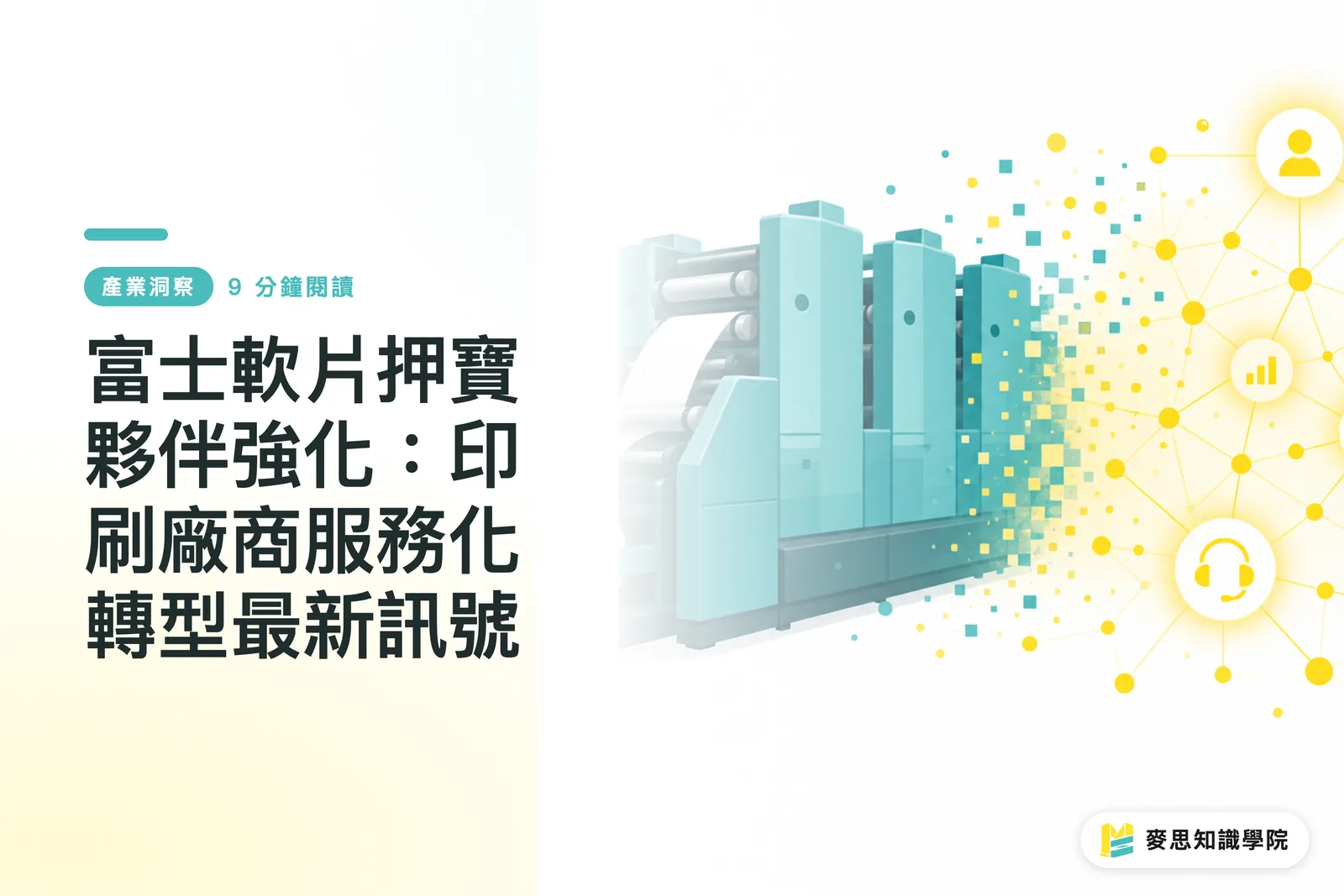
What Is Fujifilm's European Partner Event Really Signaling?
Fujifilm Business Innovation's partner event in Europe this year sent a clear signal: it is no longer competing on hardware specs and price, and is returning to partner enablement. The focus was not a flood of new machines, but a complete playbook to help channel partners transform their businesses. Quocirca's analysis points out that, with Canon, Ricoh, and Konica Minolta closing in from all sides, this is the core route Fujifilm has chosen to differentiate itself
From the clients and projects I've been working with lately, the logic behind this approach is actually simple: as print volumes keep falling and margins tighten, the ceiling for equipment makers that continue to sell machines is already in sight. Fujifilm is moving the center of value from hardware to services, and from transactions to improving its partners' operations. It is a choice that follows the market. For Taiwan's small and midsize print companies, this means the future relationship with the manufacturer will no longer be just "buy a machine, call for repairs, buy consumables." The real question is whether they can get a complete package of business-transformation support
Has the Print Industry Entered a "Post-Hardware Era," with Service Ecosystems as the Main Battleground?
Fujifilm is not the only company calling for a transformation. Quocirca's report on its ACT framework lays out three dimensions, "automation and AI," "the cloud," and "technology ecosystems," and makes clear that the global print market is being pushed by three mutually reinforcing forces: shrinking print volumes, margin pressure, and accelerating consolidation. Xerox CEO Pastor likewise declared in Quocirca's 100th-episode special interview that the company intends to evolve from an equipment vendor into an IT services and AI solutions provider
Put these developments together and the shape of the trend comes into focus: the hardware sales boom is over, and services and ecosystems are the next bets shared by the industry's leading equipment makers. For Taiwan's print companies, this is not just a big-player issue. It will directly affect what comes with the equipment you buy in the future. Whether you can get an integrated package covering cloud workflows, AI-powered predictive maintenance, and process automation will matter more than the machine's sticker price
Why Choose Partner Enablement Instead of Going Direct to End Customers?
Clients often ask me, "Will the manufacturer bypass us and serve brand customers directly?" Fujifilm's strategy speaks directly to that concern. The European market is more mature than Taiwan's, and end customers are more receptive to digital services. If the manufacturer tries to go straight to end customers, the cost of maintaining channel relationships can actually be higher
At its core, Fujifilm's partner-enablement model acknowledges that channel partners cannot be replaced when it comes to serving end customers. From my long-running view of production floors and customer sites, printing is a highly customized service business that depends on local communication. Even the strongest manufacturer cannot replace a channel partner's ability to respond to end customers in real time. That is why Fujifilm has chosen to treat partner success as its own success, and to make the ecosystem's collective capacity for transformation a competitive moat
For Taiwanese distributors and print companies, this signal deserves serious attention: when a manufacturer is willing to share transformation playbooks, customer-management tools, and digital-service capabilities, those who move with it may reach a much higher ceiling than they would on their own
How Should Taiwan's Small and Midsize Print Companies and Brand Clients Respond?
After talking with print companies of different sizes over the past few months, I have found one shared anxiety: they know they need to transform, but do not know where to begin. Breaking down Fujifilm's European strategy reveals three moves worth borrowing directly:
・Reassess the channel role: Distributors and print companies should take the initiative to discuss the terms and revenue-sharing model of a "service-led partnership" with manufacturers, upgrading the relationship from "buying and selling" to "operating the business together"
・Deepen end-customer services: End customers want more than print quality. They also want process integration and data feedback. That is where a small or midsize shop can beat a large one with local knowledge and responsiveness
・Move early on cloud and automation: Quocirca's ACT report names cloud workflows as a must-have rather than an optional add-on. If you do not start now, customers will bypass you three years from now
For brand-side procurement and marketing teams, the logic for choosing a print supplier is changing too. PINE New England's generational gap analysis finds that Gen Z and millennial buyers tend to assess suppliers through social media, online portfolios, and visual brand consistency rather than word-of-mouth referrals. That means no matter how the manufacturer transforms, if the print company ultimately serving you lacks a clear digital brand identity, it may be left off your procurement list
The Print Company's Own Marketing Homework: Is Direct Mail Back?
After looking at how manufacturers are transforming, let's turn to the industry's own marketing strategy. Another article from PINE New England notes that, after the pandemic, some savvy print companies have brought direct mail back as a core marketing weapon. The reason is practical: digital advertising is saturated and returns are declining, while physical mail stands out more amid the digital noise and delivers measurable ROI
For Taiwan's print companies, this is a useful reminder: while the whole industry is talking about digital transformation, services, and AI enablement, the most traditional tool of all, direct mail, may turn out to be a differentiator. The key question is not whether print will be replaced, but whether print companies can use the tool they know best to show clients that print still has value
Key Takeaways
・Fujifilm's partner-enablement strategy shows that printing-equipment makers are shifting from a hardware red ocean to competition built around service ecosystems
・The cloud, AI, and ecosystem forces identified by the ACT framework are structural variables that will determine which print companies survive over the next three to five years
・Taiwan's small and midsize print companies have an advantage in the depth of their end-customer service. They should proactively discuss a joint operating model with manufacturers instead of treating them as mere suppliers
・Brand clients' procurement logic has shifted across generations. Building a digital brand is now a condition of survival for print companies
・Print companies also need to rethink their own marketing tools. In the digital noise, direct mail may actually become a breakthrough weapon
Further Thoughts
Based on the industry signals of the past two weeks, the print industry's transformation pressure has moved from "Should we do it?" to "How do we make it work?" For print manufacturers, I suggest starting by mapping the gaps in your channel's service capabilities, then proactively discussing a service-partnership framework with equipment makers. Do not wait until the manufacturer steps in directly before reacting. For graphic design and brand teams, when choosing a print supplier, add "cloud workflow integration," "digital portfolio transparency," and "online reviews and social presence" to the evaluation criteria. These are the places Gen Z buyers actually look. For AI and SaaS companies, print companies have never lacked tools. What they lack is the hands-on support to help clients' businesses grow after implementation. That is the real entry point for technology service companies entering the print industry. If you are stuck somewhere along the transformation journey and do not know where to start, the Mai Strategy Knowledge Academy consulting team can help you assess your current situation and map out concrete actions for the next three to six months
Further Reading
FAQ
- What practical impact does Fujifilm's European partner event have for Taiwan's print companies?
- Fujifilm is moving the center of value from hardware to partner enablement and service ecosystems. In the future, the support available to Taiwanese channel partners will expand from machine repairs to business-transformation playbooks, with the relationship moving from buying and selling to operating together
- What does the print industry's "post-hardware era" mean?
- It means the hardware-sales boom is over, while cloud workflows, AI automation, and technology-ecosystem integration have become the three competitive dimensions that determine whether companies survive. That is the core point of Quocirca's ACT framework report
- Do Taiwan's small and midsize print companies still have a chance in this transformation?
- Yes, but the opportunity lies in the depth of end-customer service, not in a machine-fleet price war. Smaller companies' strengths are local communication and rapid response. The key is to get ahead on cloud and automated workflows
- What new indicators should brand clients consider when choosing a print company?
- In addition to traditional quality and price, they should consider cloud-workflow integration, transparency of the online portfolio, and social-media presence, because Gen Z buyers increasingly use these dimensions to assess suppliers
- Can print companies still use direct mail for marketing, or is it too old-fashioned?
- It is actually a chance to stand out. After digital advertising became saturated, physical direct mail gained more attention amid the digital noise and offers measurable ROI. Some companies have already brought it back as a core marketing weapon
Related articles
The Print × AI weekly
The print and AI know-how designers, brands and enterprises can use before they commit — one email, every week
MINDS Free Tools
AI background removal, a LINE sticker maker, spine & imposition calculators — all free, right in your browser, no upload.
MINDS Group
Need actual printing or gifting services?
From premium printing to online ordering and festive gifts — the MINDS Group sister brands take it from here.