

Why Can't Pantone Color Swatches Accurately Match Foil-Stamped Gold?
Printing ink gets its color by absorbing light with pigments, while foil film gets its color by reflecting light off a metal layer. Their underlying optical physics are completely different
Hot stamping uses heat and pressure to transfer metallic foil onto paper, creating a strong metallic sheen
Many designers assume that specifying Pantone 876 copper means the production floor can produce an identical foil
In reality, the K-gold or antique-copper sheen of commercially available hot-stamping foil depends entirely on the foil's electroplated layer
Ink printed on paper is matte, while foil stamping reflects the surrounding light, even the color of the proof reviewer's clothing
To close that gap, the only answer is to compare against a physical foil swatch, not stare at a screen
That's the reality. Physics is what it is

How Should Brand-Specific Gold Be Foil-Stamped?
Brand values cannot be sent straight to foil stamping. You have to confirm the final look through foil proofs and press tests
I've seen far too many clients specify a particular rose gold or champagne gold. There are three ways to evaluate it:
・Check whether the gold defined in the brand guidelines is a printed color swatch or a physical foil film
・Clarify the use case and durability requirements. For packaging that gets handled frequently, remember that specialty foils are usually less scratch-resistant
・Choose the type of foil proof. Pick the three closest foil films and stamp them directly onto the specified paper stock
The paper's base color and texture will absorb some of the sheen
If it isn't stamped on the right paper, the color will never be accurate
Why Is Holographic Foil Especially Prone to Turning Into a Muddy Mess?
The iridescent patterns on laser foil are fixed in size and cannot be scaled proportionally with your artwork
This material looks spectacular, but it is the ultimate boss on the production line
If the pattern is too small or the lines are too fine, the foil will not capture a complete laser pattern. The stamped result will be nothing more than a strange reflective color block
・Open up the spacing between lines: the adhesive has high flow and can easily bleed together when heated
・Minimum type size: reversed-out type should be at least 8 pt, and positive type should also be heavier than it would be with standard gold foil
・Pattern randomness: you cannot specify where the sparkle of a shattered-glass pattern will land, so it may not line up exactly with the center of the logo
How Can Designers Avoid Foil-Stamping Pitfalls Before Handoff?
Forget the habit of judging by color. Open the layers panel and check your K100 black artwork, line weights, and the separate embossing plate
Foil-stamping failures often come from poorly prepared files, not from the visual appeal of the design itself
At the prepress stage, every foil-stamping area must be made into black artwork (Spot Color)
When we review artwork, these are the five self-check points we focus on
・Check line width: solid lines should be no thinner than 0.2mm. Otherwise, they can break during foil stamping
Keep enough spacing: leave at least 0.3mm of white space between two lines to prevent thermal expansion and contraction from making them stick together
Make sure the underlying artwork is knocked out: remove the ink beneath the foil-stamping area. Overprinting can reduce adhesion
Review the plate layout: foil stamping combined with embossing needs a small tolerance zone. Do not take it all the way to the edge
・Check the paper texture: laid paper or watercolor paper has a deep texture, and fine type will definitely break. In that case, ask the Mai Strategy Knowledge Academy consulting team to help assess the process combination
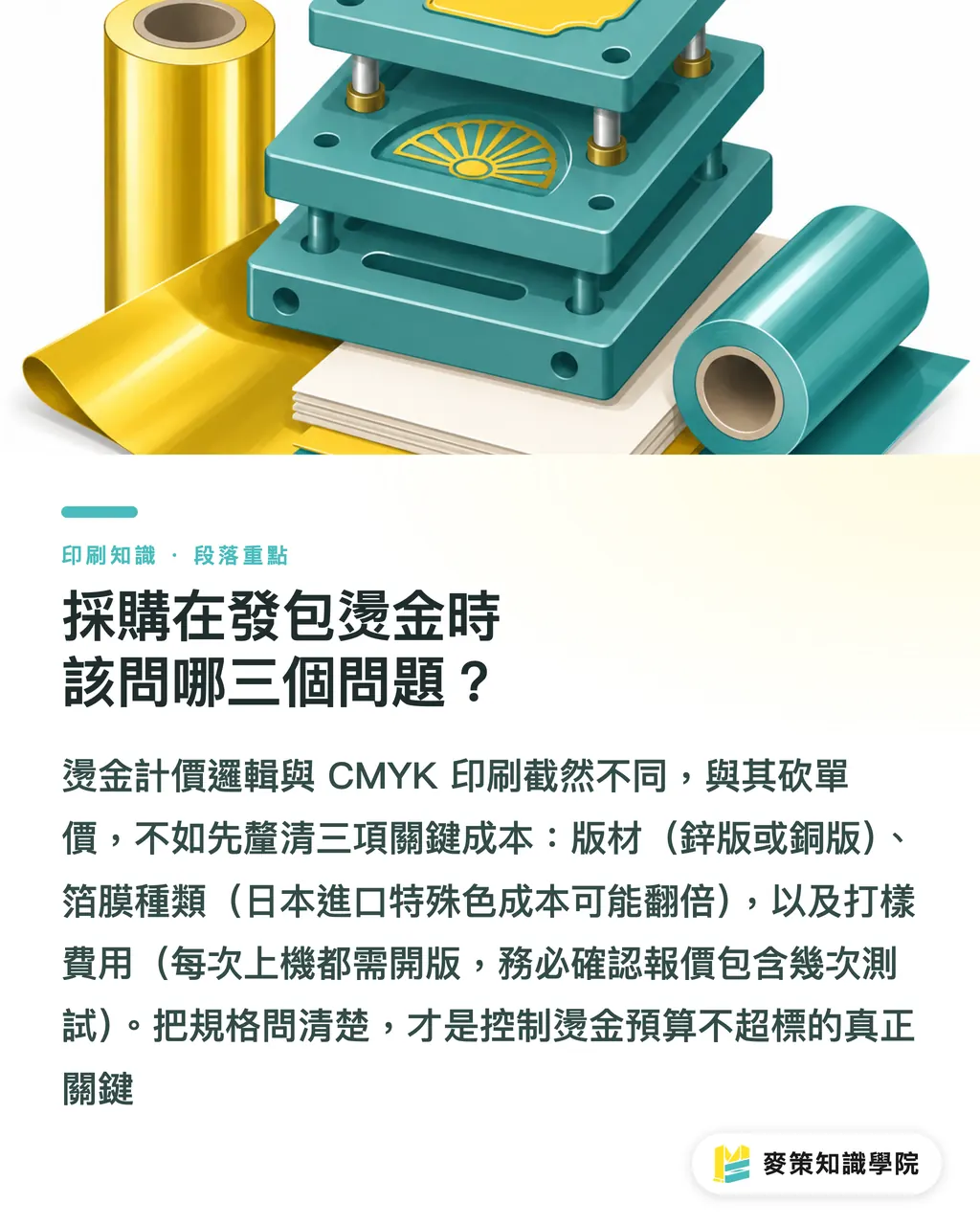
Which Three Questions Should Purchasing Ask When Outsourcing Foil Stamping?
Before deciding whether the budget will run over, confirm the three cost items: plate charges, basic production time, and foil price differences
Foil-stamping pricing works differently from standard CMYK printing. When negotiating, it is better to clarify the specifications first than to haggle over the unit price
・Foil-stamping plate material and cost: zinc plates are cheaper and suitable for small runs, while copper plates are more durable and have sharper edges, but cost more
・Specialty foil: standard gold and silver foils are relatively stable in price, but imported specialty colors from Japan or holographic foil can cost twice as much
・The true cost of proofing: foil stamping cannot be digitally proofed. Every press run requires a plate to be made and paper to be wasted, so always ask how many test types are included in the proofing fee
Key Takeaways
Foil sheen comes from reflected ambient light. Comparing it with a printed color swatch will never be accurate
Brand-specific gold must be foil-proofed on the actual paper stock to reveal the real result
Patterns on holographic foil cannot be freely scaled, so the design must accommodate the foil's characteristics and leave enough line weight
For foil-stamping artwork, check only the K100 black artwork. Spacing between lines matters more to the outcome than the line weight itself
Further Thoughts
For designers and purchasing teams, foil stamping should not be added at the very end. It should be considered from the paper-selection stage
With demand growing for short-lead-time packaging, understanding foil behavior and artwork tolerance can significantly reduce the number of jobs rejected by the production line
Without increasing the plate-making budget, use existing standard foil rolls to create different layers of texture
Treating physical limitations as design conditions is what mature prepress thinking looks like
FAQ
- Why does gold designed on screen always print darker?
- Because a screen emits light, while printing ink absorbs it. The most direct way to show a metallic look is foil stamping, which uses a physical foil film to reflect light and make up for ink's dullness
- How thin can foil-stamped lines actually be?
- On smooth coated paper, 0.2mm is the recommended minimum. If you are using rough-surfaced art paper, increase the line weight to at least 0.3mm. Otherwise, the pressure cannot make the foil film bond fully into the paper fibers
- Can embossing and foil stamping be done at the same time?
- Yes, but they require two separate plates, which means two operations. There are also three-dimensional engraved plates that can complete both in one pass, but their plate costs are extremely high, so they are usually reserved for premium-priced wine labels or luxury packaging
Related articles





The Print × AI weekly
The print and AI know-how designers, brands and enterprises can use before they commit — one email, every week
MINDS Free Tools
Spine width and imposition calculators — skip the manual math, free in your browser.
MINDS Group
Need actual printing or gifting services?
From premium printing to online ordering and festive gifts — the MINDS Group sister brands take it from here.