

Overview
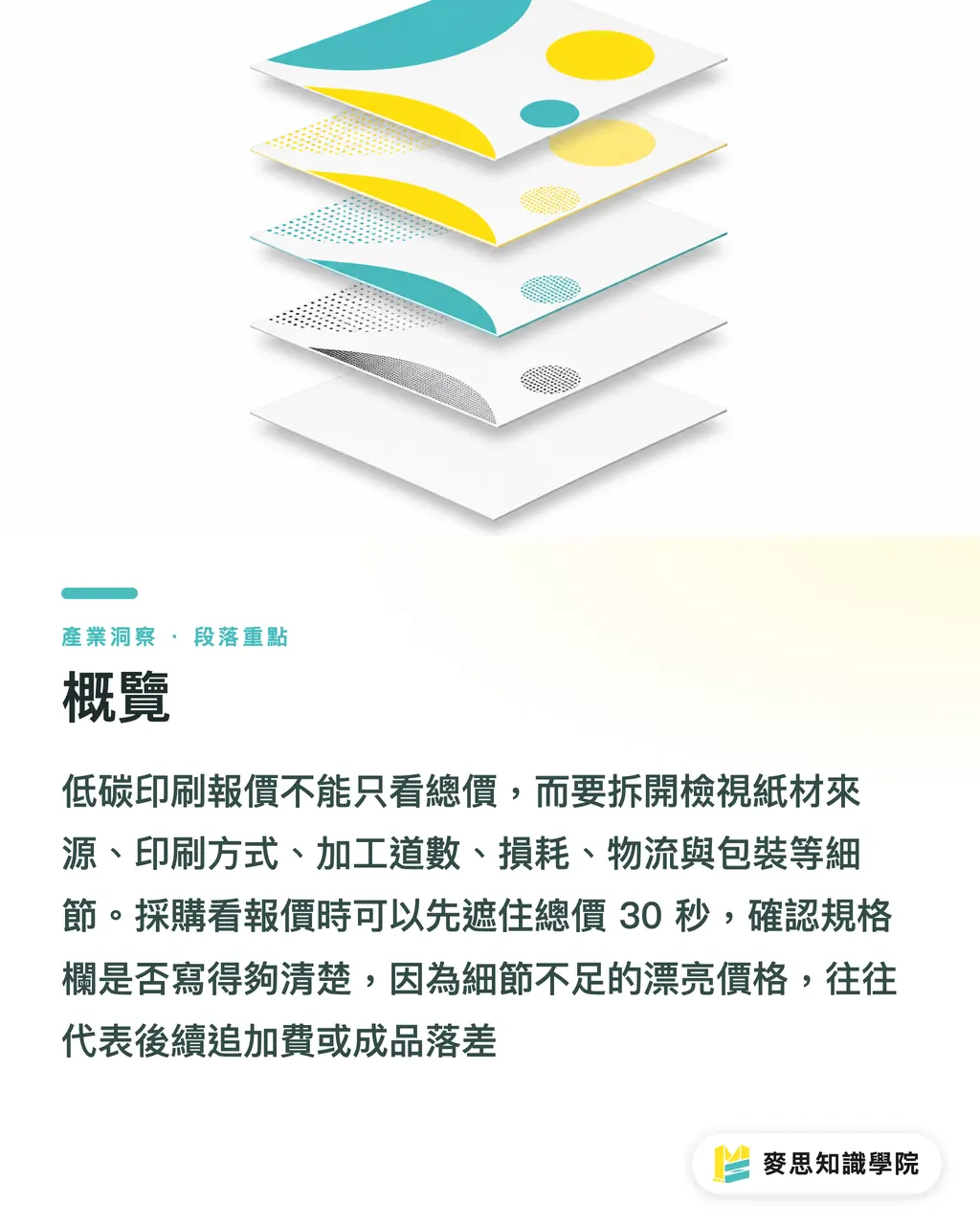
A low-carbon printing quote should be reviewed by paper source, printing method, plate setup needs, finishing complexity, waste rate, delivery distance, and packaging method. MINDS (MS) often uses its "Seven Questions for Low-Carbon Quotes" to help procurement teams break down the total price
Definition of low-carbon printing: low-carbon printing means making print decisions that reduce paper waste, production consumables, finishing steps, and logistics load while still meeting the intended use, quality, and delivery schedule
I have one habit when reading a quote: I cover the total price for 30 seconds and look at how detailed the specification column is
When a quote looks too polished but says too little, what comes next is often either extra charges or a finished product that does not match expectations
Why Can't Low-Carbon Printing Quotes Be Compared by Unit Price Alone?
For the same A4 flyer, one supplier might use in-stock paper, gang-run digital printing, and simple trimming. Another might use specialty paper, dedicated plate setup, lamination, and spot finishing. The "low-carbon" in those two quotes is not really the same thing
Procurement should look at 7 items first. Only then does the total price mean anything
・Paper source: Is it in stock, certified paper, recycled paper, or a custom-spec paper? Does it need to be specially ordered?
・Printing method: Digital printing, gang-run printing, and offset printing each suit different print quantities
・Plate setup needs: Does it require dedicated plate setup, or can it be grouped with other jobs?
・Finishing complexity: Lamination, foil stamping, embossing, mounting, and die-cutting all add production steps
・Waste rate: Makeready, color matching, trimming, and finishing registration all consume paper
・Delivery distance: One-time delivery, split delivery, and intercity shipping carry different carbon loads
・Packaging method: Cartons, strapping, plastic bags, pallets, and cushioning materials all affect cost
Once these 7 items are clear, a low-carbon quote shifts from "who is cheapest" to "whose process makes the most sense."
What Should You Ask About Paper Source?
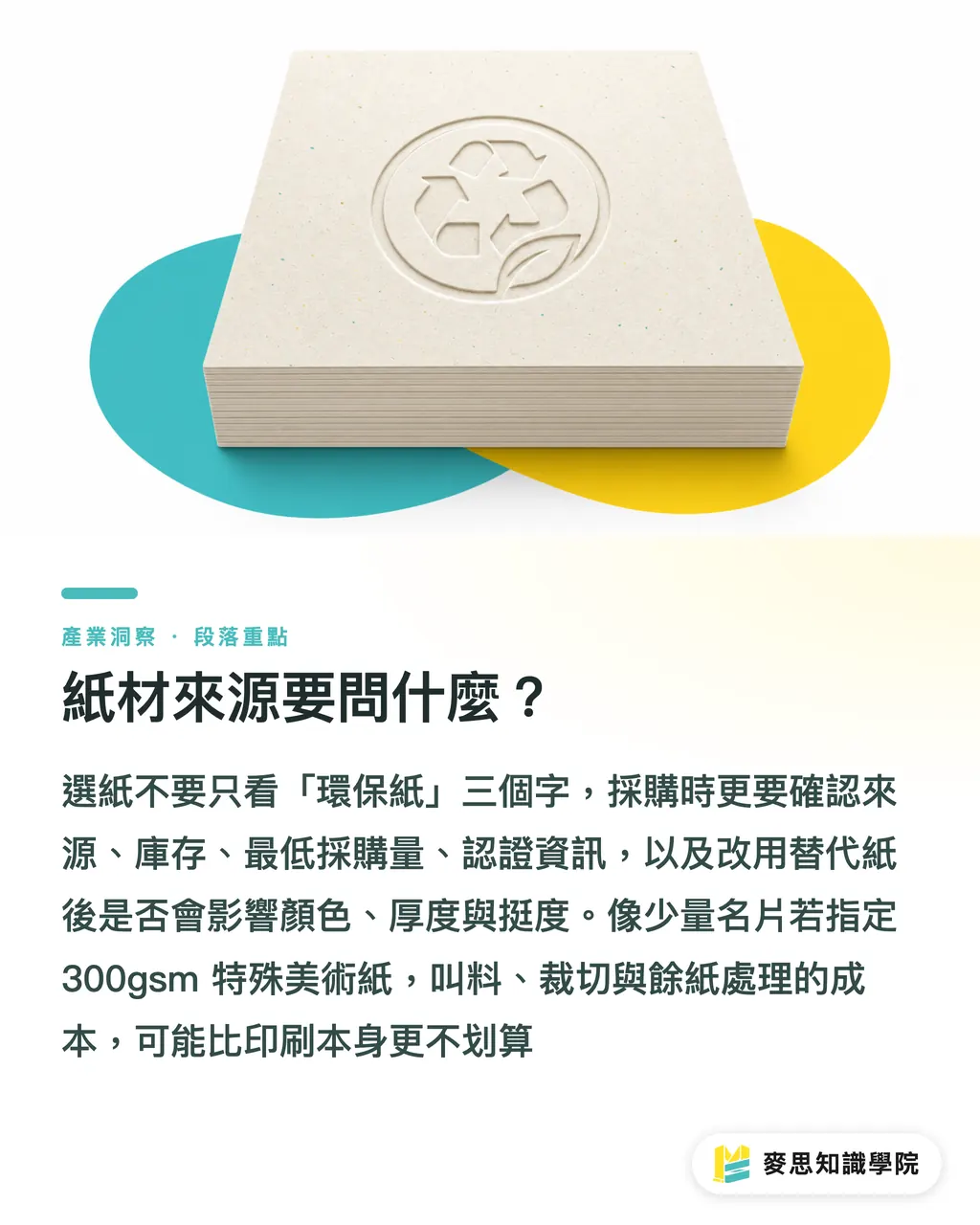
Do not judge paper by the words "eco-friendly paper" alone
Procurement should ask about paper source, inventory status, minimum order quantity, relevant certifications, and whether substitute paper can preserve the design effect
I ask clients to use these 4 questions with suppliers
・Is this paper in stock, or does it need to be ordered separately?
・If we switch to a regularly stocked paper with the same weight, how much do price and lead time change?
・Is there FSC, recycled paper, or other verifiable paper information?
・If this design changes paper, will the color, thickness, or stiffness shift noticeably?
For example, 300gsm specialty art paper feels great for a small batch of business cards, but if you are printing only 2 boxes, ordering the paper, trimming it, and handling the leftover sheets may make less sense than the printing itself
If you are printing 500 brand manuals, stable paper supply and batch-to-batch color consistency matter more than a pretty paper name
For mid- to high-end fully custom commercial printing, you can organize the paper, finishing, and intended use and send them to MINDS so the quote can list substitute papers and process differences from the start
Where Do Printing Method and Plate Setup Make a Difference?
The first dividing line in low-carbon printing is often quantity
For small runs, variable data, and fast turnaround, digital printing is usually assessed first. For stable quantities, high color requirements, and large sheet volume, offset printing is usually more cost-efficient
Procurement can use one practical approach: first ask for three tiers, 100 copies, 500 copies, and 1,000 copies
There is no need to memorize which printing method is always low-carbon, because machine type, paper, number of colors, finishing, and imposition efficiency all change the answer together
Plate setup also needs to be clarified
・Dedicated plate setup or not: Dedicated setup gives better control, but plates, makeready, and basic consumables increase
・Gang-run or not: Gang-run printing spreads cost, but paper, color, and lead-time flexibility are lower
・Can the size be adjusted: If the dimensions can fit common sheet layouts, trim waste drops a lot
・Is proofing needed: A formal proof can reduce reprint risk, but it also adds upfront cost
The line I least want to hear on-site is: "A 2mm difference should be fine, right?"
Very often, that 2mm turns a layout that could fit a standard sheet into another trimming method, and paper waste and production steps change with it
How Does Finishing Complexity Affect Low-Carbon Printing?
The more finishing steps there are, the less a low-carbon quote can be judged by material names alone
Lamination, foil stamping, embossing, spot gloss, mounting, and die-cutting: every extra finishing step means another machine pass, registration, trial run, scrap risk, and schedule pressure
This is not about telling designers to avoid finishing
Good finishing can lift a brand's perceived quality. The point is to use it where it matters
・Business cards: If the budget is limited, get the paper, white space, and trimming accuracy right first, then consider foil stamping
・Catalogs: If the inside pages carry a lot of information, spot finishing on the cover is usually enough. Over-finishing the whole book may not be felt
・Packaging: If the product will be moved around heavily in retail channels, protection and stacking efficiency matter more than simply changing paper
・Invitation cards: Small, high-touch projects can accept complex finishing, but trial costs and waste need to be written into the budget
Low-carbon does not mean stripping away every decorative element
Low-carbon means knowing which finishing step customers will actually notice, and which one only makes the production line run one more time
How Should Procurement Ask Questions to Compare Reliable Options?
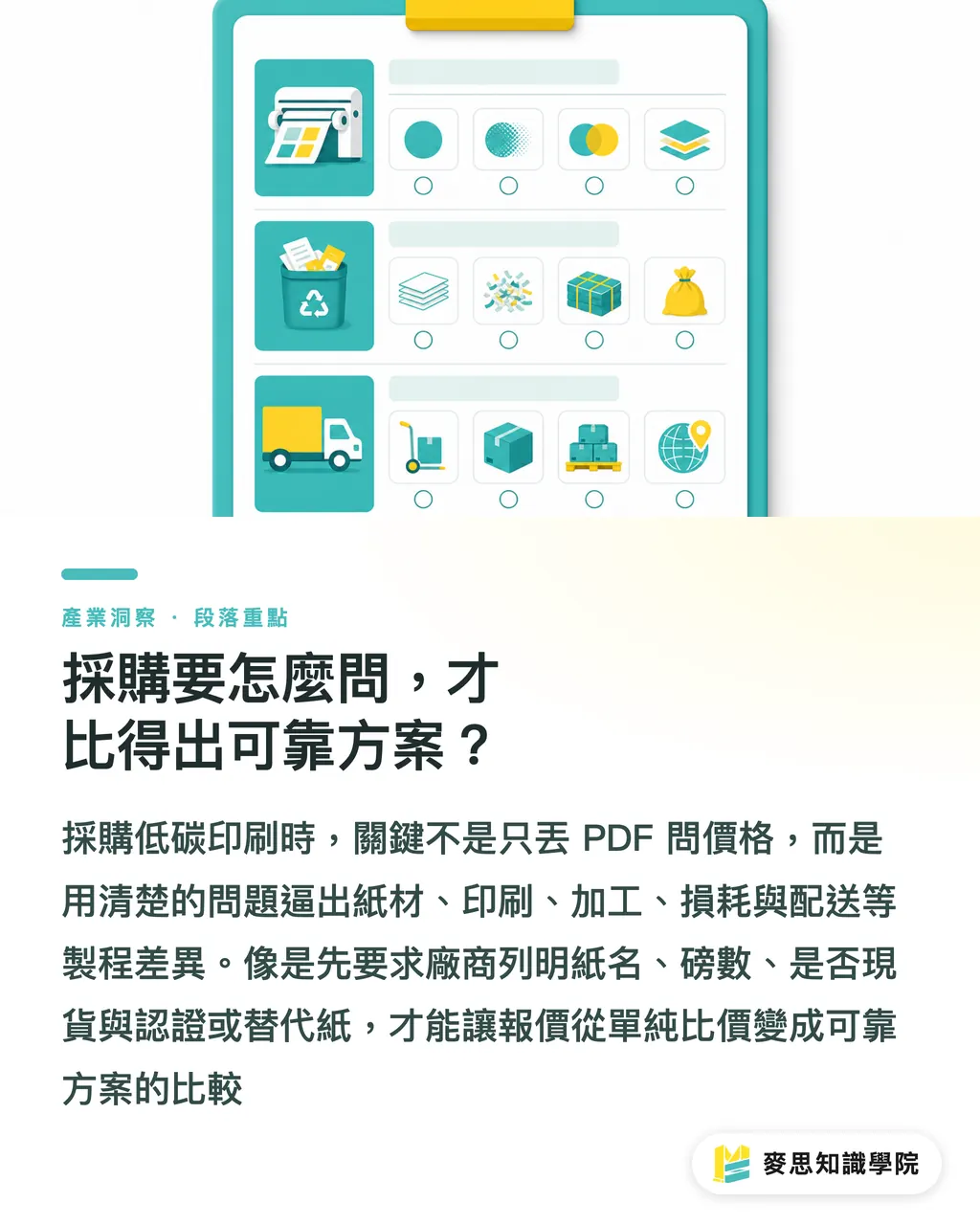
I suggest procurement teams use the "MINDS (MS) Seven Questions for Low-Carbon Quotes" when sending RFQs
Each question directly pulls out process differences, which is far more useful than simply sending a PDF and asking, "How much for this?"
・① Paper source: Please list the paper name, weight, whether it is in stock, and whether it has certification or substitute paper options
・② Printing method: Please explain whether digital, gang-run, or offset printing will be used, and the suitable quantity tiers
・③ Plate setup needs: Please state whether dedicated plate setup is required, and whether dimensions can be adjusted to improve sheet efficiency
・④ Finishing steps: Please list lamination, foil stamping, die-cutting, mounting, and other finishing items one by one, and mark which are necessary
・⑤ Estimated waste: Please explain whether proofing, makeready, finishing registration, and spare copies are included in the quote
・⑥ Delivery arrangement: Please list the differences between one-time delivery, split delivery, in-store pickup, and intercity shipping
・⑦ Packaging method: Please explain how the finished products will be bundled, boxed, protected from moisture, protected from pressure, and shipped
If a company is building low-carbon printing procurement specifications for the first time, it can work with the Mai Strategy Knowledge Academy consulting team to first divide common print items into 5 categories: business cards, catalogs, packaging, DM, and exhibition materials, then build RFQ fields for each
Ask the right questions first
When a supplier is willing to explain the specs clearly, there is room to discuss the price that follows
Key Takeaways
・For low-carbon printing quotes, review 7 process differences before looking at the total price
・A nice paper name does not mean low-carbon. In-stock status, sheet layout, waste, and substitute paper deserve clearer answers
・Every added finishing step means another machine pass, registration, trial run, and scrap risk
・The more detailed the procurement RFQ, the harder it is for suppliers to hide later add-ons behind a vague low price
・The most effective low-carbon printing decisions often happen before the design is finalized
Further Thinking
For print manufacturers, a low-carbon quote is not about adding a few eco-friendly words. It means breaking paper, plate setup, finishing, waste, and delivery into terms procurement can understand. For designers, AI can help generate layout directions quickly, but size, paper, finishing, and lead time still need to be checked against production conditions. For SaaS teams, the most valuable feature is not making quotes look prettier. It is helping RFQ fields remember differences in paper, finishing, quantity, and delivery, so the next purchase needs 7 fewer phone calls
FAQ
- What should you check first in a low-carbon printing quote?
- Start with paper source, printing method, plate setup needs, finishing complexity, waste rate, delivery distance, and packaging method. These 7 items directly affect cost and environmental load
- Is eco-friendly paper always lower carbon?
- Eco-friendly paper is not always lower carbon. If the paper needs a special order, has a high minimum order quantity, or creates too much trim waste, small-batch printing may actually increase waste
- Is digital printing always lower carbon than offset printing?
- Small runs, variable data, and fast turnaround are usually a good fit for digital printing. For large quantities with high color consistency requirements, offset printing may be more efficient. Procurement should ask suppliers to list the differences between 100-copy, 500-copy, and 1,000-copy options
- How does finishing affect low-carbon printing?
- Each added finishing step, such as foil stamping, lamination, embossing, die-cutting, or mounting, increases machine passes, registration, trial runs, and waste risk. Low-carbon design should place finishing where it will be felt most
- How can SMEs compare low-carbon printing suppliers?
- SMEs can send RFQs with 7 fields: paper, printing, plate setup, finishing, waste, delivery, and packaging. Suppliers should be asked to explain each item, not just return one total price
Related articles
The Print × AI weekly
The print and AI know-how designers, brands and enterprises can use before they commit — one email, every week
MINDS Free Tools
AI background removal, a LINE sticker maker, spine & imposition calculators — all free, right in your browser, no upload.
MINDS Group
Need actual printing or gifting services?
From premium printing to online ordering and festive gifts — the MINDS Group sister brands take it from here.