

Overview
Reorganization at a century-old printer often happens when print volumes fall, costs rise, and the profit model fails to adapt at the same time. Brands can use Mai Strategy's three-gate print check to examine supplier resilience and contingency arrangements
From my years of watching production lines and working with clients, the most dangerous point for a printer often comes when the orders are still there, but unit prices, run sizes, and lead times have already gone off-kilter

Why Did Maury Imprimeur Enter Reorganization?
Maury Imprimeur entered reorganization because a long-term contraction in print volumes and rising costs had already outpaced the company's existing operational adjustments
Maury Imprimeur is a French family-owned printing group. Together, Maury Imprimeur and Roto France Impression print 36 national weekly publications each week, and about 680 employees are still working across the group's sites. Commercial print volume fell by about 15% in the first half of 2026, after an 8% decline in 2025. Revenue dropped from €59.2 million in 2024 to €53 million in 2025. After two years of restructuring, the group entered court-supervised proceedings. See Maury Imprimeur Enters Reorganization in France: A Turning Point for the Printing Industry
Commercial printing is the business of producing printed materials for publishers, brands, and companies. Profitability is shaped by print volume, unit prices, equipment utilization, and post-press costs. Court-supervised reorganization is an arrangement that allows a company to keep operating under court proceedings, coordinate its debts, and propose a plan to continue operations. It does not mean an immediate shutdown or liquidation
What strikes me most about this case is that the capacity is still there, but demand is no longer enough to cover the old fixed costs
Volumes are still falling
Where Are Traditional Printers Getting Stuck?
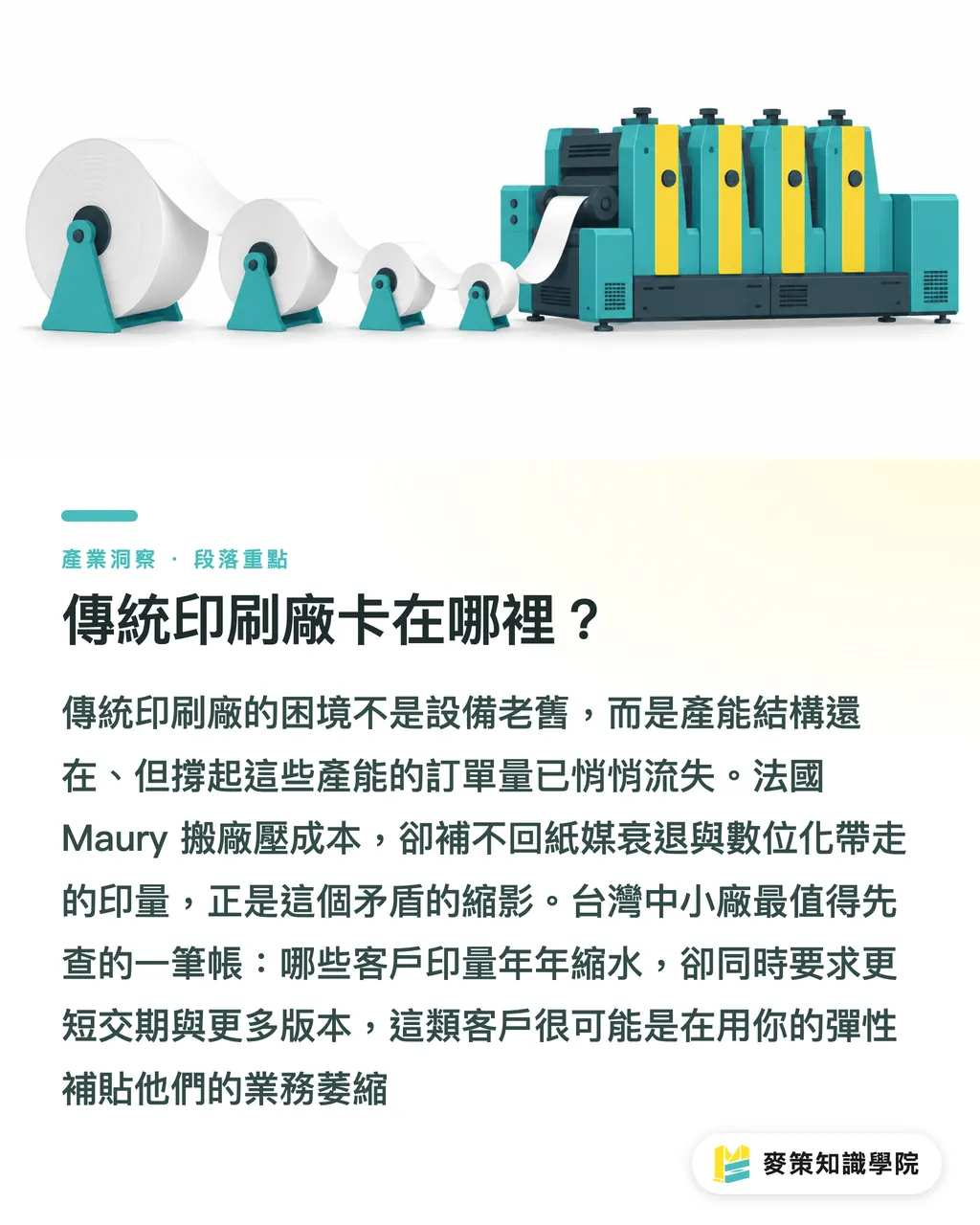
Traditional printers get stuck when fixed capacity remains in place even as market demand and pricing conditions change
In February 2024, Maury announced that it would close the Malesherbes plant and move production to Manchecourt, about 10 kilometers away, with the move expected to be completed in 2025. In June 2025, it proposed a workforce reduction affecting 52 positions, but the plan was later rejected
The pressures Maury cited included the decline of print media, the digitization of content, the end of mailbox flyer delivery, and rising paper and energy costs. Moving a plant can address part of the cost problem, but it will not automatically bring back the print volume that has disappeared
I would ask Taiwan's small and midsize printers to start by checking three sets of numbers
・Which customers are steadily cutting their print volumes while still demanding shorter lead times and more versions
・Which equipment and post-press operations serve only a few legacy customers while continuing to consume labor and maintenance costs
・Whether quotes treat paper, energy, outsourcing, and rework risk as costs that never change
Why Should Brands Reassess Their Printing Partners?
Brands need to reassess their printing partners because a supplier's financial health and production-line condition directly affect delivery schedules, proofing, and specialized post-press work
Maury's reorganization proceedings are allowing its sites to keep operating, but they have already affected the production chain behind the 36 national weekly publications printed each week by Maury and Roto France Impression. Brand procurement teams cannot ask only whether a job can be printed today. They also need to ask whether the next scheduled run can be delivered reliably
Mai Strategy's three-gate print check can be built into supplier interviews and annual evaluations
・First gate, delivery: Who notifies us when there is a problem with proofing, production runs, or scheduling? Is there an alternative production line
・Second gate, quality: Who signs off on paper-stock batches, color standards, post-press work, and file versions? How is responsibility for rework assigned in writing
・Third gate, resilience: Where are the breakpoints involving critical equipment, subcontractors, raw materials, and staffing? How soon will the brand receive an early warning
If a brand wants to turn these questions into a supplier interview form, the Mai Strategy Knowledge Academy consulting team can help organize its procurement requirements. Do not wait until a delivery deadline is missed to start asking about backup arrangements
How Should Taiwan's Small and Midsize Printers Respond?
Taiwan's small and midsize printers should recalculate profitability by customer and process before deciding which equipment and services are worth keeping
Maury announced the plant move in 2024, proposed a workforce reduction in 2025, and entered reorganization in 2026. By then, it had already gone through two years of restructuring. Transformation cannot be treated as a one-time equipment-purchase project
Run the numbers first
・Segment customers by print volume, gross margin, lead time, and post-press complexity. Find the jobs that consume the most capacity while their volumes continue to shrink
・Treat specialized post-press work, small-run customization, and complex project management as chargeable capabilities. Do not bury every service in a single quote
・Then decide which processes to keep in-house, outsource, or phase out, so fixed costs do not stay attached to outdated demand
What Can AI and SaaS Cover?
AI and SaaS are best suited to handling specifications, versions, and handoff information first. They cannot replace on-site sign-off for color, paper stock, printing conditions, or post-press work
Software as a Service (SaaS, a software delivery model that provides functions through a subscription) can first be used for quotations, scheduling, proof status, and incident records. AI tools can help compare differences between specifications and file versions, cutting one round of back-and-forth for the design team
Designers should document specialized post-press work, paper-stock batches, and color standards in specifications that can be handed over. When a brand changes personnel or printers, it can still use those specifications to enforce its quality requirements
Maury's adjustment period from 2024 through 2026 was already long enough. Digital tools should serve delivery, not hide unclear costs. For mid- to high-end, fully customized commercial printing, brands can discuss paper stock, color, and post-press options with MINDS. Procurement documents still need to spell out their own backup requirements

Key Takeaways
・Maury Imprimeur and Roto France Impression print 36 national weekly publications each week. That scale is no substitute for a viable profit structure
・Commercial print volume fell by about 15% in the first half of 2026. The pressure from paper, energy, and demand for print will all hit the production line at once
・Brand procurement teams should write delivery-issue alerts, quality sign-offs, specialized post-press work, and alternative production lines into the terms of cooperation
・AI and SaaS should first reduce errors in specifications, versions, and handoffs. They cannot replace judgment about paper stock, color, or post-press work
Further Considerations
Printers should first separate customers, processes, and costs. Designers should write paper stock, color, and post-press work into handoff-ready specifications. Brands should put a second supplier and early-warning conditions into procurement documents. AI should handle version and specification organization, while SaaS should handle orders, proofing, and incident records. Only then does digitization start serving actual delivery
Further Reading
FAQ
- Does Maury Imprimeur entering reorganization mean it has already shut down?
- No. The source says the group's sites are still operating, and the court process is intended to let the company submit a plan for continuing operations. Brands should still confirm individual orders and backup arrangements
- Why can even a century-old printer fall into reorganization?
- Falling print volumes, rising paper and energy costs, and reduced demand for print media and flyers squeeze equipment utilization and cash flow at the same time. A plant's age alone cannot offset structural change
- What should brands ask first when choosing a printing partner?
- Start by asking about notifications for delivery problems, backup options for proofing and post-press work, and arrangements for critical paper stocks and subcontractors. Then put quality sign-off and alternative suppliers into the procurement documents
- Can AI solve a printer's transformation problems?
- AI is useful for checking specifications, managing versions, and organizing data. It cannot replace on-site judgment about color, paper stock, printing conditions, or post-press work
Related articles





The Print × AI weekly
The print and AI know-how designers, brands and enterprises can use before they commit — one email, every week
MINDS Free Tools
Spine width and imposition calculators — skip the manual math, free in your browser.
MINDS Group
Need actual printing or gifting services?
From premium printing to online ordering and festive gifts — the MINDS Group sister brands take it from here.