
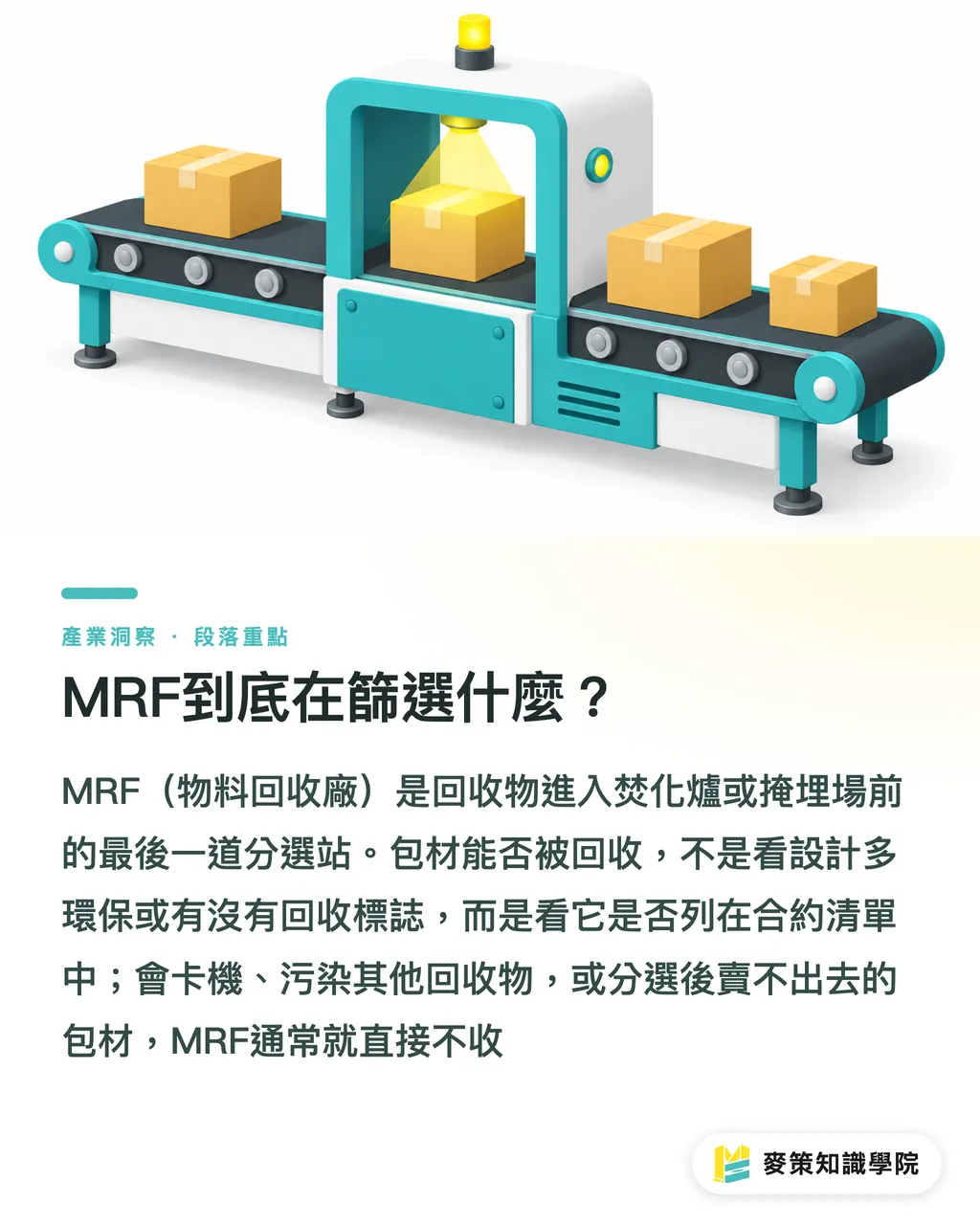
What Is an MRF Actually Sorting?
An MRF (Material Recovery Facility) is the last sorting stop for recyclable materials before they head to an incinerator or landfill. It uses optical sensors, magnetic separators, and shredders to separate and sort paper, plastic, and metal. This Packaging Dive report points to a fact brands often overlook: whether an MRF accepts a type of packaging is determined by the list in its contract with the local government or waste hauler. It has nothing to do with how environmentally thoughtful the packaging designer was
That list is driven by very practical business logic. MRFs make money by selling the recovered materials they sort. If a package can jam the machinery, contaminate other material streams, or leave the facility with something it cannot sell, the contract simply excludes it, regardless of whether the package carries a recycling symbol
Why Can 'Recyclable' Materials Still Be Rejected?
Because 'recyclable' only means the material itself can theoretically be reprocessed. It does not mean it can make it through the particular shredder on that line. That gap is where most brands get things wrong at the design stage
Metal containers are a good example. Aluminum cans and tinplate boxes are often held up as recycling-friendly models, but once they reach an MRF's shredding line, structural complexity, residue, label materials, and coatings all become extra processing costs. That is why even metal containers do not all make it smoothly into the recycling stream
Apply the same logic to paper-plastic composite packaging and the problem becomes even clearer: as soon as a paperboard box gets a plastic laminate or a label made from another material, an MRF's optical sorter no longer sees it as 'paper.' It sees a mixed material that requires extra handling, so it often gets classified as unacceptable
How Can Brands Make Prepress a Line of Defense?
The answer is straightforward: eliminate the structural traps that will make an MRF reject the packaging before the prototype is finalized. Do not wait until consumers have the finished product in hand to discover that the package cannot enter the recycling system at all. That is the core idea behind the three prepress checkpoints used by MINDS (MS, mid-to-high-end fully customized commercial printing): ① Confirm that the package uses a single material listed by the MRF. ② Check whether labels, inks, or coatings will be classified as contaminants. ③ Confirm whether the structural complexity will add processing costs on the shredding line
・Prioritize a single material: If the structure can be made entirely from paper or from one type of plastic, avoid combining materials whenever possible. Even if both are theoretically recyclable, putting them together often means neither stream will accept the package
・Be explicit about labels and inks: Waterproof coatings, metallic inks, and certain adhesives can lead an MRF to classify the entire load as contaminated
・Simpler structures are easier to process: Packaging with too many bonded layers or too many component combinations puts extra strain on sorting equipment and adds cost
In theory, designers all understand these three points. In practice, they are often discovered only after prototyping. By then, changing the structure means restarting the entire schedule. That is why MINDS, when handling packaging projects related to ESG (Environmental, Social, Governance), confirms material choice and recycling compatibility before sending the job to press instead of waiting until the finished product is out and trying to patch the hole

Why Does This Matter More to Brands Than They Might Think?
Consumers have less and less tolerance for 'greenwashing.' If a package carries a recycling symbol but is rejected in the real world, that is more than an operational loss. It is a breach in brand trust. An ESG report can look polished, but if the packaging design in the supply chain is out of step with what local MRFs actually accept, the report will not stand up to scrutiny
Over the past few years, working with brand clients, I have been asked more and more often not 'Can we print a recycling symbol on this package?' but 'Will this package actually make it through the recycling system in its target market?' That is a good shift. It means decision-makers are starting to see that a recycling symbol is a ticket to enter, not a guarantee
For owners of small and midsize brands, completing this check before the design is finalized is far more cost-effective than waiting for consumers or environmental groups to raise questions and then scrambling to fix the problem. The time cost is far lower than the cost of a PR crisis later. Brands that need a systematic review of packaging structure and recycling compatibility can also bring in the Mai Strategy Knowledge Academy advisory team to help vet the work
What Can Smaller Manufacturers and Designers Do Next?
Start by asking the waste hauler or recycling system serving the destination market whether it publishes a material acceptance list. This is the most direct first step, and the one most easily overlooked. Many brands are used to finalizing the design first and asking about recycling afterward. Reverse that order and you can save a huge amount of rework
Next, make 'single material' the default, not the exception. Reserve composite materials for cases where there truly is no alternative. Do not treat mixed materials as the default choice simply to keep design options open
Finally, put a recycling-compatibility check into the prepress workflow. Make it a required checkpoint, alongside prototyping and color matching, rather than a last-minute add-on after the prototype is complete

Key Takeaways
・A recycling symbol is only a ticket to enter. The material acceptance contract used by the MRF (Material Recovery Facility) is the real gate
・Metal containers are not born recycling role models. Their structure and coatings can get them rejected too
・Single-material construction, a simple structure, and clean labels are the three basics for making it through the shredding line
・Checking material compatibility before sending a job to press costs far less than fixing the problem afterward
・The crack in brand trust often hides in the gap between 'a symbol was printed' and 'the package was rejected.'
A Further Thought
For the printing and packaging supply chain, the next step is concrete: make recycling-compatibility checks a required field in the design brief, giving them the same weight as color management and structural prototyping instead of leaving the question until the end. For brands, make this one of the standard questions in supplier selection. Ask whether the printer you work with can check material and structural recycling compatibility before the job goes to press. That says more about the supply chain's real maturity than receiving a polished ESG report after the fact
Further Reading
FAQ
- Why can a package still be rejected by a recycling facility even if it has a recycling symbol printed on it?
- A recycling symbol only says the material is theoretically recyclable. Actual acceptance depends on the acceptance contract the MRF (Material Recovery Facility) has with the waste hauler. If the package has a complex structure, mixes different materials, or uses labels or coatings that contaminate the material stream, it may still be rejected even with the symbol
- Is a metal container easier to recycle than paper-plastic composite packaging?
- Not necessarily. Although metal containers are made from relatively straightforward materials, structural complexity, residue, labels, and coatings can still increase processing costs on the shredding line at an MRF (Material Recovery Facility). Not every metal container can make it into the recycling stream smoothly
- How can brands confirm that their packaging can actually be recycled?
- The most direct approach is to confirm the material acceptance list with the waste hauler or recycling system in the target market. Before finalizing the design, complete three checks: single-material construction, labels and inks, and structural complexity. Do not wait until after prototyping to discover a problem
- How is a recycling-compatibility check before sending to press different from a standard prototyping workflow?
- Standard prototyping usually focuses on color and dimensions. A recycling-compatibility check also confirms that the package is made from a single material and that its labels and coatings will not be classified as contaminants. These questions usually need to be answered at the design-brief stage
Related articles



The Print × AI weekly
The print and AI know-how designers, brands and enterprises can use before they commit — one email, every week
MINDS Free Tools
AI background removal, a LINE sticker maker, spine & imposition calculators — all free, right in your browser, no upload.
MINDS Group
Need actual printing or gifting services?
From premium printing to online ordering and festive gifts — the MINDS Group sister brands take it from here.