

Overview
When dealing with multi-SKU, small-batch packaging for products like health supplements or coffee beans, the cheapest way to place an order is not simply to look at the total number of sheets. The better approach is to choose the ordering strategy based on the number of versions and the complexity of finishing. If the run is under 500 copies and includes many styles, digital printing saves the most on plate-making costs. If the specifications are unified and the quantity is over 1000 copies, shared die-cut tooling and dedicated plate-making are a better fit. With the "MINDS (MS, mid-to-high-end fully custom commercial printing) Three-Gate Print Submission" decision framework developed through the hands-on work of the MINDS team, companies can control their packaging procurement budgets with far better precision
Before comparing production methods in depth, it is worth getting clear on the core definitions of the three common printing approaches:
・Digital printing: A method that sends digital files directly to the press without making physical printing plates. It is well suited to small batches and multi-version print jobs
・Gang-run printing: A method that combines different artwork from multiple clients onto the same large press sheet, sharing plate costs and lowering the cost of each individual job
・Dedicated plate-making: A production method where one project gets its own imposition and print run, allowing precise control over spot colors, special paper stocks, and complex finishing
Why Estimating Multi-Style Packaging Costs by Total Sheet Count Will Get You in Trouble
From more than ten years of working around production lines, I have seen too many buyers use a total quantity of 5000 sheets to push for a lower price, only to freeze on the spot when the printer breaks it down and realizes it is actually 10 styles at 500 sheets each, then doubles the quote
Many brands assume a larger total quantity means they can get mass-production pricing, but they miss the hidden costs a print shop takes on when handling multiple versions. When you print 5 products at 100 copies each, 500 copies in total, the real budget drain comes from these tasks:
・Version changeover costs: In traditional offset printing, every style change requires the press to be replated, washed up, and registered again
・Color proofing waste: Each press start and color match consumes dozens, sometimes hundreds, of sheets of paper and ink
・Finishing separation: Different styles need to be manually sorted and marked during cutting, folding, or lamination
Hold on a second
Think of multi-item print ordering like ordering at a restaurant. If 10 people order the same dish, the chef can cook one big batch and the cost naturally comes down. If 10 people order 10 different dishes, the prep work and pan-washing show up in the price
How Should You Choose Between Digital Printing, Gang-Run Printing, and Dedicated Plate-Making?
Print volume and the number of styles are the most direct indicators for choosing a printing process. The cost structures vary sharply across different quantity ranges:
・Under 500 copies: Digital printing avoids traditional plate-making costs. The unit cost for 100 sheets and 500 sheets is almost fixed, and adding more styles does not add extra plate costs
・500 to 1000 copies: This is the awkward middle range. If the job is urgent and uses common paper stocks, choose digital printing. If the paper stock has special requirements or you are aiming for a lower unit price, gang-run printing is worth assessing
・Over 1000 copies: The run reaches a scale where dedicated plate-making starts to pay off. Once plate costs are spread across the run, the unit cost drops sharply, and specified Pantone spot colors can be controlled accurately
If you need frequent online ordering or want to test demand quickly, you can also refer to the standardized online quotation system from Mai Printing to quickly estimate the budget efficiency of small-volume print jobs
How to Use the MINDS Three-Gate Print Submission Framework to Make the Best Purchasing Decision
To keep brands from guessing when placing multi-SKU print orders, MINDS distilled the process into the "MINDS (MS) Three-Gate Print Submission" decision flow, helping procurement teams clarify their needs step by step:
① Gate One, "Inventory SKUs and estimate print volume": Classify every style by monthly sales. Slow-moving items under 300 copies per month go into the digital printing zone, while bestsellers above 1000 copies go into the dedicated plate-making zone
② Gate Two, "Assess specifications and die-sharing potential": Check whether different product lines can use the same outer box dimensions. If the box structure is the same and only the graphics differ, shared die-cut tooling with plate changes can save several thousand dollars in die-making costs
③ Gate Three, "Confirm paper stock and finishing complexity": If the job includes foil stamping, spot gloss, special debossing, or other finishing processes, gang-run printing is more likely to create finishing registration errors. Digital finishing or dedicated plate-making is recommended for quality control
It is simple
These three steps turn scattered ordering needs into a clear production job ticket, reducing wasted effort during the quotation stage
Practical Cost-Saving Combinations for Health Supplement and Coffee Bean Packaging
For new product lines that are just starting out or still testing market response, there is no need to put a large budget into custom color box plate-making right away
Common industry combinations with strong cost advantages include:
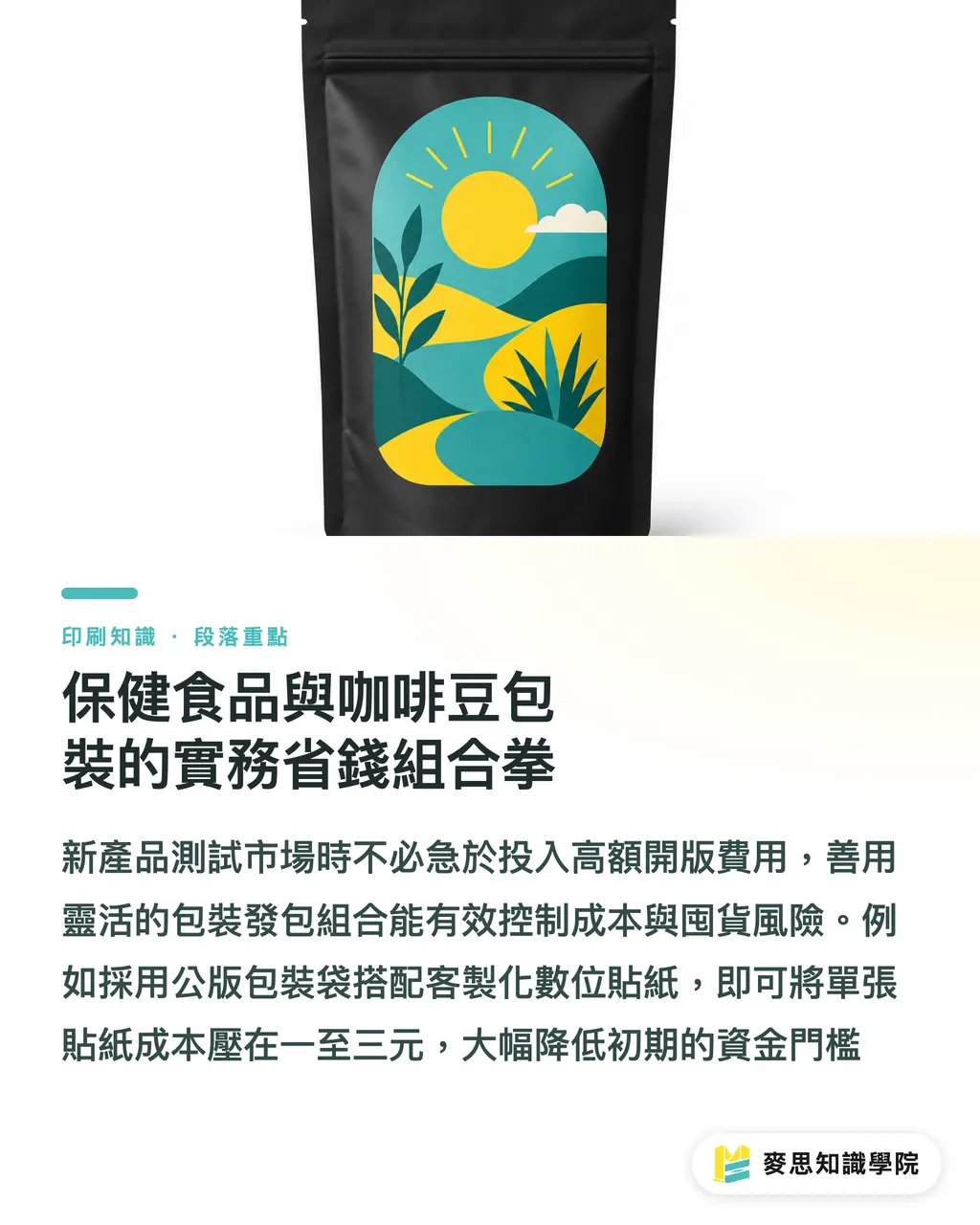
・Stock packaging bags plus custom digital stickers: For coffee beans or bagged health supplements, you can first buy ready-made stock sealed bags, then produce small-batch custom stickers through digital printing. Sticker cost can be kept at 1 to 3 yuan per piece, greatly reducing the early risk of sitting on unused packaging
・Shared die-cut tooling with plate changes: When you have multiple color boxes in the same size, specify to the print shop that all styles should share the same cutting die set and only the printed surface should change. This can save around 3000 to 8000 yuan in die-making fees
・Digital spot flexible packaging: For film or aluminum foil bags, output directly with digital flexible packaging equipment, avoiding the tens of thousands of yuan often required for traditional gravure plate-making
Key Takeaways
・Low-volume, multi-version printing should not be costed by total sheet count. Version changeovers and color proofing waste are the main expenses
・For multi-SKU print jobs under 500 copies, choose digital printing first. There are no plate fees, and style flexibility is high
・For bestselling styles above 1000 copies, use shared die-cut tooling with dedicated plate-making to get the lowest allocated unit cost
・Early-stage product lines can pair stock packaging with custom digital stickers to reduce initial inventory pressure
Further Thought
As demand grows for multi-item and personalized packaging, print manufacturing is shifting from traditional mass production toward more flexible supply chains. For brands and procurement teams, building a systematic way to decide how packaging orders should be placed does more than control purchasing budgets precisely. It also shortens the time needed to bring new products to market. In the future, with AI file checking and digital printing technology working together, small-batch packaging will move toward more efficient automated production
Further Reading
・Mai Strategy Knowledge Academy guide collection for print ordering
FAQ
- For multi-SKU packaging printing, below what quantity is digital printing the most cost-effective choice?
- When a single style is under 500 copies, digital printing avoids traditional plate-making fees and offers the best unit cost efficiency. Even with many styles, there is no need to pay extra plate fees
- For color box packaging with the same size but different graphics, how can printing costs be reduced?
- You can ask the print shop to use shared die-cut tooling with plate changes, so every style uses the same cutting die set. This can save 3000 to 8000 yuan in die-making fees
- When launching a new product, how can a brand avoid creating too much packaging inventory through printing?
- Use stock packaging bags paired with small-batch custom digital stickers first, then switch to plate-based printing after product sales become stable
Related articles

The Print × AI weekly
The print and AI know-how designers, brands and enterprises can use before they commit — one email, every week
MINDS Free Tools
Spine width and imposition calculators — skip the manual math, free in your browser.
MINDS Group
Need actual printing or gifting services?
From premium printing to online ordering and festive gifts — the MINDS Group sister brands take it from here.