
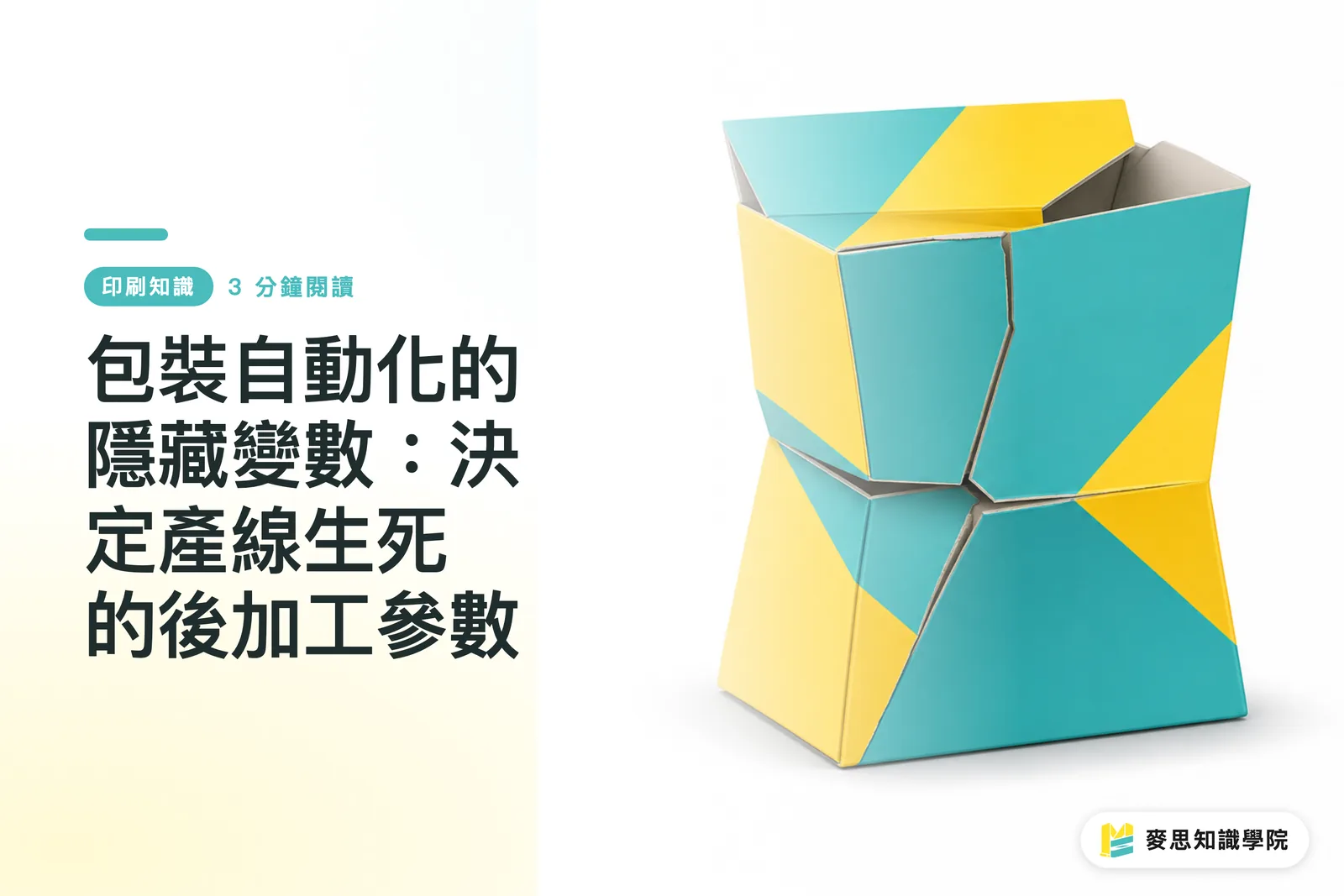
Why does your beautiful packaging keep jamming on an automatic cartoner?
Over the past few months, I visited several contract manufacturers rushing to ship orders. The scene I saw most often was a furious owner complaining that the new high-speed cartoner kept breaking down
Most of the time, the issue was not the equipment. It was that gorgeous packaging dieline
According to the latest industry discussion released in PackPod Episode 4, if the structural details of packaging are not controlled properly, the failure rate of a cartoner can jump by 3 to 5 times
Brand designers think in terms of maximum visual impact and unboxing experience. Factory engineers care about smooth feeding and cycles per minute
When the two sides do not align their specs, that knowledge gap burns a lot of money and rework time on production lines every year
If the machine does not run smoothly, is the equipment spec really the problem?
Many people buy CNC die-cutting machines by looking only at speed and stroke, while ignoring the physical behavior of the paperboard after the die cuts through it
On the post-press floor, automation yield is really decided by a few tiny variables that are hard to spot with the naked eye
・Flap Angle: a difference of just a few degrees can make the suction cups leak air or get stuck during pickup
・Tuck Depth: too shallow and the box can pop open during transport. Too deep and the automatic pusher may not reach the correct position, causing a stop
・Board Stiffness: many people overlook the match between grain direction and paper weight. If the rebound force at the folded corners is wrong, the whole batch may have to be scrapped
If even one of these variables is neglected, no expensive machine can bring the yield back
Why do short runs and precision packaging demand tighter structural accuracy?
Over the past year or two, I have seen medical devices getting smaller. That trend has had a clear reverse impact on packaging design
The smaller the device, the higher the requirements for barrier performance and sterilization compatibility. For this kind of precision packaging, the tolerance for error is almost zero
On top of that, regulations such as California SB 54 are tightening, so packaging has to carry all kinds of EPR recycling traceability codes
If a carton shifts even slightly during high-speed forming and the traceability code lands on a crease where it cannot be scanned, that shipment may face rejection once it reaches an overseas recycling facility
Structural accuracy is no longer just an aesthetic issue. It can decide whether an export order survives
How to close the communication gap with 10 parameters before artwork approval
The only way to solve this pain point is to pull post-press thinking forward into the design stage
Designers cannot submit only appearance files. Before final approval, they need to confirm a spec sheet with the post-press vendor covering 10 structural parameters
Think of it as a shared language across departments, one that quantifies physical conditions such as tuck depth, glue flap, grain direction, and pre-crease lines
When the MINDS team handles one-stop integration, this early-stage work is what we care about most
Once these 10 parameters are locked down at the prepress stage, the downstream automated line can run with its eyes closed. That is the real way to save clients from hidden costs
Key Takeaways
・Designers optimize visuals while engineers optimize speed. The two sides need 10 post-press parameters as their shared language
・If flap angle and tuck depth are off, cartoner failure rates can surge by 3 to 5 times
・Precision packaging and EPR traceability-code regulations have sharply reduced the tolerance for structural error
・Real print automation is not about buying the most expensive machine. It is about designing a physical structure the machine can actually run
Further Thinking
From a practical point of view, many small and midsize print shops and brand clients in Taiwan are still running production lines through old-school trial and error
Introducing these 10 key parameters is not just about reducing scrap. It is also about building standardized in-house data
If AI is later applied to dieline generation or SaaS factory scheduling systems, these structural parameters will become the core data foundation
Align the physical structure specs first, and the production line's digital transformation will finally have solid ground to stand on
Further Reading
FAQ
- Why does a newly purchased automatic cartoner keep jamming and stopping?
- Usually, the equipment specs are not the problem. The packaging structure's flap angle or board rebound does not meet the machine's physical feeding requirements
- What should designers confirm with the factory before handing off final artwork?
- They should ask the post-press vendor for a list of 10 structural parameters, including tuck depth and board stiffness, to make sure the dieline meets automation requirements
- How does this affect strict export orders?
- An unstable structure can cause cartons to shift during forming. If that affects the scanning of EPR traceability codes, the entire shipment may be rejected overseas
- How can the communication gap between design and the factory be solved at the root?
- Work with a team like MINDS that has integration experience from prepress through post-press, so the machine's physical limits are turned into design specs before the drawing is finalized
References
- 包裝結構才是自動化的隱藏變數:設計師不知道的後加工 10 個關鍵參數 · youtube.com
Related articles
The Print × AI weekly
The print and AI know-how designers, brands and enterprises can use before they commit — one email, every week
MINDS Free Tools
Spine width and imposition calculators — skip the manual math, free in your browser.
MINDS Group
Need actual printing or gifting services?
From premium printing to online ordering and festive gifts — the MINDS Group sister brands take it from here.