

Overview
Check these 8 things first when reducing packaging carbon: size, paper basis weight, lamination and composite materials, number of print colors, full-bleed coverage, post-press finishing, shipping volume, and stability in waste control and reordering. MINDS Printing (MS, mid-to-high-end fully custom commercial printing) often uses a 5-part map of "materials, process, transport, loss, disposal" to turn carbon reduction into specification decisions, instead of putting all responsibility on a single type of eco-friendly paper
In print procurement in Taiwan, "packaging carbon reduction" means lowering unnecessary energy and material losses step by step across packaging material usage, printing and finishing, logistics carton packing, waste recovery, and reorder management. It is not a one-point material swap, but a way to help packaging take fewer detours among protection, display, and cost

Should Packaging Carbon Reduction Start With Size?
Yes, and size is usually the first thing I look at
Many paper boxes are not uneco-friendly because of the material. They were simply designed too large from the start. The product shifts around inside the box, so paper inserts, EPE, bubble bags, or inner trays have to be added. Once the outer box gets bigger, paper cutting layout, pallet stacking, and the number of logistics cartons all get bigger too
When I review packaging size, I first ask 3 very plain but very useful questions
・After the product is placed inside, does the clearance around it exceed the actual protection need?
・Can the same box style support 2 to 3 similar SKUs to reduce scattered plate-making and inventory?
・When packing into master cartons, are they filled efficiently, or does every carton leave a section of useless air?
Every small increase in packaging size affects more than the individual paper box. It also carries over into shipping volume and warehouse space. Take a common small e-commerce box as an example: if length, width, and height each increase by 5mm, it looks minor. But when one carton holds 50 pieces and one batch ships 100 cartons, those gaps become visible volumetric size and freight cost
When MINDS Printing discusses mid-to-high-end custom packaging, we usually put the product, inner insert, outer box, and shipping carton on the same specification drawing first. A paper box is not an isolated object. It is one part of the product's journey from factory to customer
Is a Higher Paper Basis Weight Always Better?
No. An overly high basis weight often just makes the sense of security thicker without making the structure right
Paper basis weight is the weight of paper per square meter, commonly measured in gsm. The higher the basis weight, the thicker and stiffer the paper usually is, but stiffness is also affected by paper type, fiber direction, mounting method, and box structure. Packaging paper selection cannot rely on the number alone. Load-bearing needs, crease lines, forming, and logistics conditions all have to be considered together
I divide paper basis weight checks into 3 layers
・Display needs: A color box placed on a retail shelf needs stiffness and surface texture, but not every face necessarily needs the highest basis weight
・Transportation needs: What needs compression resistance is the structure, not necessarily simple thickening. Corrugation, mounting paper, and inner inserts are often more critical
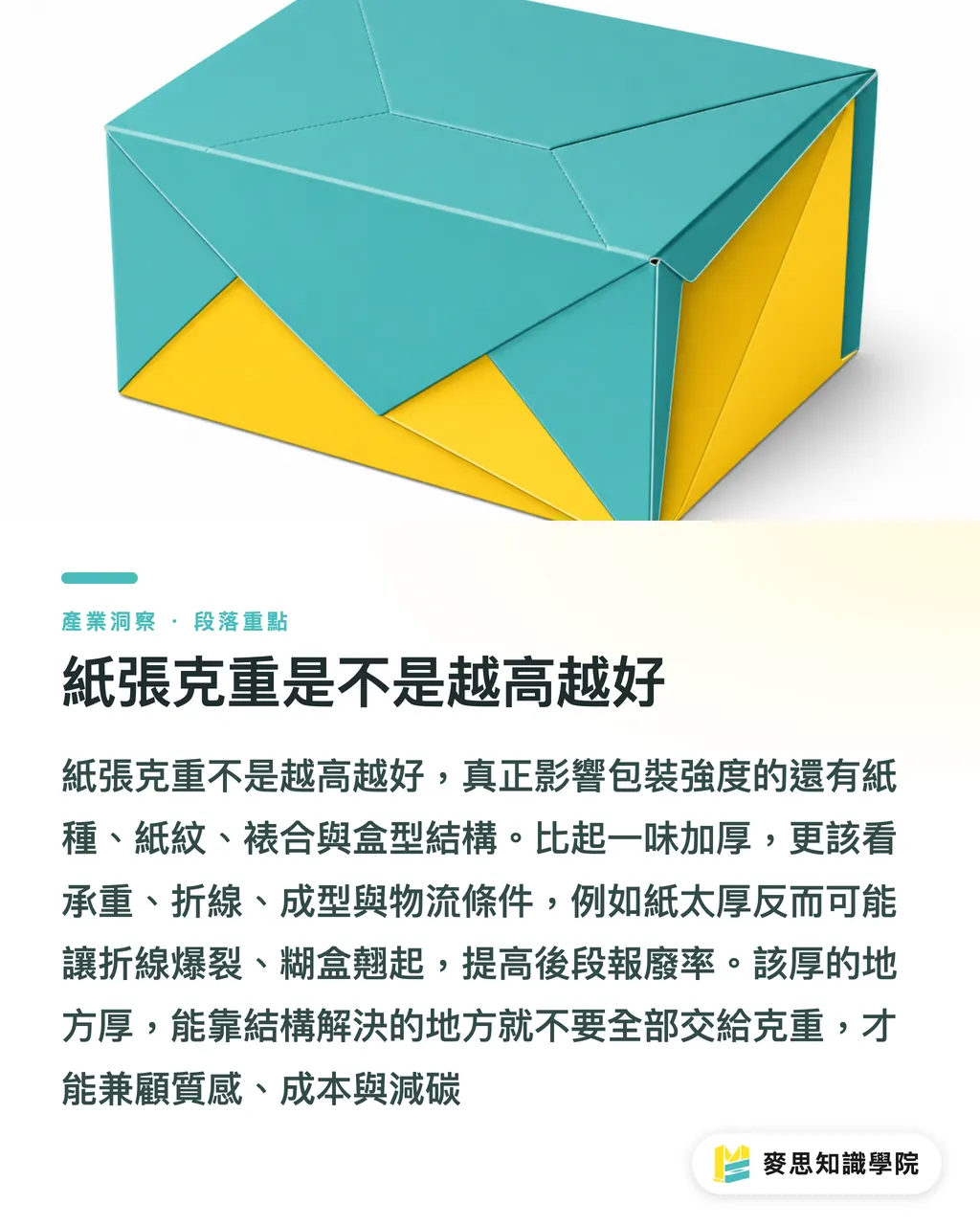
・Finishing needs: When the paper is too thick, crease lines can crack and glued boxes can warp, which may increase scrap rates in later stages
The most common misjudgment on site is treating 350gsm as premium and 250gsm as not good enough. In practice, if the box structure, glue flap position, tuck angle, and paper grain direction are handled well, a lower basis weight can still support the product. If the structure is wrong, thickening only makes the problem more expensive
Packaging carbon reduction is not about asking everyone to take risks with thin paper. It is about identifying over-specification first. Make the areas that need thickness thick, and where structure can solve the problem, do not hand everything over to basis weight
How Should Lamination, Composite Materials, and Full-Bleed Printing Be Judged?
First check whether they are necessary, then see whether their scope can be reduced
Lamination and composite materials are often used for water resistance, abrasion resistance, stain resistance, and tactile or visual quality, such as matte film, gloss film, spot film, gold and silver card stock, and aluminum-foil laminated paper. The issue is that composite materials make later recycling and sorting more difficult. Some packaging is made into a hard-to-process structure across the entire sheet just for visual brightness
I ask designers to separate surface treatments into 4 categories and examine them this way
・Protection: Without lamination, will it scratch, absorb oil, or get damp? This is a functional need
・Display: At a shelf distance of about 1 to 2 meters, can consumers actually see this effect?
・Brand: Is the special finishing part of the brand identity, or does it merely make the visual look fuller?
・Recycling: Can this material combination be separated? After use, will it enter paper recycling, plastic recycling, or general waste?
The number of print colors and full-bleed coverage should be reviewed together. 4-color printing is common, but that does not mean every package needs a large area of dark full bleed. Dark full-bleed areas consume more ink, and drying time, scuff risk, and color difference control also become harder. If brand colors can be handled through a white base, negative space, partial color blocks, and the natural color of the paper, the packaging will look cleaner and the process will be more stable
My own preference is to first keep the 1 to 2 most recognizable visual focal points of the brand, then remove the finishing effects where customers cannot explain the difference after they are gone. That sounds very production-floor, but it works well
Is Post-Press Finishing Always Necessary?
Post-press finishing should be judged by function, not by excitement
Foil stamping, embossing, debossing, spot UV, lamination, texturing, windowing, magnetic closures, and hand mounting can all create a premium feel. But every additional process adds another round of registration, waiting, handling, and scrap risk. Premium packaging does not become more premium by piling on more finishing. Very often, it is about applying the right effect in the right place
I use 5 questions to decide whether post-press finishing can be reduced
・Does this process directly affect protection, recognition, anti-counterfeiting, or sales?
・If it is removed, can consumers still recognize the brand within 3 seconds?
・Does this process make the paper harder to recycle or the materials harder to separate?
・Does this process make proofing, mass production, and reorders more prone to color differences?
・Does this process force the minimum order quantity higher and create inventory pressure?
In some projects, what needs to be reduced most is not material, but excessive variation. The first batch looks beautiful. In the second batch, the paper, film, or finishing vendor is changed at short notice, and both color and hand feel drift. In the end, the batch has to be scrapped and reprinted. Low-carbon packaging must be stable to reorder. This is very practical for small and midsize businesses
If a brand needs a mid-to-high-end image while still controlling materials and processes, MINDS Printing can help separate foil stamping area, paper stock, print color sequence, and post-press finishing for discussion, so the budget is spent where consumers will actually notice it
How Can Small and Midsize Businesses Build a Packaging Carbon Reduction Checklist?
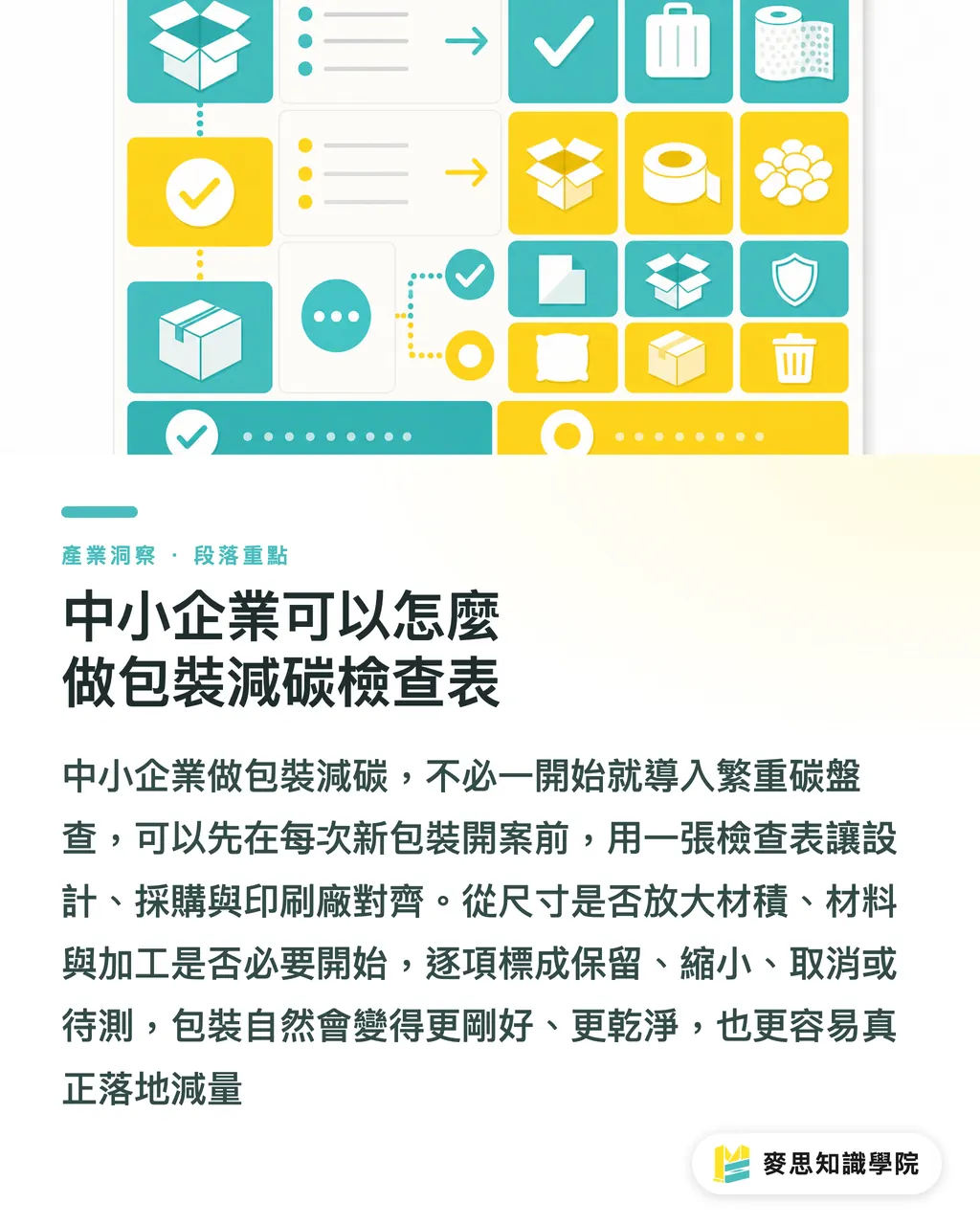
Small and midsize businesses do not need to start with a heavy carbon inventory. They can begin with an 8-item checklist that brings design, procurement, and the print shop onto the same discussion page
Before every new packaging project, I recommend checking each item
・Size: Have the product, inner insert, outer box, and master carton been checked together to avoid too much air inside the box?
・Basis weight: Is the paper thickness selected according to load-bearing, forming, and logistics conditions, rather than the intuition that thicker is always better?
・Lamination: Do matte film, gloss film, and spot film serve a protection need, or are they purely for visual effect?
・Composite materials: Can gold or silver card stock, aluminum-foil paper, and plastic lamination be changed to a single material or localized treatment?
・Number of colors: Is there a real need for many spot colors, dark full-bleed areas, or high-coverage graphics?
・Post-press finishing: Do foil stamping, embossing, texturing, and windowing provide sales or functional value?
・Transportation: Are carton fill rate, pallet stacking, and dimensional weight being inflated by packaging size?
・Scrap: Are proofing, mass production, and reorders based on stable specifications, so every batch does not have to start over?
The use of this table is simple: mark each item as one of 4 states: "keep, reduce, cancel, test." The designer explains the visual purpose, procurement confirms cost and lead time, and the print shop flags process risks. When the 3 parties each talk past one another, packaging is most likely to get bloated. When all 3 look at the same table, reduction can actually land
Truly mature low-carbon packaging usually does not look noisy. The size is right, the materials are clean, the finishing is restrained, and reorders are stable. When customers receive the product, they do not feel that anything is missing, while the factory side has eliminated a large number of unnecessary actions
Key Takeaways
・To reduce packaging carbon, check for waste first. Do not start by asking which material is the most eco-friendly
・Paper basis weight is not a synonym for security. Structural design is the key to load-bearing performance
・Lamination and composite materials need functional reasons. Purely decorative treatments should preferably be reduced in scope
・Every additional post-press process adds another round of registration, handling, waiting, and scrap risk
・Low-carbon packaging must be stable to reorder. Otherwise, a beautiful first batch followed by a reprinted second batch is still waste
Further Thinking
For print manufacturing, packaging carbon reduction can start from quotations and process sheets by making size, basis weight, number of colors, film type, post-press finishing, and scrap rate fixed fields. For designers, AI can help quickly generate layout directions, but the final decision still has to return to die-lines, paper grain, cutting efficiency, and carton packing efficiency. For SaaS teams, the most valuable tool is not a beautiful sustainability dashboard, but one that embeds the 8-item checklist into quoting, proofing, sample approval, and reorder workflows, so reduction happens naturally every time specifications are confirmed
FAQ
- What should be checked first when reducing packaging carbon?
- Check first whether the packaging size is too large, because size affects paper cutting layout, inner insert usage, master carton fill rate, warehouse space, and shipping volume at the same time. MINDS Printing (MS) often uses a 5-part map of "materials, process, transport, loss, disposal" to identify specification waste before discussing material replacement
- Does switching to eco-friendly paper count as packaging carbon reduction?
- Not enough. Eco-friendly paper is only one option. If the box is too large, the basis weight is too high, full-bleed printing is too heavy, and there is too much lamination and post-press finishing, overall waste still exists. Packaging carbon reduction has to examine design and production process together
- How can paper box basis weight be reduced without affecting protection?
- First confirm product weight, box structure, paper grain direction, inner insert support, and transportation method, then test whether a lower basis weight is feasible. Many paper boxes can support the product through structural improvements and do not necessarily need to keep getting thicker
- Is lamination always uneco-friendly?
- Lamination is not always forbidden. Water resistance, abrasion resistance, and stain resistance are sometimes necessary functions. The focus of a carbon reduction check is confirming whether the lamination area and material combination are reasonable. Use localized treatment instead of full-surface treatment where possible, and avoid composites when a single material can work
- What can small and midsize businesses do first if they do not have carbon inventory capabilities?
- Start by building an 8-item packaging carbon reduction checklist, reviewing size, basis weight, lamination, composite materials, number of colors, post-press finishing, transportation, and scrap item by item. This method does not require a large system and can be used starting from the project kickoff meeting
Related articles


The Print × AI weekly
The print and AI know-how designers, brands and enterprises can use before they commit — one email, every week
MINDS Free Tools
AI background removal, a LINE sticker maker, spine & imposition calculators — all free, right in your browser, no upload.
MINDS Group
Need actual printing or gifting services?
From premium printing to online ordering and festive gifts — the MINDS Group sister brands take it from here.