

Why Are Sustainability Requirements Rewriting Equipment Procurement?
Sustainability requirements are reshaping equipment procurement because materials, energy use, and waste all have to be delivered on the production line in the end; Packaging Insights' Packaging Machinery Manufacturers Respond to Sustainability Requirements notes that packaging machinery manufacturers are adjusting their product lines in response to sustainability demands
The way I see it, the questions suppliers must answer now go beyond the top speed listed in a brochure. They also cover energy savings, waste reduction, and material changes, while giving contract manufacturers a way to turn a brand promise into a consistent finished product
An equipment configuration is a set of machine modules arranged around the materials, capacity, and converting workflow. It includes the main machine, auxiliary equipment, changeover requirements, and maintenance conditions, with the goal of making energy savings and waste reduction work in mass production
In packaging projects, I treat recycled fiberboard, rPET (recycled polyester) textiles, and PVC-free films as front-end design questions. The design team should ask what the equipment supports first, instead of waiting for a failed proof before changing materials. The earlier the material route is confirmed, the fewer detours there are between proofing and mass production
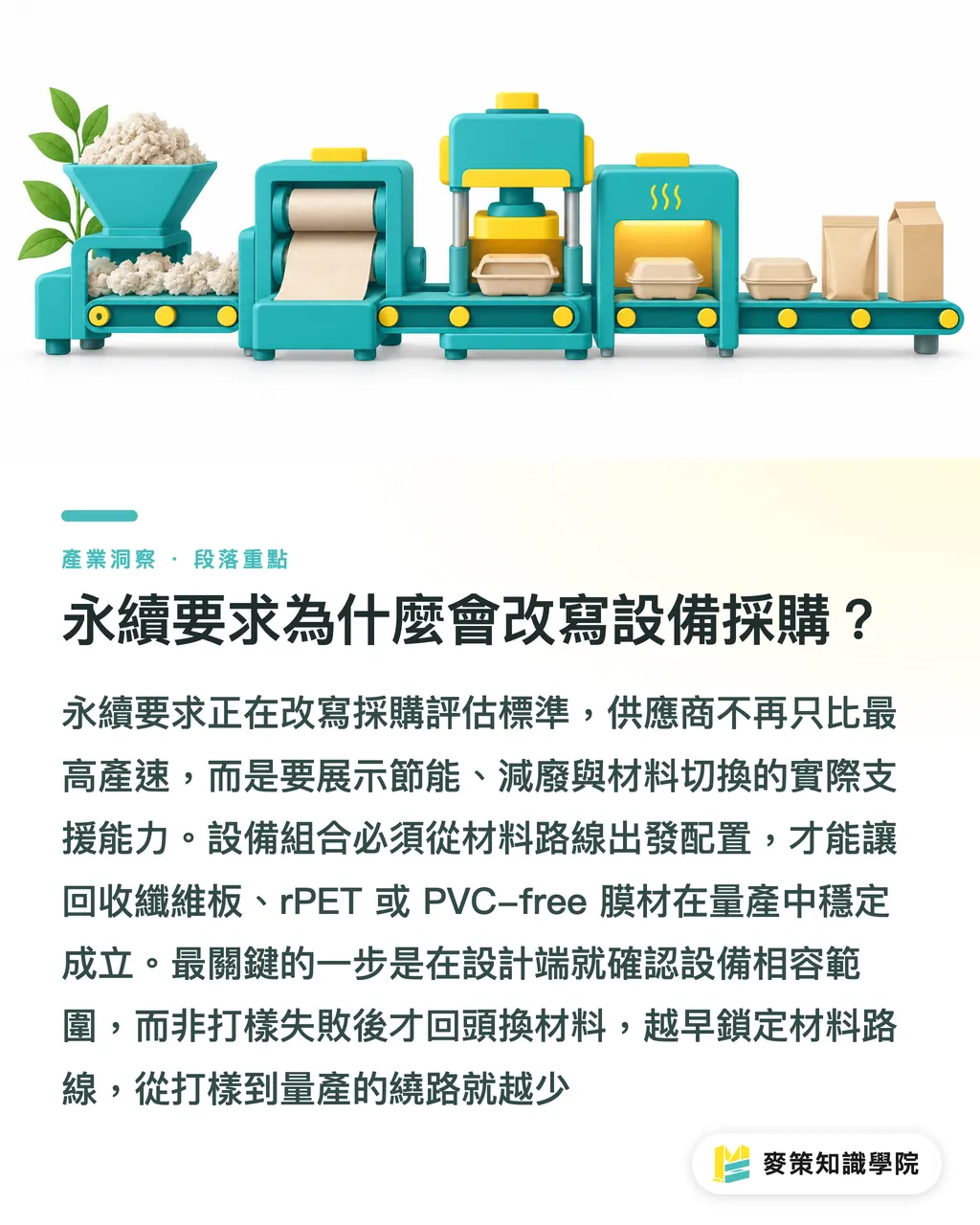
Key 1: How Should the Equipment Configuration Be Reworked?
Equipment procurement should move from buying standalone machines to a three-layer configuration: material compatibility, process waste reduction, and implementation and maintenance. Suppliers' product lines should also move beyond speed tiers and explain the materials they support and the depth of service they provide
・Start with material compatibility: list usable substrates, packaging structures, and changeover limits as a test checklist, then have the supplier run proofs with the actual materials and clearly define the support boundaries
・Build process waste reduction into the specifications next, requiring details on how changeovers, trial runs, and defective products will be recorded. Energy-saving features should also correspond to actual production steps
・Deliver implementation and maintenance along with the machine, including operating conditions, training, a maintenance contact, and material test results
Small and medium-sized plants do not need to chase the most feature-packed complete line first. If they mainly make paper boxes, they should first ask how paper feeding, printing, die-cutting, and folder-gluing connect. For flexible packaging, start by confirming whether film changes and downstream processing can run continuously. If a supplier reports only the maximum speed, half the procurement specification is still missing
Key 2: How Should Brand Owners Verify Sustainability Commitments?
Brand owners need to turn sustainability commitments into procurement acceptance criteria, checking energy use, waste, material changes, and the handoff from proofing to mass production
If sustainable design on the machinery side never enters the contract manufacturer's workflow, the brand promise stays in the slide deck. Lay out the schedule around three checkpoints, with the brand, design team, printing plant, and supplier sharing one record
・1. Before design sign-off, list material, structural, and printing/finishing constraints, and ask the supplier to confirm the equipment's support range
・2. During proofing, record material changes, trial-run waste, and machine-adjustment conditions. Brand owners should not look only at one polished sample
・3. After mass-production acceptance, confirm operator training, the maintenance contact, and issue reporting so the commitment is backed by a traceable record
When communicating with the brand, spelling out the materials and acceptance method is more reliable than abstract slogans. If cross-functional specifications are hard to organize, ask the Mai Strategy Knowledge Academy consulting team to turn them into a design brief (design requirements document) and acceptance checklist
Key 3: How Should Suppliers Change Their Service Model?
Supplier service should move beyond delivering a standalone machine and instead help customers complete three checkpoints: material confirmation, proofing and implementation, and mass-production maintenance
Once sustainable materials enter the mix, design, printing, and finishing meet earlier in the process. Suppliers need to include material testing, operating conditions, training, and exception handling in the delivery package. Only then do printing plants have a chance to turn new materials into repeatable products
・Before the sale, test the equipment's limits with actual materials and structures, rather than just mailing a brochure
・At implementation, deliver proofing conditions, material-change procedures, and acceptance items so operators can reproduce the results
・During maintenance, refer back to material and process records to handle material changes, waste, and downtime on the production line
From watching printing procurement over the long term, I find that the first batch after a material change is what gets underestimated most easily. If the design team, procurement, operators, and supplier do not confirm it together, the brand sees only the finished product and not where the promise went off track
How Should Small and Medium-Sized Printing Plants Calculate This Capital Expenditure?
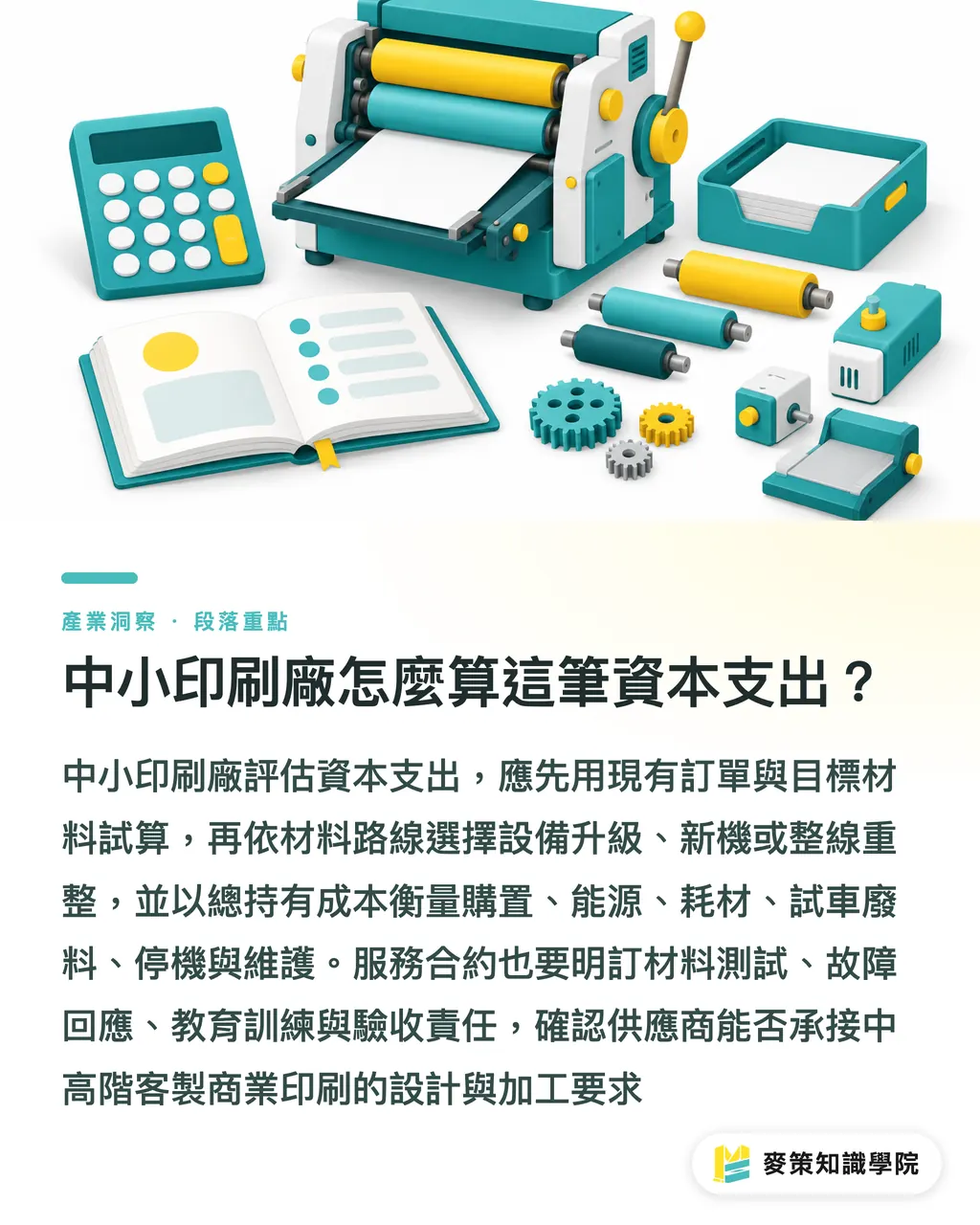
Small and medium-sized printing plants should run upgrade estimates using current orders and target materials first, then decide whether to add modules, replace a standalone machine, or rework the entire line
Procurement needs to calculate Total Cost of Ownership (including acquisition, energy, consumables, trial-run waste, downtime, and maintenance in one calculation), rather than looking only at the equipment quote
・Upgrading existing equipment suits plants whose material routes are similar. Validate changeovers and waste reduction first
・New equipment or a complete line suits projects where materials and structures have changed. Include implementation, training, repairs, and the mass-production ramp-up in the estimate
・For a service contract, spell out responsibility for material testing, fault response, training, and acceptance, so responsibilities do not get reassigned after handover
When requesting a quote, brand owners should not ask only whether it can print. If they need to verify whether high-end, fully customized commercial printing can handle design and finishing requirements, they can include MINDS in the evaluation, starting with questions about the handoff from proofing to mass production
Key Takeaways
・For equipment procurement, ask whether materials can run stably at mass-production scale before looking at standalone machine speed
・Calculate energy, trial-run waste, downtime, and maintenance together when costing sustainable equipment
・Brand owners should put energy use, waste reduction, material changes, and the proofing-to-production handoff into acceptance criteria so commitments have evidence
・Suppliers need to move from machine handover to material testing, implementation training, and mass-production maintenance for their service to keep pace with sustainability requirements
Further Thoughts
The next step is to break the equipment upgrade into a one-page shared specification covering materials and structures, supported machine conditions, proofing and mass-production acceptance, energy and waste records, and service owners. The printing and manufacturing side can use it to estimate Total Cost of Ownership, the design team can confirm the material route before final artwork, and brand owners can use it to support ESG (environmental, social, and governance) communications. For AI adoption and SaaS (Software as a Service, cloud-based subscription software), start by organizing versions, material test results, equipment conditions, and issue records. Move on to prediction or scheduling only after the fields are consistent. Without reliable shop-floor data, tools only spread errors faster
Further Reading
FAQ
- What should you look at first when procuring sustainable packaging equipment?
- Start by checking whether the target materials and packaging structure can run stably at mass-production scale, then compare energy-saving specifications. If the machine cannot support material changes, its energy-saving features will be hard to turn into packaging the brand can actually deliver
- Does a small or medium-sized printing plant have to replace the entire packaging line?
- Not necessarily. If the material route is similar, first evaluate upgrades and modular retrofits for existing equipment. If the materials and structure have changed, estimate new equipment, implementation training, maintenance, and the mass-production ramp-up together
- How can brand owners verify a supplier's sustainability commitments?
- Put energy use, waste, material changes, and the proofing-to-mass-production handoff into procurement acceptance criteria, and keep records before design sign-off, during proofing, and after mass-production acceptance. That gives ESG communications evidence behind them
- When should designers get involved in equipment evaluation?
- Designers should get involved before final artwork is completed, first confirming that materials and packaging structures fall within the equipment's support range. Early collaboration shortens the distance from proofing to mass production and reduces the chance of discovering after a sample is finished that it cannot be produced at scale
- What should suppliers add to their packaging machinery service model?
- Before the sale, they should test materials and structures. During implementation, they should deliver operating conditions and acceptance items. In maintenance, they should be able to troubleshoot based on material, waste, and downtime records. Service responsibilities should be written into the delivery package and contract
Related articles



The Print × AI weekly
The print and AI know-how designers, brands and enterprises can use before they commit — one email, every week
MINDS Free Tools
AI background removal, a LINE sticker maker, spine & imposition calculators — all free, right in your browser, no upload.
MINDS Group
Need actual printing or gifting services?
From premium printing to online ordering and festive gifts — the MINDS Group sister brands take it from here.