

Why Does Packaging Innovation Hit Recycling Systems First?
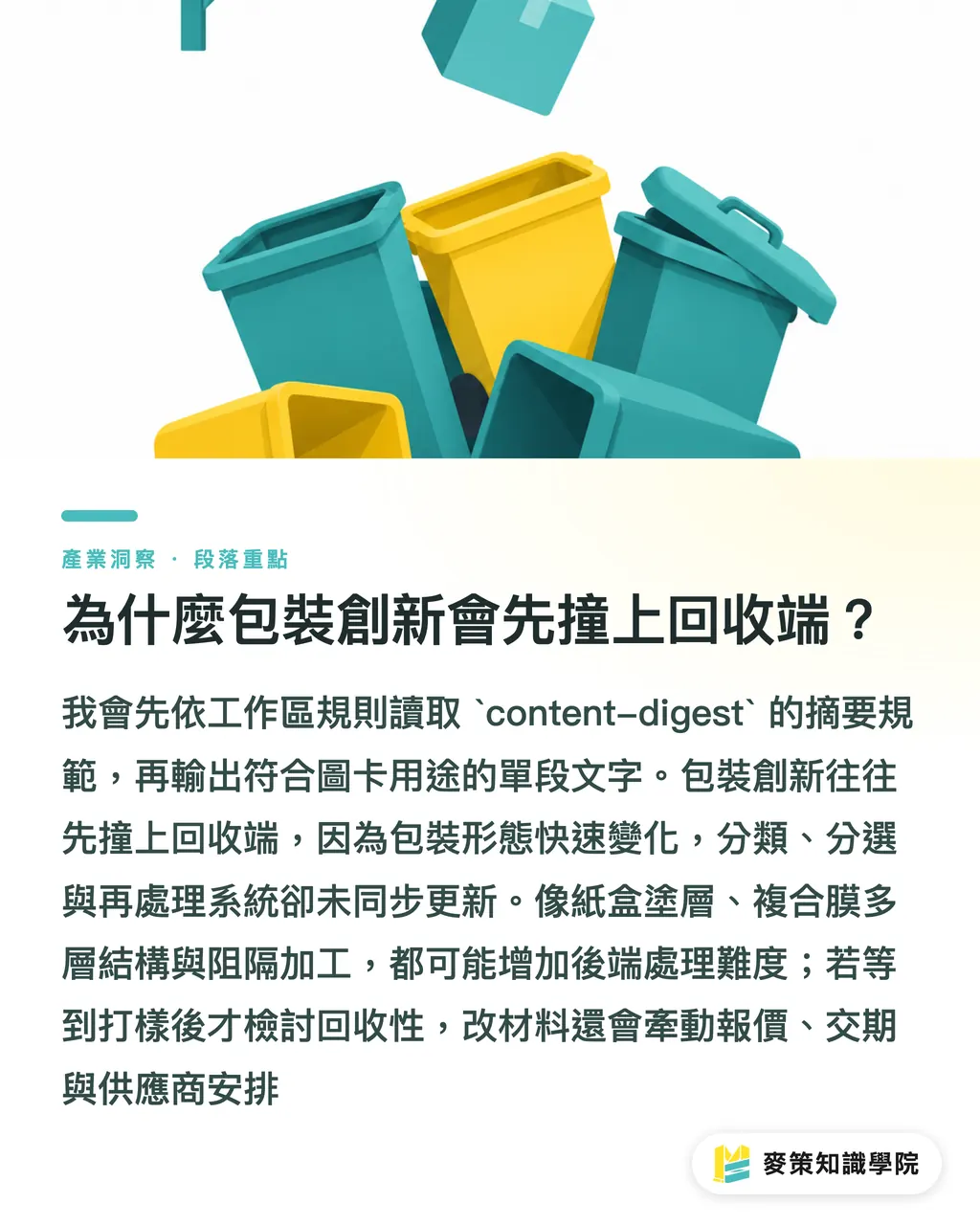
Because packaging design changes quickly, while the sorting, separation, and processing conditions of recycling systems are not updated at the same pace. Packaging Dive cited a report saying that packaging formats have changed, but recycling systems have not kept up. Here, a recycling system means the actual process through which packaging, after use, is collected, sorted, separated, and reprocessed before finally entering a recycled-material stream or another use
Put this signal into a Taiwan project context, and it becomes very concrete. Coatings on paperboard cartons, multilayer structures in composite films, and processing added for greater barrier performance can all make downstream sorting and processing harder. I have spent years looking at proofs, procurement, and mass production. Brand teams often ask first about color, feel, abrasion resistance, and shelf appeal, while the recycling stream only enters the conversation after the proof is made. By then, changing the material means reworking the quote, lead time, and supplier arrangements. See the original report: Packaging Has Changed, but Recycling Systems Haven't Kept Up
How Do Recycling Streams Change a Brand's Packaging Decisions?
They shift packaging decisions away from a narrow question of appearance and back toward a connected assessment of materials, structure, processing, and what happens after use. Recyclability means the practical extent to which packaging can be collected, sorted, and turned into usable material under existing collection and processing conditions. It is not the same as having a material name that sounds environmentally friendly
Before a design file goes out, brands should put at least three questions into the sign-off checklist:
・Material: Can paperboard cartons, composite films, and coatings enter the recycling stream in the target market? Does the supplier have processing information that can be verified?
・Structure: Will multilayer materials, components made from different materials, or the adhesive method add another requirement for sorting, separation, or downstream processing?
・Communication: Do ESG (environmental, social, and corporate governance) claims match actual recycling conditions? Otherwise, consumers receive a polished promise but cannot find a corresponding route in practice
This is also the box I see brand procurement teams miss most often: finishing the design file does not mean the packaging solution is finished. If no one asks about the packaging's life cycle, everything afterward becomes damage control
How Should Small and Midsize Print Shops Check Recycling Risk Before Quoting?
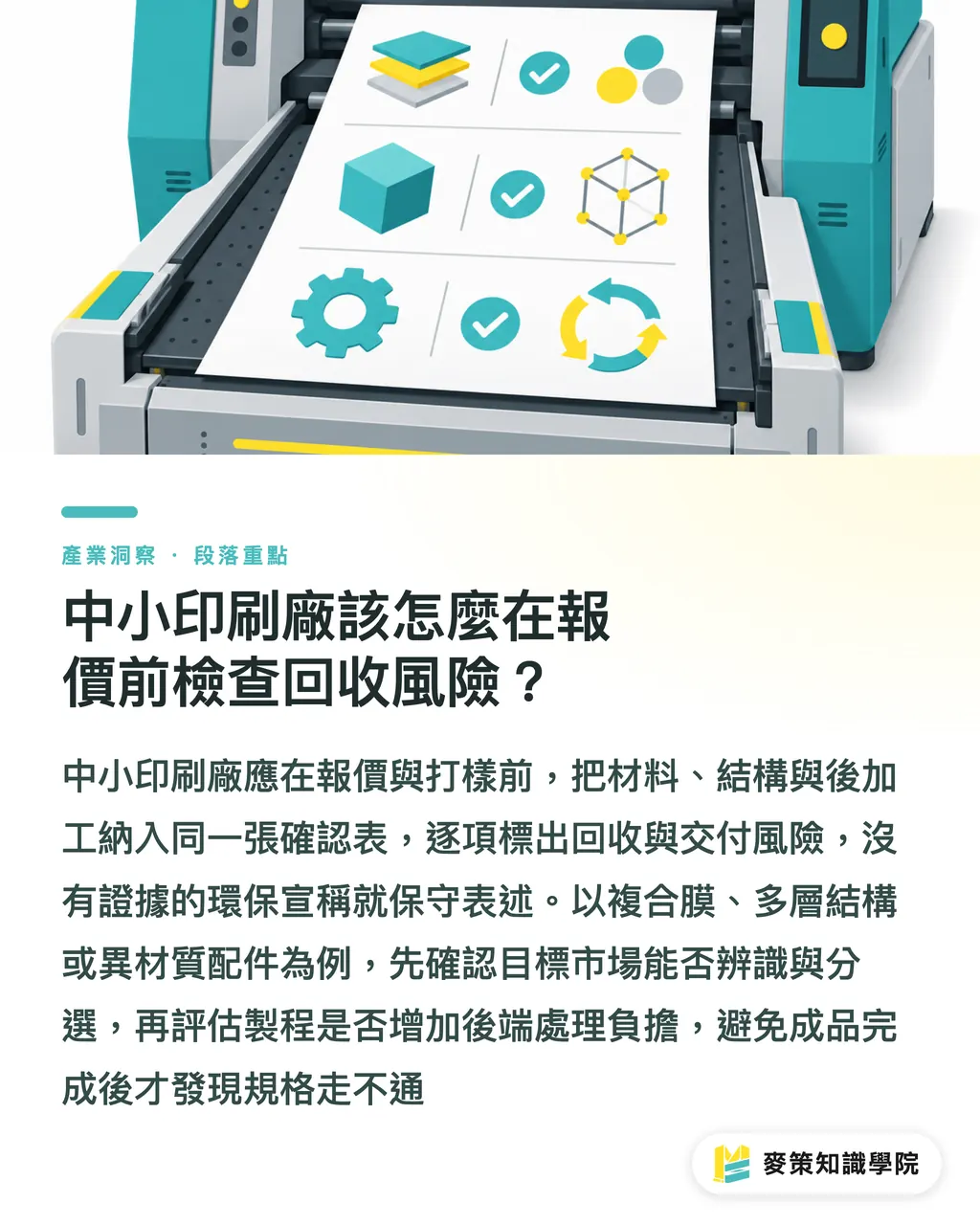
Small and midsize print shops should put materials, structure, and post-processing on the same checklist before quoting and making proofs. I use Mai Strategy's Three-Gate Print Check to frame this issue, so brands, designers, and print shops can answer from the same page
・① Material gate: Spell out the paper stock, film material, coating, and adhesive method first, then confirm what recycling or processing information the supplier can provide. Without evidence, keep the claim cautious
・② Structure gate: Check whether the packaging can be identified under the sorting conditions in the target market, and list composite films, multilayer structures, and components made from different materials as items requiring confirmation
・③ Process gate: Put printing inks, varnishing, lamination, foil stamping, and die-cutting back into the overall solution review, and confirm whether the visual requirements add to the burden on downstream processing
A print shop cannot guarantee recycling in every market, but it can flag uncertainties before quoting. If a brand is adjusting the specifications for a paperboard carton, composite film, or coating, it can bring MINDS into the conversation before proofing to review printability, post-processing, and delivery risks together. If the specification proves unworkable only after production is complete, it is usually too late
How Should Brands Balance Packaging Performance with Recycling Conditions?
Brands should first decide which product functions cannot be sacrificed, then set the materials and structures that the recycling stream can handle within the design boundary. Three common choices can be viewed like this:
・Single-material paperboard carton: The specifications and messaging are more straightforward. If special coatings or composite components are added, the recycling conditions still need to be checked again. This is a good place to start when testing a simplified solution
・Multilayer film structure: Barrier performance, sealing, and appearance are easier to achieve together. The more complex the material layers, the more you need to confirm where the packaging will be sorted and processed in the target market. Without a clear destination, do not rely on green copy alone
・Special surface finishing: Tactile feel, gloss, and shelf recognition may improve. Every added finishing step should prompt a return to the same question: Is the packaging still within the target market's recycling stream?
Extended Producer Responsibility (EPR, which requires brands to take responsibility for managing packaging after use) rules in different markets will bring these questions into procurement and compliance discussions earlier. There is no need to rush to guarantee that any particular material is recyclable. Start by keeping a record that maps the market, packaging material, and recycling stream. Then brand communications have evidence behind them
What Can AI and SaaS Do for Packaging Teams?
AI and SaaS (Software as a Service, cloud software accessed by subscription) are best suited to managing specifications and decision trails. They cannot vouch for a brand or for a recycling system. A packaging project may repeatedly revise material names, structural drawings, processing conditions, and supplier responses. Tools can keep versions in one place, flag missing fields, and give design, procurement, and the print shop the same source of information
I would put AI in these three places:
・Organize material and processing differences across versions, and identify specification changes first
・Compare supplier responses with the design file and flag inconsistencies
・Generate a list of questions for review, reminding the team to confirm the recycling stream, labeling, and market conditions
Final recyclability judgments still have to come back to the actual conditions set by material suppliers, recycling processors, and the target market. If a team lacks an internal method, it can ask the Mai Strategy Knowledge Academy consulting team to build the question list into the procurement and proofing workflow. Tools can manage versions, but they cannot replace human responsibility for the material

Key Takeaways
・Recycling systems are not an end-of-project issue. Brands need to ask where packaging goes after use when selecting materials
・Every added function in a paperboard carton, composite film, or coating adds another recycling condition to the procurement checklist
・Bringing the print shop in before quoting is the only way to keep material risks at the revision stage
・AI and SaaS can manage versions and question lists, but recyclability still has to be confirmed against real supply-chain conditions
A Further Thought
Here is my simple next step for brand teams: on the next packaging project, add a one-page checklist for materials, structure, processing, and the recycling stream beside the quote. Before the design file goes out, the brand, designer, and print shop should each confirm their respective fields. The print manufacturing team can spot rework risks earlier, the design team can bring recycling conditions into the creative boundaries, and AI and SaaS can handle versions and records. That gives the company enough evidence to answer questions about ESG and EPR
Further Reading
FAQ
- Are composite films always unrecyclable?
- Not across the board. The answer depends on whether the target market has an actual route for collecting, sorting, and processing that structure. Until that is confirmed, brands should not present "recyclable" as an unconditional promise
- When should a brand talk to a print shop about recycling conditions?
- Before quoting and proofing is the best time, because once a paperboard carton, composite film, or coating enters mass production, changing the material affects the quote, lead time, and supplier arrangements
- Which parts of a brand's work are affected by EPR?
- EPR brings post-use packaging management responsibilities into procurement, material records, and compliance communications. Brands need to retain the corresponding data for packaging specifications and recycling conditions
- Can AI determine whether packaging is recyclable on its own?
- AI can compare specifications, organize supplier responses, and list missing information, but recyclability still has to be confirmed against the recycling and processing conditions in the target market
Related articles


The Print × AI weekly
The print and AI know-how designers, brands and enterprises can use before they commit — one email, every week
MINDS Free Tools
AI background removal, a LINE sticker maker, spine & imposition calculators — all free, right in your browser, no upload.
MINDS Group
Need actual printing or gifting services?
From premium printing to online ordering and festive gifts — the MINDS Group sister brands take it from here.