
Why does "we need eco-friendly material" leave printers unable to quote?
Here is the direct answer: "eco-friendly" is not a material property. It is an intent. You have to break it down into concrete conditions a factory can match to material codes before quotes can be compared on the same basis. The five-layer packaging specification framework from MINDS (MS, high-end fully custom commercial printing) does exactly that: it turns sustainability needs into ① paper source ② FSC claim type ③ ink and surface treatment ④ proofing conditions ⑤ acceptance standards, with clear fields for every layer
The same phrase, "use eco-friendly material," can be interpreted by a printer as: virgin pulp paper with an FSC mark, a 30% post-consumer waste (PCW) blended stock, or a 100% recycled fiber board. The cost difference among these three options can reach 25-40%. Some recycled materials have lead times two to three weeks longer than standard paper, and their printability is completely different
Suppliers will not proactively clarify everything. They will move in the direction that is easiest for them, then fit your request into that path and make it sound reasonable. So the job of a specification sheet is to spell out every layer clearly, leaving no blanks for the supplier to fill in
Paper Specs: Three Dimensions You Cannot Skip
The conclusion first. Once the paper specs are clear, more than half of the later quote variance disappears
Dimension 1: Raw material source and recycled content
Specify virgin pulp, post-consumer waste (PCW), pre-consumer waste (PIW), or a blended ratio, and state the percentage. Do not just write "high recycled content." A common starting point in the market is 30% PCW. Once it goes above 70%, board stiffness and printability change noticeably, so ask the supplier for test data to confirm
Dimension 2: FSC claim type
FSC certification has three types, each tied to a different cost structure and use case:
・FSC 100%: all material comes from certified forests. This has the highest cost and suits products where the brand needs a strong external claim
・FSC Mix: a mix of certified material and recycled material. A common label is FSC Mix Credit, and this is currently the most widely used option in the market
・FSC Recycled: 100% recycled material, with the supplier holding CoC certification. This is not the same as "printing on recycled paper." The latter has no traceability chain and cannot use the FSC mark
If you want to put the FSC mark on the box surface, you must confirm that the printer itself holds Chain of Custody (CoC) certification. Specifying the paper alone is not enough
Dimension 3: Grammage and box structure
Folding cartons, rigid boxes, and top-and-bottom boxes have clearly different paper strength requirements. State the grammage, add the flat size and box-style code, such as the RCTS 0201 series, and do not just write "refer to last time's specs."
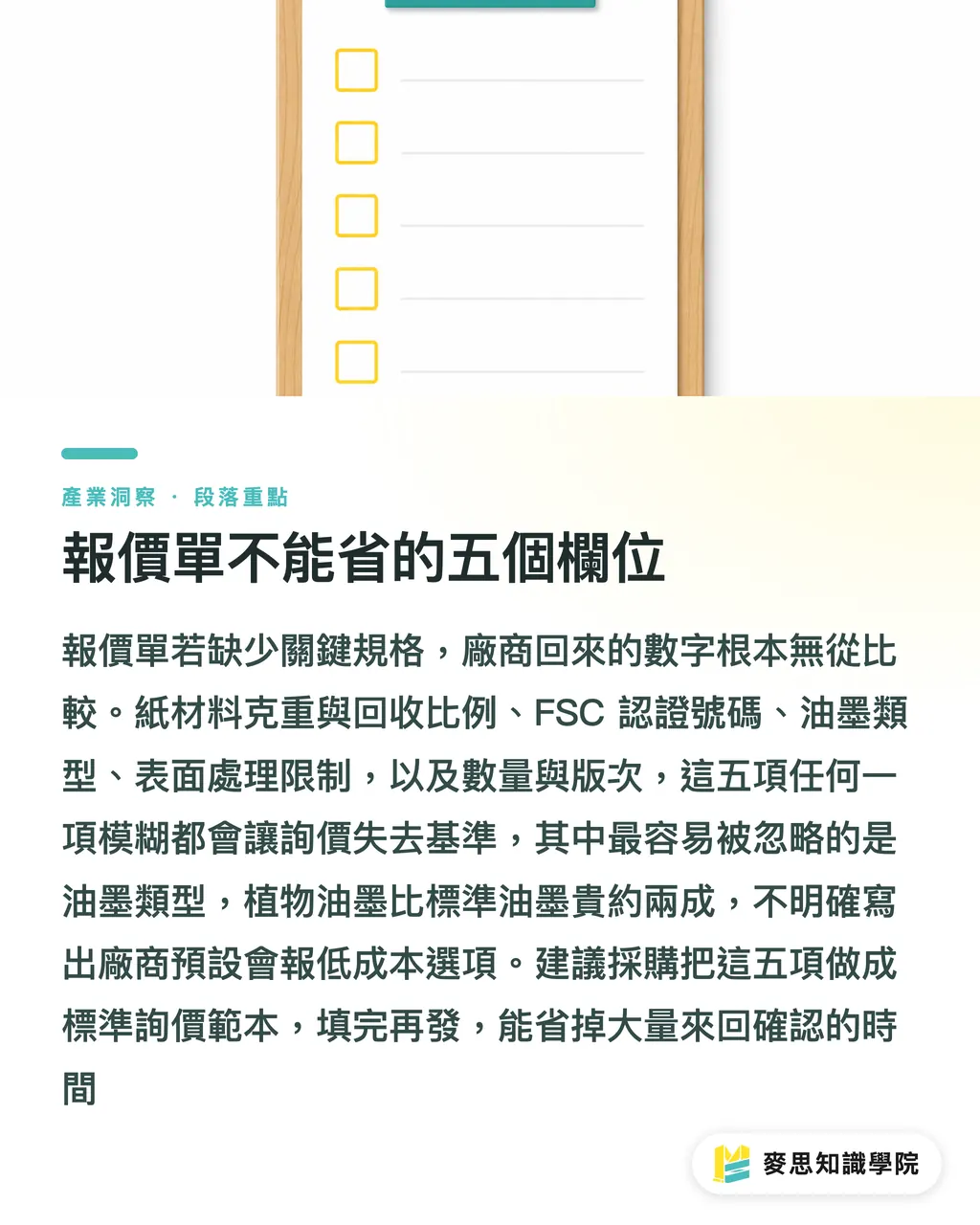
Five Fields an RFQ Cannot Leave Out
If even one of these five items is vague, the returned prices cannot be compared properly:
・Paper material code or specification description: include grammage and recycled content (%)
・FSC claim type: also require the supplier to fill in its CoC certification number
・Ink type: clearly state water-based, UV, or vegetable-based ink. Vegetable-based ink costs about 15-25% more than standard ink. If you do not specify it, the supplier will quote with standard ink by default
・Surface treatment limits: BOPP gloss lamination and matte lamination both require separate sorting in most recycling systems. If you are going the eco-friendly route, explicitly exclude BOPP lamination in the spec sheet and specify water-based varnish instead
・Quantity and version count: FSC-certified materials have minimum order thresholds. Some suppliers cannot provide FSC Recycled material codes for orders under three thousand pieces. The earlier this is confirmed, the less work you create later
Sometimes I suggest that purchasing teams turn these five items into a standard RFQ template. Fill it out before sending every inquiry, and you can cut a lot of back-and-forth clarification
How should proofing conditions be set to avoid problems?
The most common proofing trap: the supplier uses proofing stock for the sample, then switches material for mass production. Both may be the same grammage, but from different brands, and the color, stiffness, and glue-flap rebound all end up subtly different. By the time you notice, the machine is already running
The proofing sheet needs to state four things clearly:
・The proofing paper and mass-production paper must be the same brand and the same FSC claim type. If they cannot be from the same batch, require the supplier to provide material code mapping documents
・Color management standard: require a specified ICC Profile, such as Japan Color 2011 Coated or Fogra39, which are commonly used in Taiwan, or attach L*a*b* values. Do not accept "looks close enough" by eye
・Post-processing confirmation: folding-carton crease positions, glue-line strength, and die-cut precision must be checked during proofing. Flat press proofs will not show these issues
・If the box surface will carry an FSC mark, confirm during proofing whether the supplier is also applying for the Transaction Certificate (TC). If this is only handled after mass production, it may block the shipping schedule
Use at least three to five folded physical samples. A flat proof confirms color, but structural problems do not show up until the box is actually folded
Acceptance Standards: What has to go into the delivery contract?
If the acceptance clause only says "must meet the specification sheet," and the specification sheet contains no quantified standards, it is basically saying nothing
Document acceptance
・FSC Transaction Certificate (TC): one certificate per batch, with the number checked against the supplier's CoC certification number
・Ink safety data sheet (SDS): keep it for at least three years. For food-contact requirements, also attach a food-grade suitability declaration
・Export products: ink compliance documents for EU REACH or U.S. CPSC must be submitted at acceptance
Appearance acceptance
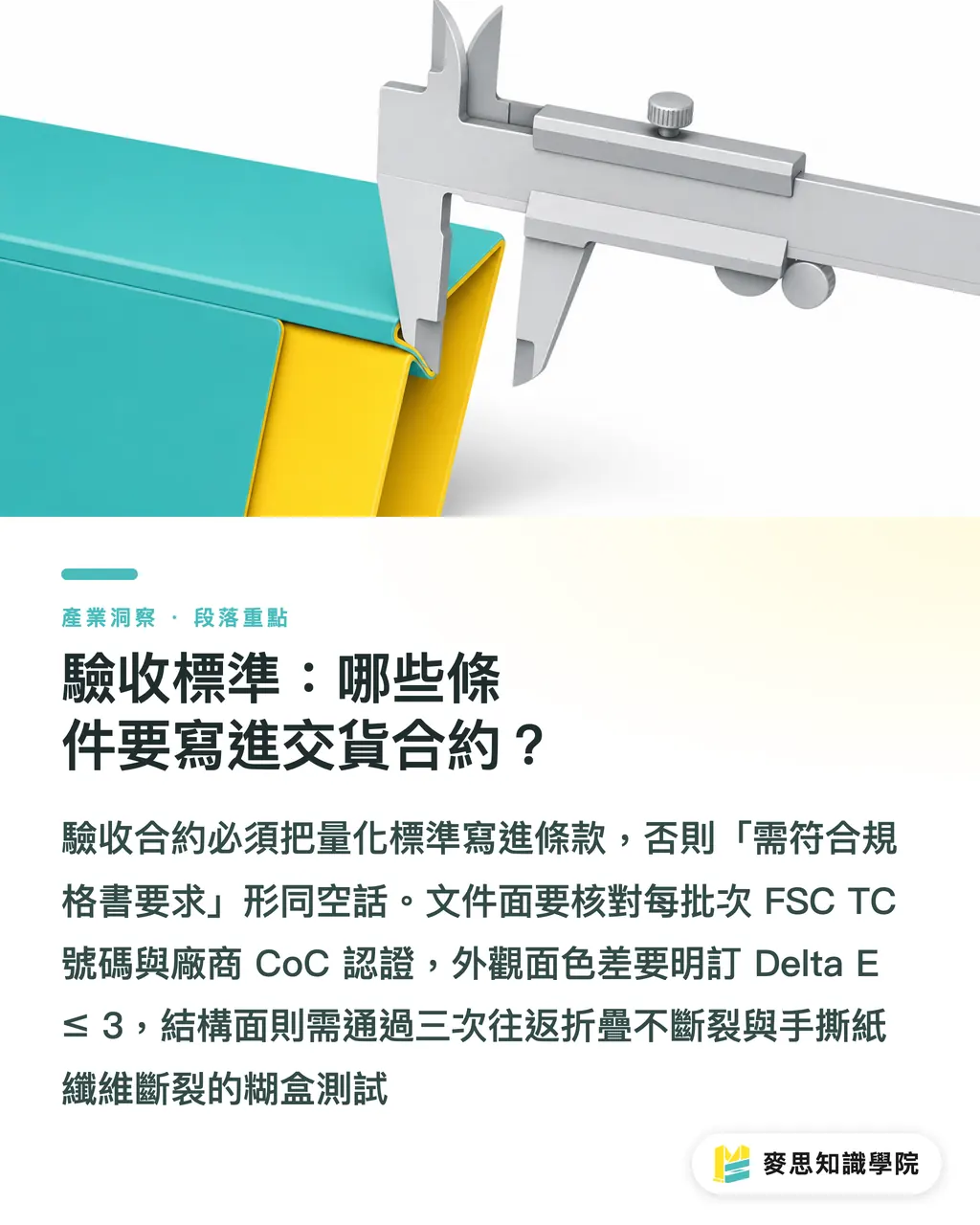
・The color difference standard should be written as Delta E ≤ 3. Food and medical packaging usually require ≤ 2
・The acceptable ratio of print defects must be specific, such as no more than 0.3% color-difference items per thousand pieces and 0% glue-line detachment
Structural acceptance
・Folding strength: folding-carton crease lines must withstand more than three back-and-forth folds without cracking
・Glue-box strength: in a hand-tear test, the glue line should fail in the paper fiber, not separate at the glue surface
・Stacking pressure: e-commerce shipping packaging should include a six-layer stacking pressure requirement, with conditions confirmed before delivery
If you want a purchasing specification template aligned with the FSC certification process, or want a consultant to help clean up your current RFQ conditions, you can check with the sales team at MINDS. They have run the full certification process for high-end fully custom packaging and can clarify the details before the RFQ goes out
Key Takeaways
・The four words "eco-friendly material" do not map to any material code. Break them into three layers: raw material source, FSC claim type, and grammage. Only then can quotes be compared on the same basis
・FSC claims fall into three types: 100%, Mix, and Recycled. Each has different cost and traceability requirements. To use the FSC mark, the printer must hold CoC certification. Specifying the paper alone is not enough
・BOPP lamination and eco-friendly packaging claims usually cannot coexist. The spec sheet should explicitly exclude it and use water-based varnish instead
・The proofing sheet must lock in the paper brand and FSC claim type. Material switching in mass production is the most common reason things go wrong after a proof is approved
・Acceptance clauses must be quantified: write the Delta E value for color difference, and require FSC documents down to the batch-specific TC number. Do not just write "meets the specification sheet."
Further Thinking
Building a sustainable packaging specification sheet to this level does add some early purchasing preparation, but the communication loops and sample remake costs saved later usually far outweigh the time spent upfront. For designers, the most direct way to put this into practice is to submit a post-processing restriction list together with the artwork, clearly stating which surface treatments cannot be used under this spec sheet, instead of leaving that work for purchasing to patch later. For SaaS teams developing packaging management tools, sustainable specification sheets are already structured enough to be turned into a standardized spec-generation interface, allowing buyers to choose from option sets and output a supplier-ready format, cutting large amounts of repeated back-and-forth confirmation. The five-layer framework maps to five field groups, and each field group has a limited set of values, so the data model is not hard to build
FAQ
- How should buyers choose between FSC Mix and FSC Recycled?
- FSC Mix allows certified pulp and recycled material to be mixed. It costs less, is easier to source, and suits most general packaging. FSC Recycled requires 100% recycled material and a supplier with CoC certification. It suits products where the brand needs to clearly state the recycled content. In both cases, the printer must hold CoC certification before the final box can use the FSC mark
- Does the ink type have to be written in the quote request?
- Yes. It has to be written. Vegetable-based ink, such as soy ink, costs 15-25% more than standard ink, and UV ink has sorting restrictions in some recycling systems. If you do not specify it, the supplier will quote with the lowest-cost option by default, and the returned price will not be meaningful for comparison
- What supplier qualifications need to be confirmed for an FSC mark on packaging boxes?
- The printer itself must hold FSC Chain of Custody (CoC) certification, and the number must be entered in the quote and acceptance documents. If you only specify FSC-certified paper but the printer does not have CoC certification, the final product cannot use the FSC mark under the rules
- The proof was approved, but color difference showed up in mass production. What usually went wrong?
- The most common cause is that the proofing stock and mass-production stock came from different brands, or the supplier changed color management settings during mass production. To avoid this, lock the paper brand and the same FSC claim type in the proofing sheet, and require a mass-production color difference report with Delta E values
- Must the FSC Transaction Certificate be requested during acceptance?
- If the box surface shows FSC certification, then yes. Under the rules, a TC must be requested for every batch and checked against the supplier's CoC certification number. This is a mandatory document during FSC audits. Getting it after the fact is very time-consuming, so it should be listed as a delivery condition in the purchase contract
References
- FSC 官方標章說明(FSC Mix/FSC Recycled 定義) · fsc.org
Related articles

The Print × AI weekly
The print and AI know-how designers, brands and enterprises can use before they commit — one email, every week
MINDS Free Tools
AI background removal, a LINE sticker maker, spine & imposition calculators — all free, right in your browser, no upload.
MINDS Group
Need actual printing or gifting services?
From premium printing to online ordering and festive gifts — the MINDS Group sister brands take it from here.