
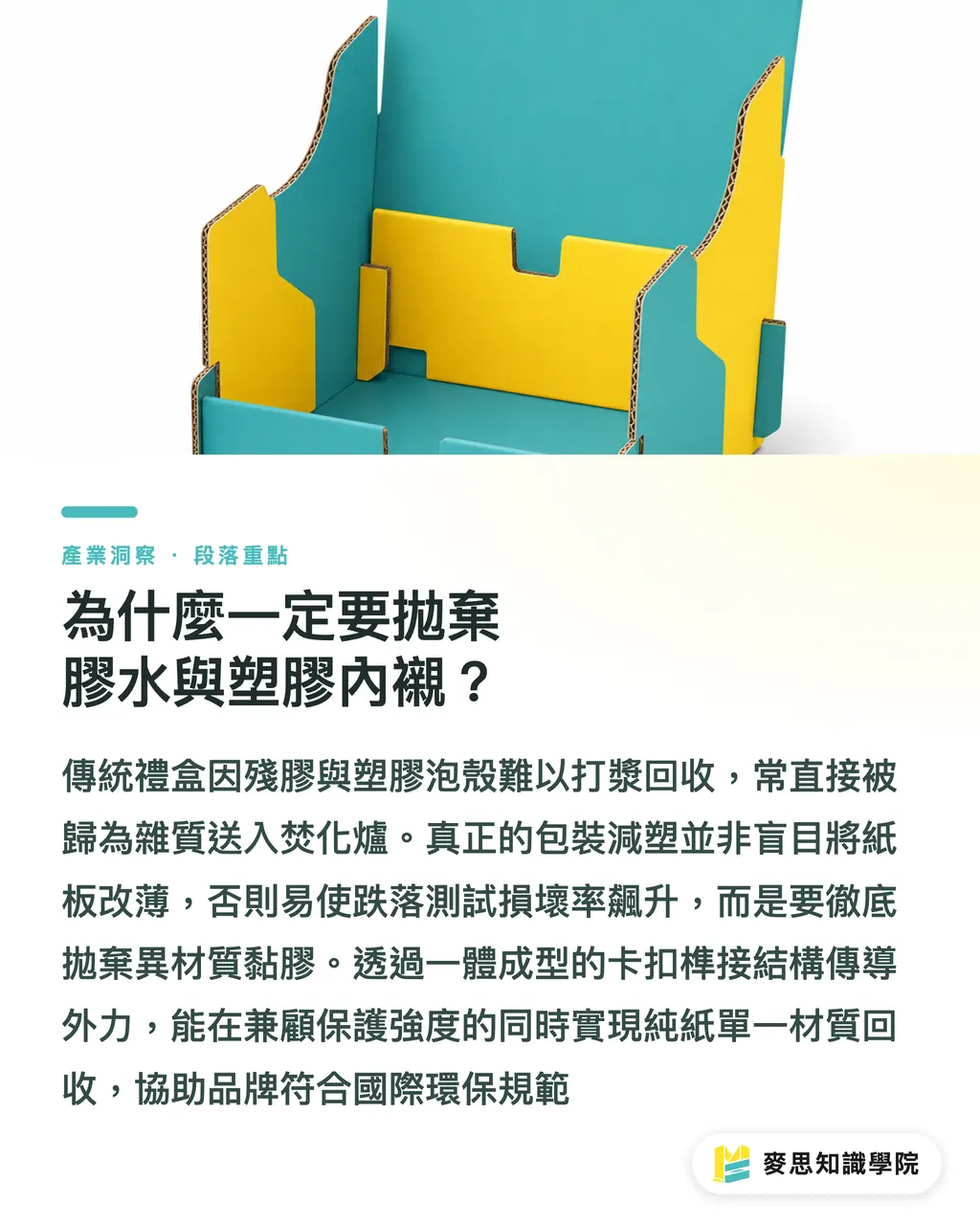
Why must glue and plastic liners be dropped?
A plastic-free one-piece paper box with no glue or liner uses snap-lock tenons, auto-lock bottoms, and integrated structures to transfer external force, combined with paperboard edge crush strength (ECT) calculations to replace conventional packaging
In production practice at MINDS, this method has become a core solution for helping brands move away from mixed materials and achieve single-material recycling
A plastic-free one-piece paper box is a pure-paper packaging structure that uses no glue or plastic liner at all. It relies on folded, one-piece paperboard and snap-lock tenons to provide both protection and packaging function
Traditional gift boxes have long relied on plastic blister trays to hold products in place, while using large amounts of double-sided tape to bond paperboard. At the recycling end, this creates a serious mess
When a recycling facility sees a paper box laminated with plastic film or contaminated with double-sided tape residue, it is usually classified as impurity and sent to incineration instead of being pulped smoothly
For brands that need to meet international Extended Producer Responsibility (EPR) rules, giving up Styrofoam and plastic foam is the first step
Over the past month or two, I have seen quite a few e-commerce clients on the production floor assume that reducing plastic simply means making corrugated board thinner. Once the drop test was done, the product damage rate jumped by 15%
Real packaging reduction cannot be done by guesswork. The key is to drop mixed-material adhesives and use interlocking snap-locks and paper structures to absorb impact force
Four Core Methods for All-Paper Snap-Lock Design
To hold products in place without any glue, structural designers need to use four all-paper methods with flexibility
No need to rush. Let's break down the structures most commonly used on production lines one by one:
・Mortise-and-tenon structure: raised tabs and slots on the paperboard edges interlock with each other, providing pull-out resistance in the direction of tension. This works well for the connection between the lid and the main body
・Auto-lock bottom structure: the four bottom flaps are folded and pressed into an overlapping pattern. After the product is placed inside, gravity makes the bottom lock tighter as the load gets heavier, removing the gluing step entirely
・Folded-corner protection method: double-layer or triple-layer hollow folded corners are designed into the eight corners of the box, forming natural paper cushioning pockets that offset corner impacts during shipping
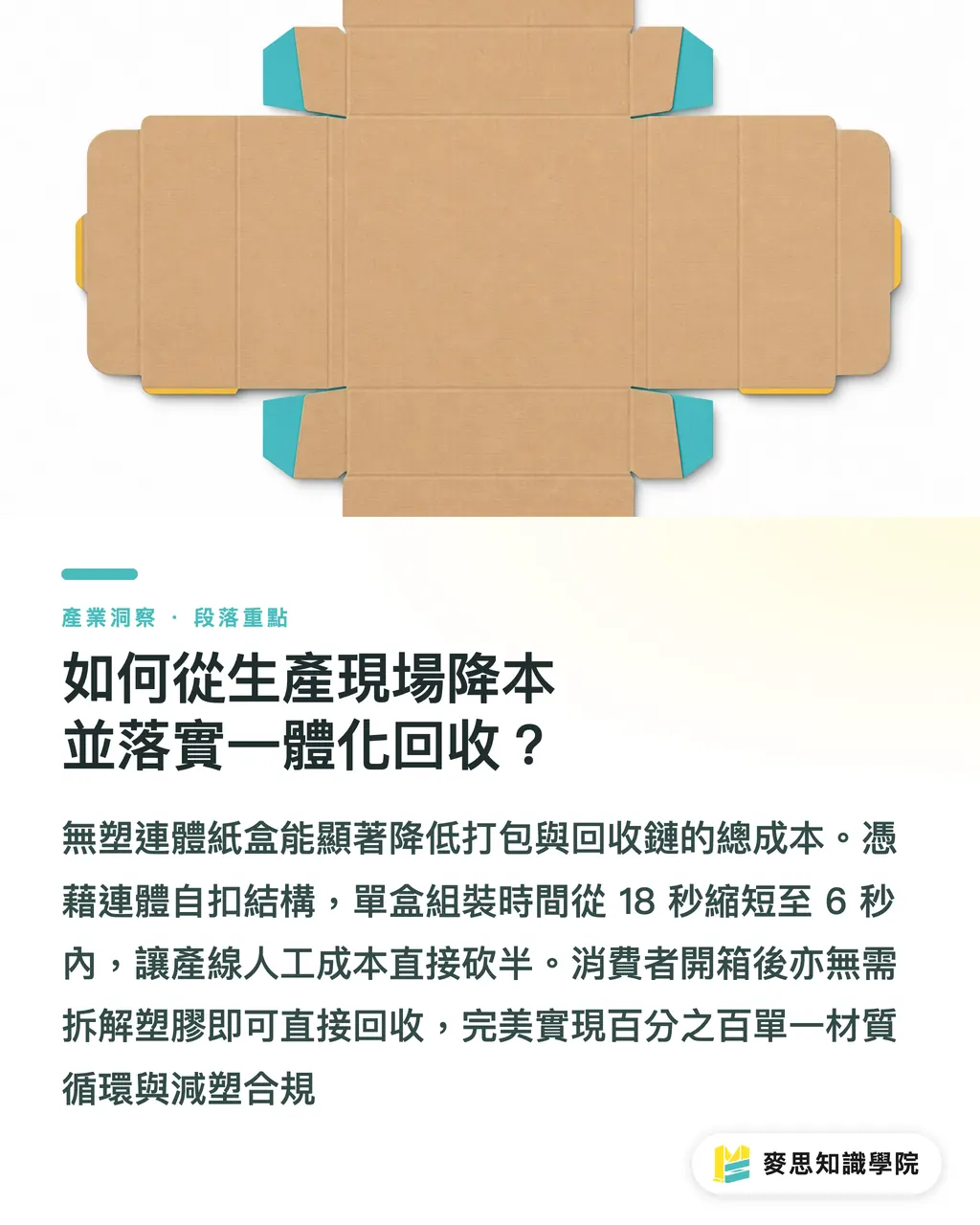
・One-piece structure: the outer box and internal holding frame are integrated into a single dieline. One sheet of paperboard folds all the way into shape, preventing loose parts and reducing the cost of secondary manual assembly at the factory
During specification decisions, the Mai Strategy Knowledge Academy consulting team often reminds designers to apply the three plastic-free snap-lock checks used by MINDS (MS, mid- to high-end fully custom commercial printing): ① structural tenons replacing adhesive, ② calculated snap-lock overlap for locking strength, and ③ folded-corner cushioning to spread drop impact
These steps make sure the paper box connects precisely from dieline drawing to automated die-cutting
How can packaging pass drop and impact tests without glue?
Whether a snap-lock can stay tight comes down to accurate calculation of snap-lock overlap and paperboard edge crush strength (ECT)
Snap-lock overlap is usually set at 1.5 to 2.0 times the paperboard thickness. If using 0.5 mm grey-backed white board, the snap-lock insertion overlap should be at least 0.8 mm to 1.0 mm to create effective friction locking
If the overlap is too small, it loosens easily. If it is too large, the board may not insert properly during automated packing or manual assembly, causing folding damage
Paperboard compression strength (ECT) determines how well the packaging can withstand stacking pressure. The calculation must account for the paperboard's ring crush test value (RCT) and the direction of the corrugated flutes
In practice, the flute direction must be perpendicular to the load-bearing surface. Vertical flutes can provide about 3 times the compression strength of horizontal flutes
It is simple: as long as the force direction of the flutes is calculated correctly at the design stage, an all-paper structure can still pass a 1.2-meter free-drop test with no glue at all
How can production costs be cut while enabling one-piece recycling?
The most direct economic benefit of plastic-free one-piece paper boxes shows up in lower total costs across factory packing and the recycling chain
Traditional packaging with plastic liners and adhesive requires workers to peel tape strips, press parts together, and place the liner during assembly. On average, each box takes 18 seconds to assemble
After switching to a one-piece auto-lock structure, operators only need to fold twice along the creases to form the box. Assembly time drops to under 6 seconds, cutting production-line labor cost by half
At the waste-processing end, consumers do not need to separate the plastic blister tray from the paper box after unboxing. The whole paper box can be flattened and placed directly into paper recycling
This not only delivers a true 100% single-material cycle, but also gives brands solid low-carbon data when facing EU plastic-reduction regulations
Key Takeaways
・The key to dropping glue and plastic liners is using one-piece structures and snap-lock tenons to transfer external impact force
・Recommended snap-lock overlap is 1.5 to 2.0 times the paperboard thickness to ensure locking strength and smooth assembly
・When corrugated flutes are perpendicular to the load-bearing surface, compression strength can increase by about 3 times, allowing packaging to pass drop tests without adhesive
・A one-piece formed dieline can reduce production-line assembly time from 18 seconds to 6 seconds, significantly lowering labor cost
・A fully single-material design allows discarded packaging to enter the paper-pulp recycling system directly, putting low-carbon ESG benefits into practice
Further Thoughts
Plastic-free packaging structure design has moved from a marketing bonus to a hard requirement for brands facing global regulations
For printing manufacturing and graphic design, future competitiveness will no longer be only about how beautiful the print looks. Physical load calculations must be built into file preparation and dieline design from the start
The adoption of AI tools and automated CAD software can help designers quickly simulate paperboard folding and stress points, shortening a process that once required repeated prototyping into just a few hours
Packaging buyers and design teams should work with printing plants that have structural engineering capability as early as the project kickoff stage. From paper gsm and flute direction to snap-lock sizing, everything should be planned quantitatively to create modern packaging that combines protection, low cost, and environmental friendliness
Further Reading
・E-commerce cartons keep getting crushed? Breaking down 3 structural optimization cases for impact-resistant packaging
・Why are packages with recycling marks still rejected? A practical guide to single-material packaging
・Reducing packaging material without sacrificing protection: a lightweight design guide for gsm, structure, and cushioning materials
・From EV charger packaging to circular spirits packaging: a brand practice guide to all-paper and reusable packaging
FAQ
- How can a plastic-free one-piece paper box prevent snap-locks from coming loose during shipping without using double-sided tape?
- It mainly depends on accurate calculation of snap-lock overlap and the elastic tension of the paperboard. Setting the overlap at 1.5 to 2.0 times the paper thickness, paired with a barbed tenon design, makes the snap-lock tighten under external pulling force during impact
- Are plastic-free one-piece paper boxes suitable for heavier or fragile products?
- Yes. As long as double-layer hollow structures are planned inside the box through folded-corner protection, and corrugated board is used with the flutes perpendicular to the load-bearing direction, the result is an excellent cushioning pocket effect with protection comparable to traditional plastic blister trays
- Will using a plastic-free one-piece structure greatly increase paper usage and printing cost?
- No. Although the unfolded area of a one-piece dieline may be slightly larger, it removes the procurement cost of plastic liners, the gluing process, and a large amount of assembly labor, so total packaging cost usually goes down instead of up
Related articles
The Print × AI weekly
The print and AI know-how designers, brands and enterprises can use before they commit — one email, every week
MINDS Free Tools
AI background removal, a LINE sticker maker, spine & imposition calculators — all free, right in your browser, no upload.
MINDS Group
Need actual printing or gifting services?
From premium printing to online ordering and festive gifts — the MINDS Group sister brands take it from here.