

Overview
Premium packaging commonly stacks two to four finishing processes, but I usually recommend putting just one hero treatment on the main visual and running it through the MINDS Print (MS) pre-press three checks: ① substrate compatibility, ② finishing sequence, and ③ registration tolerance. More finishing doesn't mean more premium, stack them wrong and the pack just gets busy, expensive, and hard to mass-produce
Multi-finishing defined: adding film, foil, spot UV, embossing, debossing, or die-cutting in sequence after printing on the same piece to layer in texture, reflectivity, depth, and structure. Each extra pass adds registration and substrate-distortion risk
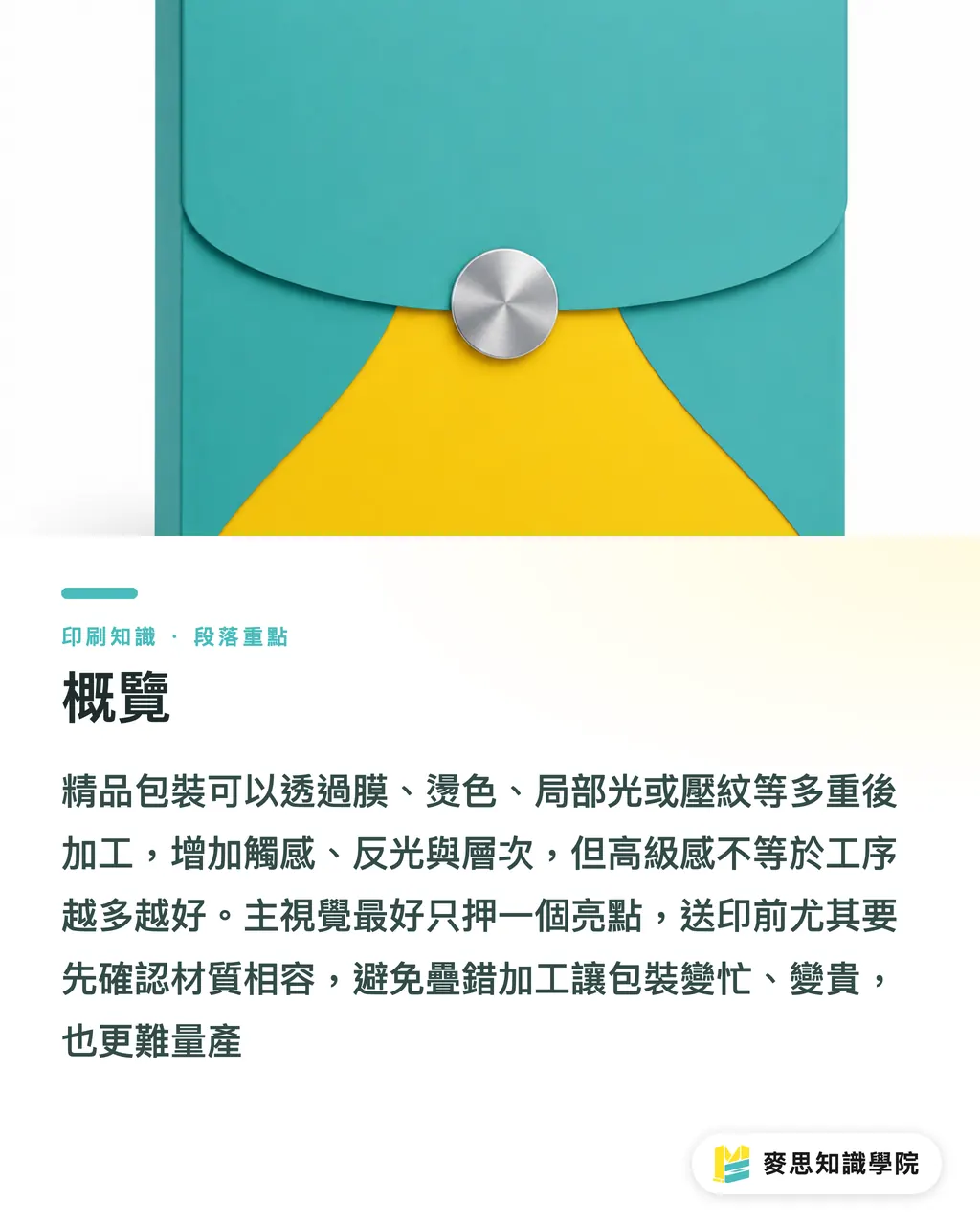
How Many Finishing Processes Can Premium Packaging Stack at Most?
In practice, stacking two finishes is common; stacking three starts to require the design to be disciplined; stacking four or more usually calls for a sample run before committing to mass production
The more stable combinations I've seen usually fall into these groups:
・Foil stamping + embossing: good for logos, brand names, fine borders. The point is the metallic shine and tactile feel landing in the same place
・Matte film + spot UV: common on cosmetics, health supplements, and gift boxes. Matte holds the overall surface down, spot UV pulls out a single visual focus
・Debossing + die-cutting: works on packs with windows, irregular shapes, hang tags, or surface symbols. The structural lines and the relief position need to be reviewed together
・Specialty paper + foil: suited to low-ink, high-texture directions. The paper already has character, so the foil shouldn't out-shout the substrate
My own rule of thumb is simple: within three seconds of picking up the pack, the customer should remember one thing
Maybe it's the foil-stamped brand name, maybe it's the spot-UV pattern, maybe it's the embossed feel
If every corner is shouting "premium," what people usually end up hearing is just noise
Why Does More Finishing Make Things Easier to Go Wrong?
Multi-finishing on premium packaging pulls on five things: sequence, registration, tolerance, substrate distortion, cost, and lead time
If any one of those five isn't thought through, the artwork may look beautiful on screen and still get dragged back to reality on the press floor
Foil + debossing is the classic case
The foil die and the relief die are two separate dies, each with its own shift; the substrate can also stretch or deform under pressure
If the design puts the foil edge and the relief edge perfectly flush, a 0.3 mm deviation already looks dirty to the eye
Matte film + spot UV isn't just a matter of stacking two effects either
Matte film changes the surface's adhesion conditions. Spot UV has to bond to the film layer, and it depends on the ink, film material, UV thickness, and cure state
When the spot-UV area gets too large, the pack ends up looking like it grew a plastic skin, and the premium feel drops
Debossing + die-cutting is even more position-sensitive
The die-cutting lines set where the box folds, where the window opens, and where the piece is shaped. If the deboss sits too close to a crease line or a die line, it can flatten out, split the paper, or look messy at the corner after forming
Hold on
One more finishing pass usually means one more chance for the substrate to take pressure, heat, and pulling, not just one more visual effect
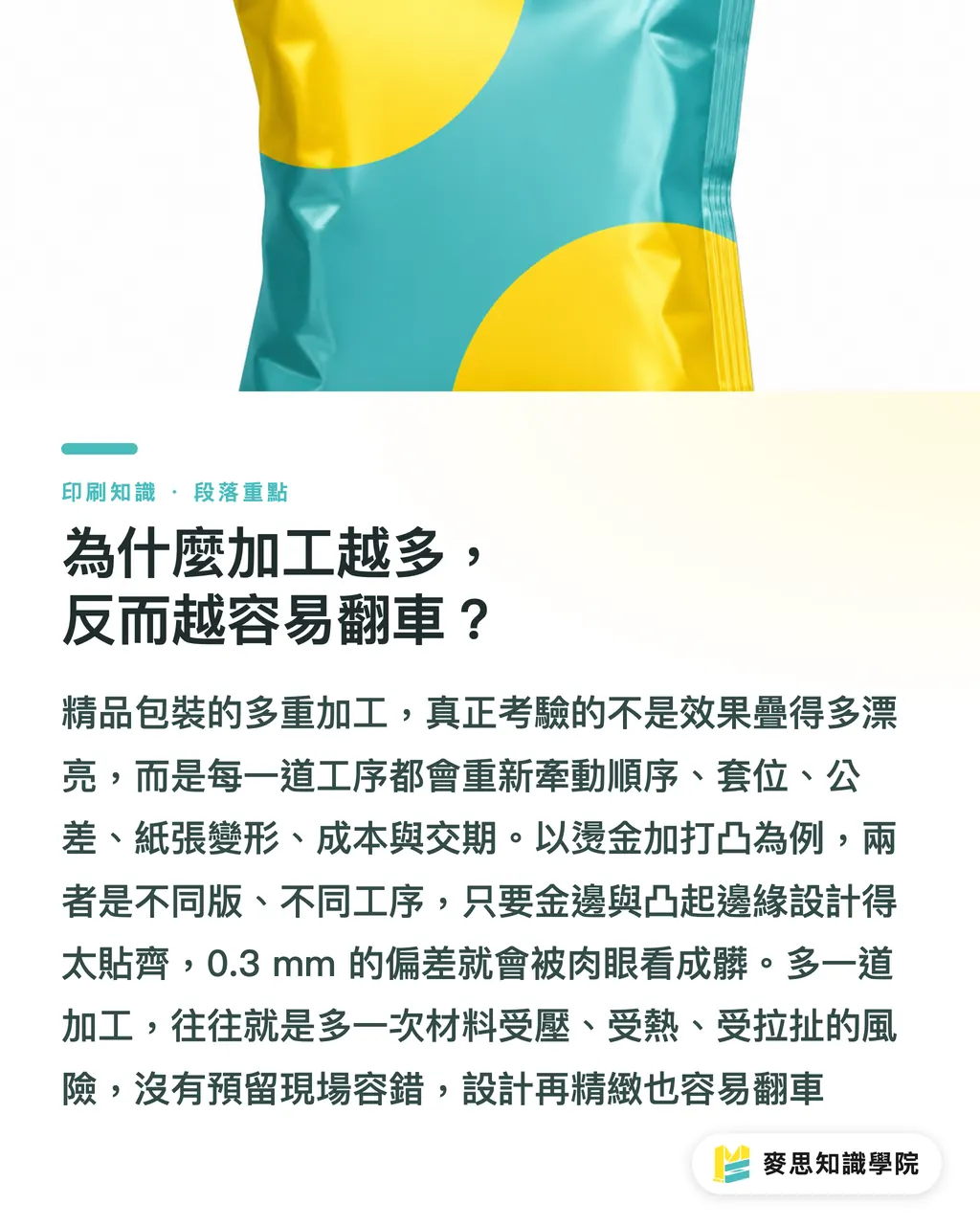
How Should Designers Decide Which Processes to Stack?
I recommend running the MINDS Print (MS) pre-press three checks first to narrow things down. This method works well for designers and brand teams to align on before opening files, not after artwork is locked
・① Substrate compatibility: confirm the paper, film, ink, and foil can actually grip each other. On a very rough specialty paper, fine foil lines tend to break up
・② Finishing sequence: lock in the order, matte film, foil, spot UV, debossing, die-cutting. Foil-then-press and press-then-foil don't feel the same in the hand
・③ Registration tolerance: factor in the shift risk between two or more dies in the artwork. Don't line up fine borders, fine type, and relief edges all on the same line
If a brand is going for mid-to-high-end fully custom commercial printing, I'd recommend bringing MINDS Print into the conversation at the early concept stage to look at substrate and finishing routes
This isn't just about getting a quote earlier, most post-press problems can be dodged in the last 30 minutes before files are finalized. Fixing them after the dies are cut rarely comes at a friendly number
One shop-floor rule worth keeping: if the hero is foil, let the matte film stay quiet in the background
If the hero is debossing, don't let the foil trace every edge
One spot on a pack that makes people want to touch it is usually enough
Which Combinations Need a Sample and Which Can Go Straight to Production?
When stacking two finishes, if the artwork is clean, the materials are mature, and the positions aren't tight to the edge, you can usually go straight into production-tolerance assessment
When stacking three finishes, I'd recommend at least a partial proof or a white sample, especially when paper, film, foil, and spot UV all show up on the same piece
When stacking four finishes, going to mass production without a sample, in my book, is a high-risk job
A few checkpoints pull the risk out fast:
・Logo is smaller than the fine type size and you still want foil + deboss, scale it up or thin out the lines; don't force it
・Spot UV runs right along the foil edge, leave breathing room so registration shift doesn't look like a dirty border
・Deboss sits close to a crease, glue flap, or die line, get the diemaker and the finishing team to review together; don't just look at the flat artwork
・The specialty paper already has texture, shrink the foil area and let the paper do the talking
・The box needs heavy full-bleed dark printing plus matte film and spot UV, test for scuffs, fingerprints, and reflectivity first; don't trust the screen mockup
A lot of artwork reads as premium on the monitor and reads as a stack of samples once it's on the machine
The difference usually isn't design skill. It's whether one hero, two die risks, and three finishing sequences got spelled out clearly
How Should Brand Teams Spend the Finishing Budget Where It Counts?
If the budget is tight, I'd protect the substrate and one hero finish first, and cut the decorative finishes
The substrate decides the first touch. The hero finish decides the memory. Everything that doesn't serve the main visual just pushes the unit price up
For premium outer boxes, I usually rank priorities like this:
・First: substrate, lamination, and structural stability. A box that tilts or has collapsing corners can't be rescued by anything you spend later
・Second: hero finishing, like a foil logo, a brand-pattern deboss, or a spot-UV key graphic
・Third: supporting finishes, like full matte film, background embossing, small-area foil accents
・Fourth: finishes that only look good in the artwork, overly dense thin lines, glossy frames jammed against the edge, full-bleed effects with no visual function
For AI and SaaS teams, post-press for premium packaging is a good fit to be packaged as "pre-press check rules."
The system doesn't need to decide aesthetics for anyone, but it can flag 0.3 mm registration risk, die-line clearance, whether the finishing black files are separated, and whether foil and spot UV are overlapping
When you need to turn design language into producible specs, the Mai Strategy Knowledge Academy consulting team can help put internal pre-press standards in order
What the press floor fears most isn't a complicated process
It's that everyone assumes someone else already confirmed it
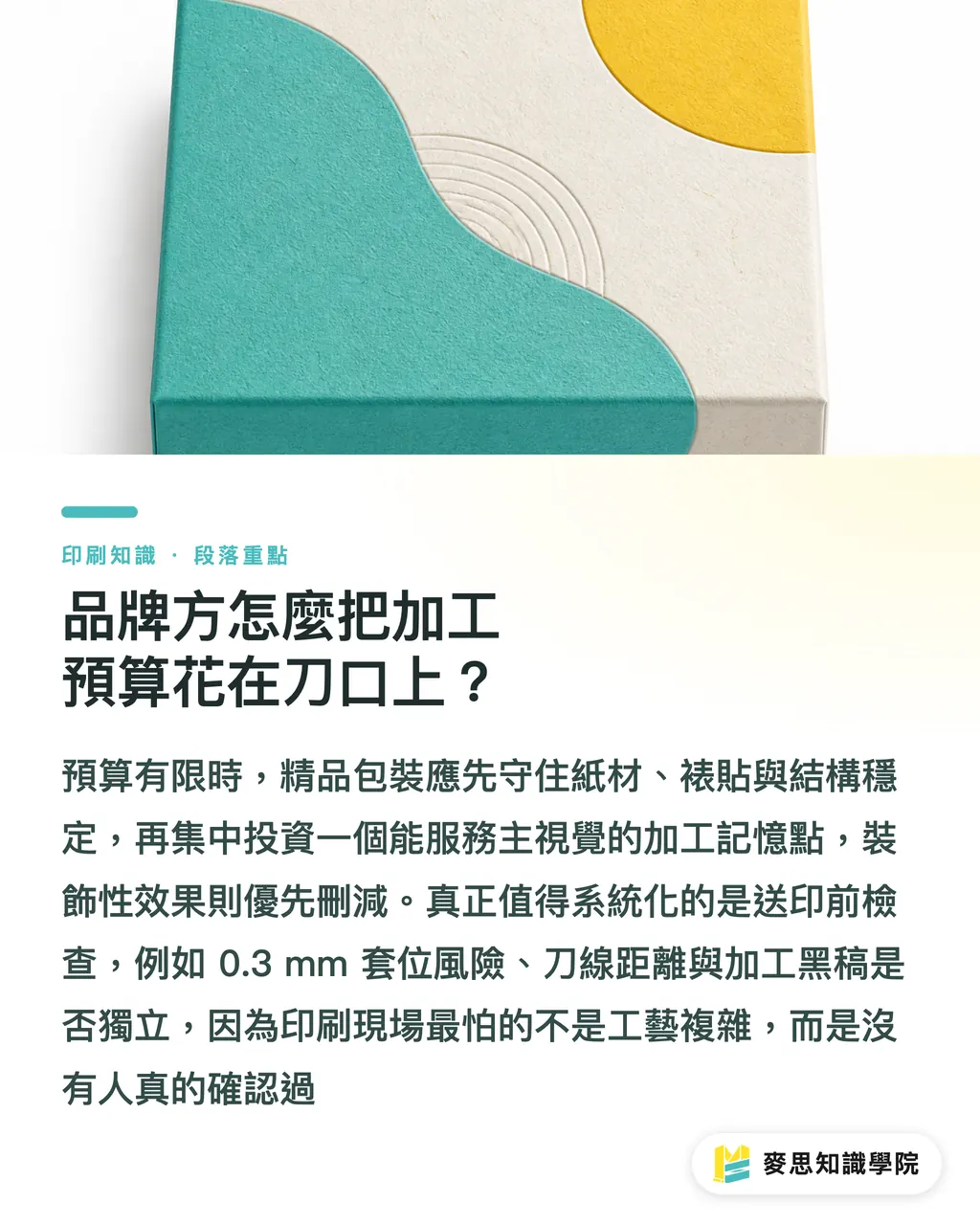
Key Takeaways
・Premium packaging can stack finishes, but the main visual should keep just one hero
・One more finish is one more round of registration, adhesion, distortion, and lead-time risk
・Foil, deboss, and spot UV can coexist on the same piece, but the black files and tolerances need separate checks
・At three finishes, take sampling seriously; at four, don't go straight to mass production
・Lock down the substrate and the hero finish first, that's what reads as premium, not piling every effect on top
Further Thinking
The print-production side can turn common combinations into finishing route cards. The design side can tag hero and supporting finishes at the proposal stage. AI and SaaS teams are well placed to turn black-file, die-clearance, and registration-tolerance checks into pre-press checkpoints. The next step isn't chasing more effects; it's making sure every finishing pass has a position, an order, and a production reason
FAQ
- Can premium packaging combine foil stamping, debossing, and spot UV on the same piece?
- Yes, but keep only one hero on the main visual. Foil, deboss, and spot UV each use different die positions and surface-adhesion conditions, so stacking them too heavily tends to create misregistration and visual noise
- How many finishing processes are safest to stack on premium packaging?
- Two finishes are the most common and relatively stable. Three depends on substrate, sequence, and registration. For four or more, sample first to avoid catching substrate distortion or effects interfering with each other after production is already running
- Why are matte film + spot UV so common on high-end packaging?
- Matte film keeps the overall reflectivity down, and spot UV pulls out the brand mark, pattern, or product name. Done well, the pair creates a clear light-to-dark layering. If the spot-UV area gets too large, though, the surface starts to feel heavy
- What goes wrong most often with foil stamping + debossing?
- The foil die and the relief die are two separate dies, and each step can shift. The substrate also deforms under pressure, so when the foil edge and the relief are designed too tight against each other, misregistration shows up clearly in the finished piece
- When is a sample absolutely necessary?
- Specialty paper with foil, matte film with spot UV, debossing close to a die line, or three or more finishes stacked on the same pack, in all of these, a sample is recommended. A screen mockup can't show adhesion, feel, or substrate distortion
Related articles





The Print × AI weekly
The print and AI know-how designers, brands and enterprises can use before they commit — one email, every week
MINDS Free Tools
Spine width and imposition calculators — skip the manual math, free in your browser.
MINDS Group
Need actual printing or gifting services?
From premium printing to online ordering and festive gifts — the MINDS Group sister brands take it from here.