
"Carbon Footprint Verification" and "Carbon-Neutral Printing" Are Two Different Things
One of the questions procurement teams ask me most often is what exactly separates these two terms. I understand why people get confused. Sales teams often put them on the same slide, making it sound as if doing one means you have done the other
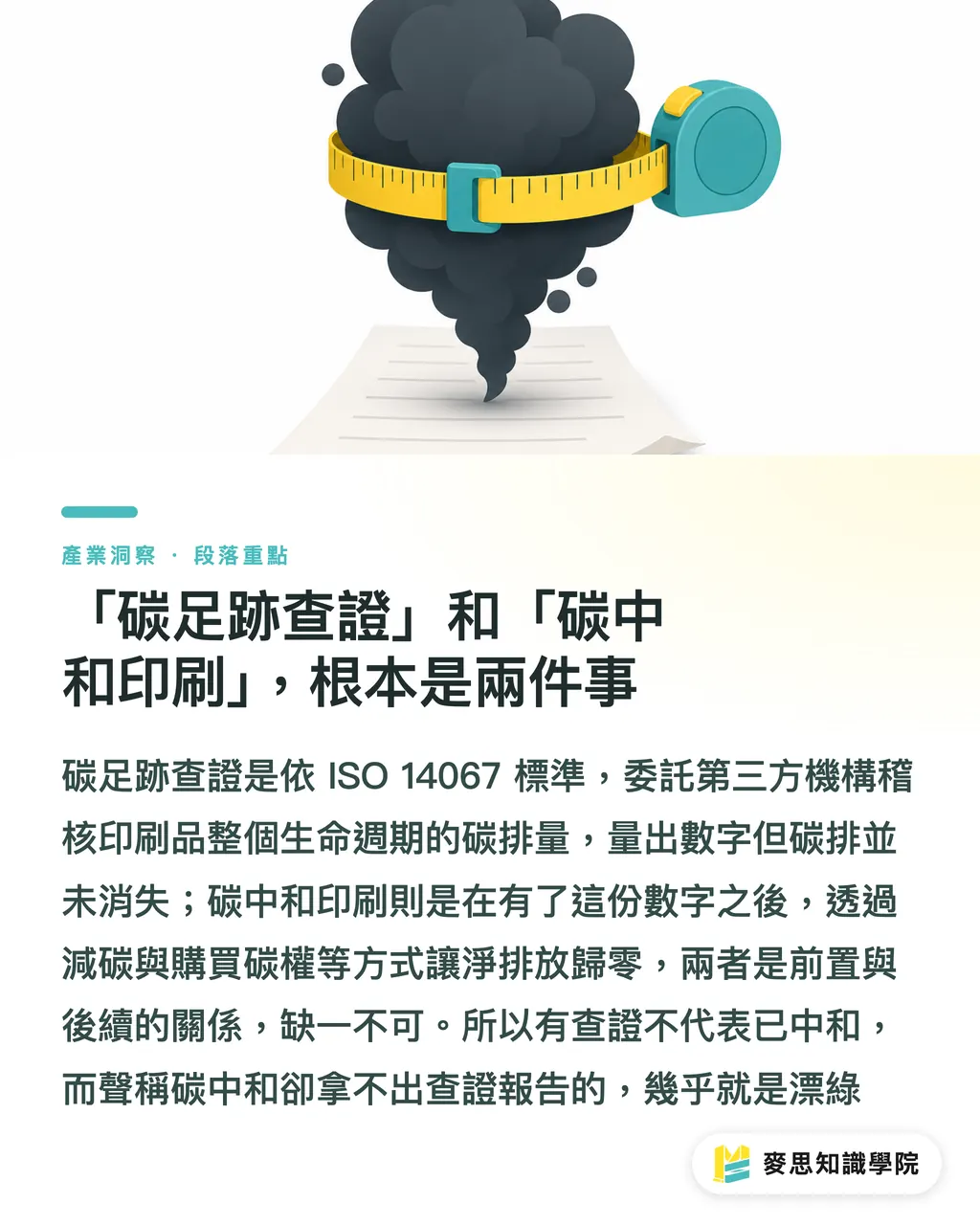
Carbon footprint verification means using the ISO 14067 standard to calculate the greenhouse gas emissions of a printed product across its life cycle, from raw materials, manufacturing, and transportation to disposal, then having those figures audited and confirmed by a third party. In Taiwan, that usually means verification bodies such as SGS, BSI, or Bureau Veritas. The output is a "carbon footprint report" that tells you how many kilograms of CO₂e each business card or packaging box in that batch emitted. It is a measurement tool. After the measurement is done, the carbon emissions are still there. They have not disappeared
Carbon-neutral printing comes after the carbon emissions have been calculated. The printer reduces emissions through lower-carbon measures, then offsets the remaining amount by buying carbon credits, planting trees, or using other offset methods, so the "net carbon emissions" of that batch of printed products reach zero on paper. It is an offsetting action. But first, you have to know how much needs to be offset, so carbon footprint verification is a required first step for carbon neutrality
Put simply: verification does not mean neutralization. And if someone claims carbon neutrality without verified numbers, it is almost certainly greenwashing
Where Are the Carbon Emissions in Printed Products Hiding?
Many people think a printing plant just runs machines and puts ink on paper, so emissions cannot be that high. Based on what I have seen on production lines, the carbon footprint of a batch of printed products usually looks roughly like this:
・Paper, or base paper: This usually accounts for 40%, 60% of the total carbon footprint, making it the largest single source. Paper involves logging, pulping, and papermaking, all of which use a lot of energy and water. For the same gsm, recycled paper does have lower carbon emissions than virgin wood pulp paper, but the gap is not as dramatic as marketing copy often makes it sound. It depends on origin and production process
・Electricity used in the printing process: This includes printing presses, drying equipment, and air-conditioned plants. This part is directly tied to whether the printer has adopted green power or solar energy, so it is easier to reduce through an energy switch
・Ink and auxiliary materials: Water-based ink has lower carbon emissions than solvent-based ink, while UV ink follows a different calculation logic. Auxiliary materials such as varnish, glue, and plates add up too
・Transportation: From supplier to printer, then from printer to customer. Emissions here depend on distance and transport mode. Within Taiwan, this part is usually smaller, but if the base paper is imported from overseas, it cannot be ignored
ISO 14067 requires all of these to be included, whether the boundary is "cradle to gate" or even "cradle to grave." You cannot count only the few hours when the printing press is running
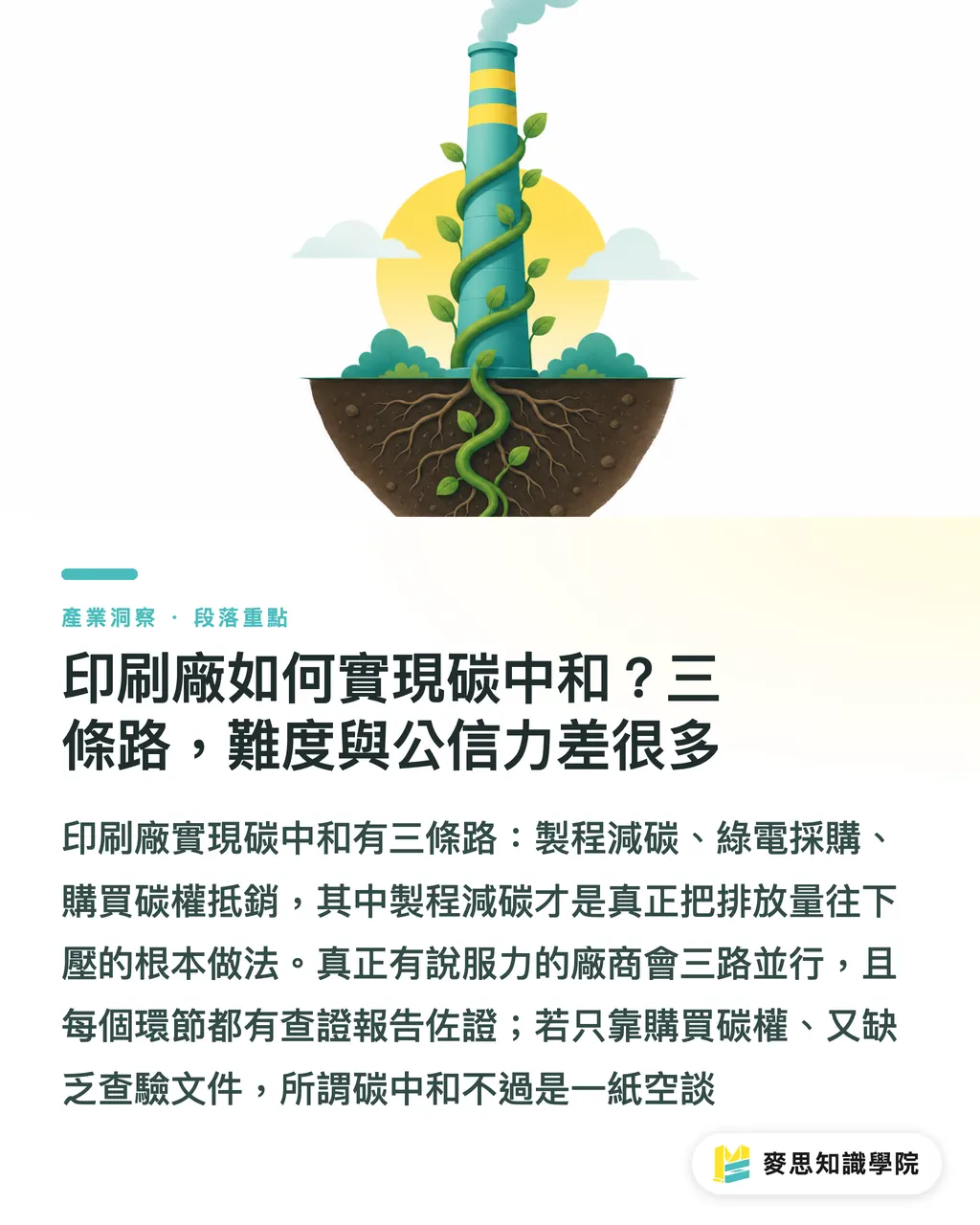
How Can a Printing Plant Achieve Carbon Neutrality? Three Routes, With Very Different Difficulty and Credibility
Most vendors in the industry that pursue carbon neutrality use some mix of the following three routes:
・Process decarbonization: Replacing energy-hungry equipment, adopting LED UV printing, which saves about 40-60% of electricity compared with traditional hot-air drying, recovering waste heat, and reducing plate loss and paper waste. This is the path that actually pushes emissions down. It is the most grounded route
・Green power procurement: Applying to Taipower for renewable energy certificates (T-REC) or signing a PPA, or power purchase agreement. This lowers the carbon emission factor for electricity used inside the plant, but carbon verification bodies do not all handle the documentation in exactly the same way. Procurement teams should ask vendors to explain the deduction logic clearly
・Buying carbon credits for offsets: Purchasing verified emission reductions from approved programs, such as VCS or Gold Standard, to offset the remaining emissions that cannot be eliminated after verification. This route is still at an early stage in Taiwan, and carbon credit quality varies a lot. My personal advice is that procurement must ask exactly what project the credits came from and who issued them
A truly convincing carbon-neutral printing plant will pursue all three routes in parallel, with verification reports supporting the numbers at each step. If a vendor relies only on buying carbon credits and has no verification report, the carbon-neutral claim is hard to believe
What Documents Should You Ask Suppliers for Before Awarding a Job?
This is the question I get most often whenever I help clients evaluate green procurement. I have put together a procurement checklist for MINDS (MS, mid- to high-end fully customized commercial printing), and procurement teams can use it directly:
・ISO 14067 third-party verification report: Ask for a carbon footprint report for the specific printed product or item, not the company's overall CSR report. The report should include the verification body's seal, a clear definition of the functional unit, such as per piece or per kilogram, and the validity period
・System boundary description: Check whether the report clearly states what is included and what is excluded. Some vendors' verification only counts electricity consumed by printing machines and leaves out base paper. A report with such a narrow boundary has limited reference value
・Basis for the carbon-neutral claim: If a vendor claims carbon neutrality, ask for the issuing body and serial number of the corresponding carbon credits. You can check the issuing body's website yourself to confirm that the credits have not been used twice
・Green power documents: T-REC certificates or a copy of the PPA contract, used to confirm the green power source for electricity consumed inside the plant
・Vendor's historical decarbonization data: Ask whether the vendor has year-by-year carbon intensity data, such as carbon emissions per 10,000 reams of paper. This shows whether they are actually reducing emissions instead of relying on carbon credits every year to keep the books looking clean
When MINDS takes on green ESG projects, it proactively provides clients with a verified carbon footprint audit summary for checking. Procurement teams do not need to chase extra documents. In my view, that is the baseline action any sincere vendor should be taking
How Do You Spot Greenwashing? Watch for These Warning Signs
Looking at the clients and projects I have worked with recently, greenwashing tactics are getting more polished. Still, several patterns remain obvious:
・The vendor claims "carbon-neutral printing" but cannot provide any third-party verification report, only self-made charts or verbal promises
・The carbon footprint report is the company's overall environmental report, not a specific verification for this batch of printed products
・The vendor cannot clearly explain the carbon credit source, or the credits come from forest conservation projects that have already been criticized for lacking "additionality."
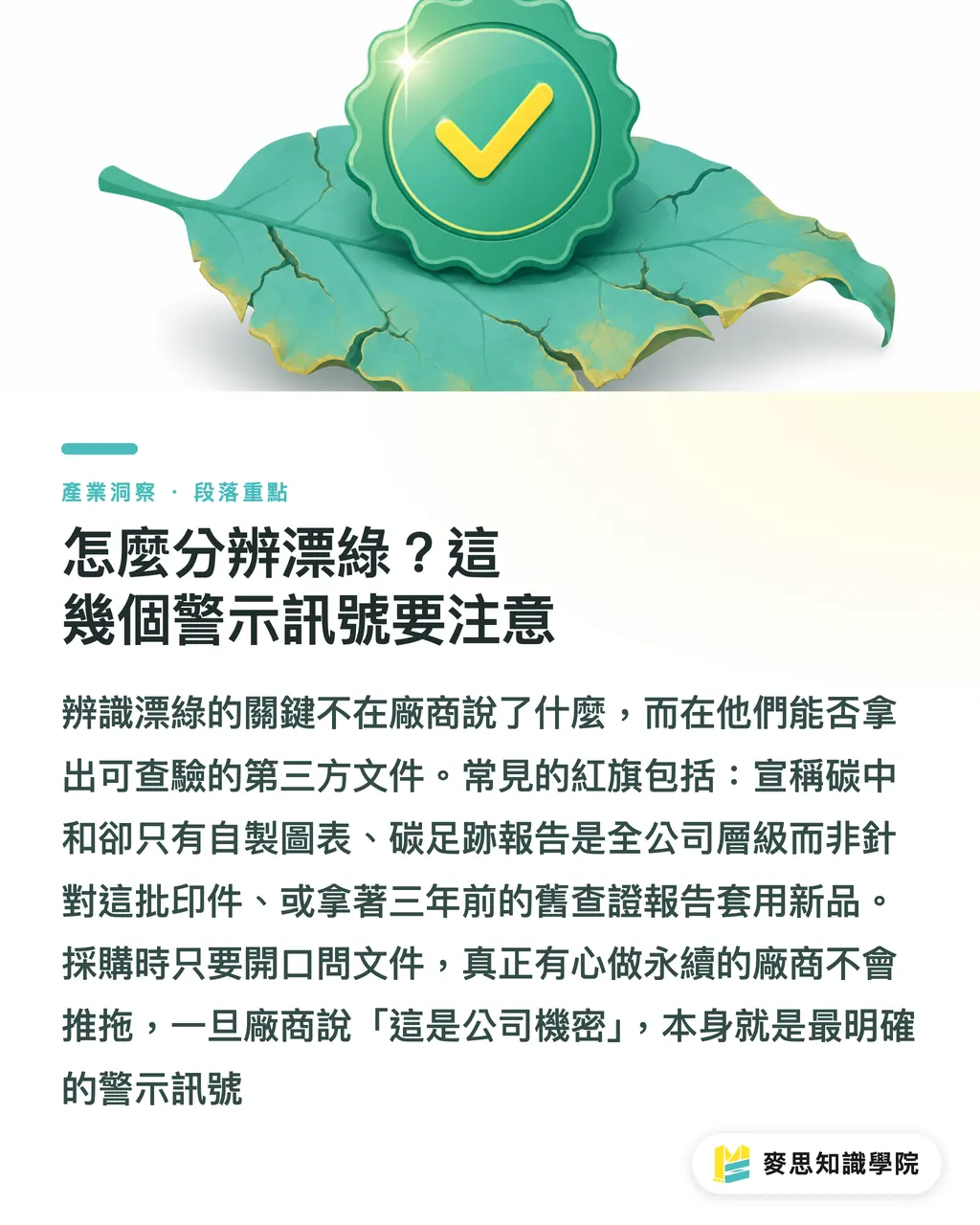
・The report has expired. ISO 14067 verification usually has a validity period. Using a three-year-old report to support a claim for a new product batch does not hold up logically
・The vendor only stresses the use of "eco-friendly paper" or "water-based ink," but does not quantify the actual impact on carbon emissions
If a vendor becomes vague or says "this is confidential" when procurement asks for the documents above, that itself is a red flag. Vendors that are genuinely willing to do sustainability work are not afraid of document requests
If your ESG report needs numbers that can be cited, and the vendor cannot even explain the functional unit clearly, I suggest switching vendors directly. It is not worth waiting for them to patch together missing documents
Key Takeaways
・Carbon footprint verification (ISO 14067) is a tool for measuring emissions. It does not make carbon disappear. Carbon-neutral printing is the offsetting action. They come in sequence and should not be mixed up
・40-60% of a printed product's carbon emissions come from base paper. This is harder to control than machine electricity use, and it is where paper selection deserves the most work
・The credibility of a carbon-neutral claim comes down to three things: whether there is a third-party verification report, whether the carbon credit source can be checked, and whether the production process has real emission reductions instead of being built entirely on purchased credits
・When outsourcing green printing, ask vendors for an ISO 14067 verification report for the specific printed product, not the company's overall CSR documents
・The most common greenwashing pattern is "many claims, few documents." Any carbon-neutral claim that cannot provide a third-party verification serial number should be questioned
Further Thinking
From a procurement practice standpoint, most companies' ESG requirements are still stuck at the level of "just find me a printer with a green label." That level is no longer enough. Supply chain emissions, or Scope 3, are becoming a reporting obligation for major brands and listed companies. Going forward, procurement teams must be able to provide not just "we did it," but "how much was done, who verified it, and how it was calculated."
Concrete next steps:
・Build a supplier carbon emissions database: Starting this year, require every key printing supplier to provide an annual carbon footprint verification report. Even if they cannot provide one this year, that is fine. Put the requirement into the next RFQ instructions first, so suppliers know where you are heading
・Separate "environmental claims" from "reportable data": Eco-friendly paper, water-based ink, and FSC certification are all good things, but in an ESG report, they belong under "process description." They cannot be entered directly into the carbon emissions field. Procurement teams need to know where each type of document belongs in their ESG reporting structure
・Work with vendors that can provide quantified figures: If your brand has a carbon neutrality target in the future, start building relationships now with printing plants that have verification capabilities. Waiting until the deadline to find one usually means higher prices, tighter timelines, and incomplete documents
For designers, adding a "paper carbon emissions comparison" to material options during the proposal stage helps brand clients lock in lower-carbon choices at the design decision stage, instead of discovering after printing that the carbon footprint is too high
FAQ
- What is the difference between an ISO 14067 verification report and a CSR sustainability report?
- An ISO 14067 verification report is a third-party carbon footprint audit document for a specific product, such as a batch of packaging boxes, with a defined functional unit, system boundary, and numbers. A CSR sustainability report discloses the company's overall environmental performance and is usually prepared by the company itself. Both have their uses, but ESG procurement needs the former. The latter cannot be used directly to report carbon emissions from printed products
- A vendor says using recycled paper means "carbon neutral." Is that correct?
- No. Using recycled paper can reduce carbon emissions on the raw material side, but it cannot make the entire batch of printed products carbon neutral. A carbon-neutral claim requires full carbon footprint verification plus an equal amount of carbon credit offsetting. If any part is missing, it cannot be called carbon neutral
- Which organizations in Taiwan can perform ISO 14067 verification for printed products?
- In Taiwan, recognized third-party verification bodies such as SGS, BSI, Bureau Veritas, SGS Taiwan, and TÜV currently provide ISO 14067 carbon footprint verification services. Procurement teams can contact these organizations directly to confirm service scope and pricing
- How can I confirm that the carbon credits used for carbon-neutral printing are real and valid?
- Ask the vendor to provide the name of the carbon credit issuing body, such as Verra VCS or Gold Standard, and the serial number. Then check that serial number in the issuing body's public registry to confirm that the credit has been issued, has not already been used by someone else, and corresponds to an emission reduction project that meets the "additionality" requirement
- In a corporate ESG report, which scope should carbon emissions from print procurement fall under?
- Under the GHG Protocol framework, outsourced printing falls under Scope 3, or value chain indirect emissions, in the "purchased goods and services" category. If a company wants to report this category, it needs carbon footprint data provided by suppliers. It should not estimate the figures on its own
Related articles



The Print × AI weekly
The print and AI know-how designers, brands and enterprises can use before they commit — one email, every week
MINDS Free Tools
AI background removal, a LINE sticker maker, spine & imposition calculators — all free, right in your browser, no upload.
MINDS Group
Need actual printing or gifting services?
From premium printing to online ordering and festive gifts — the MINDS Group sister brands take it from here.