
Overview
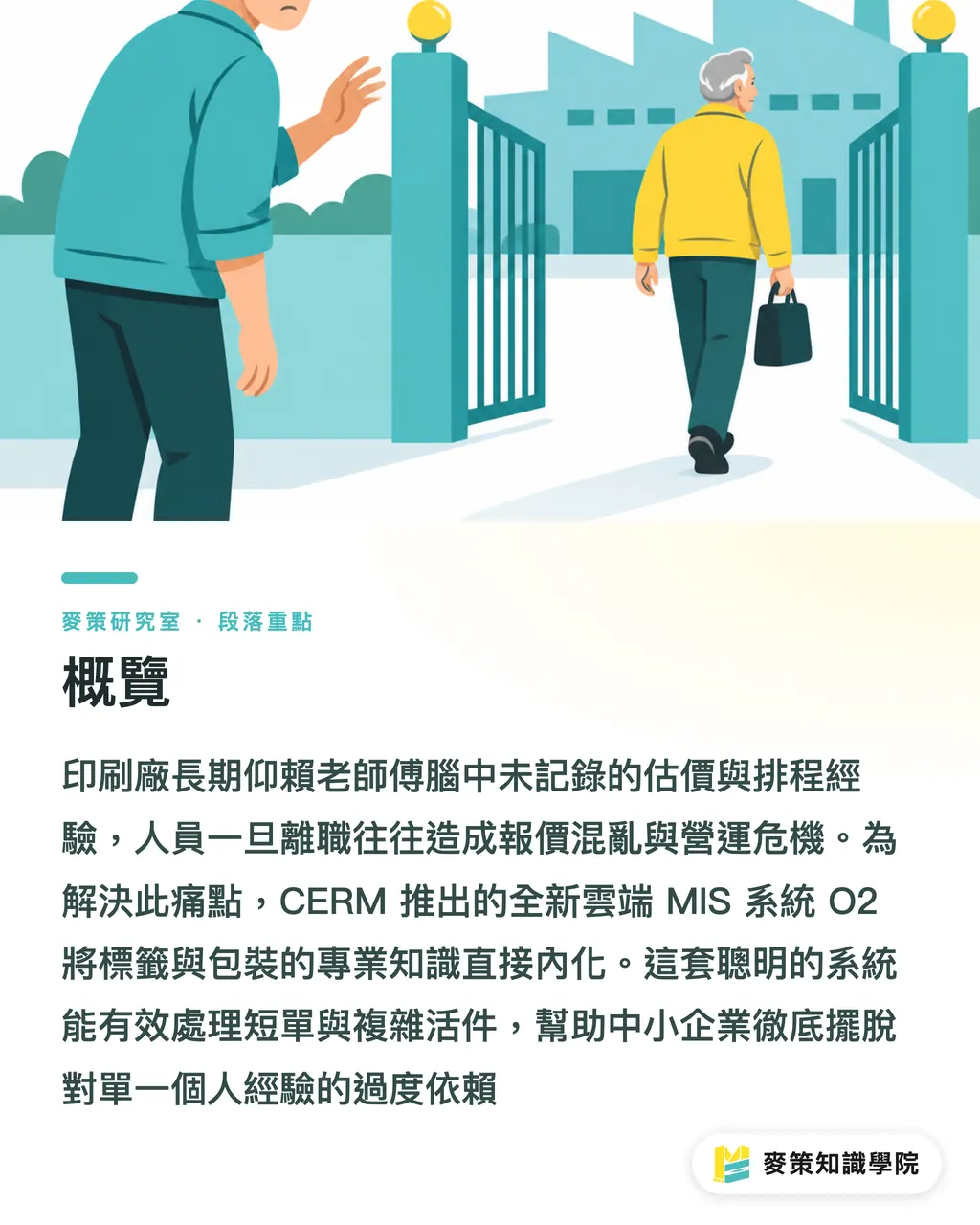
If the veteran operator who "knows everything" leaves next month, will your quoting process fall apart?
I have asked this question many times at small and mid-sized print shops in Taiwan. The usual answer is a rueful smile. With labels, flexible packaging, and folding-carton jobs, machine variables are relatively easy to control. The unwritten ledger in someone's head is much harder to calculate. How many times to run the calculations for a customer's die, how much material waste to budget for, and how to slot a rush order into the schedule are details that often exist only in an experienced operator's head. Once that person leaves, even an expensive system rarely makes up the difference
CERM introduced its cloud MIS product O2 in September 2026. The company's explanation of what drove its development is unusually direct: print runs are getting shorter, jobs are becoming more complex, and the need for automation and integration is growing, while staff with label and packaging workflow know-how are changing jobs more often. That creates a need for a smarter MIS that "knows what users are actually trying to achieve" [1]. That line deserves a serious look from Taiwan's print industry. The central question is what old problem cloud MIS is finally solving, and why small and mid-sized shops that have spent a decade watching from the sidelines are now willing to move
How Is Cloud MIS Different from the MIS of the Past?
The difference is that you no longer have to run your own IT operation, not that the feature list has gained a few more fields
When describing O2's positioning, CERM CEO Jan Heyse put it in very practical terms: it is a new-generation, cloud-native MIS that frees customers from the headaches of IT infrastructure and cybersecurity while giving them access to four decades of experience in label and packaging workflows [1]. For small and mid-sized shops in Taiwan, both are real costs in their own right: servers, backups, updates, and remote access on one side, and responsibility for cybersecurity on the other. In recent years, supply-chain customer audits have been asking increasingly detailed questions
From what I have seen, traditional enterprise MIS deployments get stuck at small and mid-sized shops because three barriers pile up: upfront capital spending on hardware and licenses, an implementation period that requires months of consultant support, and no one in the plant who can maintain the system over the long term. Moving to the cloud removes the first and third. The second has not disappeared, but it has been broken into smaller pieces
CERM's own approach backs this up. O2 is not trying to replicate the full scope of its flagship product, CERM7, from day one. Instead, it is taking a phased approach, first targeting small and mid-sized converters that can benefit from digitization and automation but do not need the depth and complexity of a traditional enterprise MIS [1]. The first release is mainly for label converters. Flexible packaging and folding cartons are planned for the second phase [1]
Suppliers have finally understood that small shops need a system designed for them from the start. Simply stripping down a large system does not work
Why Is the Real Push Labor Shortage, Not Cost Savings?
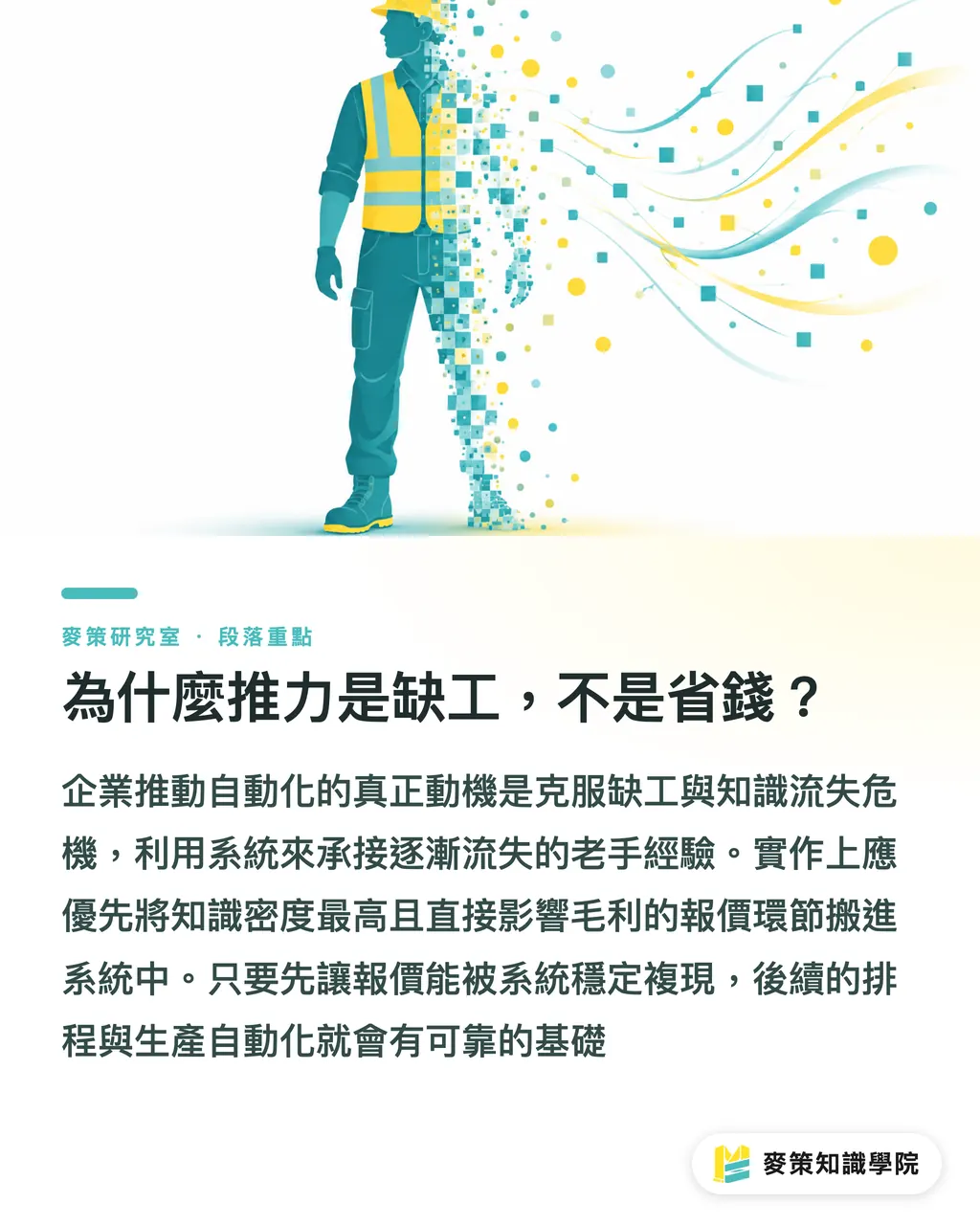
The reason is simple: knowledge is disappearing too quickly for owners to close the gap by hiring new people
CERM directly lists turnover among staff with label and packaging workflow experience and know-how as one motivation for developing a new-generation MIS [1]. This matches the path I have seen at small and mid-sized shops in Europe: faced with labor shortages, they would rather invest in process automation than pay a premium to poach a shrinking pool of increasingly rare veterans
Here is the order in which I would move know-how from people's heads into a system at a small or mid-sized shop:
・Start with quoting. Quoting has the highest knowledge density and is the stage most likely to vary by person. One mistake comes straight out of your gross margin
・Move on to work orders and scheduling. This turns the assumptions behind a quote into instructions the shop floor can execute
・Leave inventory and reconciliation for last. This part looks most like a conventional ERP, has the most alternatives, and is the least urgent
This order is not theoretical. When European print shops introduce AI and automation, they generally start with quoting and scheduling too, because the return on investment in those two areas is easiest to verify. I call this the first gate in Mai Strategy's "Three Gates for Sending a Job to Print" framework: make the quote reproducible by the system first. Only then can downstream automation receive stable inputs
One clarification: this ranking is my own analysis, not CERM's official recommended implementation path
Why Is API-First the Line You Should Look At First When Choosing a System?
Because the value of an MIS depends on whether it can connect to the prepress and equipment data flows you already have
O2's product priorities include an enhanced user experience, more automation, built-in intelligence for the print industry, and an "API-first" approach to integration [1]. At the same time, O2 will carry forward CERM's partner ecosystem, built through years of collaboration with technology suppliers such as Esko, HYBRID Software, ABG, and SCREEN [1]. For converters, this means the MIS cannot be an island. It has to communicate with imposition, RIP, inspection, and postpress equipment
One risk is often underestimated on the shop floor in Taiwan: successful equipment integration does not necessarily mean the file specifications are compatible. If print-ready files lack a shared language, automation can simply speed up the creation of errors. Ghent Workgroup has long developed and maintained cross-industry technical specifications for prepress file exchange, covering PDF delivery requirements for different print applications [2][4]. Its specifications overview and technical documents are publicly available [3]
My advice is to discuss MIS selection and file standards together:
・Ask whether the supplier's API documentation can be reviewed in advance, rather than receiving it only after signing the contract
・Confirm whether work-order data can be written back in both directions. An integration that only outputs one way loses value quickly
・Write PDF delivery requirements into the customer ordering workflow, so the first data the MIS receives is clean
How Should Small and Mid-Sized Print Shops in Taiwan Decide Whether to Follow Suit?
Start with one question: how many decisions in your shop currently exist only inside one person's head?
More than 500 companies worldwide currently use CERM7. That installed base gives O2 a foundation to build on [1]. CERM also acquired OMIKAI in 2025, bringing cloud-development experience and technology into the company to speed its shift toward new-generation MIS software [1]. These facts tell us this is not a startup testing the waters. It is an established supplier making a generational shift. For a conservative industry like printing, a supplier's long-term viability is itself part of the selection criteria
But I do not think you should put the whole shop on it yet. A steadier approach is:
・Audit knowledge risk first. List three to five decision points that "only one person knows how to handle." That is your priority list for implementation
・Pilot with one job type. O2's first release focuses on labels. If folding cartons are your main business, the timing suggests waiting for phase two [1]
・Write acceptance criteria as numbers. For example, reduce quote turnaround from several hours to several minutes, or lower the rework rate by a given number of percentage points, rather than relying on "it feels smoother."
If your shop handles long-run contract work with a single specification, stable customers, and little variation in quoting, the marginal benefit of a cloud MIS will be low. Invest in color management or postpress automation first. Cloud MIS is meant to handle complexity and knowledge loss. It cannot solve a lack of production capacity
Another boundary that is often overlooked is data sovereignty. For customers connected to defense, medical devices, or government tenders, putting quotes and customer data in the cloud requires advance review of the contract terms. There is no one-size-fits-all answer here
Next Steps
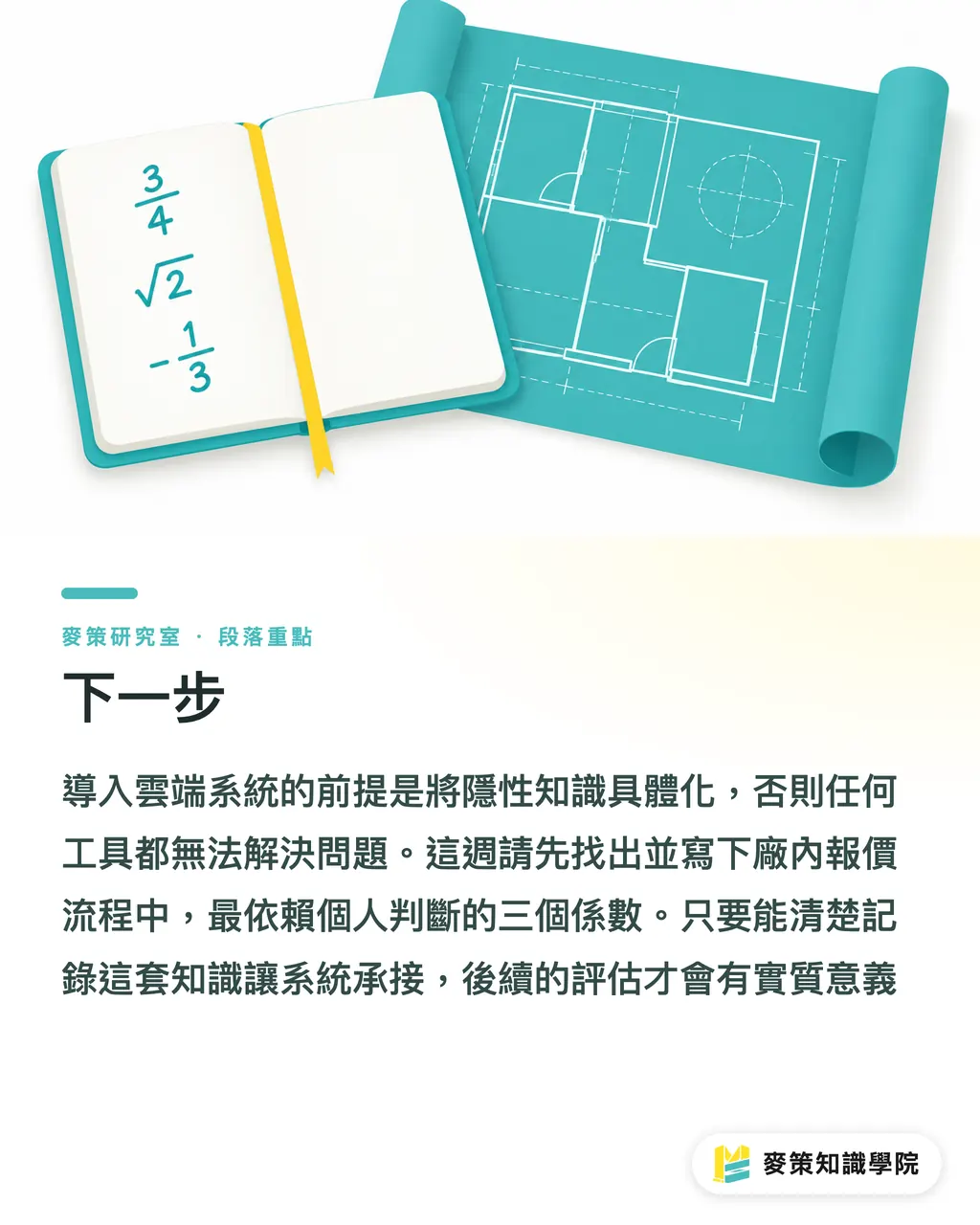
This week, try writing down the three coefficients in your shop's quoting process that depend most heavily on individual judgment. Once they can be stated concretely, a system can take them on, and evaluating a cloud MIS becomes meaningful. If you cannot write them down, go back and clarify the quoting logic first. No system you buy will help otherwise
Key Takeaways
CERM launched its cloud-native MIS product O2 in September 2026, explicitly targeting small and mid-sized converters rather than enterprise users [1]
The main forces behind this shift to the cloud are the loss of experienced operators and increasing job complexity, not simply lower hardware costs [1]
O2's first release focuses on label converting. Flexible packaging and folding cartons are planned for phase two, so shops with a different core job mix should adjust their timing [1]
API-first integration and the existing partner ecosystem, including Esko, HYBRID Software, ABG, and SCREEN, determine whether the MIS can take in the data flows already in place [1]
Before implementation, map the decision points that "only one person knows how to make." That list will determine success more than a supplier presentation will (author's assessment)
Further Considerations
For print manufacturing, cloud MIS shifts the competitive focus from "whose machines are faster" to "whose processes can be reproduced." That is a real advantage for small and mid-sized shops in Taiwan, where teams tend to be lean, because the system fills exactly the gap they feel most sharply. On the design and prepress side, moving MIS to the cloud will in turn raise the bar for file standards. Adoption of cross-industry technical standards such as those from Ghent Workgroup is worth watching [2][4]. For AI adoption, claims about built-in industry intelligence still need to be tested in the field. The key metrics should be quoting accuracy and the adoption rate of schedule adjustments, not the number of features. The SaaS model's less obvious risk is data portability when it is time to renew. Since work orders and customer history live in the cloud, switching costs will shape how much room you have to negotiate later. Check the relevant terms carefully before signing to avoid disputes down the road
References
[1] Cloud MIS Goes Live: Why CERM O2 Is Speeding Up Small and Mid-Sized Print Shops' Move to the Cloud
[2] Ghent Workgroup: GWG Technical Specifications. Ghent Workgroup
[3] Ghent Workgroup: Official Website. Ghent Workgroup
[4] Ghent Workgroup: Specifications Overview. Ghent Workgroup
FAQ
- How is a cloud MIS different from a traditional MIS for print shops?
- A cloud MIS is delivered on a cloud-native architecture, so users do not need to build their own servers or manage cybersecurity infrastructure. In its explanation of O2, CERM makes "removing the burden of IT infrastructure and cybersecurity" a central selling point [1]. Traditional MIS platforms are usually deployed on-site and require capital spending plus people for long-term maintenance
- What kind of print shop is CERM O2 suited for?
- In its first phase, O2 targets small and mid-sized converters that can benefit from digitization and automation but do not need the depth of a traditional enterprise MIS. The first release focuses on label converters [1]. Flexible packaging and folding-carton functions are planned for the second phase [1]
- Which module should a print shop start with when adopting a cloud MIS?
- Start with quoting. It is the most knowledge-dense stage, depends most on experienced staff judgment, and is also the easiest place to verify results with numbers. Work orders and scheduling, followed by inventory, come after that (author's assessment)
- Can a cloud MIS solve the labor shortage in printing?
- It can ease the pressure in part, but by moving process knowledge from individuals into the system, not by replacing the workforce. CERM lists the movement of people with label and packaging workflow experience as one reason for developing a new-generation MIS [1]
- What should a print shop prepare before adopting a cloud MIS?
- First, make sure your print-ready file delivery standards are standardized. Otherwise, automation will only accelerate the spread of errors. Ghent Workgroup publishes open, cross-industry prepress technical standards that can serve as a reference [2][4]
Related articles



The Print × AI weekly
The print and AI know-how designers, brands and enterprises can use before they commit — one email, every week
MINDS Free Tools
Imposition calculator and preflight file check — free prepress tools, right in your browser.
MINDS Group
Need actual printing or gifting services?
From premium printing to online ordering and festive gifts — the MINDS Group sister brands take it from here.