
Overview
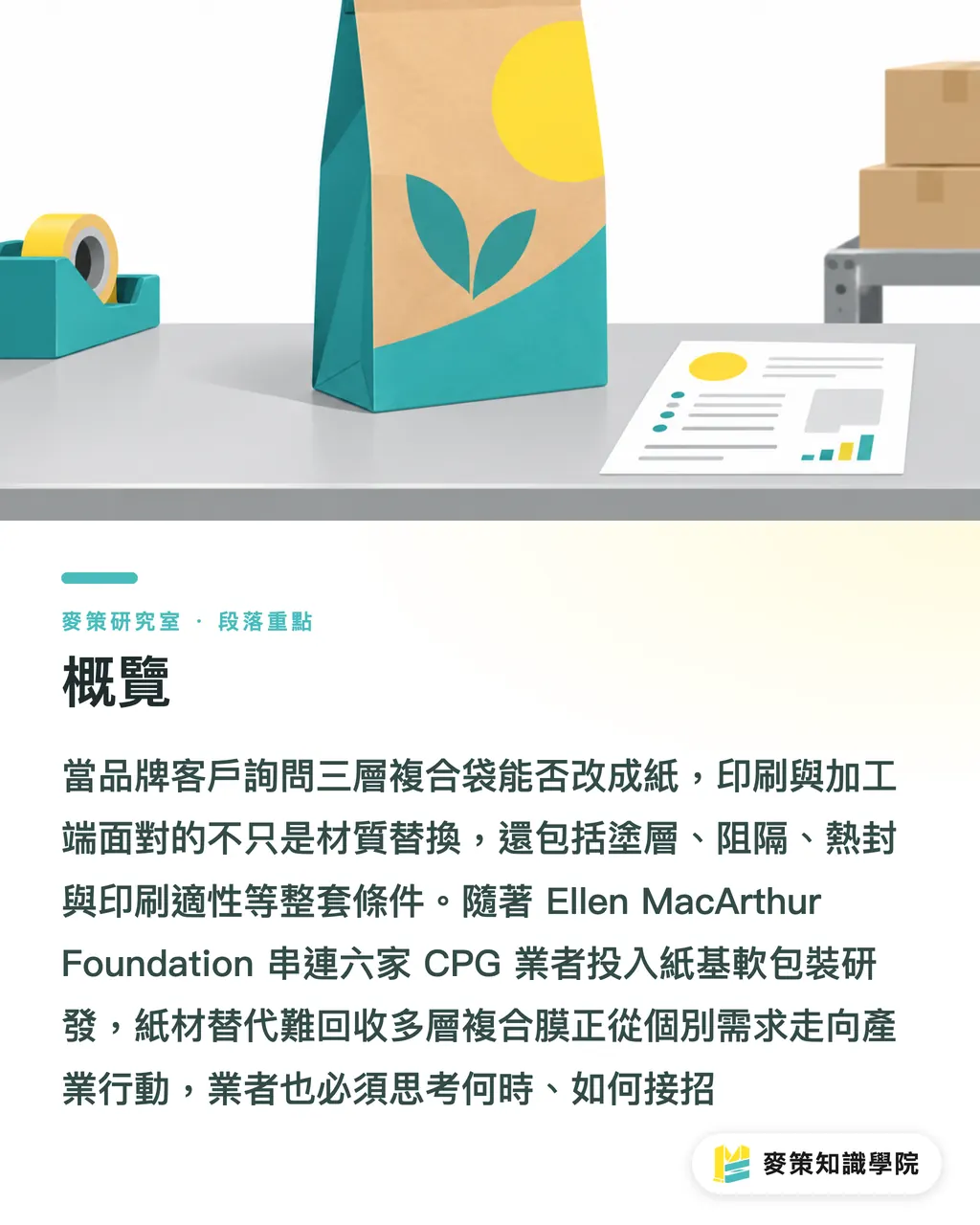
There is a scenario you may already have encountered: a brand client arrives with a sustainability guideline issued by its European headquarters and asks, "Can we change this three-layer pouch to paper next year?" You open the quotation sheet, and a long list of questions rises in your mind: coatings, barrier performance, heat sealing, and printability. But the client only wants a yes-or-no answer
Those conversations are going to become more common. The Ellen MacArthur Foundation has brought six CPG companies together to invest in the R&D of paper flexibles, with a clear goal: replacing multilayer films that are difficult to recycle (Packaging Dive report). The key question is not whether paper can replace film. It is when and how printers and converters should respond once brands start treating material selection as a collective effort
Why are six companies working together instead of developing this separately?
Because flexible-packaging recycling is not a material problem any single brand can solve. It is a systems problem spanning the entire chain
Multilayer films are difficult to recycle not because one layer is especially dirty, but because sorting facilities cannot classify them into existing material streams with current optical equipment, and recyclers cannot secure stable demand for the recycled material. Even if a single brand switches to a mono-material or paper-based structure, that packaging will still end up incinerated or landfilled at the end of its life if regional sorting infrastructure has no corresponding stream. The EU is addressing this at the regulatory level. The PPWR (Regulation (EU) 2025/40) requirements for packaging recyclability and circular design are pushing all market participants to align under the same rules [2]. The EU environmental authority's packaging-waste page also treats packaging as a systems node in the waste stream, not as an attribute of an individual product [3]
That is the significance of the six-way alliance: it is building demand at scale, not putting on a technology showcase. Only when order volumes are sufficient and predictable will paper mills invest in lines dedicated to flexible packaging, coating suppliers develop barrier formulations, and recyclers set aside dedicated material streams. One company cannot do it. Six might
This also explains why alliances like this usually do not produce a finished product quickly. An R&D alliance often produces specifications, test methods, and design guidelines. These are harder to see than a single product, but their impact on the supply chain lasts longer
Where does paper-based flexible packaging hit its technical limits?
The trade-off is between barrier performance and repulpability, and there is still no free lunch
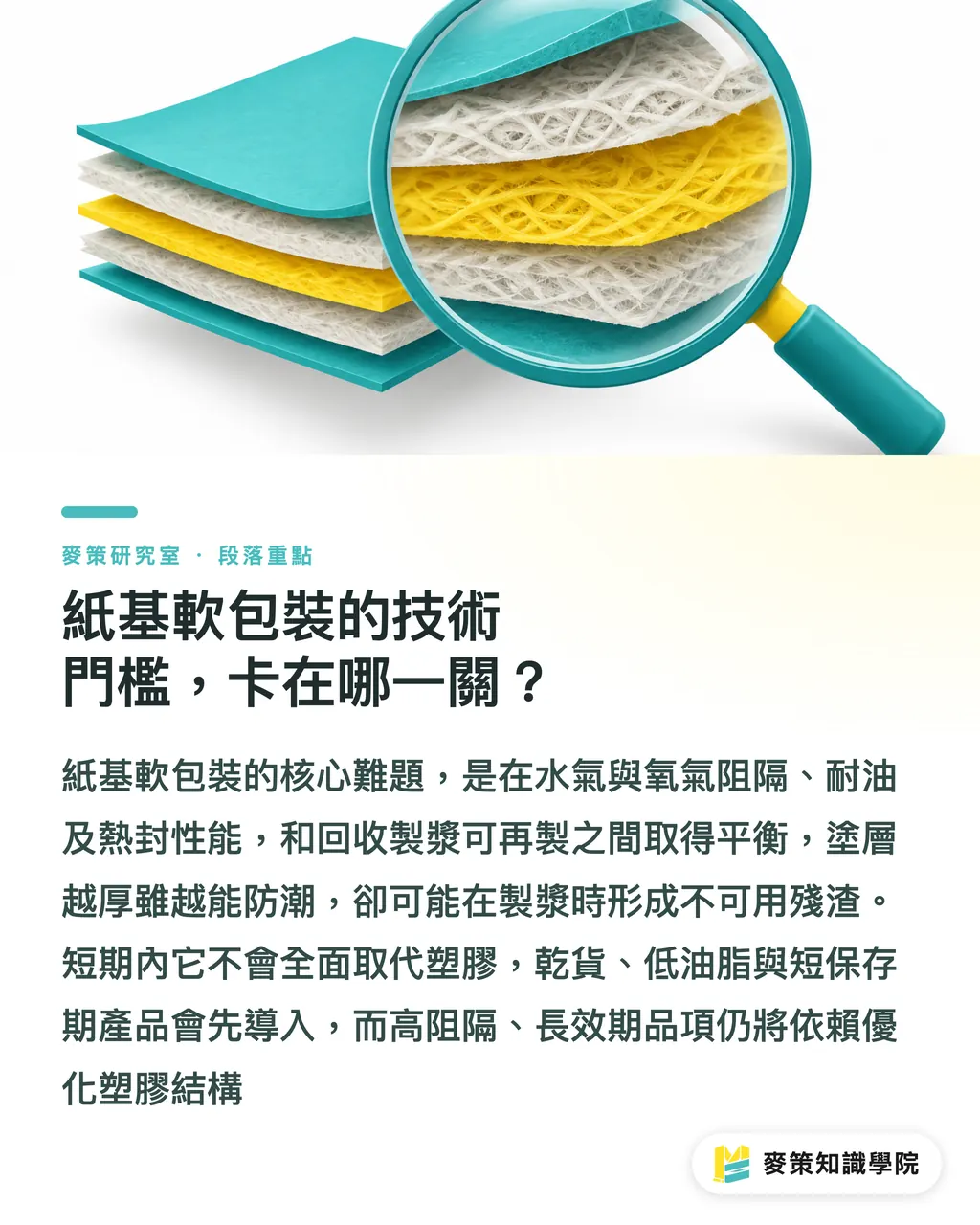
To bring flexible packaging to market, several basic requirements cannot be compromised, especially for food and pet food: water vapor transmission rate (WVTR), oxygen transmission rate (OTR), oil resistance, and heat-seal strength. Paper alone cannot meet any of these requirements, so a coating or laminate is unavoidable. Here is the problem: the coating has to be thick enough to block moisture, but that same thickness may turn the entire package into unusable residue in a recycling mill's repulping process. The industry's current approaches broadly fall into three paths: water-based coatings, ultrathin functional layers, and paper combined with a small amount of polymer in a mono-polymer composite. Each is trying to balance "is the barrier good enough?" against "can the repulping residue rate stay below the required threshold?"
In my view, there will not be a single paper-based flexible package that works for every category in the short term. Dry goods, low-fat products, and items with short shelf lives will be the first to switch. High-barrier, long-shelf-life products containing oil or water will remain in optimized plastic structures for a long time. When I previously analyzed the decarbonization paths of international flexible-packaging companies such as Coveris and Sealed Air, I saw the same pattern: the mainstream approach is to lighten structures and increase the share of recycled plastic, not to switch everything to paper. This alliance does not overturn that path. It opens a second one alongside it
Another cost item is often overlooked: changing materials means recalculating the entire printing and converting process window. The surface tension, ink receptivity, dimensional stability, and curl behavior of paper-based substrates differ from those of BOPP and PET. The ink system, drying curve, and heat-seal temperature all need to be documented again. The carton and paperboard-packaging sector already has mature structural-design standards to consult [1], but paper-based "flexible" packaging sits between the two, and its ready-made standards are still being developed
What should Taiwan's small and midsize printers do now?
Build the data first. Do not replace equipment first. Establish the data now, and only consider equipment replacement when the need arises. That is the practical route
This shift will take roughly three to five years, while most small and midsize plants have longer equipment depreciation cycles and relatively short order visibility, making the timing of investment tricky. Investing in a dedicated line while brands are still at the R&D-alliance stage creates a poor risk-return trade-off. But if you do nothing, by the time a customer actually arrives with specifications, you may not even be able to quote the job
The following three actions are feasible now, relatively low-cost, and capable of creating long-term value:
・Conduct a one-time material audit of your existing customers' flexible-packaging items: divide them into three tiers, "dry goods, low barrier," "medium barrier," and "high barrier, oil and water content," and flag customers exposed to the EU or U.S. markets. This table will be your map of order-switching risk for the next three years
・Start building trial-print data for paper-based substrates: you do not need to commit to a full production run. Ask substrate suppliers for samples, run small batches on your existing machines, and build your own records for printability, registration, heat sealing, and post-processing. When a customer asks, "Can you make it?", you will have data while competitors have only opinions
・Understand the assumptions behind life-cycle assessment (LCA): changing materials does not automatically cut carbon emissions. The conclusion depends heavily on assumptions about use conditions, transport distance, and end-of-life treatment, a point widely discussed in comparative packaging LCA studies [4]. When a customer treats "switching to paper means it is environmentally friendly" as a given, you can point out the boundary conditions. That is professional value in its own right
What signals mean it is truly time to invest?
When "specifications" start appearing on a customer's request for quotation, not in a press release
There are three concrete signals to watch. If any two appear at the same time, it is worth seriously evaluating an investment:
1. Stable supply and public specifications emerge on the substrate side: paper mills and coating suppliers begin offering paper-based flexible-packaging substrates for sale, backed by complete barrier and repulping test data rather than samples alone
2. A corresponding sorting stream appears on the recycling side: the recycling system in the target market publicly recognizes how this type of packaging should be classified. In the EU, this will show up through PPWR recyclability ratings and related implementing rules [2]
3. One of your top three customers puts it in a formal specification: this is not a vision stated only in a sustainability report, but a document that lists a product code, annual volume, and acceptance criteria
Before then, put your investment into people and data, not steel. Trial-print records, material audit sheets, and relationships with substrate suppliers can turn into revenue immediately when the shift really happens. If it does not happen, they still will not become idle assets
One final boundary condition: the judgments above apply to small and midsize printing and converting plants whose business is mainly Taiwan's domestic market and standard export work. If your main customers supply the EU directly and their products fall into categories explicitly covered by the PPWR, you need to pull the timeline forward. In that situation, compliance is the price of admission, not a competitive advantage. Waiting until all the signals are in means you will already be too late [2][3]

Key Takeaways
The Ellen MacArthur Foundation has brought six CPGs together to advance paper-based flexible-packaging R&D. At its core, this is collective demand creation for alternatives to hard-to-recycle multilayer films, not a showcase for a single technology
The core tension in paper-based flexible packaging is the trade-off between barrier performance and repulpability. In the short term, there will not be one solution that works across every category
Changing materials does not equal cutting carbon. Packaging LCA conclusions depend heavily on assumptions about use conditions, transport, and end-of-life treatment. The boundary conditions are worth making clear before presenting a proposal to a customer
At this stage, small and midsize printers should invest in data and relationships, including material audits, trial-print records, and connections with substrate suppliers, rather than dedicated production-line equipment
The real signal to invest is specifications entering customer quotation requests: public substrate specifications, a corresponding recycling stream, and inclusion in a key customer's formal specification. If any two appear at the same time, it is time for a serious evaluation
Further Considerations
For printing and manufacturing operations, the real meaning of this signal is that a "material database" will become a new competitive threshold. In the past, quotes were based on machine and labor costs. In the future, a quote will need to answer questions about substrate printability, repulping residue rates, and compliance status. This is a knowledge asset, not a capacity asset. For designers, paper-based flexible packaging behaves very differently from plastic film in shrinkage, curl, and color reproduction. Layout design, color management, and die lines all need new tolerance rules. If designers still develop artwork with a plastic-film mindset, the failure rate of proofs will show up directly in project costs. When introducing AI, first record trial-print parameters, substrate lot numbers, ambient temperature and humidity, and defect results in a structured format. This turns experience-based adjustments into predictable parameter recommendations, which fits production-line needs better than a purely generative application. On the SaaS side, there is an obvious gap. The market currently lacks a tool that can manage a three-way matrix of "material specifications × target-market regulations × customer SKUs." Most companies are still using spreadsheets, and once regulations such as the PPWR enter the detailed implementation stage, manual maintenance will almost inevitably lead to errors. One unresolved issue is that test methods for paper-based flexible packaging's repulping residue rate are not yet fully harmonized across regions. Until the methods converge, every cross-market compliance claim must identify its testing basis. Otherwise, you are creating future legal risk for the customer
References
[1] Packaging. Paper and paperboard packaging. Design of cartons. DOI: 10.3403/03086276
[2] EUR-Lex: Full text of the EU PPWR. EUR-Lex
[3] EU environmental authority: EU packaging waste page. EU environmental authority
[4] Mendeley (indexing a Journal of Cleaner Production paper): Meta-analysis of packaging life-cycle assessment studies. Mendeley (indexing a Journal of Cleaner Production paper)
FAQ
- What is paper-based flexible packaging (paper flexibles), and how is it different from an ordinary paper bag?
- Paper-based flexible packaging is a flexible packaging structure that uses paper as its main substrate, with a thin coating or a small amount of polymer added to provide barrier performance. It is used to replace multilayer plastic films that are difficult to recycle. Unlike an ordinary paper bag, it must meet food-packaging requirements for water-vapor and oxygen barrier performance, heat-seal strength, and repulpability at the same time
- Does the alliance of six CPGs to develop paper-based flexible packaging mean plastic flexible packaging is about to be phased out?
- No. The mainstream international decarbonization path for flexible packaging is still structural lightweighting and increasing the share of recycled plastic. Paper-based flexible packaging is a second path opening alongside it. High-barrier, long-shelf-life products containing oil or water are expected to remain in optimized plastic structures for a long time
- Should Taiwanese printers invest in dedicated equipment for paper-based flexible packaging now?
- Most small and midsize plants should not at this stage. The shift has a time horizon of roughly three to five years, while equipment depreciation cycles are longer and order visibility is shorter. Prioritize material audits, accumulating trial-print data for paper-based substrates, and building relationships with substrate suppliers. These can be turned into revenue immediately if the shift happens, and will not become idle assets if it does not
- Does switching to paper-based packaging automatically make it more environmentally friendly?
- Not necessarily. Life-cycle assessment (LCA) conclusions depend heavily on assumptions about use conditions, transport distance, and end-of-life treatment, and comparative packaging LCA studies have discussed this extensively. In markets without a corresponding recycling and sorting stream, the actual end-of-life outcome for paper-based packaging may not be better than that of an optimized plastic structure
- What specific impact does the PPWR have on flexible-packaging companies?
- The EU PPWR (Regulation (EU) 2025/40) sets unified requirements for packaging recyclability and circular design, effectively forcing all packaging placed on the EU market to align with the same rules. For companies supplying the EU directly, compliance is the price of admission, not a competitive advantage. Their timeline needs to move earlier than that of general exporters
Related articles
The Print × AI weekly
The print and AI know-how designers, brands and enterprises can use before they commit — one email, every week
MINDS Free Tools
AI background removal, a LINE sticker maker, spine & imposition calculators — all free, right in your browser, no upload.
MINDS Group
Need actual printing or gifting services?
From premium printing to online ordering and festive gifts — the MINDS Group sister brands take it from here.