
Overview
A client walks in holding a curved cosmetic bottle and asks for 300 limited-edition units, with artwork wrapping all the way around the shoulder. A label will wrinkle on the curved surface. Pad printing would require four-color plates, and once drying time and labor are included, the numbers simply do not work at this volume. You have probably heard other printers mention direct-to-object printing (DTO): skip the label, skip laser engraving, and print the artwork directly onto the finished surface. The chairman of Engineered Printing Solutions recently highlighted DTO's potential for packaging and industrial parts in a public appearance[1]. The question is how mature the technology actually is, and where a small or midsize print shop in Taiwan should place its first bet
What Exactly Is DTO, and How Does It Differ from Pad Printing and Labels?
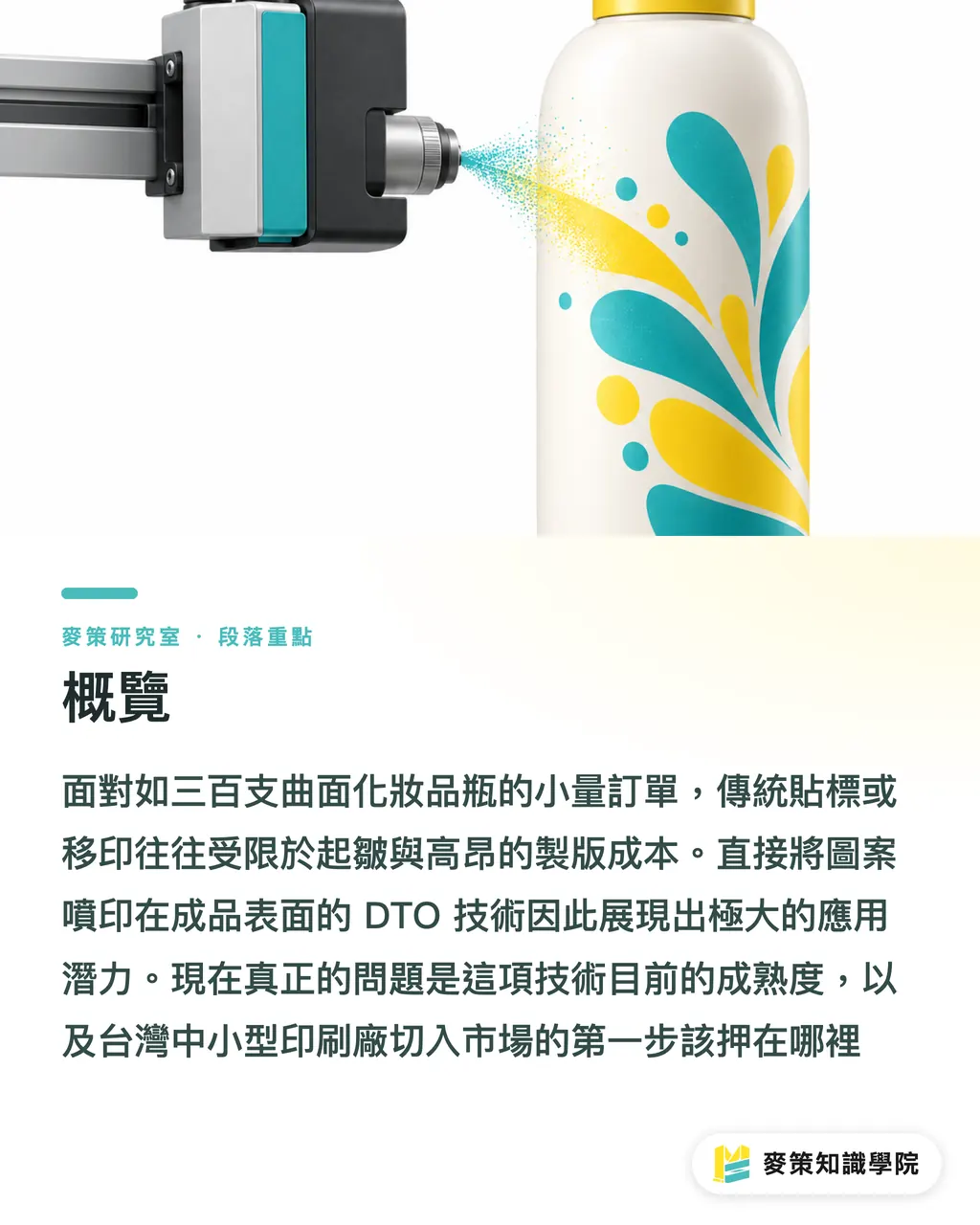
DTO aims an inkjet print head directly at the surface of a three-dimensional finished product. There is no label, transfer film, or plate in between. Its biggest difference from traditional printing is that it changes the workflow, not that it necessarily delivers better image quality. Labeling requires printing, cutting, and application. Pad printing requires plate making and plate-cylinder maintenance. DTO turns all of these front-end tasks into digital files
This distinction is clearly defined in the technical literature. The challenges of inkjet-based direct-to-shape printing are divided into three areas: the printing process itself, object-handling systems, and the connected workflow[2]. Many print shops bring in the equipment but cannot get it into stable production because they mistake DTO for a single printer and overlook the fact that it is fundamentally a complete production line for processing irregularly shaped objects
Looking at the market today, DTO is unlikely to displace high-volume production orders. Its main advantage is handling mid-volume jobs where pad printing cannot justify making a mold and labels cannot deliver a good-looking result
Is It Mature Enough to Take Orders? Where Are the Three Real Hurdles?
Yes, you can take orders, but only if you can keep three things under control: ink curing, camera registration, and white-ink layering. These are the areas where jobs most often fail in practice[1]
Here's why, piece by piece:
・Ink curing. UV ink printed onto glass, metal, or PP depends on pretreatment and whether it receives enough energy to adhere. The same formulation can pass on one substrate and scratch off on another. This is not a matter of tweaking a setting. You need a process-parameter sheet for every substrate
・Camera registration. An irregularly shaped bottle is not flat, and the angle at which each workpiece is placed in the fixture varies slightly. Without vision-based registration correction, artwork wrapping around the shoulder will not meet cleanly at the join. Automatic positioning and tracking for three-dimensional objects is fundamentally a machine-vision problem. Related object-tracking research has already developed mature algorithmic approaches in other fields[3], and the challenge in moving them onto a production line is cycle speed, not whether algorithms exist
・White-ink layering. Dark or transparent substrates need a white underbase first. White-ink thickness, coverage, and the interlayer curing sequence between the white and color inks can destroy yield
That is why DTO's technical bottlenecks sit mainly at the physical and handling layers. It is also why the technical literature treats handling systems as a separate topic[2]. By comparison, prepress file preparation is relatively straightforward
What Needs to Change in Prepress So You Do Not Discover a Registration Problem Only on Press?
Revise the file-delivery specification before you talk about buying a machine. DTO files have two variables that flat printing does not: the mapping between the unwrapped artwork and the object's coordinates, and the treatment of white ink as a separate color separation. If these two points are not spelled out in the prepress specification, the design file will blow up only when it reaches the press
A practical approach is to extend your existing PDF delivery specification. The Ghent Workgroup publishes application-specific technical specifications and PDF delivery requirements for different printing applications, making it the industry's most widely used neutral reference[5][7]. You do not need to write a whole system from scratch. Use GWG's packaging specifications as the skeleton and add three DTO-specific fields
・The naming of the white-ink separation and its overprint behavior must be stated explicitly. Do not leave it to the shop floor to guess
・The unwrapped artwork must include curved-surface reference lines and registration points, so the vision system has something to detect
・Specify whether bleed and distortion compensation are applied in the file or in the RIP, to prevent double compensation
I usually describe this as the three gates before print: the file gate, with complete separations and naming, the registration gate, with reference points and fixture definitions, and the curing gate, with a parameter table matched to each substrate. If any one of the three is incomplete, the job does not go on the machine. That is far cheaper than reworking it afterward. One clarification: GWG's specification system itself is oriented toward flat and packaging printing[5]. The DTO-specific fields are an extension you need to add yourself. Do not misrepresent them as items already defined by GWG
Where Should a Small or Midsize Taiwanese Shop Start, and How Should It Calculate Costs Without Misreading the Economics?
Start with orders where pad printing would lose money or labels cannot produce the required result, not with the flashiest applications. In concrete terms, that means irregularly shaped bottles, limited-run metal parts, and small-batch customization[1]
When estimating costs, do not look only at ink consumption per piece. Account for these three structural differences:
・Plate-making costs. Pad printing and label production both carry one-time plate and proofing costs. At a small volume, there is not enough quantity to spread them across. DTO has no plate, which is its one decisive edge on short runs
・Changeover time. With DTO, changing the artwork only means changing the file, but changing substrates means changing the curing parameters and fixtures. So a mix of many items on the same substrate is the best fit, while one item across many substrates is actually a disadvantage
・Yield and rework. When an irregular part is scrapped, you lose the finished product itself, not just a label. That difference can turn the entire calculation upside down, so use finished-product cost as the denominator
The range of applications for DTO is expanding too. Digital additive techniques that directly form an object have already been used for highly customized medical structural components, such as vascular scaffolds 3D-printed directly with bioinks[4]. This shows that the broader approach of directly forming or shaping objects is moving toward precision applications across industries. This example is not a recommendation that print shops enter medical-device manufacturing. It simply reflects the fact that the supply chain as a whole is becoming more accepting of extremely small-batch customization
What Should the First Step Be?
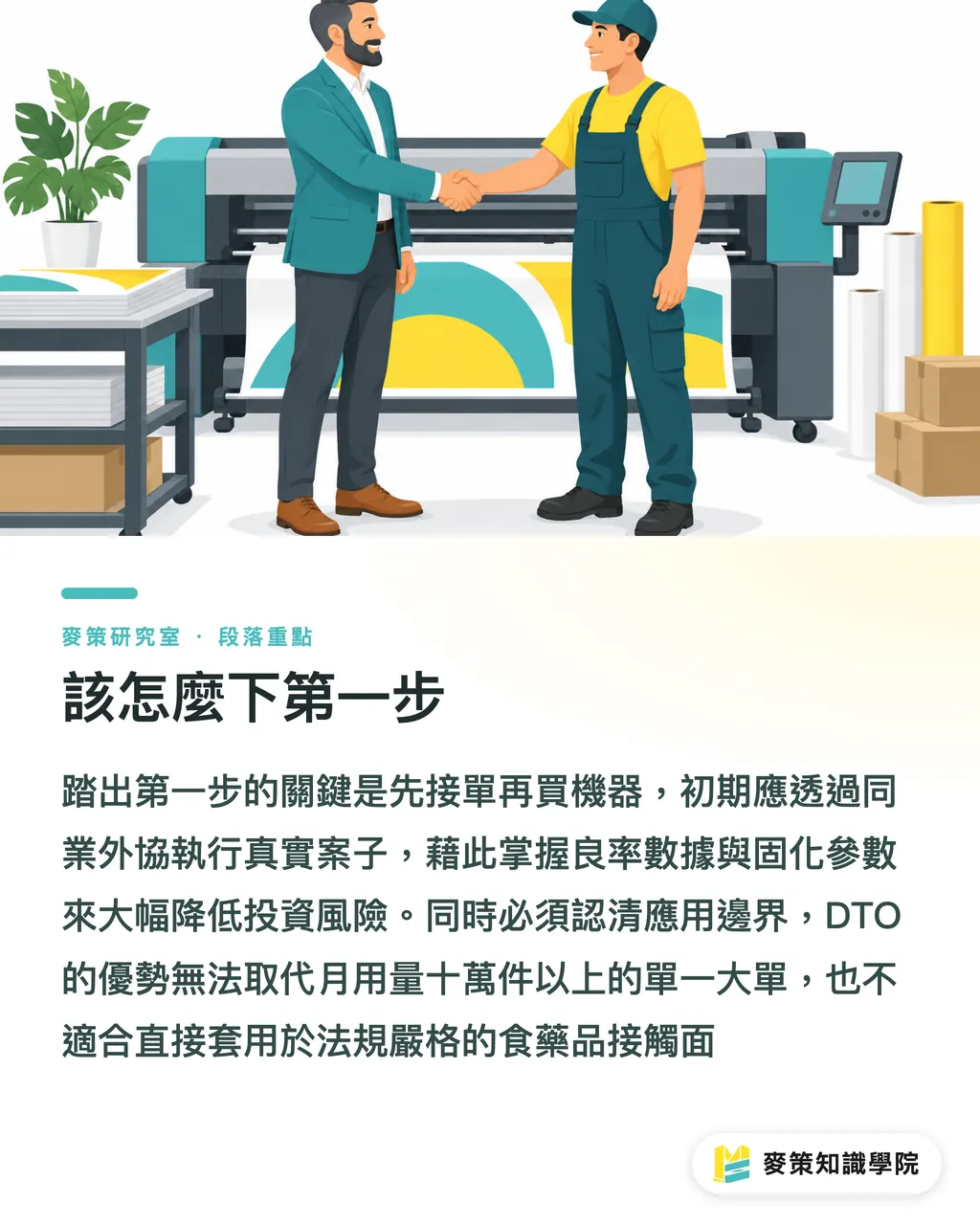
Take orders first, then buy the machine. Find a peer shop with DTO equipment and subcontract the work to them. Run three to five real jobs from your existing customer base. At the same time, write down the three-gate print-delivery specification and record each substrate's curing parameters in a table. Three months later, you will have two things in hand: real yield data and a requirements specification you can take to equipment vendors when negotiating price. This is much safer than committing to equipment first and then looking for orders, because the risk in DTO is concentrated in the handling and curing stages you have not yet experienced[2]
At the boundary of applicability, if most of your orders are for a single packaging design with a monthly volume of 100,000 pieces or more, DTO's per-piece cost still cannot beat an established labeling or gravure line. In that case, investing in an automated production line to improve efficiency is more practical. Likewise, printing on surfaces that directly contact food or pharmaceuticals involves migration and regulatory validation. That is a separate path requiring additional assessment, and experience with industrial parts cannot be applied to it wholesale
Key Takeaways
DTO's value lies in eliminating the two front-end steps of plate making and labeling. Its sweet spot is the mid-volume range where pad printing cannot justify making a mold and labels cannot deliver a clean result
Technical risk is concentrated in ink curing, camera registration, and white-ink layering, not in prepress files
The literature breaks direct-to-shape challenges into three parts: the printing process, object-handling systems, and workflow. It is worth using that structure directly as an evaluation framework
For prepress specifications, use Ghent Workgroup's PDF delivery specifications as the framework, then add three DTO fields yourself: white-ink separations, curved-surface reference lines, and distortion compensation
The recommended first move is to build yield data through outsourced jobs, then discuss equipment investment and requirements specifications after three months
Further Considerations
From the manufacturing side, bringing in DTO depends even more on fixture development and vision-based positioning. These mechanical and automation skills overlap little with the capabilities of a conventional print-operations team, so finding the right people may take more effort than waiting for the equipment to arrive. On the design side, the way teams think about curved-surface artwork and white-ink layers needs to be written into the work guidelines. Otherwise, the design team's freedom turns directly into lost production yield on the line. The clearest first use cases for AI are visual registration and defect detection. Both have clearly labeled data and measurable returns, making them much more worthwhile to tackle first than generative applications. The SaaS gap is plain to see: there is still no lightweight system that can manage substrate parameter tables, fixture coordinates, and white-ink separation rules in one place. Most shops still rely on Excel and word of mouth. That is a small, clearly defined vertical software opportunity. Three questions remain open: whether curing parameters across substrates can be turned into a transferable database, where the precision ceiling for vision registration lies at high speeds, and when the regulatory validation path for food-contact surfaces will become standardized
References
[2] Buck B. (2022). Inkjet‐Based Direct‐to‐Shape Printing with Partial or Full Coverage of the Object: Technical Challenges and Solutions for the Printing Process, Handling Systems, and Workflow. Inkjet Printing in Industry. DOI: 10.1002/9783527828074.ch56
[3] Psalta A., Tsironis V., El-Saer A. et al. (2024). Addressing Single Object Tracking in Satellite Imagery through Prompt-Engineered Solutions. IGARSS 2024 - 2024 IEEE International Geoscience and Remote Sensing Symposium. DOI: 10.1109/igarss53475.2024.10642033
[4] Wu X., Chen K., Chai Q. et al. (2022). Freestanding vascular scaffolds engineered by direct 3D printing with Gt-Alg-MMT bioinks. Biomaterials Advances. DOI: 10.1016/j.msec.2022.112658
[5] Ghent Workgroup: GWG Technical Specifications Homepage. Ghent Workgroup
[6] Ghent Workgroup: Official GWG Homepage. Ghent Workgroup
[7] Ghent Workgroup: GWG Specifications Overview. Ghent Workgroup
FAQ
- What is direct-to-object printing (DTO)?
- DTO is a technology that uses an inkjet print head to print artwork directly onto the surface of a three-dimensional finished product, without a label, transfer film, or plate. It can eliminate labeling and laser-engraving steps, making it especially suitable for irregularly shaped bottles, limited-run metal parts, and small-batch customization
- How does DTO's cost structure differ from pad printing and labeling?
- Pad printing and label production both carry one-time plate-making and proofing costs that a small run cannot absorb. DTO has no plate fee at all, which is its decisive advantage on short runs. But once the same packaging format reaches a monthly volume of 100,000 pieces, established labeling or gravure lines still have the lower per-piece cost
- What are the three technical hurdles print shops most often hit when adopting DTO?
- Ink curing, camera registration, and white-ink layering. Curing requires a parameter table for each substrate, registration needs vision correction to handle small differences in how workpieces are placed, and white-ink thickness plus interlayer curing sequence directly affects yield
- What should be changed in prepress specifications before adopting DTO?
- At minimum, add three fields: the naming and overprint behavior of the white-ink separation, curved-surface reference lines and registration points for the unwrapped artwork, and whether distortion compensation is handled in the file or in the RIP. Use Ghent Workgroup's PDF delivery specifications as the foundation and extend them from there
- Should a small or midsize print shop buy equipment first or take orders first?
- Take orders first. Run three to five real jobs through a subcontractor while building yield data and a substrate curing-parameter table. After three months, use the measured requirements specification to negotiate with equipment vendors. The risk is far lower than committing to equipment first and then searching for orders
Related articles


The Print × AI weekly
The print and AI know-how designers, brands and enterprises can use before they commit — one email, every week
MINDS Free Tools
Imposition calculator and preflight file check — free prepress tools, right in your browser.
MINDS Group
Need actual printing or gifting services?
From premium printing to online ordering and festive gifts — the MINDS Group sister brands take it from here.