
Overview
Picture a familiar scene. A small custom apparel shop spent a few thousand dollars three years ago on a converted, cobbled-together DTF setup. The first six months were great. Then the printheads clogged, white ink settled, and color consistency drifted. With no official manufacturer to call, the owner had to ask around in LINE groups. That insecurity, running a machine with zero real warranty, sums up the entire DTF market over the past few years
In June 2026, Epson officially launched the SureColor G9070, a 64-inch wide-format OEM direct-to-film printer [1]. The real signal here is not just another model hitting the market. It marks the moment DTF finally entered a phase where major manufacturers are willing to put their own brand on the line for mass production. Let's break it down
Why OEM DTF Is a Turning Point, Not Just Another Model
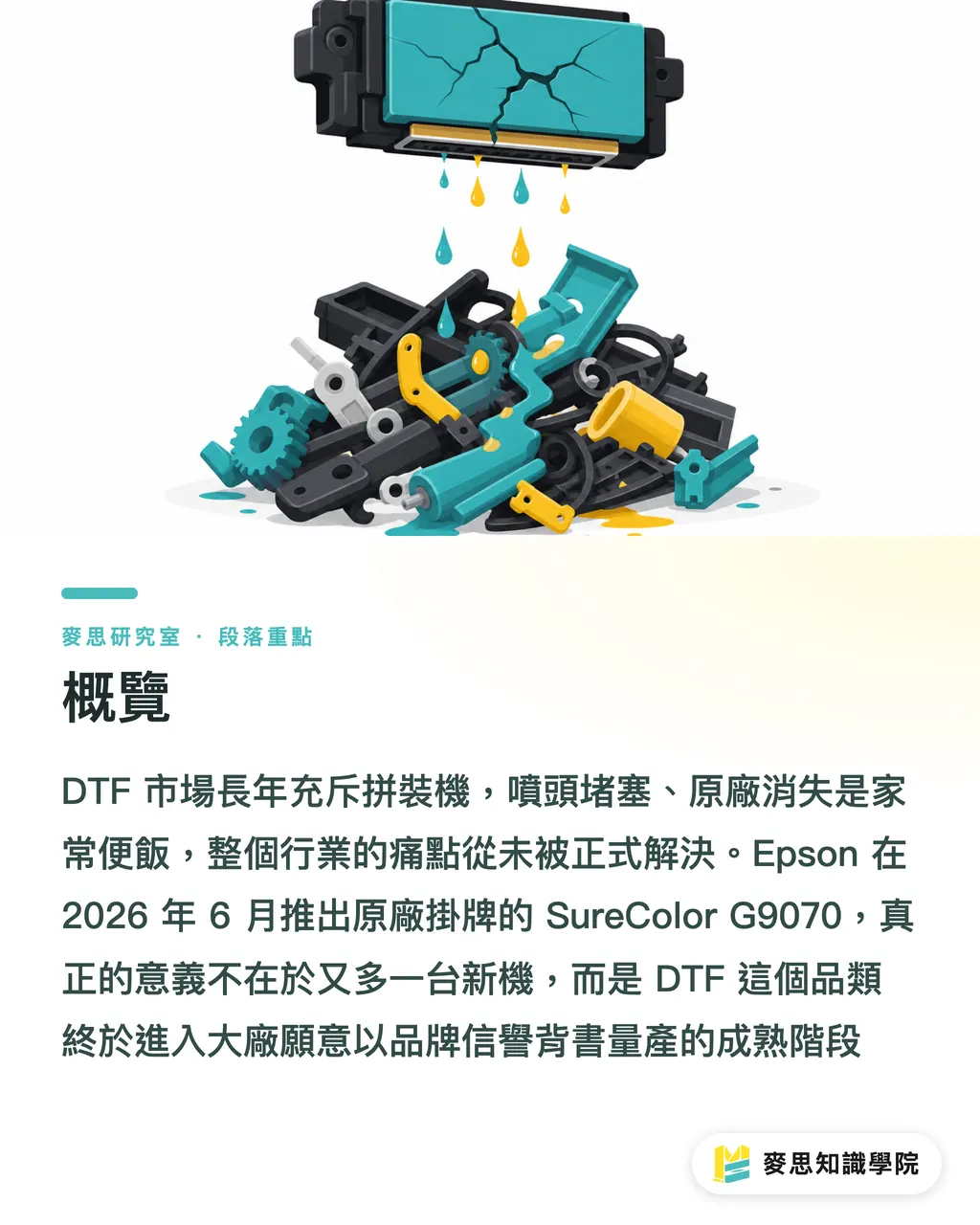
The fundamental shift lies in where quality assurance comes from. DTF grew rapidly on converted setups, taking off-the-shelf wide-format inkjet platforms, retrofitting white ink circulation, and bolting on hot-melt powder units. It was cheap and flexible, but no single manufacturer validated the interaction between ink, film, and powder. When problems occurred, accountability was murky
The G9070 completely rewrites this supply chain. It features user-replaceable PrecisionCore Micro TFP printheads, dedicated UltraChrome DF ink, Nozzle Verification Technology, and a sealed ink pack system [1]. In other words, the printheads, inks, consumables, and maintenance routines are engineered and validated as a single integrated ecosystem by the manufacturer, rather than an aftermarket combination
The weight of this move should be viewed through Epson's long-standing credibility in professional imaging. Academic research has used Epson inkjet platforms for objective print quality analysis [2], precisely because of their output repeatability. When that level of trust extends to DTF, it represents far more than just another hardware option
350 sq ft/hr vs. Zero Dropout: What Is the Real Selling Point?
The spec sheet looks great: the G9070 advertises speeds up to 350 ft²/hr and supports twin-roll simultaneous production [1]. But anyone who has run a production line knows that speed on paper does not equal finished jobs delivered at the end of the month
What truly matters is continuity. Early adopter Maximum Graphics put it plainly in Epson's announcement: they have run this machine in full production since March for gang sheets, printing continuously for six to eight hours with consistent color, zero dropouts, and startups or shutdowns that take only minutes [1]. The takeaway is not raw speed, it is not having to constantly stop to troubleshoot the machine
・Rated speed sets the theoretical ceiling
・Automated maintenance, nozzle verification, and sealed ink packs determine how much of that ceiling you can actually achieve
・For mid-volume shops producing 50 to 200 pieces daily, the latter directly dictates yield rates and delivery timelines
Look at it from another angle: whether the same machine delivers identical output day after day is the core requirement for industrial reliability. Bringing an engineering mindset centered on repeatability into DTF production is far more compelling than chasing top print speeds. In my view, for small and mid-sized shops, downtime hurts far more than running slightly slower
Where Do the Break-Even Points for DTF, Screen Printing, and DTG Actually Lie?
This is the exact calculation local print shops need to make, yet it is often glossed over. These three methods do not simply replace one another. They are separated by distinct order structures
Screen printing requires high upfront setup costs for platemaking, color separation, and press adjustment, but its marginal cost per print is tiny. Its sweet spot remains large, long runs with few colors and fixed designs, where unit costs drop as volume rises. Once a client asks for short runs with varied designs or full-color gradients, screen setup costs become impossible to amortize
Direct-to-garment (DTG) sits at the other extreme: no screens, instant on-demand output, and perfect for one-offs with intricate artwork. However, speed and fabric versatility fall behind as volumes grow. DTF sits right in the middle and is growing stronger: it requires no screens and handles full-color gradients effortlessly, but its fabric compatibility is far broader than DTG (working well on dark garments, polyester, and nylon). By using gang sheets to nest multiple small orders onto a single film, it cuts unit costs for varied short runs. The G9070's focus on continuous gang sheet production [1] targets this exact sweet spot
The break-even logic comes down to three clear rules:
・High volume, identical designs, simple colors → Screen printing remains the most economical
・One-offs, complex artwork, zero inventory → DTG or DTF
・Short runs with varied designs, full color, scaling transfer fulfillment → DTF (especially OEM mid-volume hardware) starts beating both alternatives
Should Print Shops Jump In Now? What to Verify First
Do not be won over simply by the OEM badge. OEM hardware removes uncertainties around print quality and warranties, but it comes with higher equipment costs and locked-in consumable pricing. UltraChrome DF ink, sealed ink packs, OEM film, and hot-melt powder form a closed ecosystem [1]. The hours saved on maintenance come at the expense of consumable margins
Before placing an order, get firm answers on three critical questions:
・What does local post-sales support actually cover? An OEM warranty is only as good as the local team's ability to dispatch engineers within 24 hours for printheads or ink lines. Clarify service level agreements (SLAs) rather than just looking at the warranty length
・Will consumable supply chains bottleneck you? In a closed ink system, stock shortages or price hikes leave your production line stranded. Verify local stock levels and lead times for inks, films, and powders
・Does your order volume justify mid-volume production? The G9070 is designed for operations producing 50 to 200 units a day. If your volume stays in the single digits, hardware depreciation will eat your margins. In that case, converted equipment or outsourcing transfer prints remains the more practical route
My bottom-line take: the real significance of the G9070 is shifting DTF from 'can it print?' to 'can it print reliably at volume?' For shops whose order volumes are bumping up against the capacity and quality limits of converted setups, this is an upgrade worth evaluating. For shops that haven't reached that scale, sorting out your process mix and cost structure is far more important than rushing into an OEM machine
Key Takeaways
・The core significance of the G9070 is moving DTF from the era of converted setups to OEM quality assurance, bundling printheads, inks, and consumables into an integrated validation system [1]
・While rated speeds of 350 ft²/hr and twin-roll output grab headlines, running continuously for six to eight hours without dropouts is what truly matters in mid-volume production [1]
・Break-even points depend on order structure: high volume and simple colors favor screen printing, while short-run, full-color jobs favor DTF over DTG and screen printing
・OEM hardware eliminates quality and warranty risks at the cost of higher, locked-in consumable expenses, trading consumable margins for reduced downtime [1]
・Before buying, thoroughly verify local post-sales SLAs, closed consumable supply chains, and whether your volume actually supports 50 to 200 units daily
Further Considerations
For print manufacturing, the G9070 introduces repeatability, an engineering concept from high-end metrology, into garment transfer production. This shifts competitive focus from spec sheets to overall line uptime and total cost of ownership. Hardware vendors are no longer selling pure print speed; they are selling uptime. For designers and brands, dropping unit costs for full-color gradients and varied short runs will unlock custom demand previously held back by platemaking barriers. For AI and SaaS, the highest-value opportunity lies not in hardware, but in scheduling and consumable forecasting. Once OEM machines stabilize hardware variables, bottlenecks will shift to order intake, gang sheet optimization, and maintenance scheduling at the software layer. That is precisely where small and mid-sized shops lack capabilities and stand to gain the most from investment. The remaining questions: long-term cost transparency in a closed consumable model, and whether local service can match OEM standards
References
[2] Lilić A., Kašiković N. (2019). ANALIZA KVALITETA OTISAKA DOBIJENIH INK JET TEHNIKOM ŠTAMPE NA GRAFIČKOM SISTEMU EPSON SURECOLOR T7200. Zbornik radova Fakulteta tehničkih nauka u Novom Sadu. DOI: 10.24867/03ef03lilic
FAQ
- What is the Epson SureColor G9070, and when was it released?
- The G9070 is Epson's 64-inch wide-format OEM direct-to-film (DTF) printer officially released in June 2026. Built for mid-volume production of 50 to 200 pieces daily, it emphasizes high output speeds, dual-roll feeding, and automated maintenance [1]
- What is the difference between an OEM DTF printer and a converted machine?
- The biggest difference is where quality assurance originates. OEM printers integrate printheads, UltraChrome DF inks, sealed ink packs, and maintenance routines into a factory-validated ecosystem backed by a warranty. Converted setups are pieced together in the aftermarket, leaving responsibility unclear when issues occur [1]
- How do you choose between DTF, screen printing, and DTG?
- For large volumes of identical designs with simple colors, screen printing is the most economical. For one-offs with intricate artwork, go with DTG or DTF. For short runs with varied artwork, full-color gradients, and scalable fulfillment, DTF (especially OEM mid-volume setups) beats both alternatives on unit economics
- What does the G9070's print speed of 350 sq ft/hr mean in practice?
- That figure represents the maximum theoretical print speed, supported by dual-roll simultaneous output [1]. Real-world throughput depends far more on continuous uptime. Early users report running six to eight hours straight with consistent color and zero dropouts [1]
- What should print shops check before buying the G9070?
- Three things: local post-sales SLAs and on-site repair capabilities, supply depth and lead times for proprietary consumables (ink, film, hot-melt powder), and whether your own order volume realistically supports a mid-volume capacity of 50 to 200 units daily
References
- DTF 直噴薄膜技術進入大廠量產時代:Epson G9070 上市的市場意義 · news.epson.com
- ANALIZA KVALITETA OTISAKA DOBIJENIH INK JET TEHNIKOM ŠTAMPE NA GRAFIČKOM SISTEMU EPSON SURECOLOR T7200 · doi.org
- A comparison between EPSON V700 and EPSON V800 scanners for film dosimetry · doi.org
- Gafchromic film dosimetry: Four years experience using FilmQA Pro software and Epson flatbed scanners · doi.org
- SU-F-T-581: The Effect of Scanning Orientation On New EBT-XD Film Using Vidar and Epson Scanners · doi.org
- SU‐FF‐T‐296: On the Comparison of Epson V700 and 10000XL Scanners for GafChromic EBT Film Dosimetry · doi.org
Related articles



The Print × AI weekly
The print and AI know-how designers, brands and enterprises can use before they commit — one email, every week
MINDS Free Tools
Spine width and imposition calculators — skip the manual math, free in your browser.
MINDS Group
Need actual printing or gifting services?
From premium printing to online ordering and festive gifts — the MINDS Group sister brands take it from here.