
Overview
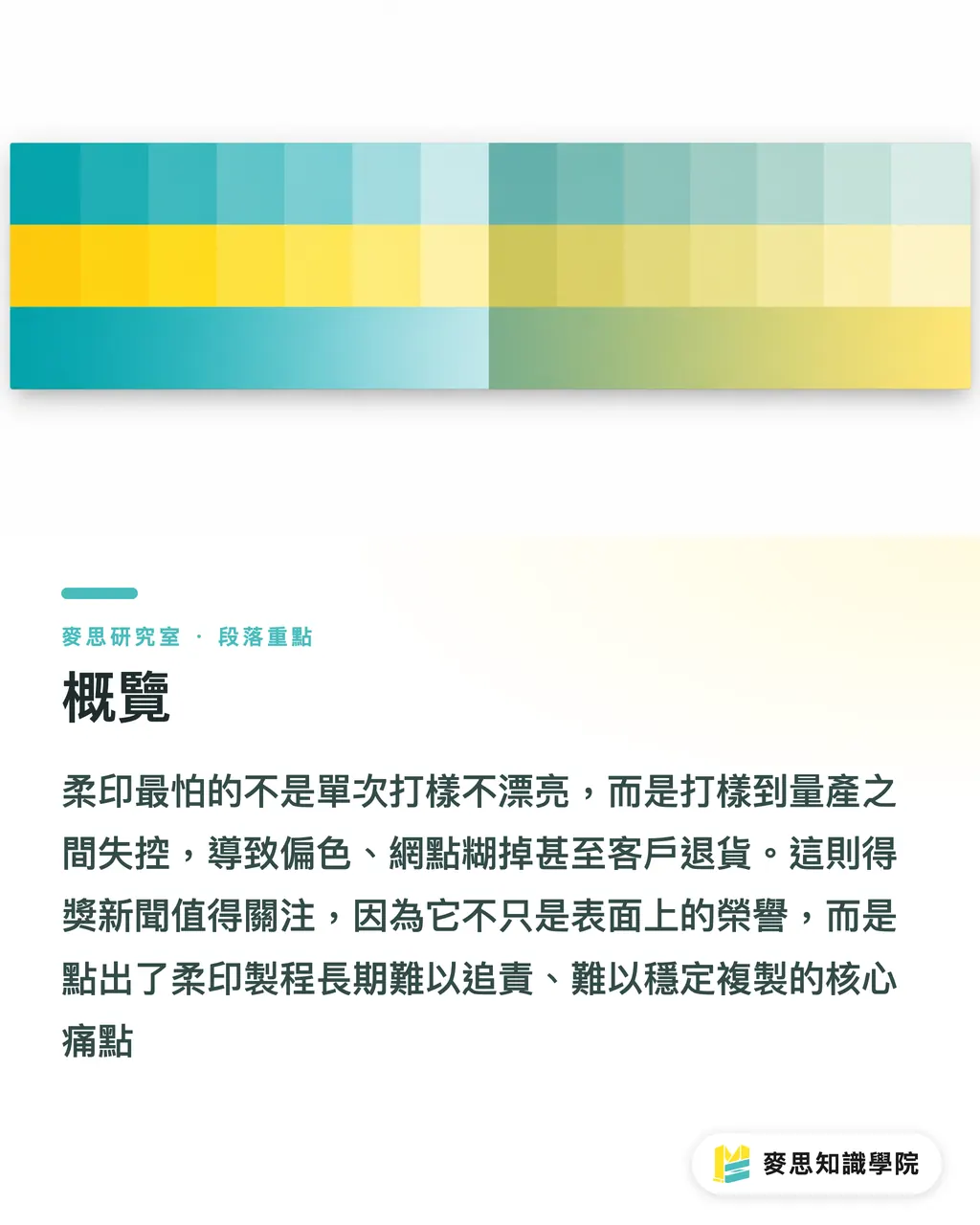
Have you ever faced this nightmare: a design proof looks stunning, but once it hits full production, colors drift across the run, dots plug up, and the customer rejects the batch. Sales blames prepress, prepress blames the ink, the ink supplier blames the plates, and nobody can pinpoint where things broke down
This is not an isolated incident. It is a chronic pain point across flexo. A recent, seemingly ordinary award announcement points straight at this sore spot, and it is worth breaking down
What Does a Flexo Gold Award Actually Reward?
First, the facts. Flint Group Packaging Solutions won Gold in the 'Technical Innovation (Supplier)' category at the 2026 FIA UK Awards for its TerraCode Bio bio-renewable ink series, presented on June 11 [1]
The real takeaway lies in why the judges picked it. They did not reward the fastest run speed or the lowest price tag. They recognized water-based inks that strike a balance between environmental responsibility and print performance, featuring up to 90% bio-renewable and recycled content while cutting CO₂ by up to roughly 25% [1]
What packaging converters in Taiwan should underline, however, is what followed. These inks were engineered to match the performance of traditional water-based formulations, maintaining output quality at high press speeds without dropping a gear [1]
In other words, the subtext of this award is clear: sustainability cannot come at the expense of print quality. If an eco-friendly ink forces you to slow down the press, introduces color shifts, or spikes customer complaints, it fails on the production floor. This series took Gold because it bundled sustainability with process stability, rather than forcing a tradeoff between the two
Why Is Packaging Flexo Shifting from Speed to Stability?
My take is straightforward: once hardware speed gaps level out, whoever reproduces quality consistently wins
In flexo's early days, the arms race centered on press hardware: running speed, web width, and plate cylinders. Over recent years, major suppliers have shifted technical investment toward upstream materials and process control. Flint Group has taken this path for a long time. They have regularly run technical workshops for flexo converters to transfer know-how directly to the floor [2], developed cost-effective water-based flexo inks for specific segments like North American retail bag converters [3], and even launched their own Narrow Web Print Awards to define what great printing looks like [4]
The trajectory is clear: what an ink giant really sells has never been just a bucket of ink, but repeatable print results
For packaging converters in Taiwan, your edge is no longer about how many presses sit on your floor. It is about whether you can guarantee that batch three matches batch one. Brand owners want shelf color consistency, not your press's theoretical top speed
This aligns with another key selling point for TerraCode Bio: strong European adoption, particularly in post-print corrugated, where it has outperformed traditional extender systems with customers reporting a smooth transition and no measurable impact on throughput [1]. Notice that phrase, 'no measurable impact.' That is process stability framed as the core value proposition

How Do Inks, Dot Control, and Floor SOPs Build a Unified Quality Chain?
Let's put the main point first: quality is never about one isolated step. The entire chain must hold steady
Ink selection is the foundation. Even with the same Pantone target, different ink systems vary in solids content, drying curves, and color gamut. If you switch ink lines without recalibrating, you end up with noticeable batch-to-batch color shifts on retail shelves. Flint Group has restructured its European packaging ink portfolio since 2008 [5], treating ink as an integrated system rather than a commodity consumable. That mindset is well worth adopting
Dot control is the magnifying glass. Because flexo transfers ink under relief pressure, highlight dots get lost easily and solids suffer from dot gain. The moment a process drifts, gradients and micro-text fall apart first. Quantifying and locking down dot gain curves determines whether you can take on premium brand packaging jobs
Shop-floor standardization is the safety net. You can mix great ink and build clean dot curves, but if press operators adjust impression pressure and viscosity purely by gut feeling, repeatability collapses anyway. Documenting mounting pressure, ink viscosity, dryer settings, and measurement checkpoints into standard procedures and tracking the data is what keeps the first two pillars standing during long production runs
Connecting these three elements gives you an auditable, repeatable quality chain. That capability is what international awards truly recognize, even when packaged as a story about a bucket of ink
What Is the First Step for Packaging Converters in Taiwan?
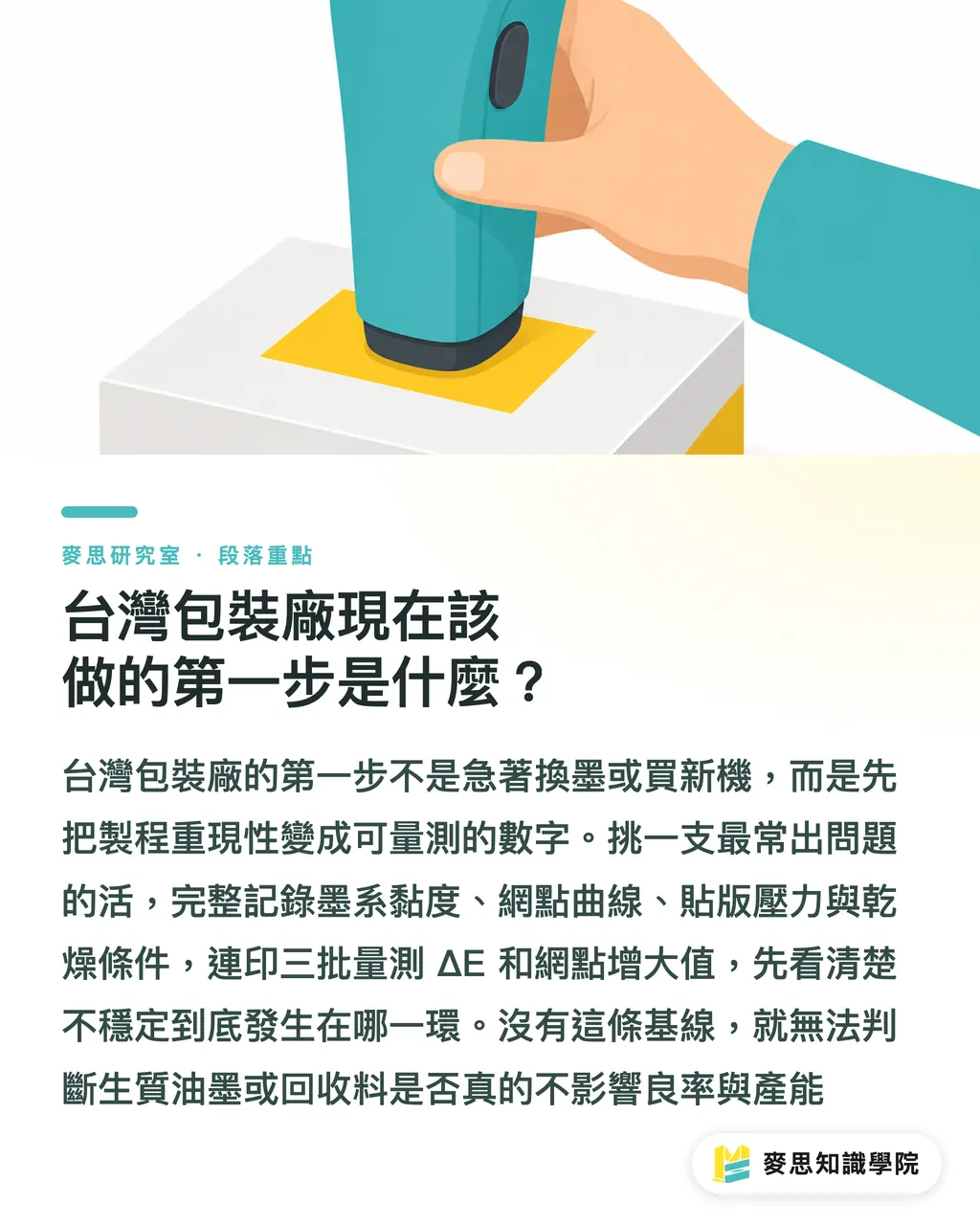
Do not rush to swap inks or buy new equipment. Turn repeatability into measurable numbers first
The most practical starting move is picking your highest-volume, most troublesome job and running a full process baseline. Record the ink system, viscosity, dot curves, mounting pressure, and drying parameters. Run three consecutive batches, measuring ΔE and dot gain with instruments to track batch-to-batch variance. For the first time, you will actually see where instability creeps in, rather than arguing over who is at fault
With a baseline established, you have the groundwork to evaluate sustainable transitions. Bio-based inks and recycled substrates will arrive in Taiwan sooner or later, but the TerraCode Bio case makes one condition clear: a green solution is only viable if it has no measurable impact on throughput [1]. Without a baseline, you cannot tell if a new ink is eating into your production yield
A final word for brand managers: when the same design looks drastically different across different packaging suppliers, the issue rarely lies in the artwork file. It usually comes down to whether the supplier maintains this quality chain. The next time you run a vendor pitch, ask bidders directly for batch-to-batch color and dot data. That tells a far more honest story than a quote sheet
Key Takeaways
Flexo awards do not celebrate raw speed or bargain pricing. They recognize the ability to deliver sustainability alongside process stability [1]
The winning ink uses up to 90% bio-renewable and recycled materials with up to 25% lower carbon emissions, yet highlights 'no measurable impact' on throughput. Stability remains the real selling point [1]
Competition in packaging flexo is moving from press speed toward a repeatable quality chain built on ink selection, dot control, and shop-floor standardization
The first step for converters in Taiwan is not buying new presses or switching inks, but establishing a process baseline on routine jobs to quantify repeatability through ΔE and dot gain numbers
Brand owners evaluating suppliers should request batch-to-batch color and dot variance data instead of comparing quotes alone
Further Thoughts
For converters, this is a clear reminder: differentiation is moving from hardware specs to process data assets. Printers that digitize and log ink formulations, dot gain curves, mounting pressures, and drying conditions will protect their yields during green transitions. For designers, file handoff cannot rely on the monitor alone. Understanding dot reproduction and gamut boundaries across print processes helps build printability directly into design decisions. For AI adoption, the biggest opening sits in process stability forecasting: training models on historical ΔE, dot gain, and ambient parameters to flag batch drift early, turning veteran press operator instincts into transferable algorithms. For SaaS, the gap is obvious: small and mid-sized packaging printers across Taiwan lack lightweight, accessible batch-tracking tools for color and dot metrics. A product that ties baseline audits, floor SOPs, and compliance reporting into a smooth loop meets a genuine operational need. The open question: as bio-based ink formulations evolve rapidly, how can color management workflows keep pace without triggering waves of customer complaints?
References
[1] The Signal Behind a Flexo Award: Inks, Dot Control, and Process Stability Are Becoming the Real Edge (thepackagingportal.com)
[2] Flint Group hosts technical seminars for flexo printers (doi.org)
[3] Flint Group introduces cost-effective water flexo ink for the North American t-shirt bag market (doi.org)
[4] Flint Group Announces winners of the 2011 Narrow Web Print Awards (doi.org)
[5] Flint Group introduces new European packaging inks portfolio (doi.org)
FAQ
- What award did Flint Group win?
- They won Gold in the 'Technical Innovation (Supplier)' category at the 2026 FIA UK Awards for their TerraCode Bio bio-renewable water-based ink series, presented on June 11 [1]
- Why was TerraCode Bio recognized by the judges?
- It uses up to 90% bio-renewable and recycled raw materials, reduces CO₂ by up to roughly 25%, and is engineered to match traditional water-based ink performance, running at high speeds without quality loss and with no measurable impact on throughput [1]
- What is the true driver of quality in flexo printing?
- With press speeds leveling out, the differentiator has shifted from machine speed to process stability. That means building a repeatable quality chain across ink selection, dot control, and floor standardization to ensure color and detail stay consistent from batch to batch
- What is the first step for Taiwanese packaging converters looking to improve flexo quality?
- Start by picking a high-volume, problem-prone job to build a process baseline. Record ink viscosity, dot curves, plate pressure, and drying settings across three consecutive runs. Measure ΔE and dot gain to locate where instability happens before swapping inks or investing in green transitions
- Do sustainable inks compromise print quality?
- Not necessarily. Recent award-winning developments show that well-formulated bio-based inks cut carbon without sacrificing quality or throughput [1]. However, converters need internal process baseline data to verify whether a new ink actually protects production yields
References
- 柔印得獎背後的訊號:油墨、網點與製程穩定性正在變成競爭力 · thepackagingportal.com
- Flint Group hosts technical seminars for flexo printers · doi.org
- Flint Group introduces cost-effective water flexo ink for the North American t-shirt bag market · doi.org
- Flint Group Announces winners of the 2011 Narrow Web Print Awards · doi.org
- Flint Group introduces new European packaging inks portfolio · doi.org
Related articles


The Print × AI weekly
The print and AI know-how designers, brands and enterprises can use before they commit — one email, every week
MINDS Free Tools
Spine width and imposition calculators — skip the manual math, free in your browser.
MINDS Group
Need actual printing or gifting services?
From premium printing to online ordering and festive gifts — the MINDS Group sister brands take it from here.