

Overview
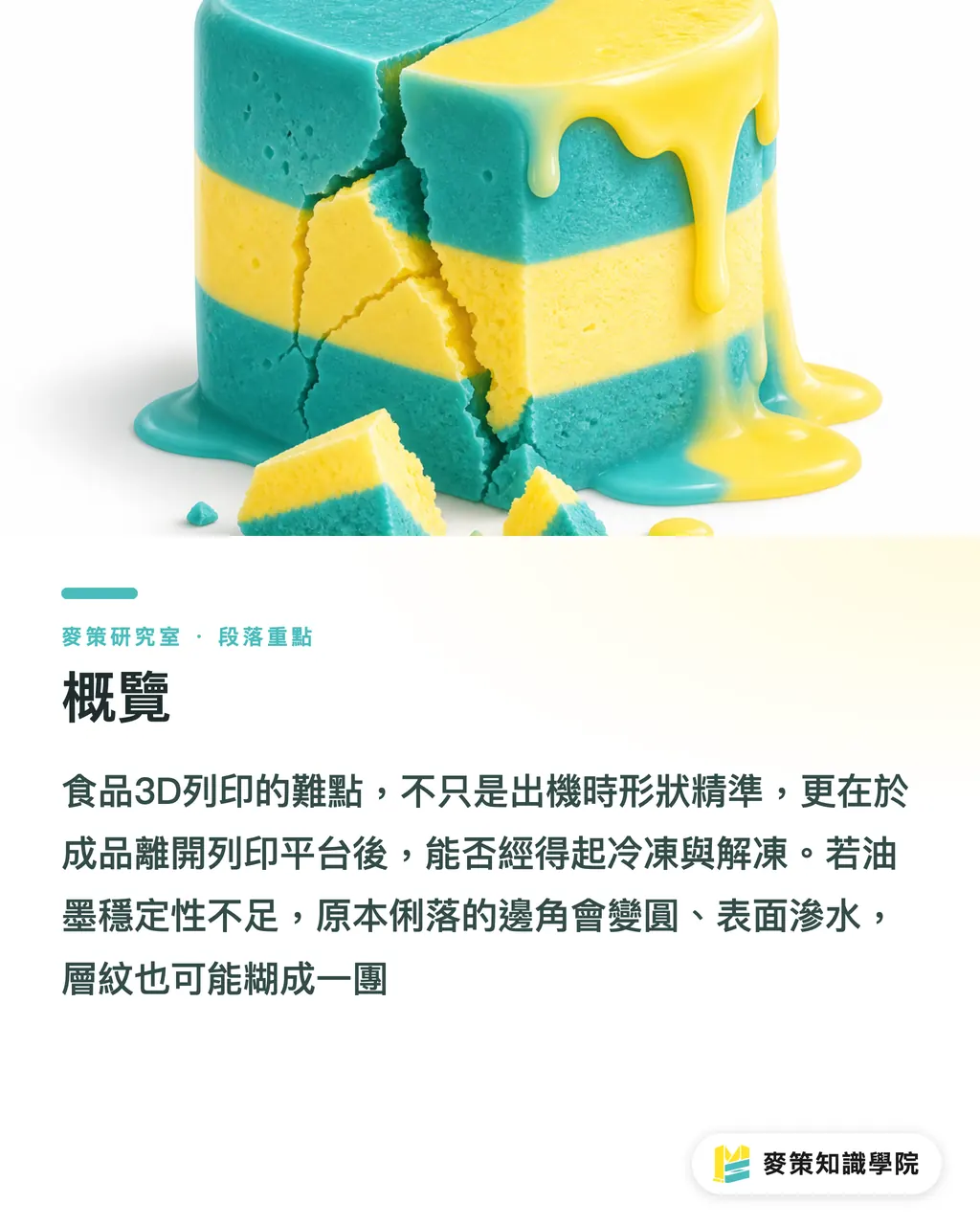
A client sits down with a render and asks for a three-dimensional dessert with sharp edges and clear facets, one that can stand inside its package without collapsing and still show depth through its shadows in photos. On prototype day, you bring out the sample. The shape is beautiful, the edges are crisp, and everyone applauds. Three weeks later, complaint photos arrive: the corners have rounded off, a film of water has seeped onto the surface, and the once-clean layers have blurred into one mass
What happened in between? Freezing and thawing
This is nothing new to the printing industry. We have long known that "it printed" and "it can be delivered" are two different things. A smooth press run and beautiful halftone dots do not mean the piece will still look the same after cutting, coating, and transport. Food 3D printing is now at the same turning point: precision is no longer the hardest part. The hard part is how much rough handling the material can take after it leaves the print bed. So the question we should really ask is this: what does a food 3D printing ink need in order to come off the printer with precision and still survive freezing and thawing?
Why Is Freezing the Real Test for 3D-Printed Food?
Because freezing can wreck the printed structure from the inside, while a post-print inspection cannot see it
When water freezes, it expands and forms ice crystals. Those crystals pierce the gel network. Once the material thaws, the water released is what you see as seepage and collapsed edges. Print precision depends on the material quickly switching from "flowable" to "self-supporting" after extrusion. But that "self-support" is mechanical strength at room temperature, which is a different capability from resisting ice-crystal damage. A recent study of O/W bigels addresses 3D printing precision and freeze-thaw stability side by side. It introduces a soy protein isolate and gellan gum complex, then adds beeswax to reinforce the structure [1]. Putting both concerns in the title of a single paper is itself an industry signal: the materials side has acknowledged that optimizing only one of them does not count as delivery
The division of labor between the reinforcement methods is worth noting. The protein-polysaccharide complex adds resilience to the aqueous network. Beeswax is a crystalline structuring agent in the oil phase, adding room-temperature support and resistance to deformation [1]. This is reinforcement on two tracks, not simply thickening the formula
What Does bigel Actually Solve, and How Is It Different from a Conventional Gel?
The value of bigel is that it contains two structural systems at once, one aqueous and one oil-based. That lets you tune "print accurately" and "hold its shape over time" separately, instead of making a zero-sum trade-off on a single parameter
A bigel is a two-phase system made by mixing hydrogel and oleogel in a defined proportion. The mixing ratio and choice of emulsifier directly determine whether it is suitable for 3D printing [3]. This is easy for people in print to understand: it is like adjusting viscosity and thixotropy together when formulating ink, except there is one more phase to tune here. Research also shows an analyzable relationship between bigel-ink printability and rheological properties. In other words, this is not something you have to leave to an experienced operator's feel. It can be measured and written into a specification sheet [4]
At a finer level, the microstructure, texture, and rheological properties of food-grade bigel inks have already been characterized together in a systematic way, providing a foundation for 3D printing design [2]. These three need to be considered together. That matters. Measure viscosity without looking at microstructure, and you can end up with a material that "extrudes fine, but the layers do not lock together."
bigel's possibilities go beyond structure. One study has used bigel in 4D printing, with a dual-nozzle printer making the finished product change color on its own to monitor the kinetic behavior of bioactive compounds [5]. From our perspective, this is almost the food version of "color-changing ink plus indicator". The same structural material also serves as a status display

What Three Questions Should You Ask During Prototyping to Avoid a Cold-Chain Failure?
Move the acceptance checkpoint from "the moment it comes off the printer" to "after thawing", then use three questions you can actually ask on the shop floor to draw a clean line around responsibility
Here is how my usual three-gate framework for prototype work applies:
・First gate, does it extrude? Extrusion pressure, nozzle diameter, and the material's degree of shear thinning determine whether the lines stay continuous. This gate is usually the fastest to pass, and the easiest one to mistake for proof that the whole project is feasible
・Second gate, can it stand? Check self-supporting strength 30 minutes after printing, the maximum layer count, and edge retention. The oleogel/hydrogel ratio and emulsifier in the bigel are decisive at this stage [3]
・Third gate, can it survive distribution? This is the new gate, and the one most teams miss. Run at least one complete freeze-thaw cycle. After thawing, measure the deformation rate, check for seepage, and take side-by-side photos against the as-printed sample
The acceptance criteria for the third gate need to be written as concrete entries in the delivery specification: what percentage of deformation is acceptable, whether seepage is allowed, and under what packaging and cold-chain conditions the test will be run. A numberless "it needs to be stable" is the same as having no specification
This is my judgment, not a conclusion from the literature: when most food 3D printing projects are quoted, the price covers only the first two gates, while the cost of a third-gate failure lands at delivery. That is a business-model mismatch, not just a technical problem
What Does This Mean for Taiwan's Printing and Packaging Teams?
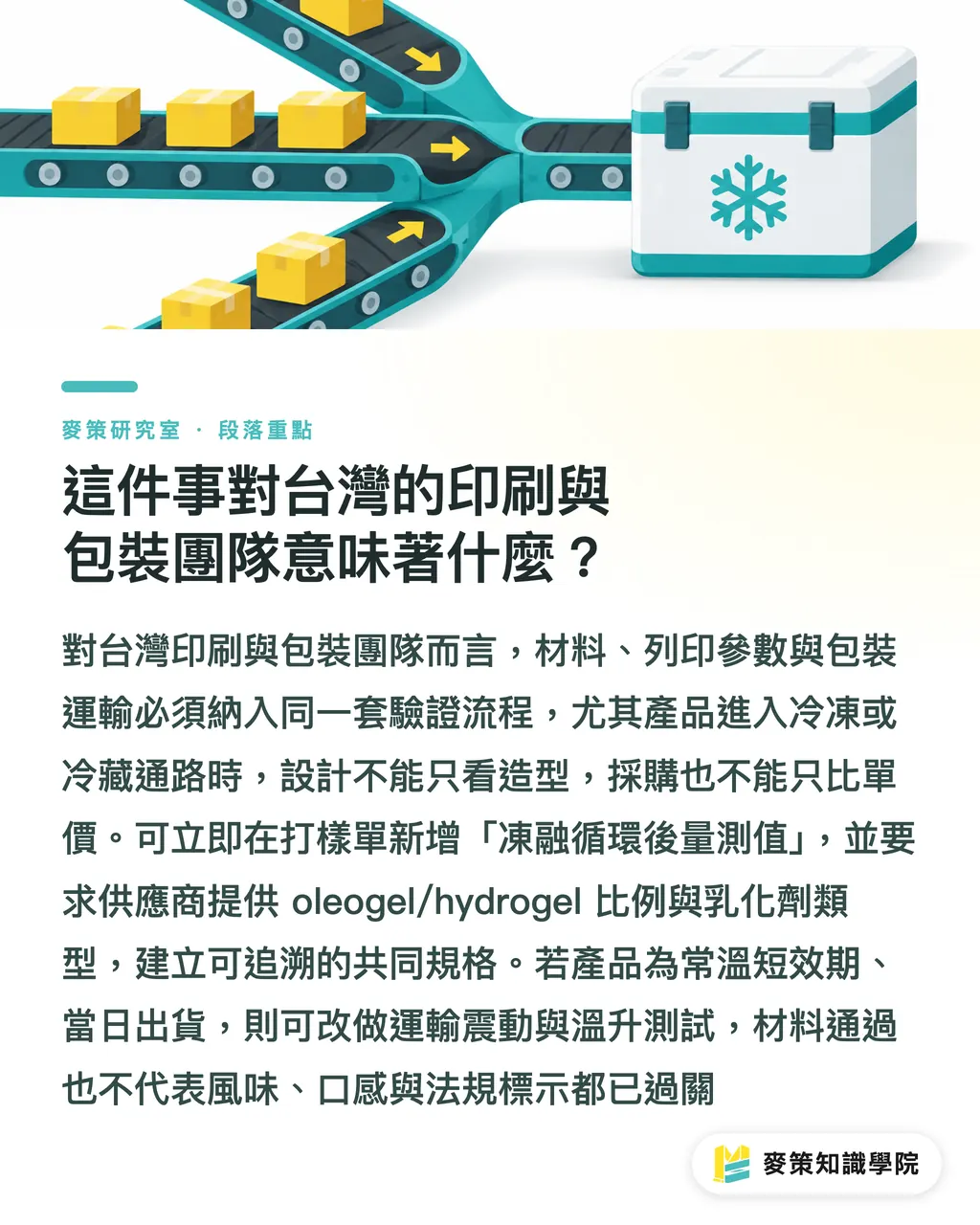
It means that materials, print parameters, and packaging and transport must be put into the same validation workflow, instead of being signed off independently by three departments
Teams in Taiwan that make customized display pieces, seasonal gift products, and functional foods generally already know how to produce the shape. Delivery is where they get stuck: room-temperature seasonal runs are usually fine, but once a product enters frozen distribution, returns and complaints climb. By putting freeze-thaw stability into the same evaluation set as 3D printing precision, the research gives purchasing and design a shared language [1]. Design cannot hand over only a render, and purchasing cannot compare price alone
This specification mindset has a mature precedent in conventional printing. Standardized testing systems for paper and packaging materials have been built and refined over decades [6], and flexographic printing has a research tradition of quantitatively mapping the relationship between print quality and process parameters [7][8]. What food 3D printing lacks is not a new concept. It is the temperature dimension in the familiar logic of "parameters, quality, conditions"
One thing you can do immediately: add a field called "post-freeze-thaw measurement" to your existing prototype form, and require material suppliers to provide the oleogel/hydrogel ratio and emulsifier type as traceable parameters [3]. If you do not add this field, you will always be cleaning up after the fact
Be clear about where this applies: the judgment above is aimed at products entering frozen or refrigerated distribution. If your finished product has a short room-temperature shelf life, ships the same day, and is eaten on site, the third gate can be simplified to transport-vibration and temperature-rise tests. Forcing in a freeze-thaw cycle only adds cost. Also, the bigel studies cited above mostly characterize materials at the material level. An actual product still has to clear flavor, texture, and regulatory-labeling requirements. Passing the material test does not mean the product has passed
Key Takeaways
Food 3D printing acceptance should move from "the shape straight off the printer" to "still deliverable after freeze-thaw exposure". A post-print inspection cannot reveal the damage ice crystals do to the gel network
The value of bigel (dual-gel) is that its aqueous and oil phases provide two structures that can be tuned separately, so print precision and structural stability do not have to be a zero-sum trade-off [3]
Recent research reinforces an O/W bigel with a soy protein isolate-gellan gum complex and beeswax, improving both 3D printing precision and freeze-thaw stability [1]
Bigel ink printability and rheological properties have a measurable relationship, which means the formula can be written into a specification sheet instead of being left to shop-floor intuition [4]
The prototype form should add a "post-freeze-thaw measurement" field, and suppliers should disclose the oleogel/hydrogel ratio and emulsifier type as traceable parameters [3]
Looking Ahead
For print manufacturing, this is an expansion of the delivery specification: quality is no longer defined by geometric precision alone, but by "geometric precision × environmental conditions" together, and pricing should be split by gate as well. For design teams, the render is no longer the endpoint of delivery. Designers need to understand how the material behaves at low temperatures. Otherwise, the aesthetic claim of sharp edges will be rejected outright by physics in the cold chain. The opening for AI is clear. The relationship between bigel printability and rheological properties has been shown to be quantifiable [4], and microstructure, texture, and rheology already have a systematic characterization base [2]. This is where a predictive model linking formulation parameters to finished-product quality can become practical. Train it on a small amount of experimental data and replace large amounts of trial-and-error prototyping. The SaaS entry point is the validation workflow itself: connect prototype records, freeze-thaw measurements, and packaging and transport conditions into one traceable digital delivery specification, so design, purchasing, and production share the same source of truth. Three problems remain open. First, the industry lacks a shared understanding of how the number of freeze-thaw cycles corresponds to actual cold-chain exposure. Second, no one has settled how material-level stability indicators should be translated into quality thresholds that consumers can perceive. Third, oil-phase formulations can face oxidation and flavor deterioration during long-term storage. Research is still focused more on structure than on sensory quality
References
[1] Kim, Ye, and Kong (2027). Structural reinforcement of O/W bigels by incorporating soy protein isolate, gellan gum complex and beeswax: Enhancing 3D printing precision and freeze-thaw stability. Food Hydrocolloids. DOI: 10.1016/j.foodhyd.2026.113358
[2] Zampouni K., Tsikoudis S., Biza T., et al. (2026). Microstructural, textural and rheological properties of food-grade bigel inks designed for 3D food printing. Food Hydrocolloids. DOI: 10.1016/j.foodhyd.2026.112752
[3] Xie D., Hu H., Huang Q., et al. (2023). Development and characterization of food-grade bigel system for 3D printing applications: Role of oleogel/hydrogel ratios and emulsifiers. Food Hydrocolloids. DOI: 10.1016/j.foodhyd.2023.108565
[4] Qiu R., Wang K., Tian H., et al. (2022). Analysis on the printability and rheological characteristics of bigel inks: Potential in 3D food printing. Food Hydrocolloids. DOI: 10.1016/j.foodhyd.2022.107675
[5] Qiu R., Liu X., Tian H., et al. (2024). Exploration of bigel 4D printing with spontaneous colour change for monitoring bio-actives kinetic behaviour based on the dual-units 3D printer. Journal of Food Engineering. DOI: 10.1016/j.jfoodeng.2023.111861
[6] ASTM International: ASTM paper and packaging standards page. ASTM International
[7] Journal of Graphic Engineering and Design: JGED paper on flexographic printing quality. Journal of Graphic Engineering and Design
[8] DiVA Portal / Karlstad University: Doctoral dissertation on the relationship between flexographic printing quality and parameters (PDF). DiVA Portal / Karlstad University
FAQ
- Why does food 3D printing look beautiful right off the printer but deform after freezing?
- When water freezes, it forms ice crystals that pierce the gel network. The water released during thawing causes seepage and collapsed edges. Print precision relies on room-temperature support strength, while resisting ice-crystal damage is a different capability altogether, so a post-print inspection cannot catch it
- What is bigel, and why is it suitable for food 3D printing inks?
- bigel is a two-phase gel system made by mixing hydrogel and oleogel. It contains separate aqueous and oil-phase structures, so flowability and support can be tuned independently. The mixing ratio and emulsifier choice directly affect printability [3]
- How can you verify that a 3D-printed food product can survive the cold chain?
- Add at least one complete freeze-thaw cycle to the prototype stage. After thawing, measure the deformation rate, check for seepage, and compare photos with the as-printed sample. Write the acceptance criteria as numbers in the delivery specification, including the acceptable deformation percentage and the packaging and cold-chain conditions used for testing
- Do all food 3D-printed products need freeze-thaw testing?
- No. Freeze-thaw testing is for products entering frozen or refrigerated distribution. For items with a short room-temperature shelf life that ship the same day and are eaten on site, transport-vibration and temperature-rise tests are enough. Forcing in a freeze-thaw cycle only adds unnecessary cost
- What parameters should you request from a material supplier?
- At a minimum, get the oleogel/hydrogel ratio and emulsifier type. These two directly determine printability and structural performance [3]. You should also request rheological data and freeze-thaw stability test results, not just a single viscosity number
Related articles


The Print × AI weekly
The print and AI know-how designers, brands and enterprises can use before they commit — one email, every week
MINDS Free Tools
Spine width and imposition calculators — skip the manual math, free in your browser.
MINDS Group
Need actual printing or gifting services?
From premium printing to online ordering and festive gifts — the MINDS Group sister brands take it from here.