

Overview
Imagine you run a label plant. Your sales team says brand customers in India and Southeast Asia are offering more and more SKUs, while each order keeps getting shorter. Then an equipment supplier arrives with a presentation titled “873,000 Labels in One Shift.” Hold off on drawing conclusions. To judge whether the equipment is worth the investment, you need to look at regional market growth and machine productivity together
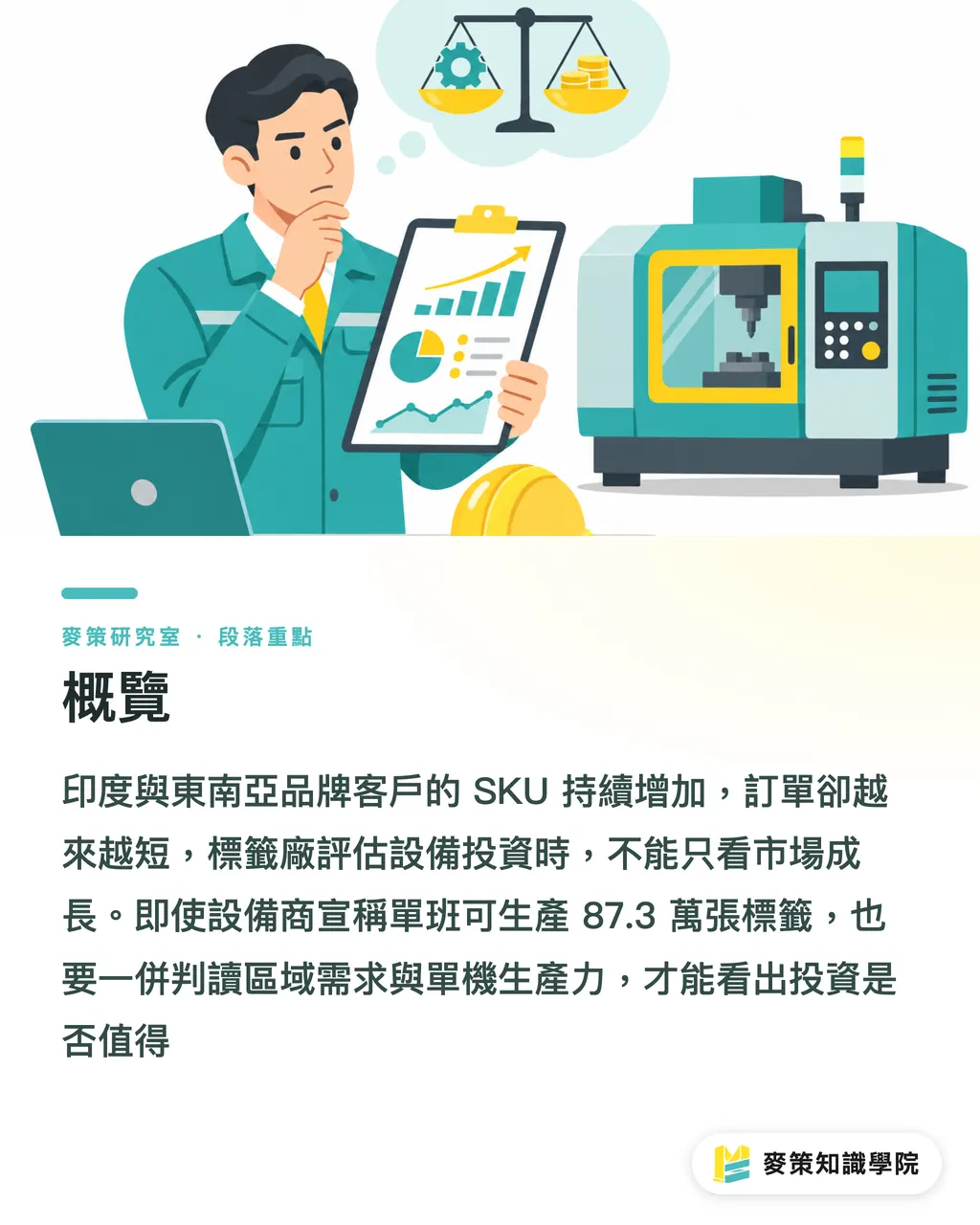
What Does 873,000 Labels in One Shift Actually Tell You?
That figure represents the total completed output of the entire workflow, not the press’s top printing speed. Mark Andy ran its Digital Series HD HighSpeed 1200 through a simulated eight-hour shift. One operator completed 10 jobs covering 25 SKUs, producing 873,000 finished labels [1]
The press was configured as a seven-color hybrid system. Two flexo units ahead of the digital engine printed white (WW); the remaining CMYK plus two spot colors (CMYKOV) were printed digitally. The press ran at 480 feet per minute and 1200 dpi, with varnishing, finishing, and downstream converting completed in the same single pass [1]
That works out to about 109,000 labels per hour, 87,000 per job, and 35,000 per SKU on average. These are my calculations based on the figures Mark Andy published. The volume falls into the middle ground where digital is often seen as too expensive and flexo as too much hassle to set up. That is exactly the gray area this demonstration is meant to address
One more detail matters: the company explicitly described this as a simulated eight-hour shift [1]. Those are demonstration conditions, not a long-term average from a customer’s production line
Why Did Makeready Time Fall 91%, While Costs Fell Only 28%?
The gap between those two figures shows where hybrid printing makes its money: time and waste. Consumable costs did not fall at the same rate. Compared with traditional flexo, the demonstration reported an 83% reduction in total production time, a 91% reduction in makeready time, an 88% reduction in material waste, and a 28% reduction in production costs [1]
Time and waste fell by 83% and 88%, respectively, while production costs fell by 28%. A reasonable inference is that some costs do not fall along with them, such as digital ink, equipment depreciation, and maintenance contracts. The published figures do not break down the cost structure, so this is an analysis, not a confirmed fact
Plant managers can start by checking a few things:
・If your main cost pressures are makeready labor and startup waste, hybrid printing is more likely to pay off
・If most of your orders are long runs with few changeovers, flexo may still have the edge in unit cost. Mark Andy also acknowledges that flexo remains a mature solution for long runs [1]
・“How much faster than traditional flexo” depends on the flexo benchmark used. The data do not identify the comparison press, its level of automation, or its plate-making workflow
Why Look at Indian Expansion and Machine Capacity on the Same Chart?
Market growth affects how many orders are available. Machine productivity affects whether you can make money after taking them on. An investment assessment needs to account for both
In the latest industry news, Gallus is targeting growth in India’s packaging market with Flexomaster, a sign that equipment suppliers are using regional demand to guide their plans. Public information does not provide comparative specifications for the two machines or examples from Indian customers, so it would be unwise to compare Flexomaster directly with Mark Andy’s demonstration figures
The shift-share method offers a useful way to break this down. The OECD uses this kind of analysis to separate changes in labor productivity into two parts: efficiency gains within industries and structural shifts between industries [2]. Applied to a label plant, I suggest looking at two layers:
・Structural effect: How much of the shift toward shorter runs and more SKUs comes from the market, such as brands expanding in emerging economies?
・Internal effect: With the same mix of orders, how many more jobs can the new press complete per shift?
I call this the “Mai Strategy Two-Layer Capacity Check.” If a growing market mainly brings in long runs, adding a wide-web flexo press makes more sense. If it brings a surge in SKUs, that is where hybrid’s changeover advantage can come into play
What Data Should You Ask Suppliers for When Evaluating a Hybrid Label Press?
When assessing these demonstration figures, compare them with your own order mix and ask the supplier for measurement conditions, quality benchmarks, and data from customer production lines
For measurement conditions, ask for the substrate type, label dimensions, repeats per meter, and how much the artwork varies from job to job. Paper and packaging materials have standardized test methods, including ASTM methods [3]. Waste and speed results vary by substrate, so you cannot treat them all the same
For quality benchmarks, flexo print quality depends heavily on process variables such as plates, anilox rollers, pressure, and substrate. These relationships have been studied systematically [4][5]. The flexo settings used in the white-printing section and how the digital color gamut aligns with flexo spot colors will both affect whether the press can consistently meet its target at 1200 dpi and 480 fpm
For real-world performance, ask for at least three months of customer-line OEE, average changeover time, and waste rates, rather than relying on figures from a single demonstration shift
One practical approach: pick the 10 jobs from your last quarter that best represent your work. Ask the supplier to run them to the original specifications, then compare the results side by side with actual labor time, waste, and consumable costs on your current flexo line

Key Takeaways
・Mark Andy’s 873,000 labels represent the total output from 10 jobs and 25 SKUs during a simulated eight-hour shift. The figure reflects the efficiency of the full workflow, not the press’s top printing speed [1]
・Makeready time fell 91%, while costs fell only 28%, suggesting that hybrid’s gains come mainly from labor time and waste, while costs such as consumables did not fall at the same rate [1]
・An investment assessment needs to weigh both the order mix coming from market growth and the effect of equipment efficiency on profitability
・When evaluating a hybrid press, ask suppliers for substrate conditions, the flexo benchmark, and long-term customer OEE. Do not rely on demonstration figures alone
・Running your own representative jobs on the press is the most reliable way to turn a supplier’s demonstration figures into an investment decision
Further Questions
Printing operations can include scheduling and makeready management in their production-efficiency assessments. As runs get shorter and SKU counts rise, the number of jobs completed per shift becomes a competitive measure. Designers also need to understand how hybrid presses split the work between flexo white and digital color to reduce registration and color-gamut risks in final artwork. AI can help route jobs based on order volume, color requirements, and deadlines. SaaS providers can improve how OEE and changeover data are combined across presses. Three questions remain: Where is the unit-cost break-even point for hybrid on medium and long runs? Are order patterns in emerging markets really shifting toward shorter runs? And how large is the gap between demonstration figures and customers’ long-term production data?
References
[1] A Two-Pronged Strategy for Label Printing: Indian Expansion and 873,000 Labels in One Shift
[2] Figure 1.12. Shift-share analysis of labour productivity. DOI: 10.1787/485207086167
[3] ASTM International: Paper and Packaging Standards. ASTM International
[4] Journal of Graphic Engineering and Design: Research on Flexographic Print Quality. Journal of Graphic Engineering and Design
[5] DiVA Portal / Karlstad University: Doctoral Thesis on the Relationship Between Flexographic Print Quality and Process Parameters (PDF). DiVA Portal / Karlstad University
FAQ
- How did Mark Andy produce 873,000 labels in one shift?
- Mark Andy used a seven-color Digital Series HD HighSpeed 1200 hybrid label press. In a simulated eight-hour shift, one operator completed 10 jobs covering 25 SKUs. The press ran at 480 feet per minute and 1200 dpi, with flexo printing the white and digital printing the CMYKOV. Varnishing and converting were completed in the same pass
- How much can a hybrid label press save compared with traditional flexo?
- In Mark Andy’s published demonstration figures, total production time fell 83%, makeready time fell 91%, material waste fell 88%, and production costs fell 28% compared with traditional flexo. The specifications of the flexo press used for comparison were not disclosed. You need to validate the actual gains with your own jobs
- What kind of label plant is a good fit for a hybrid press?
- A label plant handling mostly short runs, many SKUs, and frequent artwork changes is best positioned to benefit from hybrid’s changeover advantage. If most orders are long runs with few changeovers, traditional flexo may still offer a lower unit cost
- When evaluating label equipment, why consider both market growth and machine capacity?
- Market growth determines order volume and mix. Machine capacity determines how many jobs can be completed per shift and whether they can be profitable. Looking at just one side can leave you with equipment that does not fit your future order mix
- Can you use a supplier’s label press capacity figures directly to make an investment decision?
- It is not advisable. Demonstration figures are usually collected under specific substrate, size, and job conditions. Ask the supplier for measurement conditions, quality benchmarks, and long-term customer OEE, then run your own representative jobs on the press and compare the results
Related articles


The Print × AI weekly
The print and AI know-how designers, brands and enterprises can use before they commit — one email, every week
MINDS Free Tools
Spine width and imposition calculators — skip the manual math, free in your browser.
MINDS Group
Need actual printing or gifting services?
From premium printing to online ordering and festive gifts — the MINDS Group sister brands take it from here.