

Overview
Have you had this experience recently in front of a supermarket shelf? You pick up a box of tea, turn it over to check the ingredient list, and notice that the QR Code is printed larger than the English text. But when you scan it, it takes you to a login page or a "welcome to our brand world" message. You probably mutter to yourself: so what are the ingredients, exactly? This is not a consumer problem. It is a prepress design problem. Because the responsibility behind that black-and-white QR Code is quietly changing hands
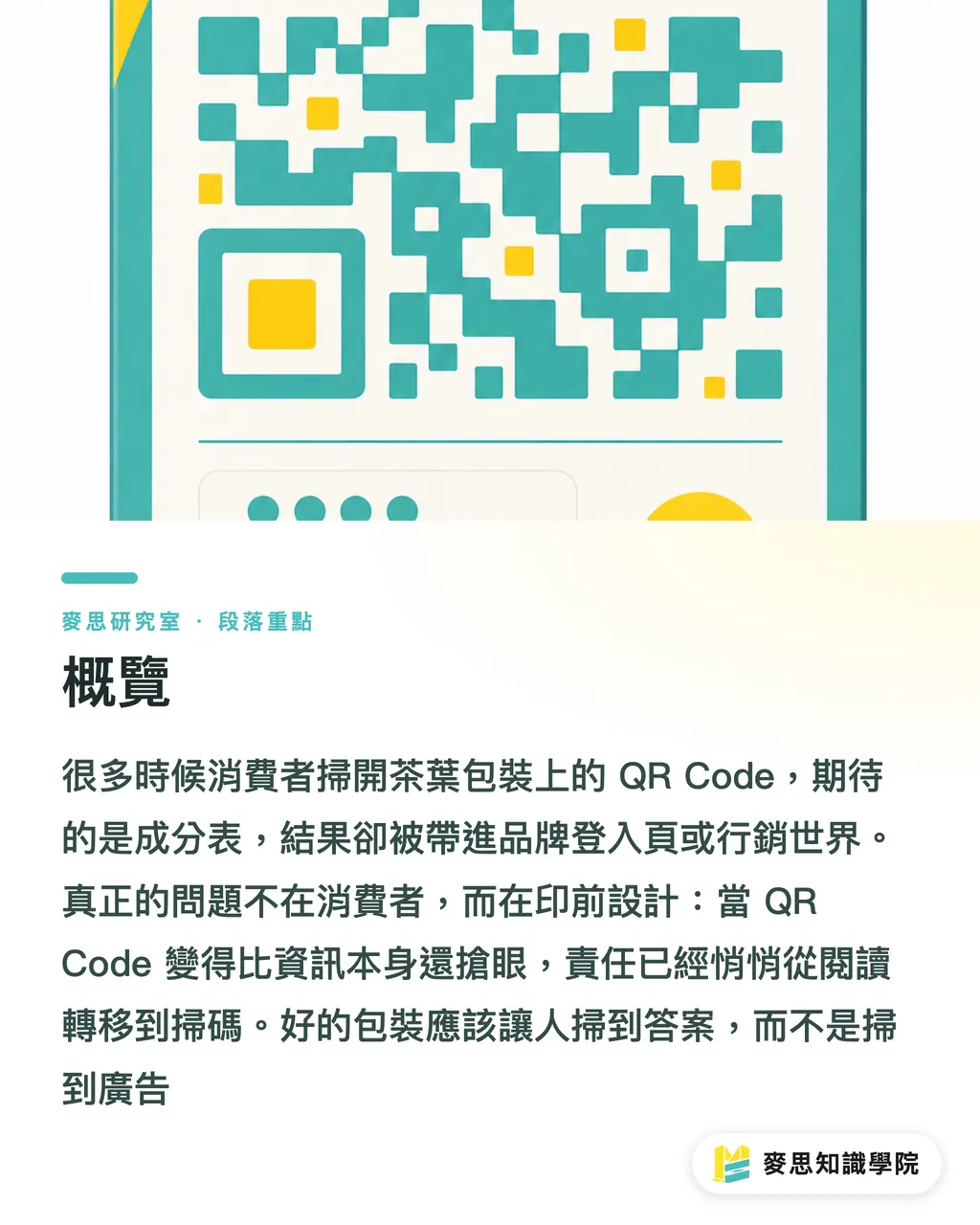
Why Is a QR Code No Longer Just About "Scan Me and Go Somewhere"?
Over the past decade, the role of QR Codes on packaging has been clear: they were marketing gateways. Scan to enter a shopping page, a prize draw, or a brand campaign page. When discussing the era of the Digital Product Passport (DPP), Segede's director put it plainly: transparency will move from being a brand bonus to becoming a basic requirement of the supply chain [1]. In other words, QR Codes are being rewritten from "what the brand wants you to see" into "what regulations require you to be able to read."
This is not a rhetorical issue. It is a technical interface issue. The European standardization bodies CEN/CENELEC have already begun releasing the backend specifications for DPP in several parts: unique identifiers, API interfaces, and system interoperability [2][3][4][5][6]. For prepress professionals, the key point is not the documents themselves, but what they collectively point to: in the future, that QR Code will no longer link to a web page. It will link to a machine-readable and machine-writable data object containing materials, carbon footprint, recycling instructions, and even repair records. Identification and lookup are being upgraded from a "marketing add-on" to "compliance infrastructure."
What Signal Does That Box of Twinings Tea Send to the Printing Industry?
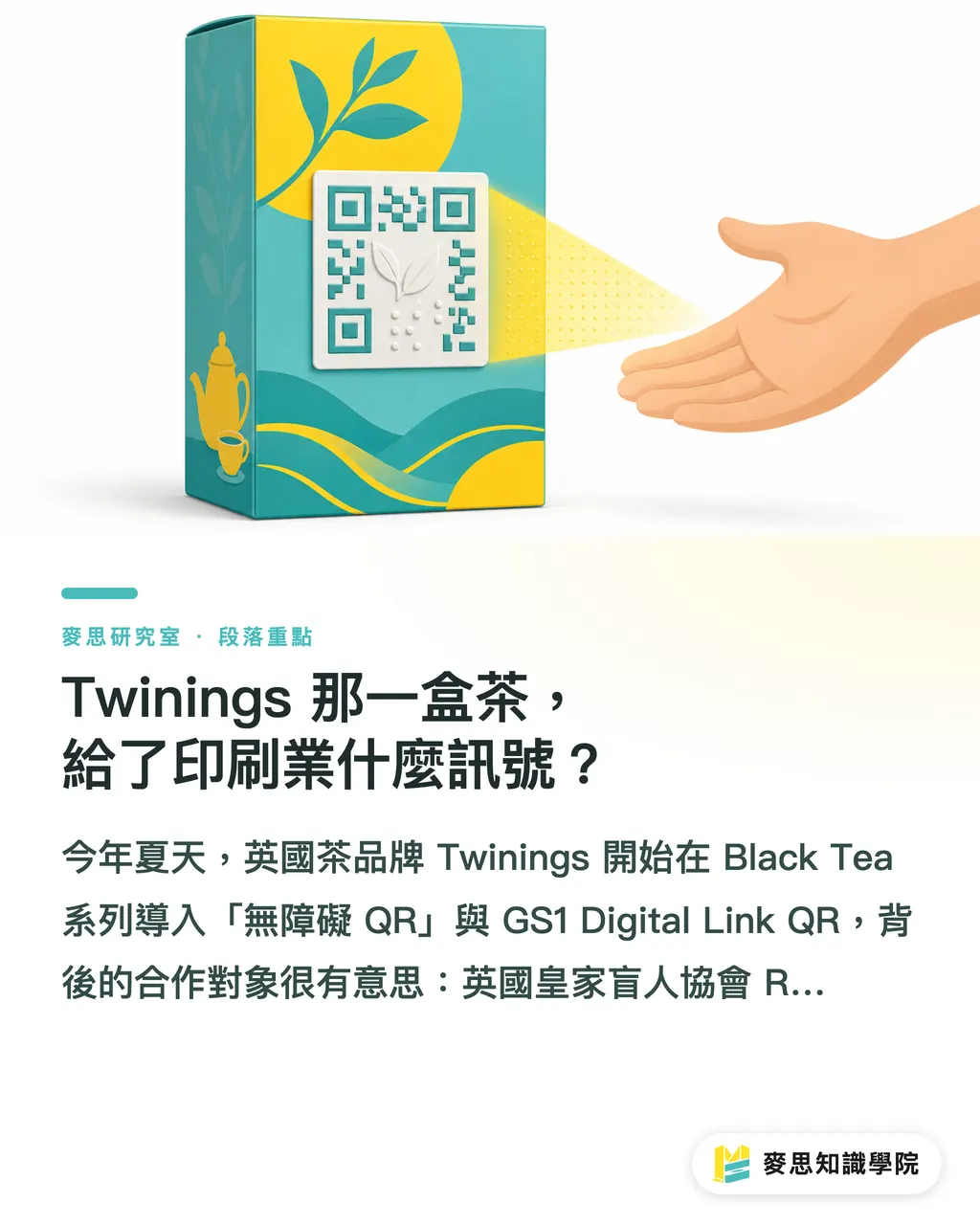
This summer, the British tea brand Twinings began introducing accessible QR and GS1 Digital Link QR across its Black Tea range. The partners behind the project are telling: the Royal National Institute of Blind People (RNIB), AR company Zappar, and GS1 solution provider io.tt [1]. This is the first large-scale rollout of this technology by a British tea brand. The point is not "we have caught up too." The real point is its design goal: allowing blind and low-vision consumers to scan for ingredient and brewing information
Why does this matter to printers in Taiwan and the broader Chinese-language market? Because it addresses two tightening requirements at once:
・Accessibility: the EU's European Accessibility Act came into force in June 2025, and accessibility requirements for consumer e-commerce and some packaging will only expand, not shrink
・Data structure: GS1 Digital Link upgrades a simple URL into a structured string that can carry GTIN, serial numbers, and batch data. It is the practical mainstream candidate for DPP unique identifiers [4]
For prepress artwork preparation, this means artwork specifications need to add at least three rules: the minimum scannable limit for QR module size, contrast and braille compatibility under accessible design, and the effect of URL length on error correction level under the GS1 Digital Link structure. These used to be a tug-of-war between "the designer's aesthetic" and "whether the engineer can scan it." Now there is a third hand at the regulatory level
From "Printed Beautifully" to "Data Correctly": Who Pays for the Upgrade?
This is where brands and contract manufacturers are most likely to argue. In the past, if a QR Code was wrong, the worst-case outcome was that consumers could not scan it and left a complaint. Now, if it is wrong, the worst-case outcome is that the product is blocked at EU customs or the recycling system fines you
Brands need to recalculate the cost. The QR Code and the data middleware behind it now belong to "compliance assets," not "marketing materials." That means:
・The prepress side must enter version control. The GTIN, URL, and error correction level for every batch need to leave an audit trail
・The print production side must revalidate minimum ink density, registration accuracy, and the scattering coefficient of surface materials, because GS1 Digital Link URLs are often 3 to 5 times longer than traditional short URLs, significantly increasing the number of modules
・Design teams must learn to reserve a QR area in the layout, because it cannot be folded, covered by foil stamping, or blurred by matte lamination
From an industry perspective, the first to upgrade will be brands with a high share of exports to the EU, such as food, beverages, cosmetics, and textiles. Next will be the printers that manufacture for these brands. Given the customer mix in Taiwan's export packaging supply chain, a collective artwork update between the second half of 2026 and the first half of 2027 is almost inevitable
What Should I Do Now So Prepress Can Catch This Compliance Wave?
Here is the conclusion first: do not wait until brand clients come knocking. You can start with these three steps:
・Step 1: Map the export destinations of your existing customers. If more than 10% of their products are sold to the EU, DPP is not "the future." It is "already in progress within the next two years." Pull out this customer list, proactively schedule conversations, and speak with their sustainability or compliance leads
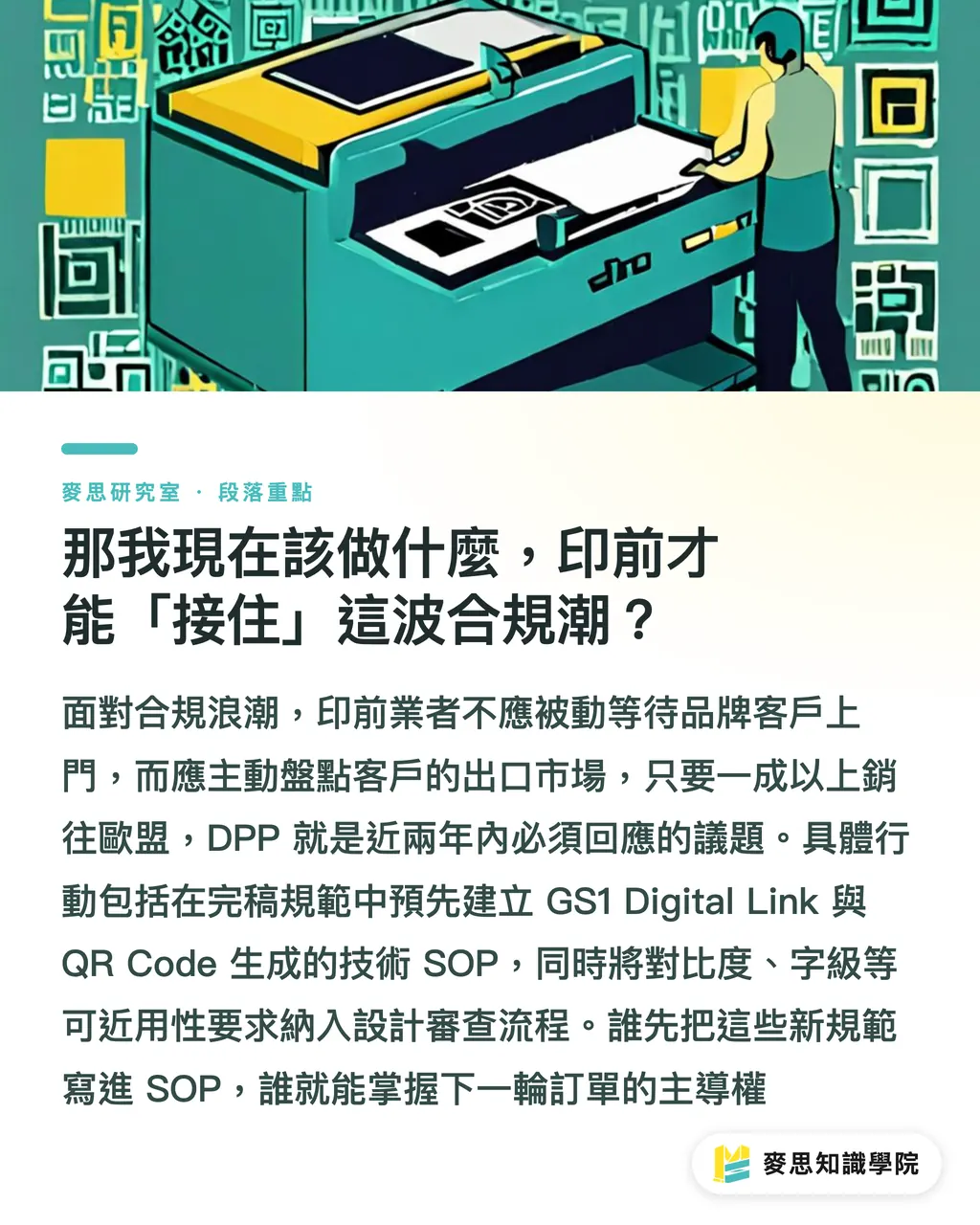
・Step 2: Pre-build GS1 Digital Link technical fields into your artwork specifications. Do not wait until a project arrives to learn it. First establish an internal SOP for QR Code generation and verification, including URL structure, error correction level (M or above), minimum size, and quiet-zone margins
・Step 3: Add "accessibility" to the design review checklist. Contrast, font size, braille, or audio assistance were once requirements seen mostly in government tenders or accessible websites. In the future, they will enter consumer packaging design briefs [1]
Ultimately, this is not a QR Code issue. It is about packaging being redefined as an "information carrier." Prepress professionals were once trained as gatekeepers of layout and color. Over the next two years, they will need to become gatekeepers of the "data interface." This path will not be easy, but whoever writes the specification into the SOP first will gain control over the next round of orders
Key Takeaways
The role of QR Codes on packaging is moving from marketing gateway to compliance gateway, with DPP as the main driver behind this shift
The EU has released DPP standards for unique identifiers, APIs, and interoperability through CEN/CENELEC, and prepress teams need to start connecting to them
GS1 Digital Link and accessible QR will become standard at the same time, affecting QR size, error correction, and layout
Customers with a high share of exports to the EU will be the most urgent group for upgrades from the second half of 2026 to the first half of 2027
Prepress providers should proactively write GS1 Digital Link SOPs and accessibility reviews into artwork specifications to capture the compliance opportunity early
Further Thinking
For print manufacturers, DPP is not about new machinery. It is about new processes. The next areas worth investing in are middleware for QR Code generation and verification, APIs that connect to brand-side data sources, and version control mechanisms for GTINs, serial numbers, and batches. For designers, layout rules need to be rewritten: the QR area can no longer be treated as "the leftover corner." It needs to enter structured design in the same way as an ingredient list. For SaaS and AI adoption, the opportunity lies in two areas: first, design plugins that automatically generate GS1 Digital Link-compliant QR Codes and simulate printability before production; second, AI tools that compare final packaging artwork against compliance databases to detect misprints in advance. The real unresolved issue is this: when a QR Code becomes a data interface that "must be read correctly by machines," most small and midsize printers in Taiwan still have quality control processes centered on "visual color checking." The gap between those two worlds is the pain point this compliance wave most urgently needs to solve
References
[1] QR Codes on packaging are moving from marketing gateways to compliance gateways
[2] Digital Product Passport - Application Programming Interfaces (APIs) for the product passport lifecycle management and searchability. DOI: 10.3403/30516701u
[3] Digital Product Passport - Application Programming Interfaces (APIs) for the product passport lifecycle management and searchability. DOI: 10.3403/30516701
[4] Digital product passport - Unique identifiers. DOI: 10.3403/30516457
[5] Digital Product Passport - System interoperability. DOI: 10.3403/30516704u
[6] Digital product passport - Unique identifiers. DOI: 10.3403/30516457u

FAQ
- Why is the role of QR Codes on packaging shifting from marketing gateway to compliance gateway?
- Because the EU Digital Product Passport (DPP) requires product data to be machine-readable. QR Codes are moving from "linking to a campaign page" to "linking to a product history data object," making this a regulation-driven interface upgrade [1]
- What is GS1 Digital Link, and how is it different from a regular QR Code?
- GS1 Digital Link is a URL standard that can carry structured data such as GTIN, serial numbers, and batch information. It has been identified by European standardization bodies as a practical candidate for DPP unique identifiers [4]
- What should prepress teams prepare for DPP?
- They need to reserve QR areas in artwork specifications, define minimum size and error correction levels, establish version control for GTINs and URLs, and include accessibility, such as contrast, braille, or audio assistance, in design reviews [1]
- What is an accessible QR Code, and is it related to DPP?
- Accessible QR uses stronger contrast, braille, or audio guidance to help blind and low-vision users access ingredient and usage information. Twinings has already rolled it out at scale on tea packaging in the UK, aligning with the accessibility direction of DPP [1]
- When is the latest Taiwanese printers should start adjusting?
- Brands with a high share of exports to the EU are expected to enter an artwork update cycle from the second half of 2026 to the first half of 2027. Prepress providers should complete SOP setup and staff training no later than the end of 2026
References
- 包裝上的 QR Code 正從行銷入口變成合規入口 · packaginginsights.com
- Digital Product Passport - Application Programming Interfaces (APIs) for the product passport lifecycle management and s · doi.org
- Digital Product Passport - Application Programming Interfaces (APIs) for the product passport lifecycle management and s · doi.org
- Digital product passport - Unique identifiers · doi.org
- Digital Product Passport - System interoperability · doi.org
- Digital product passport - Unique identifiers · doi.org
Related articles




The Print × AI weekly
The print and AI know-how designers, brands and enterprises can use before they commit — one email, every week
MINDS Free Tools
Imposition calculator and preflight file check — free prepress tools, right in your browser.
MINDS Group
Need actual printing or gifting services?
From premium printing to online ordering and festive gifts — the MINDS Group sister brands take it from here.