
Introduction: A Variable Treated as a Constant
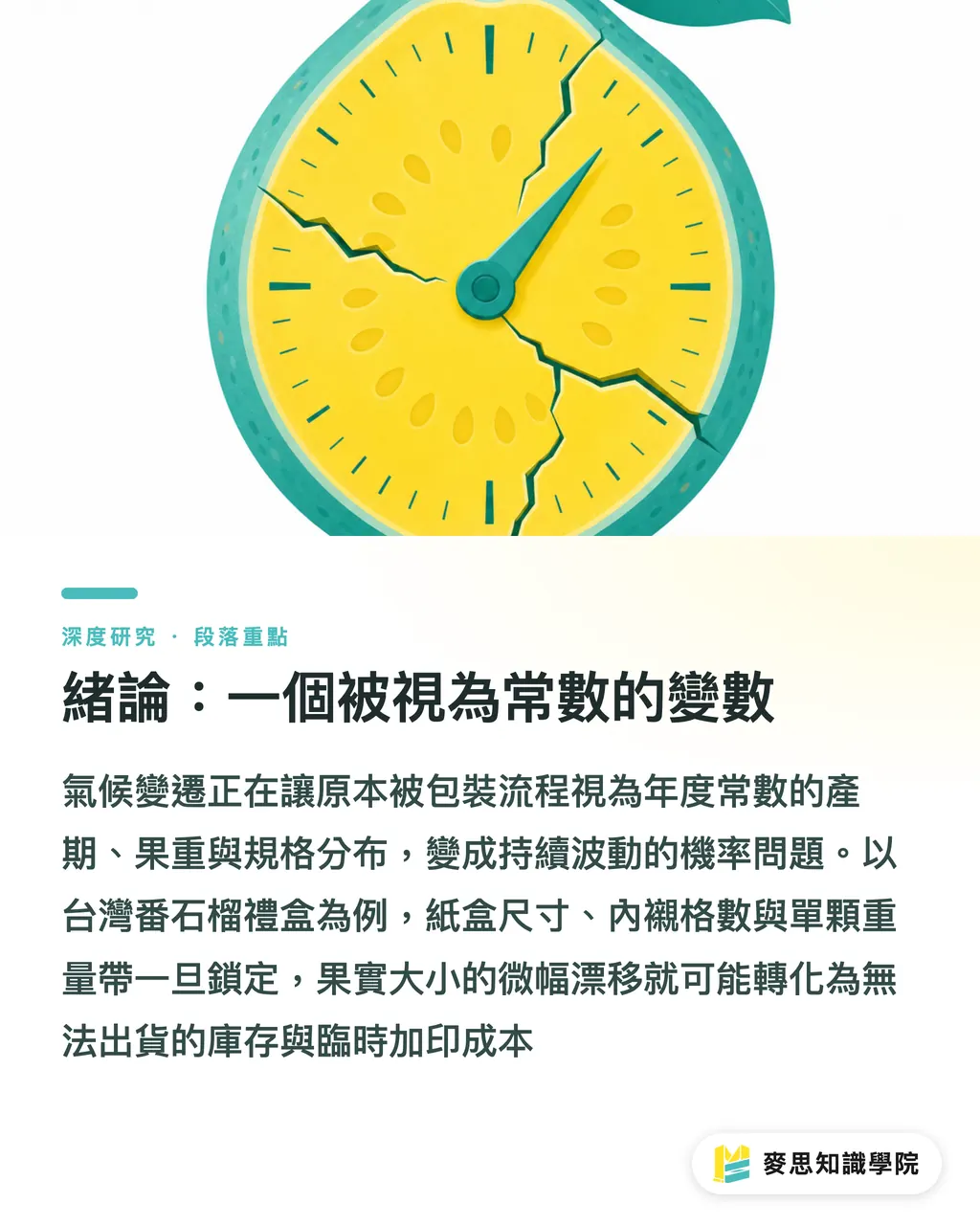
The design workflow for produce brand packaging has long rested on an implicit assumption: a crop's harvest timing, single-fruit weight, and specification distribution are predictable annual constants. Climate change is dismantling this assumption, yet the packaging side has not realized that its spec system depends on it
Guava is a suitable subject for examining this issue. Existing research notes that guava (Psidium guajava L.) is the third most commercially important fruit crop in Pakistan with high nutritional potential, but over the past two decades has faced severe production challenges due to global climate change, occurring even more frequently in South East Asian (SEA) countries [1]. The study further points out that rising temperatures, changing rainfall patterns, and increased frequency of extreme weather events interfere with key physiological processes such as flowering, fruit set, fruit growth, and maturation, leading to irregular bearing, yield drop, and damage to quality parameters like fruit size, color, and sweetness [1]
Almost every variable listed in this description turns into a spec input once moved into the packaging workflow. Fruit size determines tray slot dimensions and clear box volume. Color determines photography and print color gamut alignment. Sweetness and maturity determine shelf-life claims and logistics parameters. Irregular bearing directly dictates print volume and delivery deadlines. This analysis holds that this represents a translation chain between agricultural phenology research and packaging design research that has long remained unconnected
Research gap. Existing literature on climate change and fruit tree phenology centers its core inquiries on agricultural adaptation and mitigation, such as irrigation system improvements, canopy management under high-density planting, and effective application of microelements like zinc and boron [1]. Policy recommendations in these studies point toward precision horticulture and supportive policy frameworks [1], but fail to extend downstream: when fruit specs become probability distributions rather than fixed values, how should specification systems in processing, grading, and packaging be rewritten? Similarly, institutional discussions on climate adaptation mostly focus on legal litigation and urban infrastructure [3][4][5], leaving the packaging supply chain almost entirely out of sight
Based on the above gap, this article proposes three verifiable analytical tasks, addressed across the main sections:
・First, map variables from fruit tree phenology research (flowering period, fruit set, fruit size, and quality) item by item to packaging spec parameters (capacity, tray inserts, color, copywriting claims) to establish a translation matrix; see section "Translating Phenological Variables into Packaging Parameters"
・Second, unpack the failure mechanism of "annual single-run print volume decisions" under phenological uncertainty, detailing how the cost structure of dead stock and emergency rush printing gets amplified by climate variables; see section "Temporal Misalignment in Print Volume Decisions"
・Third, propose layered packaging design principles centered on spec tolerances, translating them into actionable workflows for Taiwan's small and medium print shops, designers, and brand owners; see section "Implications for Taiwan's Design and Printing Industry"
This topic holds direct importance for Taiwan because Taiwanese guava (Pearl Guava, Emperor Guava, etc.) is a crop produced year-round but with distinct harvest peaks, and relies heavily on boxed gift and branded sales channels. Gift boxes are the packaging items with the highest spec rigidity. Once box dimensions, insert slot counts, and weight tiers are locked in, even minor shifts in fruit specs translate directly into unfillable stock
Literature and Current State Review
This section divides existing discussions into three clusters: climate impacts on fruit tree phenology, cross-crop consistency checks, and institutional/spatial studies of climate adaptation, highlighting their connection to this analysis at the end of each cluster
First cluster: direct impacts on phenology and commercial quality. Guava research explicitly points out that phenology (shifts in the timing of plant growth activities) is one of the most well-documented consequences of climate change, and climate change is altering the length of vegetative and reproductive growth phases. Warming temperatures tend to shorten the vegetative phase, reducing the number of days required for flowering in most fruit tree crops [1]. The study also records the effects of extreme events such as prolonged summers, droughts, and heavy monsoon rains on production, noting that climate-induced biotic stresses exacerbate pest and disease pressure, further threatening commercial output [1]. Citing this cluster of research, the focus here is not on adopting its agronomic advice, but on drawing upon peer-reviewed evidence to show that commercial fruit specs already shift with climate conditions, and any discussion on packaging specs must start here
Second cluster: cross-crop consistency. Analysis by the same research team on the climate impacts on mango (Mangifera indica L.) phenology, yield, and quality shows that this issue is not an isolated case in a single crop [2]. Its repeated occurrence across crops allows "phenological drift" to be viewed as a structural trend rather than an isolated anomaly in a given year. This analysis holds that the implication for packaging is decisive: if a single crop experiences an anomalous year, businesses will usually absorb it as a one-time loss. But if it is a recurring structural trend, packaging specs can no longer rely on old assumptions, giving related investments a chance for cost recovery. The difference between this cluster of research and this article is that those studies stop at agricultural yield and quality descriptions, without tackling downstream spec decisions
Third cluster: institutional and spatial perspectives on climate adaptation. Institutional responses to climate change have become heavily litigated in the EU and the UK, with case compilations showing climate issues imposing constraints on corporate and governmental actions through judicial channels [3][5]. Urban-level research indicates that climate change impacts will hit city residents first, exploring the mitigation potential of green infrastructure [4]. Together, these two lines of inquiry show that the framework for discussing climate adaptation has expanded beyond pure science into legal liability and spatial planning. This analysis views its implication for packaging as spillover: when climate-related statements enter judicial scrutiny, packaging claims regarding harvest timing, origin, and quality also become verifiable public statements rather than plain marketing copy. The connection between this cluster and this article rests on analogical inference rather than direct evidence; this article does not claim that existing litigation cases already cover produce packaging labels
Bringing it down to unresolved gaps. All three literature clusters establish two premises: "climate alters fruit specs" and "climate liability is institutionalized." Yet none of them address the step in between: how spec drift passes through grading, processing, and printing workflows to end up as dead packaging stock, labeling risks, and design rework. This article takes that gap as its entry point
Translating Phenological Variables into Packaging Parameters
The core proposition argued in this section is that every degraded variable in fruit tree phenology research corresponds to a packaging spec field that is currently hardcoded
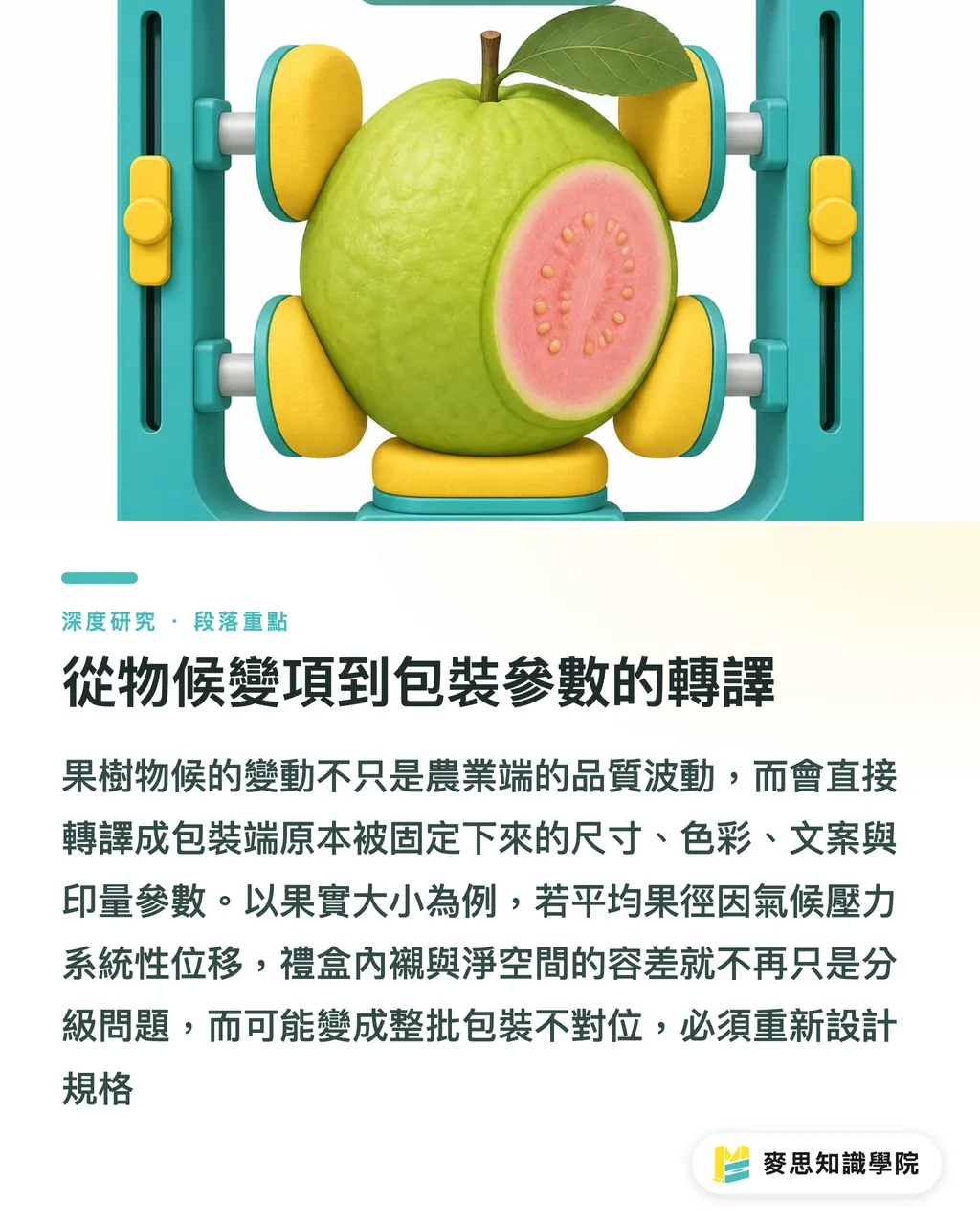
The first pair is "fruit size" versus "tray inserts and clear space". Guava research records that climate stress impairs fruit size [1]. The meaning for packaging: tolerances between gift box insert slot dimensions and fruit diameters were originally built to absorb natural variations of around ±5% (estimated here from packaging practice, not cited figures). When mean fruit diameter itself shifts rather than just expanding in variance, tolerance design fails. The box doesn't just fail to fit occasionally; whole batches misalign. Spec mismatches and quality fluctuations cannot be handled the same way. The former usually requires structural redesign, while the latter can mostly be absorbed by stricter grading
The second pair is "color" versus "print color management". Studies show that fruit color is one of the commercial quality parameters affected by climate [1]. For designers, hero visuals on produce packaging usually use photographed fruit from a specific year as a color benchmark, building spot colors and color gamut alignment around it. If actual skin color shifts systematically, the fruit image on the box creates a noticeable gap with the physical item inside. This analysis holds that consumers in fresh produce interpret this gap directly as poor quality or misleading imagery, carrying higher risk than routine printing color variance
The third pair is "sweetness and maturity" versus "copywriting claims". Guava research lists sweetness as a quality parameter impacted by climate change [1]. Packaging claims like "seasonal limited," "Brix over X degrees," or "fresh season direct delivery" essentially freeze agricultural variables into unalterable printed text. When phenology shortens flowering days and shifts maturity timelines [1], the verifiability of such statements drops. Considering climate-related public statements have faced courtroom scrutiny in the EU and UK [3][5], this analysis suggests writing produce packaging quality and harvest claims toward "verifiable minimums" rather than "typical values" to lower labeling risks
The fourth pair is "irregular bearing" versus "print volume and delivery schedules". Studies explicitly state that climate stress causes irregular bearing and yield drops [1]. The point here is immediate: the denominator for print volume estimates is no longer stable. This article treats this separately in the next section
Temporal Misalignment in Print Volume Decisions
The core proposition of this section is that cost blowouts in produce packaging stem not from unit prices, but from climate variables widening the gap between when print decisions are made and when yields are confirmed
The typical operational pace for produce gift boxes involves finalizing designs months before harvest and executing a single large print run to secure unit price advantages from economies of scale. The premise of this decision is that harvest timing and yields can be reasonably estimated at the time of printing. Irregular bearing and yield drops recorded in guava research [1] directly erode this premise: estimation errors widen when placing print orders, and the strongly stepped cost structure of printing turns errors on both sides into tangible losses
When errors swing toward overestimation, the result is dead packaging stock. Dead stock in produce packaging is especially difficult to handle because boxes typically carry year, season, or batch info, making cross-year reuse far less viable than with standard consumer goods. When errors swing toward underestimation, the result is mid-season rush reprints: small-batch reprints carry unit costs significantly higher than the original run, and delivery windows compress to the absolute limit of logistics tolerance, often sacrificing proofing verification. This analysis holds that the hidden costs of the latter outweigh the price gap on paper, as skipping proofs is precisely where color shifts and spec errors occur most
It is worth highlighting that agricultural adaptation strategies, improving irrigation systems, managing canopies in high-density planting, and applying microelements like zinc and boron effectively [1]—aim to lower the variance of yield and quality, not eliminate it. For packaging, the takeaway is clear: even if agricultural adaptation succeeds, packaging spec systems must still be designed to accommodate residual variance rather than assuming adaptation restores variables to constants. Precision horticulture and supportive policy frameworks highlighted in existing research [1] should be understood in this analysis as variance compression tools, not certainty restoration tools
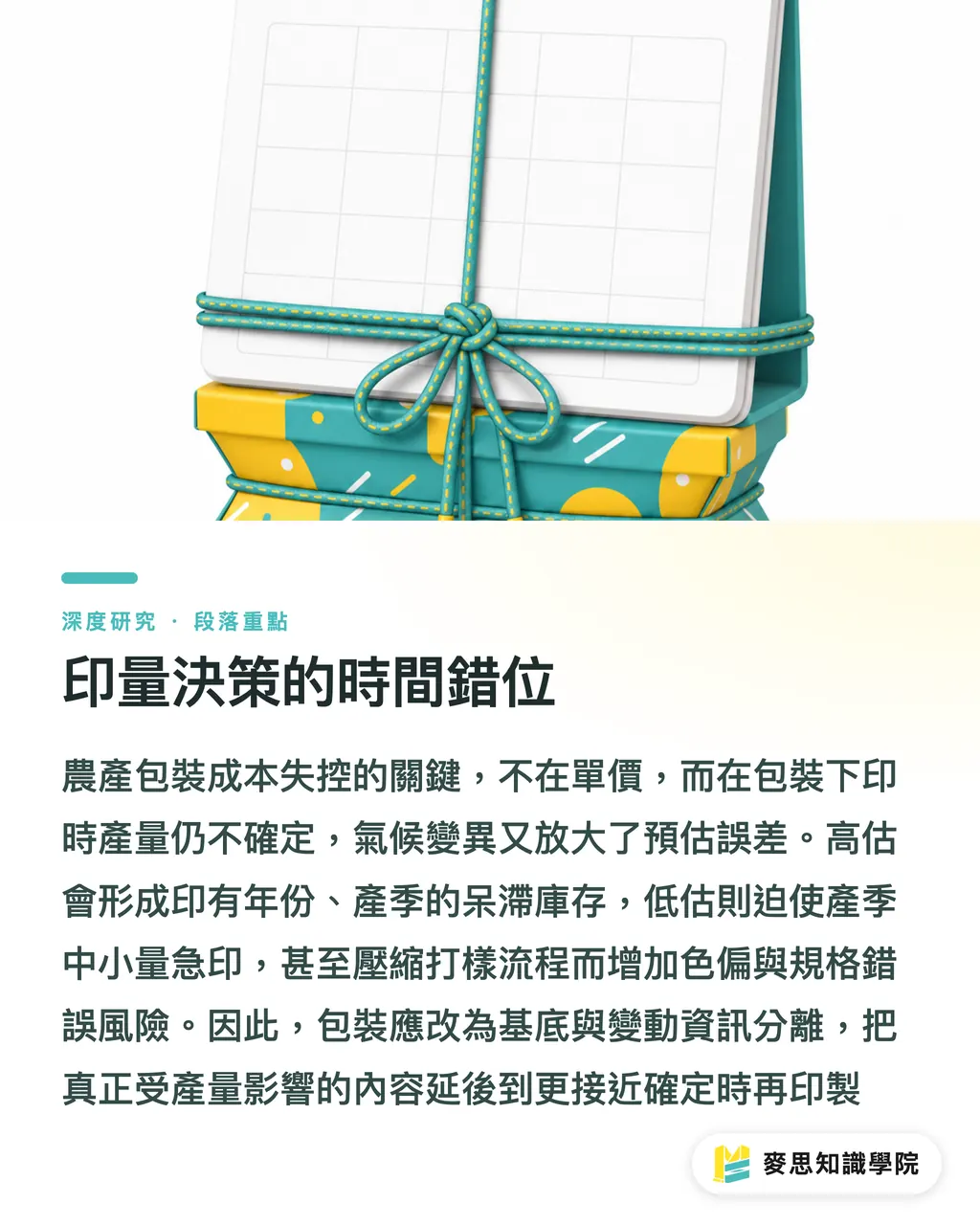
From this follows a structural judgment: packaging decisions should shift from a "single print run" to a "split between base and variable layers." Base elements (brand identity, material structure, non-time-sensitive information) can maintain large print runs to keep cost advantages, while variable elements (year, season, specs, Brix range) should move to carriers whose printing time can be delayed. This analysis considers that this is not a new design trick, but a shift pushing the timing of print decisions from when yield is unknown to when yield is known
Implications for Taiwan's Design and Printing Industry
This section translates the analysis into actionable practices across three groups of actors. Because Taiwanese produce brands rely heavily on gift box channels with high spec rigidity, the value of this translation is immediate
For small and medium print shops. The main opportunity lies in turning "climate uncertainty" into a productized quoting and scheduling capability, rather than passively taking rush reprint orders
・Separate quoting structures: Quote base box structures and variable information layers separately, helping brand owners clearly see the cost trade-offs and savings of delaying decisions
・Non-negotiable red line on proofing: Tight deadlines on rush reprints most often compromise proofing, yet color alignment of fruit photography carries the highest risk. Digital proofing should be set as a mandatory checkpoint in reprint workflows rather than a negotiable item
・Annualized template management: Separate time-sensitive information like year, season, and Brix levels into swappable layers, reducing multi-year revision prep from full artwork re-creation to field swapping
For designers. What designers manage is no longer a single spec, but a set of tolerances acceptable on the production floor
・Build spec bands into insert design: Use fruit diameter ranges rather than single sizes as design inputs, confirming during structural design that both upper and lower limits securely hold the fruit
・Benchmark governance for visual color: Establish traceable color benchmarks and acceptable deviation windows for key fruit visuals, avoiding using a single year's photography as a permanent baseline
・Design copywriting for verifiability: Rewrite "typical value" claims into "guaranteed minimums," and position volatile information in areas suitable for post-processing
For brand owners. The core decision is reallocating print timing and inventory risk
・Staggered print runs over single runs: Lock in costs with large base runs while using small in-season batches for the variable layer, accepting higher unit costs in exchange for lower dead stock risk
・Annual review of spec drift: Record actual fruit diameter, color tone, and Brix distributions at the end of each season to serve as inputs for next year's packaging specs, rather than reusing historical dimensions
・Upfront compliance checks for claims: Given that climate-related public statements face judicial review in the EU and UK [3][5], packaging claims for exported produce should undergo internal verifiability reviews before finalizing design specs
These practices can be combined into a named review framework termed here the "MINDS Printing (MS, high-end custom commercial printing) Three Pre-flight Checks": Check 1 verifies spec tolerances (matching inserts with fruit diameter ranges), Check 2 verifies color benchmarks (ensuring fruit visuals stay within acceptable deviations from physical produce), and Check 3 verifies claim verifiability (confirming timing and quality wording reflect verifiable minimums). This framework describes a methodology synthesized from the preceding analysis and makes no claim of prior empirical validation
Conclusion and Limitations
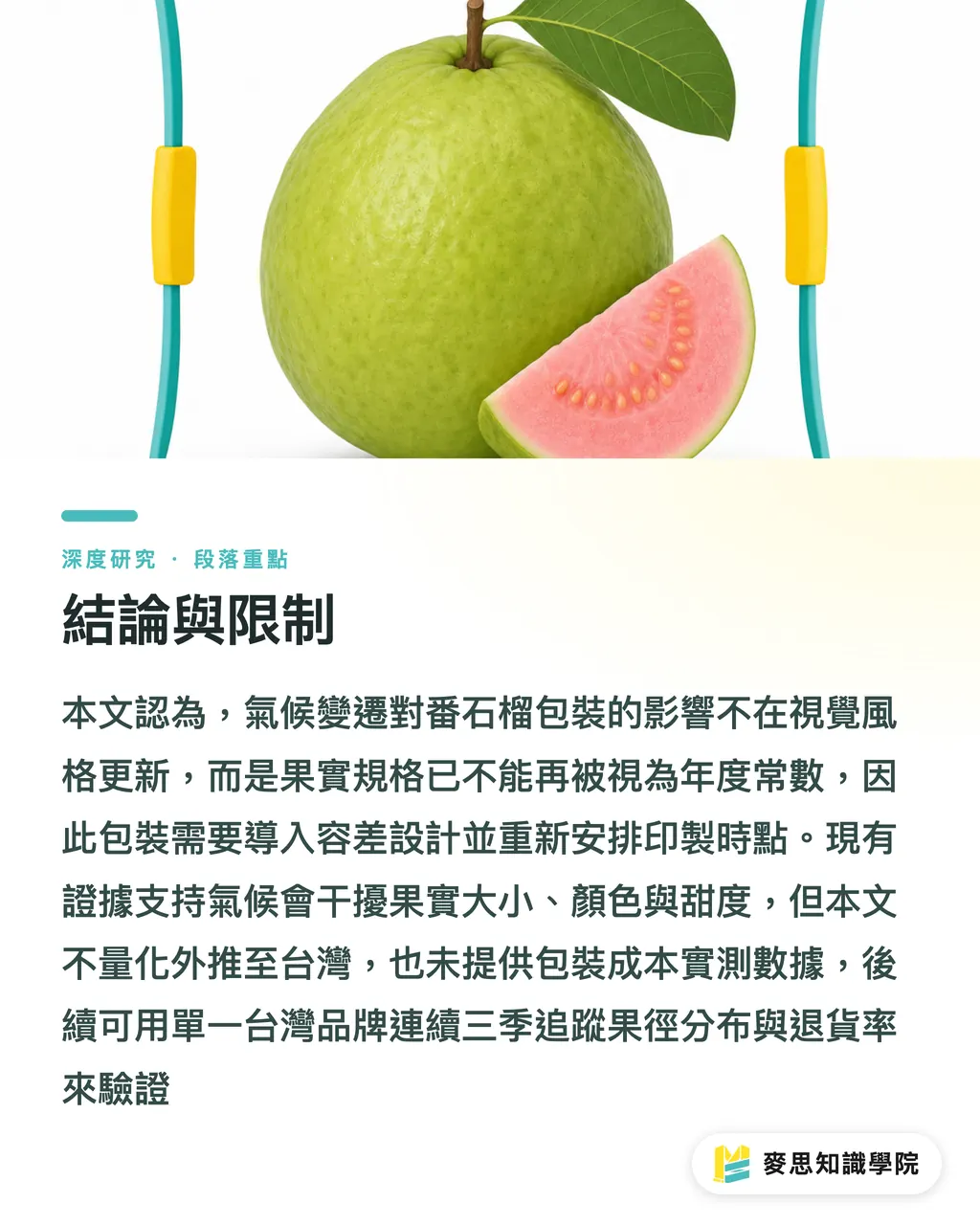
The research question of this article is what climate-driven shifts in guava harvest timing and quality mean for spec design in branded produce packaging. The conclusion is that the significance lies not in refreshing visual styles, but in the fact that the underlying assumption of packaging spec systems, that fruit specs are annual constants, no longer holds, requiring a restructuring of tolerance design and print timing
On the evidence side, existing research confirms that key physiological processes of guava, such as flowering, fruit set, fruit growth, and maturation, are disrupted by rising temperatures, rainfall shifts, and extreme weather, resulting in irregular bearing, yield drop, and impaired fruit size, color, and sweetness [1]. The same phenological impact pattern appears in mangoes [2], supporting the view that this is structural rather than accidental
Limitation 1: geographic and crop coverage of data. Guava phenology evidence cited here reflects production contexts in Pakistan and Southeast Asia [1]. Because Taiwan differs in climate patterns, cultivated varieties (such as Pearl Guava), and greenhouse protection levels, this article makes no quantitative extrapolations regarding the magnitude of harvest timing shifts in Taiwan, asserting only that the directional judgment "specs should be treated as variables" holds across regions
Limitation 2: lack of corresponding empirical data on the packaging end. Discussions here regarding dead stock costs, reprint unit price tiers, and insert tolerance windows stem from mechanism deductions based on packaging supply chain structures rather than quantitative packaging studies. No sources in the reference list support specific numbers, so concrete figures are omitted. Consequently, conclusions here should be taken as testable hypotheses rather than measured effect sizes
Directions for future research. Concrete and executable next steps include Three:
・First, use a single Taiwanese guava brand as a case study to log actual fruit diameter distributions and packaging return rates across three consecutive harvest seasons, testing the correlation between spec drift and return rates
・Second, quantify total cost differences between "splitting base and variable layers" versus a single print run, factoring in dead stock scrap and reprint price premiums
・Third, compare compliance requirements for produce packaging quality claims across export markets to test whether analogical inferences drawn from climate litigation compilations [3][5] hold true at the labeling regulation level
Key Takeaways
Existing research shows climate change affects fruit size, color, and sweetness [1]. On the packaging end, these three factors dictate tray inserts, print colors, and copywriting claims, respectively
Cost blowouts in packaging stem not from unit prices, but from the temporal misalignment of "ordering prints when yields are unknown." Irregular bearing and yield drops [1] convert estimation errors into both dead inventory and reprint premiums
Agricultural adaptation strategies (irrigation, canopy management, zinc and boron application) compress variance rather than eliminating it [1]. Packaging spec systems must still be designed to accommodate residual variance
The same pattern of phenological impact recurs in mango research [2], supporting the treatment of spec drift as a structural trend and providing a foundation for cost recovery in rewriting packaging systems
A workable structural solution is separating print runs into base and variable layers, delaying the timing of print decisions from when yield is unknown to when yield is known
Further Reflections
For print manufacturing, the commercial value of this problem lies in upgrading "rush reprints" from a firefighting service into a presellable capacity reservation plan. If print shops can offer combined quotes for large base runs alongside multiple in-season variable batches, they absorb climate uncertainty for brand owners, a rare form of differentiation in a market traditionally competing on unit price. For design teams, deliverables must evolve from a single final art file to a specification document with tolerance guidelines: insert dimensions defined in ranges, color specified as baseline plus deviation margins, and copy written to verifiable minimums. The logical entry point for AI integration is not generating visuals, but in-season spec monitoring and early warning: using grading-line image data to estimate fruit diameter and color distribution, triggering alerts when readings deviate from existing packaging tolerances so artwork revisions happen before printing rather than after returns. At the SaaS level, a lightweight system for "Produce Packaging Spec Version Management" meets a clear demand, core functionality being binding time-sensitive fields like year, season, and Brix to artwork files while archiving historical distributions, allowing next year's design inputs to rely on measured data rather than historical specs. Two unresolved issues remain: the lack of public quantitative benchmarks for dead stock and return rates on the packaging side makes ROI hard to justify upfront; and acquiring grading-line image data requires crossing organizational boundaries between farms and packing facilities, presenting higher data governance challenges than technical ones
References
[2] Mukhtiar Ahmed, Bilal Ahmed Awan, Badi Uz Zaman et al. (2025). Impact of Climate Change on Mango (Mangifera indica L.), Phenology, Yield, and Quality. Global Research Journal of Natural Science and Technology. DOI: 10.53762/grjnst.03.03.27
[3] Climate Change Litigation Cases: EU. Climate Change Law and Practice. DOI: 10.5040/9781526531483.chapter-008
[4] Grote R. (2019). The impact of climate change will hit urban dwellers first, Can green infrastructure save us?. Climanosco Research Articles. DOI: 10.37207/cra.2.2
[5] Climate Change Litigation Cases: UK. Climate Change Law and Practice. DOI: 10.5040/9781526531483.chapter-006
FAQ
- What are the specific impacts of climate change on guava?
- Existing research notes that rising temperatures, changing rainfall patterns, and extreme events like prolonged summers, droughts, and heavy monsoon rains interfere with guava flowering, fruit set, fruit growth, and maturation. This leads to irregular bearing, yield drop, and damage to commercial quality parameters such as fruit size, color, and sweetness [1]
- Why do shifts in fruit harvest timing affect packaging design?
- Because fruit size determines gift box insert slot dimensions, skin color dictates print color baselines, sweetness and maturation timing govern quality and seasonal packaging copy, and yield regularity dictates print volume and delivery schedules. In traditional packaging workflows, all four are treated as fixed constants hardcoded into artwork files
- How can produce brands reduce dead packaging stock and reprint costs?
- By splitting packaging into base and variable layers printed separately. The base layer (brand identity, box structure, non-time-sensitive information) maintains large print runs to lock in unit prices, while the variable layer (year, season, specs, Brix range) uses small in-season batches, shifting print decisions from when yield is unknown to when yield is known
- Can agricultural adaptation techniques restore stability to packaging specs?
- Not completely. Precision horticulture strategies proposed in research, such as irrigation improvements, high-density canopy management, and microelement applications of zinc and boron [1]—work by compressing the variance of yield and quality rather than eliminating it. Therefore, packaging specs must still be designed around tolerance bands rather than single dimensions
- Are there compliance risks associated with harvest timing and quality claims on packaging?
- This analysis suggests there are, though based on analogical inference rather than direct evidence. Climate-related public statements have entered judicial review in the EU and UK [3][5], and produce packaging claims regarding harvest timing, origin, and Brix levels are similarly verifiable public statements. Writing them as "verifiable minimums" rather than "typical values" is recommended, with internal reviews completed before finalizing artwork for exports
Related articles




The Print × AI weekly
The print and AI know-how designers, brands and enterprises can use before they commit — one email, every week
MINDS Free Tools
AI background removal, a LINE sticker maker, spine & imposition calculators — all free, right in your browser, no upload.
MINDS Group
Need actual printing or gifting services?
From premium printing to online ordering and festive gifts — the MINDS Group sister brands take it from here.