

Introduction: The Promise of Reduction and the Tension of Protection
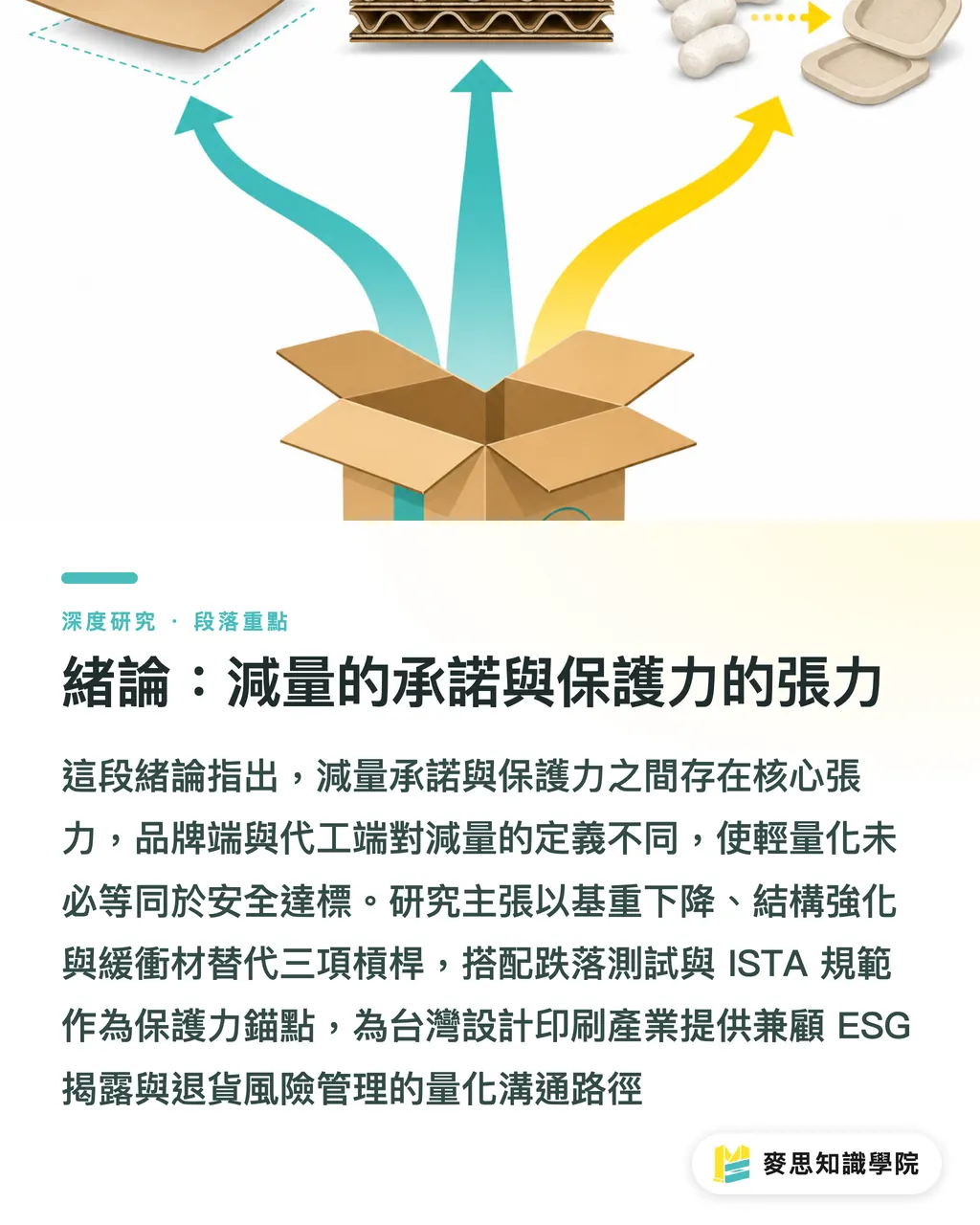
Packaging lightweighting simultaneously engages three levers, material cost, transport carbon emissions, and waste volume, making it one of the few sustainability contributions that can be backed by hard numbers in corporate reports. In practice, however, brands and contract manufacturers define "reduction" differently: brands often target a percentage drop in per-unit grammage, while manufacturers require that any existing protection specification still be met. The gap between these two definitions forms the central tension this study seeks to address: does reducing packaging weight inevitably come at the cost of protection?
This research adopts an industry-review (review article) approach with three objectives:
・First, to map the three principal levers of lightweighting, grammage (gsm) reduction, structural reinforcement, and cushioning substitution, and to delineate the boundaries of their applicability across different distribution scenarios
・Second, to shift protection assessment from "by feel" to "anchored in standards," specifying the role of drop testing and the ISTA procedure series within the decision process
・Third, to propose a quantifiable pathway that can be communicated to clients and stakeholders, enabling reduction outcomes to be presented in both ESG disclosures and cost reports. For Taiwan's design and printing industry, highly export-oriented and serving clients across the diverse regulatory environments of Europe, the Americas, and Asia, this framework responds simultaneously to decarbonization pressure and to the need to manage return-risk exposure
Literature and Current-State Review: Three Strategy Families and Their Fault Lines
The tension between grammage reduction and corrugated structural reinforcement
Reducing paperboard grammage is the most intuitive lightweighting move, yet its mechanical consequences are frequently underestimated. When the grammage of both liner and medium is reduced together, Edge Crush Test (ECT) and Flat Crush Test (FCT) values both decline non-linearly. Industrial literature indicates that, to maintain the same stacking load capacity, designers typically compensate for single-ply grammage loss by adding flute layers (for example, switching from a B-flute to a BC double-wall) or by changing flute profiles (such as moving from an E-flute to a denser F-flute) [1][2]. This is where the first decision fault line appears: procurement tends to favor "same spec, lower grammage" to preserve existing creasing and converting equipment, while design tends to prefer "same grammage, upgraded structure" to secure mechanical headroom. The two paths carry different cost and carbon implications and must be clarified at project kickoff
The conditional substitution of paper-based materials for EPE/EPS
Replacing petrochemical cushioning such as expanded polyethylene (EPE) and expanded polystyrene (EPS) with paper honeycomb, molded pulp, or creased/cradle paper has become a familiar plastics-reduction narrative in recent ESG disclosures. However, existing industry case studies show that the cushioning performance of paper-based materials is highly dependent on post-molding thickness uniformity and moisture control; under long-haul ocean freight or repeated temperature-and-humidity cycling, their energy-absorption curves are not directly interchangeable with EPE [5]. In addition, the peak acceleration (Grms) performance of molded pulp at drop angles above 90° tends to fluctuate with fiber formulation and mold wear, requiring batch-sampling verification. The literature therefore argues that paper-based substitution should not stand alone as a single environmental claim, but should be accompanied by a full cushioning performance verification process [4][5]
Opportunities in internal-tray simplification and structural reuse
A third strategy family focuses on "eliminating unnecessary internal trays"—redistributing cushioning function without increasing the burden on the outer structure. Common moves include one-piece folding, structural inserts, and consolidating the inner tray and outer box into a single die-cut tooling layout. Related discussion emphasizes that tray simplification is often constrained by cosmetic-protection requirements and assembly-line compatibility, particularly when the brand has already folded the unboxing experience into its marketing assets [1]. This fault line shows that the boundary of lightweighting is not a purely technical problem, but a multi-objective optimization problem involving design vocabulary, line tact, and brand communication
Gaps in the existing discussion
Synthesizing the three bodies of literature above, two issues remain insufficiently addressed:
・First, protection assessment is frequently reduced to a single "did it pass one drop height?" question, lacking systematic reference to the probability distributions of distribution environments (for example, the different vibration and shock spectra represented by ISTA 3A and 3E) [3][4]
・Second, the quantification of reduction outcomes for ESG purposes tends to stop at "X kilograms saved," without being linked to the transport-stage module of a product life cycle assessment (LCA) [6]. On this basis, the article advances the following core analyses
Core Analysis 1: An Evaluation Process with Protection Specifications as the Leading Constraint
Flipping the question from "how much to cut" to "what must it pass"
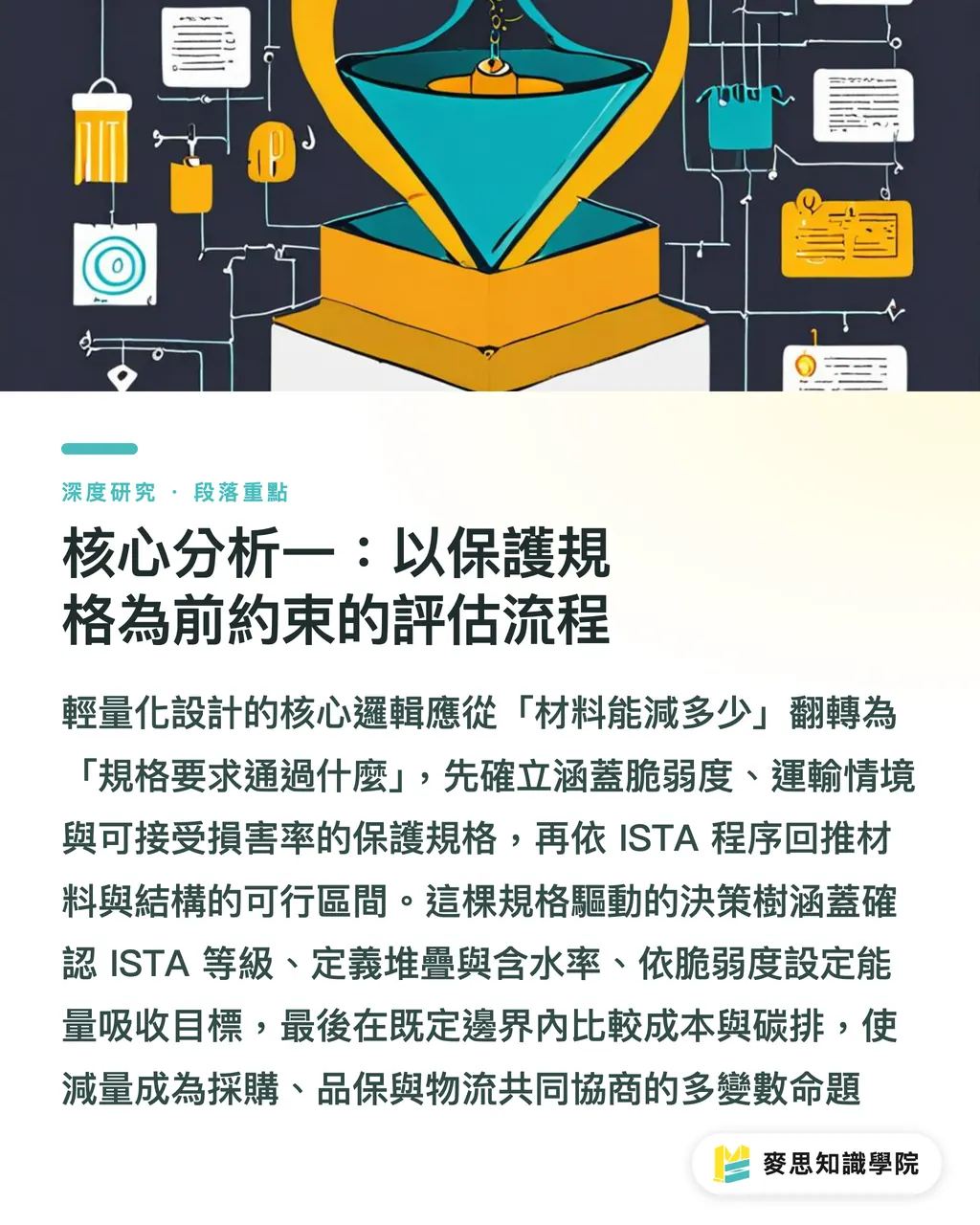
This section argues that lightweighting decisions should first establish a protection specification, then work backward to define the feasible range of materials and structures. Such a specification should comprise at least three layers: product fragility rating, distribution environment, and acceptable damage rate (typically expressed as DPPM, defects per million). Procedures such as ISTA 2A, 3A, and 3E correspond to different vibration, shock, and stacking stress spectra, and designers should select the procedure that matches the product's final destination and transport mode rather than defaulting to a single domestic convention [3]
Common misreadings of drop testing
In industry practice, drop-test results are often misread as "passed, therefore safe." In fact, drop testing is destructive sampling: the sample size and confidence interval are predefined in ISTA procedures, but in practice they are often compressed under time and cost pressure, leaving the confidence interval inadequate. Also, the choice of drop orientation (face, edge, corner) does not affect paper-based cushioning symmetrically, corner impacts generate peak accelerations far higher than face impacts, and this is the scenario in which molded pulp most often fails [4][5]. The analysis here holds that drop-test interpretation must align with the product's actual packing and loading configuration; otherwise, "passing the test" is only a local optimum under laboratory conditions
A specification-driven decision tree for reduction
Pulling these threads together, a specification-driven decision tree can be built. Step one: confirm the product's ISTA level and target market. Step two: define stacking height and moisture exposure according to transport mode. Step three: set the cushioning energy-absorption target according to fragility rating. Only at step four, within these boundaries, should the cost and carbon implications of different grammage and structural combinations be compared [1][3]. The key significance of this tree is that reduction is no longer a unilateral design decision, but a multi-variable negotiation among procurement, quality assurance, and logistics
Core Analysis 2: Substitution Elasticity between Grammage and Structure
Mechanical compensation through corrugated structure
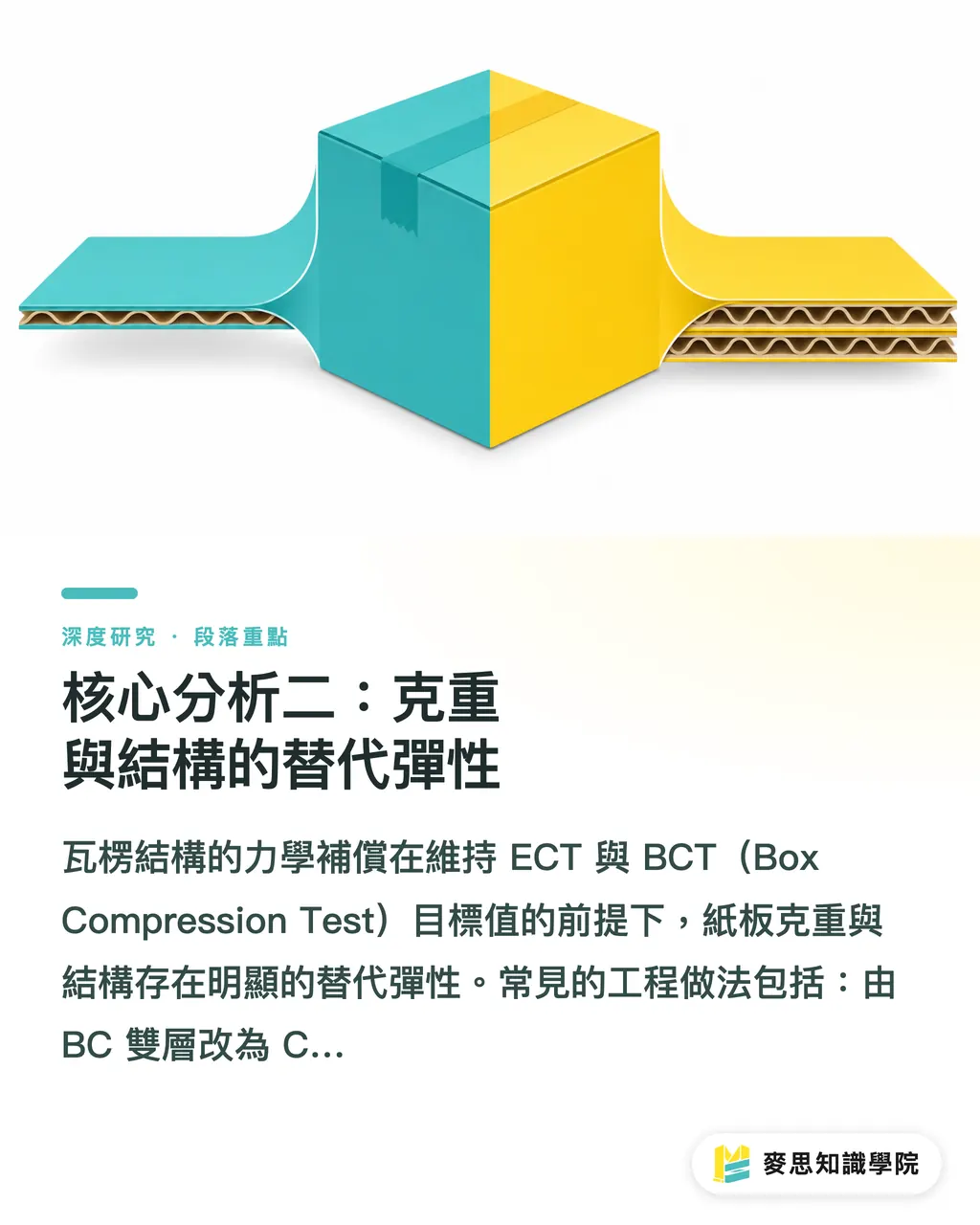
Holding ECT and BCT (Box Compression Test) targets constant, there is clear substitution elasticity between paperboard grammage and structure. Common engineering moves include: replacing a BC double-wall with a thicker-medium C-flute single-wall, replacing an E-flute with micro-flutes (F, N) to increase flute density, or adopting directional-strength specialty mediums (X-PLY). Industry literature indicates that the latter two can improve edge crush strength by 10% to 25% at the same grammage, but their cost premium and supply stability must be assessed in parallel on the procurement side [1][2]
Reduction opportunities from one-piece folding and structural inserts
Grammage reduction is not the only lever. One-piece folding and structural inserts can often remove standalone internal trays without sacrificing BCT, simultaneously lowering paper consumption and assembly time. Both the literature and field cases show that this strategy is most effective for higher-value, larger-volume products (such as small appliances); for high-density stacking or visually sensitive products (such as cosmetics or 3C electronics), the gains are more limited [1]
A data comparison: a medium-duty corrugated box
Consider a typical B-flute outer box (roughly 400 mm × 300 mm × 250 mm) commonly built with a 250 gsm liner and 130 gsm medium. If the liner drops to 220 gsm and the medium to 110 gsm, theoretical single-box grammage can fall by about 8% to 12%, but ECT often drops by 15% to 20%. At that point, switching the flute from B to a BC double-wall brings single-box grammage back up to roughly 105% of the original, while restoring or even surpassing the original ECT [1][2]. These numbers show that pure grammage reduction typically trades away mechanical headroom, while structural adjustment opens a different cost and carbon trajectory
Core Analysis 3: Engineering Boundaries of Cushioning Substitution
Energy-absorption comparison: EPE/EPS versus paper-based alternatives
EPE and EPS display a clear elastic plateau region in their stress–strain curves, enabling energy absorption across a wide strain range. Molded pulp and cradle paper, by contrast, exhibit a steeper energy-absorption curve, meaning a narrower protection window. Once strain exceeds the design range, the energy-absorption capacity of paper-based cushioning falls off rapidly, often accompanied by permanent deformation and visible damage [5]. Introducing paper-based substitutes should therefore be treated not as an equivalent exchange of "eco for not-eco," but as a redistribution of cushioning design capacity
Batch variation and mass-production stability
Batch variation in molded pulp is another engineering risk. Subtle changes in fiber formulation, mold wear, and drying process all surface as statistical dispersion in peak acceleration and cushion thickness. In practice, during initial introduction a higher AQL (Acceptable Quality Level) sampling ratio is typically required for verification; only after the process stabilizes can sampling return to routine levels [5]. The analysis here holds that paper-based substitution, unaccompanied by process stabilization and sampling verification, can readily drive return rates upward and in turn undermine the brand's ESG narrative
Special considerations under ocean-freight scenarios
Under ocean-freight scenarios, the long-duration vibration and temperature/humidity cycling place paper-based cushioning under particular strain. When relative humidity remains above 75% for extended periods, the ECT and energy-absorption capacity of paperboard and molded pulp can each decline by more than 20%. EPE and EPS, under the same conditions, exhibit far smaller mechanical variation [4][5]. As a result, for products shipped to subtropical or tropical markets, paper-based substitution without a cushioning specification redesigned for the actual transport scenario can itself become a return-rate risk factor
Core Analysis 4: Carbon Quantification and Communication of Reduction Outcomes
From grammage to CO₂e: the conversion chain
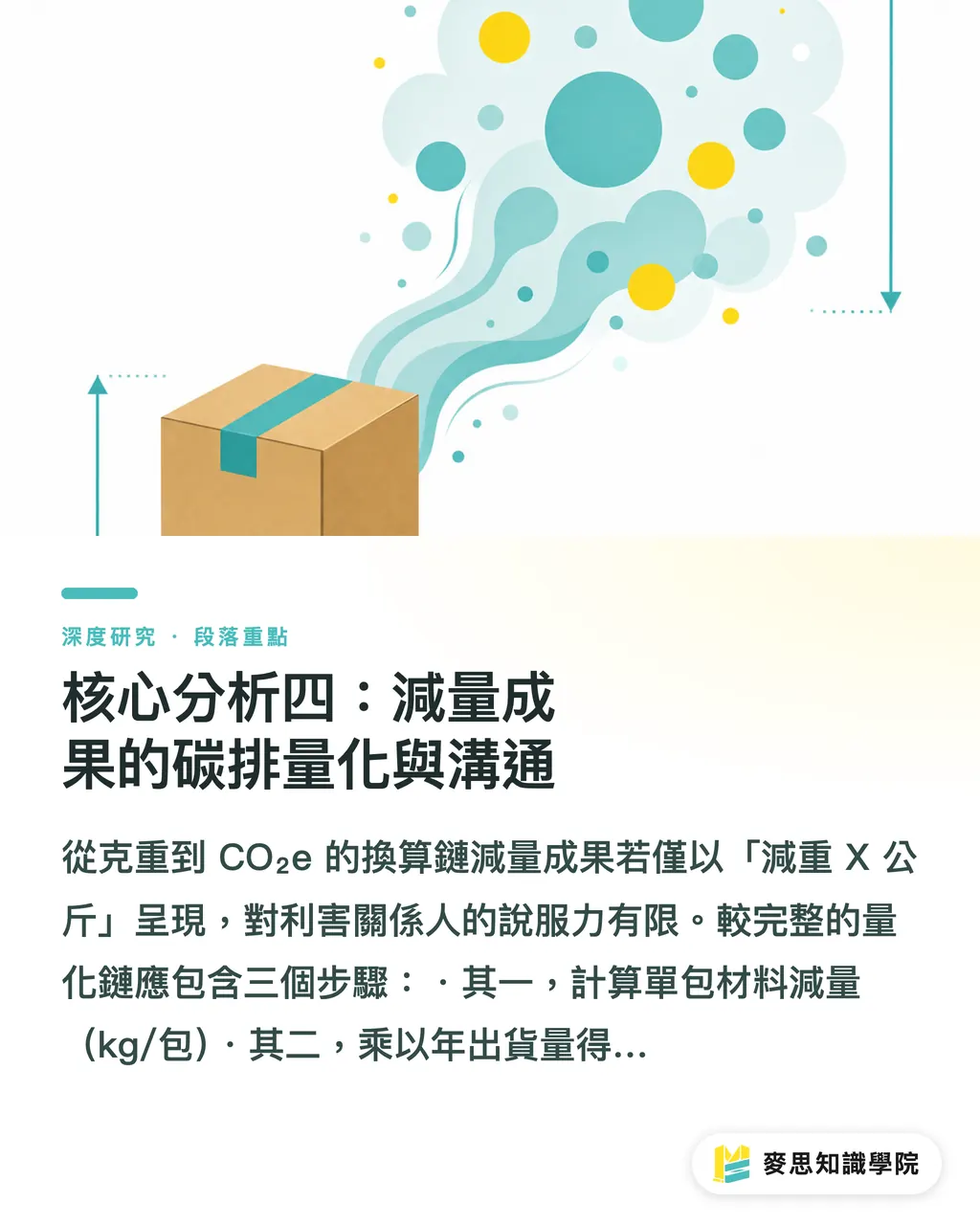
Presenting reduction outcomes as "X kilograms saved" carries limited persuasive force with stakeholders. A more complete quantification chain comprises three steps:
・First, calculate the per-pack material reduction (kg/pack)
・Second, multiply by annual shipment volume to obtain the total reduction
・Third, convert to CO₂e using material- and transport-specific emission factors (EFs). Paper EFs commonly range from 0.5 to 1.0 t CO₂e per tonne (varying with process and recycling share), while maritime EFs vary substantially with vessel type and voyage distance [6]. The value of this conversion chain lies in enabling reduction decisions to appear simultaneously in cost reports and ESG disclosures, forming a single source of truth
Additional carbon savings in the transport stage
Beyond material reduction, lightweighting has a multiplier effect on transport-stage emissions. When package weight drops, the number of products that can be loaded per vehicle or per container rises, spreading transport emissions across more units. The literature indicates that, in urban short-haul distribution, this lever can reduce per-unit transport emissions by 3% to 8%; in long-haul ocean freight, where transport emissions are dominated by vessel fuel use, the multiplier effect is far more limited [6]. The analysis here argues that, in narrative terms, brands should distinguish between "material carbon reduction" and "transport carbon reduction," rather than collapsing all benefits into a single figure
Common pitfalls in quantitative communication
Common pitfalls in practice include: substituting raw-material-stage EFs for full-life-cycle EFs, ignoring carbon credits in recycling or composting scenarios, and treating "less plastic" as directly equivalent to "less carbon." The last of these deserves particular caution: when molded pulp replaces EPE, without accounting for the energy consumed in pulping and drying, the carbon-reduction magnitude can easily be overstated [6]. Honest quantitative communication must disclose these assumptions transparently in ESG reports or product carbon-footprint declarations
Implications for Taiwan's Design and Printing Industry
Actionable steps for small and mid-sized printers
For small and mid-sized printers, the first step in lightweighting is not new equipment, but the establishment of a protection-specification-driven order-acceptance flow. Specifically, an ISTA-level inquiry form can be introduced on the sales side, requiring brand clients to indicate transport mode and target market at the time of order; on the design side, a substitution-elasticity database for grammage and structure can be built, enabling designers to compare cost and carbon quickly while maintaining ECT/BCT targets; on the QA side, a standardized drop-and-vibration test station can be set up, equipped with an environmental chamber capable of adjusting temperature and humidity to simulate ocean-freight scenarios [3][4]
Concrete recommendations for the design side
Designers should avoid the simplistic equation "lower grammage equals reduction success," and instead adopt a multi-objective optimization view that weighs protection, brand language, and manufacturability together. Concrete moves include: inviting procurement and QA into the review before die-tool development; running first-article drop tests during the sampling stage rather than discovering mechanical shortfalls only after mass production; and presenting packaging carbon emissions in a "per-pack CO₂e" format within design proposals, so that brands can see the reduction benefit at the specification decision stage [1][6]
A decision framework for brands
Brands driving lightweighting typically face decarbonization pressure and return-rate risk at the same time. A two-stage decision framework is recommended: in stage one, use the protection specification as the leading constraint to screen the pack range eligible for reduction; in stage two, after the supplier is selected, validate mass-production stability through a small-batch pilot order before scaling up gradually. This structure helps balance the carbon narrative against return-rate exposure, avoiding the customer-experience deterioration that comes with over-reduction [4][6]
Realistic timelines and cost estimates
For a medium-sized project, the path from specification mapping to first-article mass-production validation typically takes 8 to 14 weeks: 2 to 3 weeks of transport-scenario analysis, 2 to 3 weeks of structural and material design, 2 to 4 weeks of sampling and testing, and 2 to 4 weeks of small-batch pilot. On the cost side, lightweighting does not necessarily deliver short-term cost savings; structural reinforcement and cushioning substitution often come with upfront investment. Yet once externalities such as transport emissions, return rates, and brand ESG scores are included, the overall TCO (Total Cost of Ownership) typically shows a positive return [1][6]
Conclusion and Limitations
Answering the research question
This article addresses the central tension posed in the introduction: packaging reduction does not necessarily sacrifice protection, but it requires protection specifications as the leading constraint, the substitution elasticity of structure and cushioning as the design space, and carbon quantification as the communication bridge, otherwise the common pitfall of "less material, more returns" becomes hard to avoid. Specifically, the lightweighting decision sequence should be: first, establish the protection specification and distribution environment (ISTA level); then, within those boundaries, compare alternative grammage, structural, and cushioning combinations; and finally, close the loop with per-pack CO₂e and return-rate indicators
Research limitations
As an industry review, this study carries the following limitations:
・First, the cited literature consists largely of industry white papers and technical case studies, with relatively few peer-reviewed mechanical experiments; future research could use designed experiments to quantify ECT and BCT gains across different structural substitutions
・Second, the choice of carbon EFs depends heavily on localized databases, and Taiwan currently lacks a unified, publicly accessible packaging LCA database, making cross-plant comparison difficult
・Third, existing literature on the long-term performance of paper-based cushioning under high-humidity ocean-freight conditions still has limited sample sizes, and the external validity of conclusions should be read conservatively [4][6]
Directions for further research
Further research could advance along three lines:
・First, build a Taiwan-localized public packaging LCA database so that printers and brands can compare using consistent EFs
・Second, design systematic durability trials for paper-based cushioning under subtropical ocean-freight conditions, and publish peer-reviewed datasets
・Third, combine reduction decisions with AI-assisted design, so that the multi-objective optimization of grammage, structure, and cushioning can be presented in real time at the design-proposal stage. All three directions require industry–academia collaboration and carry tangible implications for the international competitiveness of Taiwan's design and printing industry

Key Takeaways
Lightweighting decisions should use protection specifications (ISTA level and distribution environment) as the leading constraint, not single-mindedly target grammage reduction
Grammage reduction often requires structural reinforcement (additional flute layers or changed flute profiles) to compensate for ECT loss; adjusting a single variable carries higher risk
Paper-based cushioning has a narrower energy-absorption window than EPE/EPS, and its introduction must be paired with batch sampling and ocean-freight scenario validation
Reduction outcomes are best presented as "per-pack CO₂e," distinguishing material carbon from transport carbon rather than collapsing all benefits into a single figure
Brands should adopt a two-stage decision framework: first screen the reducible range using protection specifications, then validate mass-production stability with small-batch pilots
Further Reflection
For printing manufacturers, the bottleneck in driving lightweighting lies less in printing or converting technology than in whether the order-acceptance flow incorporates protection-specification inquiry and test-verification mechanisms; in the future, ISTA level and distribution scenario could be added as standard RFQ fields to reduce communication friction. For the design side, the ability to estimate per-pack CO₂e in real time will become a differentiator, meaning design tools need to extend from visual and structural simulation alone to integration with material-EF databases and distribution-scenario parameters. For AI adoption, the lightweighting decision tree is a high-value training target: a multi-objective optimization with protection specifications as the leading constraint, grammage/structure/cushioning as variables, and carbon and cost as objective functions is precisely where generative design and agentic search can contribute. For SaaS providers, the localization and standardization of packaging LCA and EF databases is the public infrastructure that underpins the entire ecosystem; without this layer, any reduction commitment will struggle to escape greenwashing scrutiny. Taken as a whole, the next step for Taiwan's design and printing industry lies not in chasing new materials, but in building a lightweighting decision infrastructure that can be cited, verified, and communicated
References
[1] McKee, R. C., Gander, J. W., & Wachuta, J. R. (1963). Compression strength formula for corrugated boxes. Paperboard Packaging, 48(8), 149–159. (The classic mechanical estimation formula relating box compression strength [BCT] to edge crush strength [ECT] and paperboard thickness; it remains the foundation of box structural design.)
[2] ISO 12048:1994. Packaging, Complete, filled transport packages, Compression and stacking tests using a compression tester. International Organization for Standardization. (Standard for compression and stacking testing of transport packaging; for edge crush strength ECT, see also ISO 3037 and TAPPI T 811; for box compression BCT, see also TAPPI T 804.)
[3] ISTA Test Procedures (2A / 3A / 3E). International Safe Transit Association. (Vibration, shock, and stacking simulation procedures designed around parcel and pallet distribution scenarios; the normative anchor for a "distribution-scenario-first" approach.)
[4] ASTM D4169. Standard Practice for Performance Testing of Shipping Containers and Systems. ASTM International. (Integrated performance testing of shipping containers and systems for drop, vibration, and compression, including sample size and confidence-interval specifications.)
[5] ASTM D1596. Standard Test Method for Dynamic Shock Cushioning Characteristics of Packaging Material. ASTM International. (Standard method for measuring dynamic cushioning curves and energy-absorption characteristics of packaging materials; the basis for comparing paper-based alternatives with EPE/EPS.)
[6] ISO 14067:2018. Greenhouse gases, Carbon footprint of products, Requirements and guidelines for quantification. International Organization for Standardization. (Requirements and guidelines for product carbon-footprint quantification; for life-cycle assessment methodology, see also ISO 14040/14044; for product carbon accounting, see also the GHG Protocol Product Standard.)
FAQ
- Does reducing packaging weight always sacrifice protection?
- Not necessarily. Whether reduction sacrifices protection depends on whether protection specifications (ISTA level and distribution environment) are used as the leading constraint, with grammage, structure, and cushioning then adjusted within that boundary. Reduction decisions made without a leading constraint almost inevitably carry return-rate risk
- Once a package passes drop testing, is it definitely safe?
- Drop testing is destructive sampling and only proves safety within the agreed sample size and confidence interval. In practice it must be paired with the distribution scenario (stacking height, temperature/humidity, vibration spectrum) and the actual loading configuration; otherwise "passing the test" may be only a local optimum under laboratory conditions
- Can molded pulp fully replace EPE/EPS?
- Molded pulp has a narrower energy-absorption window and performs less stably than EPE/EPS under high strain or long-haul high-humidity ocean-freight conditions. Whether substitution is viable must be assessed individually against the product's fragility rating and distribution scenario, and validated for mass-production stability through batch sampling
- How many kilograms of weight reduction translate into how much carbon reduction?
- A complete conversion chain is required: per-pack weight reduction × annual shipment volume × material-specific emission factor (EF) = material carbon reduction; transport carbon must additionally be calculated using vehicle-, vessel-, and voyage-specific EFs. No single number can capture all benefits
- What should a Taiwan small-to-mid-sized printer do first to drive lightweighting?
- Start by introducing an ISTA-level and distribution-scenario inquiry form on the sales side. Without a protection specification as the leading constraint, any adjustment to grammage or cushioning is guesswork; establishing the specification is the common foundation for subsequent collaboration among design, QA, and procurement
References
Related articles




The Print × AI weekly
The print and AI know-how designers, brands and enterprises can use before they commit — one email, every week
MINDS Free Tools
AI background removal, a LINE sticker maker, spine & imposition calculators — all free, right in your browser, no upload.
MINDS Group
Need actual printing or gifting services?
From premium printing to online ordering and festive gifts — the MINDS Group sister brands take it from here.