
Introduction: A Decision Taken for Granted, Yet Lacking a Systematic Criterion
・"Should this job go digital or offset?" is the most frequent decision in the design and printing workflow, yet it is most often handled by intuition. Most practitioners summarize it as "use digital for small runs, offset for large runs," but this rule of thumb hides three undefined variables: where exactly the intersection threshold for print volume lies, in what scenarios quality differences are decisive, and how lead time pressure alters the cost optimum
・The research question of this article is: Under the constraints of print volume, quality requirements, and lead time, how should the optimal choice between digital printing and traditional offset lithography be determined, and what structural factors drive their intersection point? This article argues that the essential difference between the two technologies stems from the structural divide between "fixed costs/variable costs," rather than a simple difference of "good vs. bad."
・This topic is of special importance to the Taiwanese industry. The printing industry in Taiwan is dominated by small and medium-sized firms that generally hold both digital and offset capacities, and the precision of job scheduling directly determines profit margins. The contribution of this article is to organize scattered intuitions on cost and quality into an actionable three-axis framework, while honestly marking the boundaries of what existing literature can and cannot support
・The structure of this article is as follows: First, it reviews the technical definitions and existing discussions of digital and offset printing, positioning the research gap; second, it deconstructs cost intersection, quality gaps, and lead time mechanisms in three separate sections; it then discusses the implications for three types of roles in the Taiwanese industry; finally, it concludes with research limitations and subsequent directions

Literature and Current Status Review: Clear Definitions, Yet Absent Decision Models
・Existing literature clearly defines the "imaging principles" of the two technologies, but systematic discussions on "print procurement decision-making" are relatively scarce. Clarifying this gap is the starting point of this article
・In terms of technical definitions, digital printing mainly covers two routes: toner and inkjet. Toner systems use electrostatic methods to transfer toner to the substrate, and their operating logic is homologous to electrophotography; literature classifies toner-related processes into standard entries in dictionaries of electronic imaging and communications [1][2]. Inkjet images by ejecting micro-droplets; both share the characteristics of being plate-free and allowing per-sheet variability. In fact, relevant research has also observed differences in the deinking behavior of toner and inkjet, such as the different removal characteristics of liquid toner and inkjet ink in the deinking process [3][4], indicating that the "materiality" of digital prints is not perfectly equivalent to traditional ink
・In terms of application extension, the digitally controllable nature of inkjet has been used in the field of printed electronics, such as using inkjet to print antenna components for M2M applications [5]. This article analyzes that this development confirms the core advantage of digital printing lies in being "variable piece-by-piece" and "plate-free," rather than just being a cheap substitute for traditional printing
・In contrast, the value proposition of traditional offset printing focuses on economies of scale and color control. Offset is based on mass reproduction after plate-making, and the unit cost flattens rapidly as the print volume increases. This article analyzes that existing retrievable literature focuses mostly on imaging chemistry, deinking, and material behavior, with limited discussion on practical procurement issues such as "print volume thresholds," "spot color decisions," and "lead time trade-offs." In other words, technical knowledge is mature, but there is a clear gap in model-based discussion from the decision-making side
・This article is positioned at this gap: it does not repeat descriptions of imaging principles, but rather translates technical features into criteria usable by procurement specialists. The following three sections deal with cost, quality, and lead time in sequence
Cost Intersection: The Structural Divide Between Fixed and Variable Costs
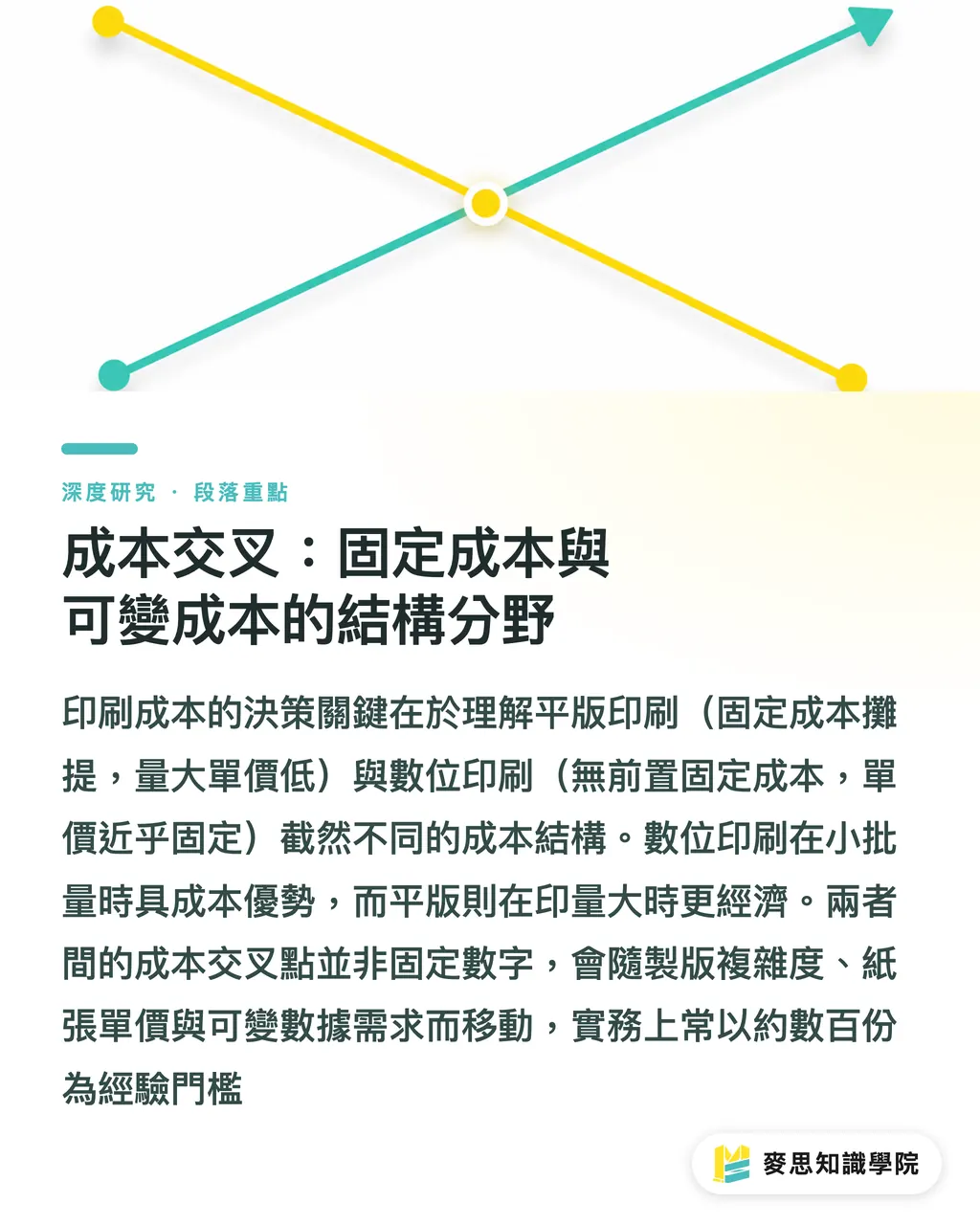
・The core of cost decision-making lies in understanding that the two technologies have different cost curve shapes, rather than comparing a single quote. This is the fundamental mechanism for determining the intersection point
・The cost of offset printing consists of two parts: first, fixed costs independent of print volume, including plate-making, machine setup, and color registration; second, paper and ink costs that increase linearly with print volume. Since fixed costs must be amortized by the total volume, the unit cost of offset drops significantly as volume increases. This article analyzes that this is the mathematical root of "large volume equals low unit price" as plate-making fees are diluted
・Digital printing is the opposite. Toner/inkjet is plate-free, with almost no pre-production fixed costs unrelated to volume. The unit cost is close to a constant value and does not drop significantly as volume increases [1][2]. Its advantage range therefore falls on small quantities: when the volume is insufficient to amortize the plate-making costs of offset, the "zero plate-making" characteristic of digital makes its total cost lower
・The point where the two cost curves meet is the "cost intersection point." This article analyzes that this intersection point is not a fixed number, but moves according to the following factors:
・The higher the plate-making and setup costs (e.g., multi-color, spot colors, special paper requiring repeated calibration), the more the intersection point moves toward higher volumes, expanding the digital advantage range
・The higher the unit price of the paper, the lower the relative proportion of digital unit costs, and the intersection point is also affected
・When containing variable data (e.g., names, numbers, or QR codes that differ per sheet), offset can hardly process it, while digital has a structural advantage at any volume
・In practice, a common empirical threshold is in the hundreds: within about 500 copies, and without the need for independent spot colors, digital is usually more cost-effective; beyond this volume, the economies of scale of offset begin to emerge. This article must honestly point out that this threshold is an industry rule of thumb rather than a constant that can be precisely supported by cited literature, and the actual intersection point should be recalculated according to the plate-making complexity and paper material of each case
Quality Gaps: Decisive Scenarios for Halftones, Spot Colors, and Dimensions
・Quality is not "offset is definitely better"; rather, differences are only decisive in specific scenarios. Identifying these scenarios can prevent paying a premium for unnecessary quality
・The first is halftones and color gradation. Offset presents colors with physical halftone dots, and in large-area gradients, delicate skin tones, and high-end printed matter, the stability of the halftone structure is generally considered better. The imaging precision of digital printing continues to improve, but in the most demanding color transition scenarios, traditional offset still has the edge. This article analyzes that for general commercial print jobs, most readers find this difference hard to perceive; only for quality-sensitive items like high-end art books and photography collections does the difference constitute a reason for choice
・The second is spot color and post-processing. Offset can use independent plates to print Pantone spot colors, metallic, silver, and fluorescent colors, and integrate post-processing such as hot stamping, embossing, and coating, with higher color consistency and craft integrity. Digital printing mainly relies on CMYK four-color simulation, and spot color reproduction and certain post-processing options are limited. This article analyzes that when brand colors are designated spot colors, or high-end finishing is required, offset is almost the only choice, which often determines the technical route earlier than print volume
・The third is dimensions and substrates. The format of offset presses and the range of printable paper materials are usually broader, providing better compatibility for large-format posters, special grammages, and specialty papers. It is worth adding that the material properties of digital prints differ from traditional ink, and this difference has already been observed in deinking behavior [3][4]; this article analyzes that this suggests that digital and offset are inherently different in ink layer adhesion and surface appearance, which in turn affects the final texture of certain paper materials
・In summary, the criterion for the quality axis is not "who is better," but "whether the case falls into a scenario where the difference is decisive": if fine gradients, designated spot colors, high-end post-processing, large dimensions, or special paper are required, the balance tilts toward offset
Lead Time and Batch Structure: Small-Variety vs. Large-Single-Item Time Mechanisms
・Lead time is often considered a secondary factor, but in many procurement scenarios, it is actually the primary constraint. Its mechanism stems from the duration of the pre-production processes of the two technologies
・Digital printing is plate-free and setup-free, and printing can begin almost immediately after file confirmation, making it especially suitable for urgent jobs, proofing, and short lead-time needs. Offset requires plate-making, machine setup, and color registration, resulting in a longer lead time; however, once on the press, the unit-time capacity for mass reproduction is high. This article analyzes that lead time and volume interweave here to create a time mechanism: for small urgent jobs, the "zero-pre-production" of digital wins; for large jobs with ample time, the high-speed reproduction of offset dilutes the pre-production costs
・Batch structure further amplifies this difference. In "small-quantity, high-variety" (e.g., multiple versions, multiple languages, regional customization) scenarios, if every version were to go through offset, it would need independent plates, causing fixed costs to skyrocket; the variable-per-piece capability of digital gives it an overwhelming advantage in this scenario, and it can be combined with variable data to complete in one go [5]. Conversely, "large-quantity, single-item" standardized long-run print jobs are the home ground of offset economies of scale
・It is worth emphasizing the mixed strategy. This article analyzes that digital and offset are not mutually exclusive; in practice, combined usage is common: using offset to print the large shared body (e.g., catalog inner pages), and then using digital to supplement a small amount of customized covers or localized versions; or using digital for quick proofing and confirmation, and then switching to offset for mass production. Manufacturers with both types of capacity can dynamically schedule based on the location of the case on the three axes, which is a flexibility that single-technology manufacturers do not possess

Implications for Taiwan's Design and Printing Industry: Actionable Practices for Three Types of Roles
・The three-axis criteria have different actionable meanings for different roles in the industry. This section explains the implementation directions for SMEs, designers, and brands in layers
・For small and medium-sized printing firms, the value of dual-track capacity does not lie in taking orders independently, but in the "optimal split of the same case." This article analyzes that actionable practices include: establishing cross-point calculations with plate-making complexity and paper as variables, rather than applying fixed-quantity thresholds; designing standard product lines of digital + variable data for "small-quantity, high-variety" needs; and reserving the complete process of offset + spot color + post-processing for long-run high-end items. Competitiveness comes from precise scheduling, not the age of the equipment
・For designers, technical understanding should be shifted forward to the design stage. If expecting to go digital, one must note that spot colors will be simulated by CMYK, and some post-processing may not be feasible, so one should converge on color matching and process choices in advance; if going offset, one can open up to using spot colors, hot stamping, and embossing. This article analyzes that color management alignment (screen CMYK and physical finished product) needs to adopt different expectations for the two routes to avoid discovering process incompatibility after finalization
・For brands, procurement should clarify the positioning on the three axes before ordering: the volume range of the batch, whether it includes designated spot colors or high-end finishing, and whether lead time is a hard constraint. This article analyzes that the actionable decision order is: first look at quality hard conditions (whether spot color/processing forces an offset choice), then look at lead time (urgent jobs prefer digital), and finally use volume to determine the intersection on the cost curve. Placing "hard constraints of quality and lead time" before volume can avoid misjudgment based on a single-quantity threshold
Conclusion and Limitations: Complementary Rather Than Substitutes, Criteria Rather Than Constants
・This article responds to the research question in the introduction: the choice between digital and offset is determined by the three axes of volume, quality, and lead time, and their cost intersection is a function that moves with plate-making complexity, variable data, and post-processing, rather than a fixed number of copies. The essential difference between the two technologies lies in the structural divide between fixed costs/variable costs [1][2], so they are complementary; the home ground for digital is small quantities, variety, urgency, and variable data; the home ground for offset is large quantities, standardization, spot colors, and high-end crafts. Manufacturers holding dual-track capacity are able to dynamically schedule between the three axes
・This article must honestly disclose its limitations:
・First, searchable academic literature focuses on imaging principles, deinking, and material behavior [1][2][3][4][5], lacking direct support for "precise values of volume intersection points"; the quantity thresholds in the text are industry empirical values and should be recalculated according to individual cases
・Second, this article does not include quantitative models of specific machine models, paper prices, and regional wages; the actual position of the intersection point still needs to be verified by case-specific quotes
・Third, digital imaging precision and spot color reproduction capabilities continue to evolve, and the boundaries of quality gaps will move with technological progress
・Subsequent research directions include: establishing a quantitative cross-point model with plate-making costs, paper materials, and variable data ratios as inputs; and empirically investigating the actual decision-making criteria of dual-track scheduling in Taiwan's SMEs to make up for the existing literature's gap on the "decision-making side."

Key Takeaways
・Digital and offset are complementary rather than substitutes: differences originate from the structural divide between fixed costs (plate-making) and variable costs [1][2]
・The cost intersection point is not a fixed quantity, but a function that moves with plate-making complexity, spot colors, and variable data
・The decisive scenarios for quality are fine gradients, designated spot colors, high-end post-processing, large dimensions, or special paper; if any one is met, it leans toward offset
・Lead time and batch structure often determine the route before print volume: small urgent jobs and small-quantity high-variety jobs go digital; large-quantity single-item jobs go offset
・The competitiveness of dual-track capacity lies in the "optimal split of the same case" and dynamic scheduling, not the age of the equipment
Extended Thinking
For printing manufacturing, the next step is to upgrade from "quoting based on experience" to "cross-point calculation using plate-making complexity and paper as variables," standardizing dual-track scheduling into a repeatable decision-making process. For the design side, technical constraints should be moved forward to the design stage to avoid incompatibility with spot colors or finishing discovered after finalizing. The entry point for AI and SaaS is clear: procurement decision-making is essentially a multi-variable optimization problem. One can build a calculator tool that inputs print volume, paper, spot colors, variable data ratio, and lead time, and outputs recommended routes and cost curves, correcting the intersection point with historical quote feedback. The problem to be solved is that "quality hard constraints" such as spot color reproduction and post-processing compatibility are difficult to quantify and still require human craftsmanship judgment and model collaboration
References
[1] toner offset. SpringerReference. DOI: 10.1007/springerreference_27143
[2] Weik M. (2000). toner offset. Computer Science and Communications Dictionary. DOI: 10.1007/1-4020-0613-6_19739
[3] Fischer A. (2011). Recent developments in the Deinking of Inkjet and Liquid Toner. NIP & Digital Fabrication Conference. DOI: 10.2352/issn.2169-4451.2011.27.1.art00080_2
[4] Kemppainen K., Körkkö M., Niinimäki J. (2011). Fractional pulping of toner and pigment-based inkjet ink printed papers,Ink and dirt behavior. BioResources. DOI: 10.15376/biores.6.3.2977-2989
[5] Suzuki Y., Sumi M. (2016). Multiband film antenna comprising offset fed dipole elements using inkjet printer for M2M applications. 2016 International Workshop on Antenna Technology (iWAT). DOI: 10.1109/iwat.2016.7434798
FAQ
- What is the approximate cost intersection point between digital and offset printing?
- Common industry experience values fall in the range of hundreds, where digital is usually more cost-effective within about 500 copies without designated spot colors. However, this is not a fixed constant; the intersection point moves with plate-making complexity, spot colors, and paper materials, and should be recalculated based on individual case quotes
- Why is digital printing cheaper for small-volume jobs?
- Because digital printing (toner/inkjet) is plate-free, there are no fixed pre-production costs unrelated to volume, and the unit cost is close to a fixed value. Offset requires plate-making fees that must be amortized by the total volume, making it more expensive than digital when the volume is too small to dilute those costs
- Under what circumstances must offset be used instead of digital?
- When designated Pantone spot colors, metallic, silver, or fluorescent colors, or high-end post-processing such as hot stamping and embossing are required, or when seeking large-area delicate gradients and large-format specialty paper, offset is usually the only choice, which often determines the route earlier than print volume
- Can digital and offset be mixed?
- Yes, and it is common in practice. For example, using offset for mass-producing shared main bodies and digital for supplementing a small amount of customized or localized versions; or using digital for quick proofing followed by switching to offset for mass production, using the scheduling flexibility of dual-track capacity
- Which one should I choose if the lead time is very tight?
- Urgent jobs are usually assigned to digital because it is plate-free and can begin printing almost immediately after file confirmation. Offset requires plate-making and color registration, resulting in a longer lead time, making it more suitable for large-volume print jobs with ample time
References
- toner offset · doi.org
- toner offset · doi.org
- Recent developments in the Deinking of Inkjet and Liquid Toner · doi.org
- Fractional pulping of toner and pigment-based inkjet ink printed papers,Ink and dirt behavior · doi.org
- Multiband film antenna comprising offset fed dipole elements using inkjet printer for M2M applications · doi.org
Related articles





The Print × AI weekly
The print and AI know-how designers, brands and enterprises can use before they commit — one email, every week
MINDS Free Tools
Spine width and imposition calculators — skip the manual math, free in your browser.
MINDS Group
Need actual printing or gifting services?
From premium printing to online ordering and festive gifts — the MINDS Group sister brands take it from here.