
Why Is California's SB 54 Holding Up US Export Orders?
Because California put a literal price tag on packaging design quality, and non-compliant designs will face steep Extended Producer Responsibility (EPR) fees
Two major laws California rolled out recently, SB 343 (the Truth in Labeling law) and SB 54, shut down the packaging industry's loose, self-styled definitions of recyclability for good
Both laws explicitly write in the design guide from the APR (Association of Plastic Recyclers, the core body setting North American plastics recycling technical standards) as the sole benchmark
As APR Chief Policy Officer Kate Bailey put it bluntly at a recent Flexible Packaging Association (FPA) forum: California is the first state in the country to put a price tag on packaging design choices
This means brands can no longer just slap a chasing arrows recycling logo on a pack and call it a day. Even the ink you print or the label adhesive you apply directly determines how much you pay the state government
Plenty of Taiwanese OEMs still think this is a 2026 problem. But North American brand buyers I have talked to recently are already locking APR standards into next year's contracts
What Exact Details Must Change in Flexible Packaging Design?
The core task is stripping out anything that disrupts optical sorting and pelletizing, including multi-material laminates, heavy dark ink coverage, and incompatible adhesives
In the past, when we made pouches for clients, we almost always laminated PET with PE to block moisture and get that stiff, premium feel
Under APR standards, though, recycling facilities cannot separate these mixed-material films. They are flagged as an unrecyclable disaster
While the Mai Strategy Knowledge Academy consulting team was recently auditing several export manufacturers, I usually had the production lines focus on these three hard metrics:
・Material structure: Swap out traditional PET/PE or foil laminates entirely for mono-PE or mono-PP structures, backed by an ultra-thin EVOH barrier layer if needed
・Inks and visuals: Cut back on full-bleed dark printing across the board. Dark shades blind near-infrared (NIR) optical sorting gear in recycling plants, and excessive print coverage severely contaminates recycled pellet purity
・Labels and adhesives: Surface labels must use materials compatible with the main pouch body, or switch to wash-off adhesives that release quickly in the wash sink so leftover glue does not ruin the whole recycling batch
How Should Mid-Sized Converters and Brands Take Action Now?
Brands must immediately stop re-ordering legacy packaging specs, and start demanding material test data and redesign plans from suppliers that meet APR standards
On paper, the fines hit the brand owners selling into California, but that bill will inevitably get passed down to the converters and contract manufacturers
To drive down EPR fees, brands have only one real move: purge their supply chain and drop any supplier that cannot deliver compliant packaging
To dodge the risk of losing purchase orders, I suggest taking these three steps across procurement and production right now:
1. Audit high-risk SKUs: Pull every product shipping to California and the West Coast, cross-reference them against the APR Guide's negative list, and flag non-compliant specs in a redesign red zone
2. Adjust visuals and finishing: Designers need to put sustainability at the very start of the workflow, negotiate white space ratios, and drop non-essential embellishments like foil stamping and spot UV that degrade recycled material purity
3. Run line trials and validation: Mono-materials behave very differently from traditional laminates. Once you change resin, retest sealing temps, tensile strength, and barrier performance to ensure compliance without triggering customer complaints
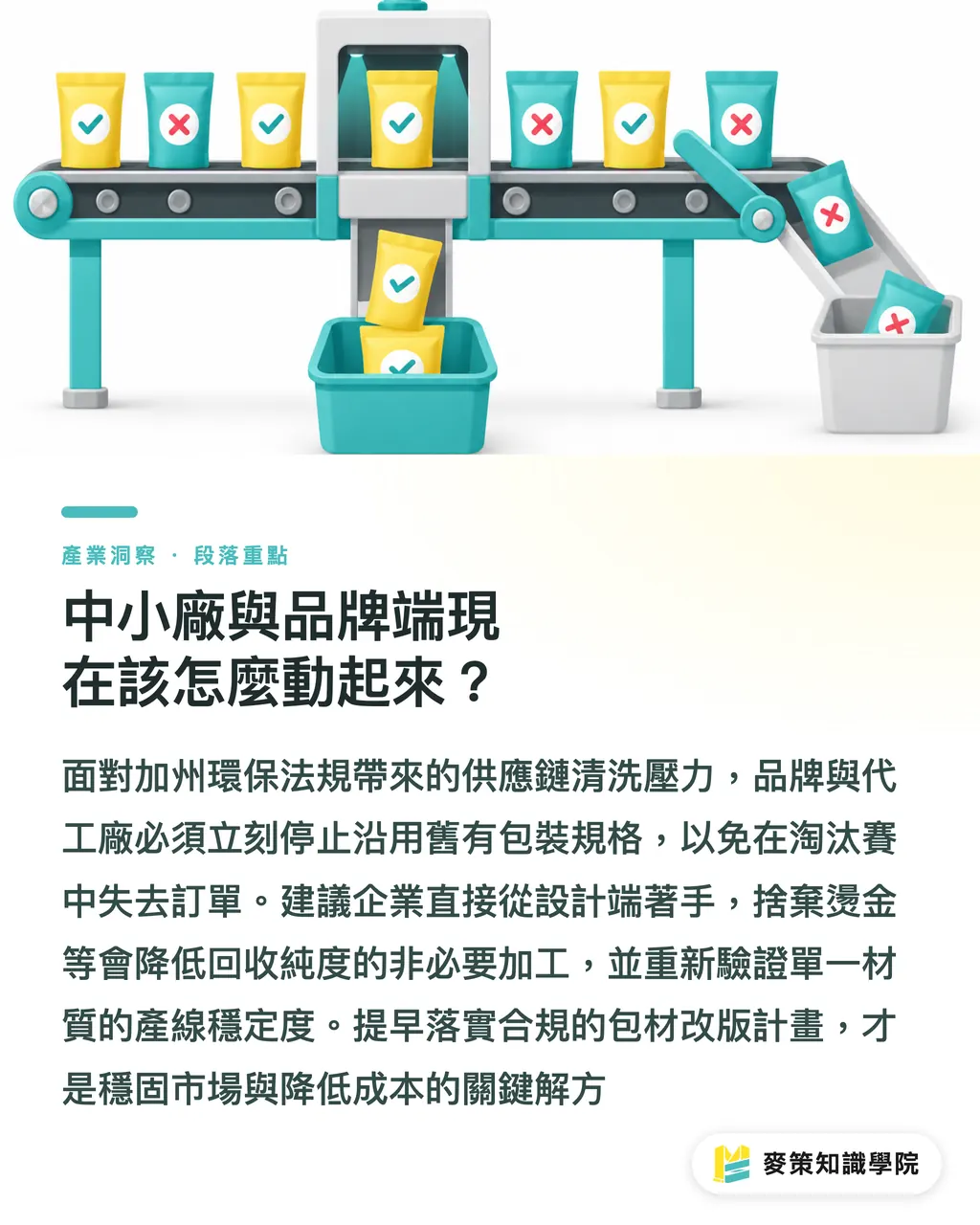
Key Takeaways
California SB 54 turns recyclability from a PR buzzword into a hard benchmark for fees and fines, backed strictly by the APR Design Guide
Flexible packaging exported to North America must move to mono-materials. Traditional PET/PE laminates face severe pressure to be phased out
Design choices on ink coverage, white space ratios, and adhesive selection now dictate exactly how much in EPR fees a brand pays
Further Thoughts
Lately, I have seen far too many projects treat sustainability as nothing more than printing a few extra eco-labels. California's SB 54 sends an unmistakable signal: regulations now reach deep into the very front of the line, dictating resin choice and ink formulations. If mid-sized Taiwanese converters keep sitting back and waiting for clients to hand down specs, they will quickly fall behind in this 2026 compliance wave. Proactively pitching APR-aligned packaging solutions to brands is the only way to win North American orders over the next two years
Further Reading
FAQ
- What is the APR Design Guide?
- It is a set of technical standards developed by the Association of Plastic Recyclers. It spells out which plastic packaging designs and materials can actually move through the recycling stream, serving as California's legal baseline for defining what counts as recyclable
- Who pays SB 54 fees, the brand owner or the manufacturer?
- Under the law, the brand owner or importer selling into California owes the EPR fees. But to keep those compliance costs down, brands will make APR design rules a mandatory qualification for procurement and factory audits across their contract supply chain
- Does mono-material flexible packaging hurt product shelf life?
- That is the main pain point most converters face early on. Switching to mono-PE or mono-PP usually requires high-barrier coatings like EVOH to hold moisture and oxygen barriers, and production lines have to dial in new heat-sealing parameters
Related articles




The Print × AI weekly
The print and AI know-how designers, brands and enterprises can use before they commit — one email, every week
MINDS Free Tools
AI background removal, a LINE sticker maker, spine & imposition calculators — all free, right in your browser, no upload.
MINDS Group
Need actual printing or gifting services?
From premium printing to online ordering and festive gifts — the MINDS Group sister brands take it from here.