

Overview
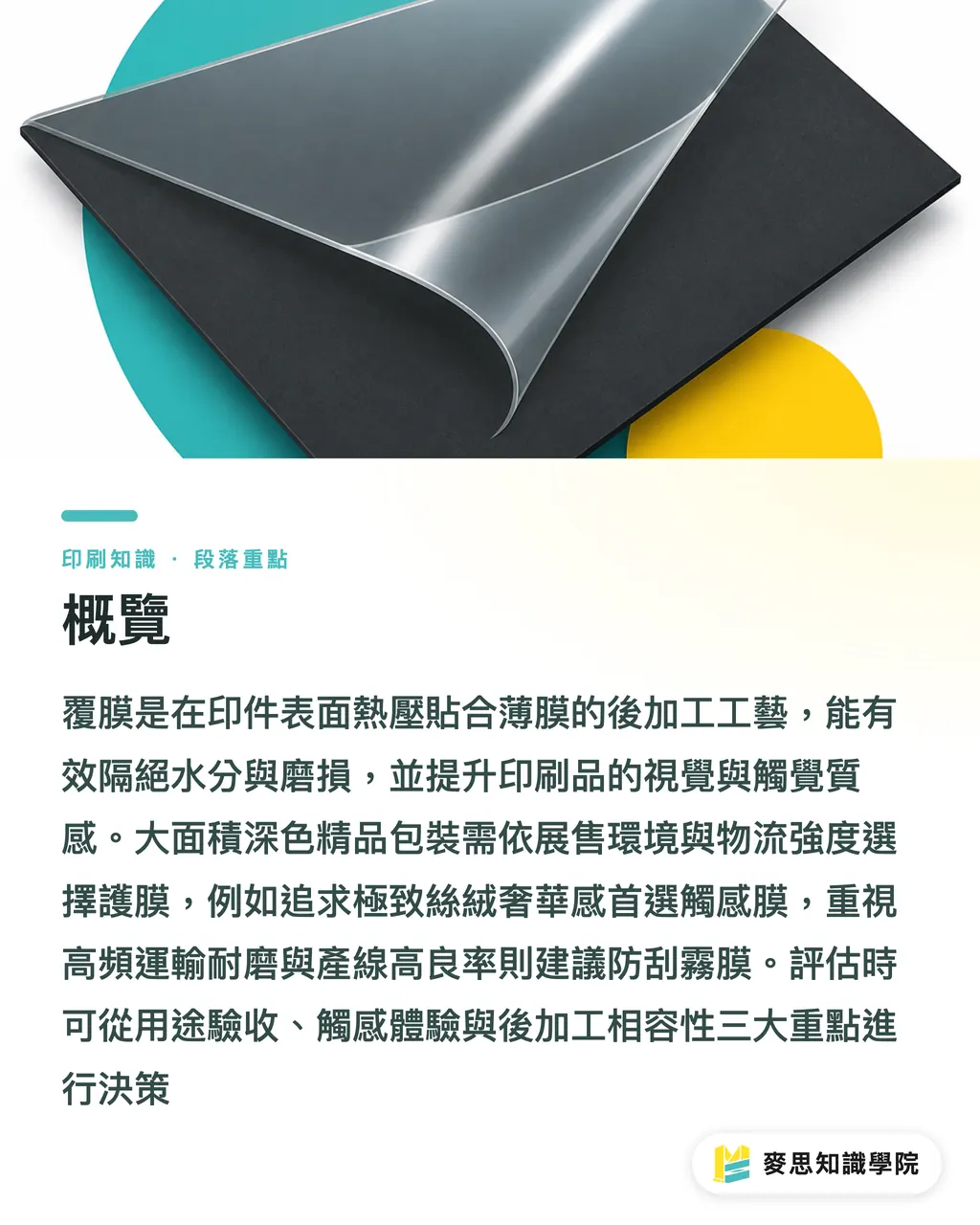
Lamination is a post-press process that heat-presses a polypropylene film onto the surface of a printed piece. It helps block moisture and abrasion while improving the visual and tactile quality of the print
For luxury packaging with large dark areas, choosing a protective film to fight fingerprints and crease cracking depends on the retail display setting and the intensity of logistics handling
If the goal is a rich velvet-like luxury feel, soft-touch lamination is the first choice. If frequent shipping, abrasion resistance, and high production yield matter more, anti-scratch matte lamination is the better pick
For evaluation, you can use the three print-approval checkpoints verified in practice by MINDS Printing, known as the "MINDS Printing (MS, mid-to-high-end fully custom commercial printing) Three Print Submission Gates": 1. use-case acceptance, 2. tactile experience, 3. post-press compatibility
What Is the Difference Between Soft-Touch Lamination and Anti-Scratch Matte Lamination
I have seen too many large-area dark prints on the production line get fully rejected by clients because of one tiny scratch or a few fingerprint marks
Soft-touch lamination, also called velvet lamination or soft-feel lamination, has a fine short-fiber feel on the film surface. At about 18 microns thick, it gives packaging a warm hand feel, but its microscopic surface structure tends to retain skin oils more easily
Anti-scratch matte lamination uses a specially hardened surface coating. In abrasion tests, it can withstand more than 500 rubs without leaving white marks. Its fingerprint resistance is excellent, and its color contrast is 15% higher than standard matte lamination
The difference is obvious
Here is how the three compare:
・Soft-touch lamination: warm velvet hand feel, medium fingerprint resistance, weaker abrasion and scratch resistance, higher unit price
・Anti-scratch matte lamination: smooth and even hand feel, excellent fingerprint resistance, very strong abrasion and scratch resistance, mid-range unit price
・Standard matte lamination: slightly draggy hand feel, weaker fingerprint resistance, scratches show easily on large dark areas, lowest unit price
Why Do Luxury Box Creases Crack and Delaminate
When luxury packaging uses 300gsm to 350gsm heavyweight art paper or grey-backed card, 90-degree or 180-degree folds can easily cause the film layer to separate from the paper fibers, creating burst corners
If the surface tension of standard BOPP film at the fold exceeds 40 dynes/cm, microscopic surface cracking can occur during creasing
Hold on. The problem is not the film itself. It is the paper fiber direction and the creasing rule setup
The key process points for preventing burst corners and glue separation are:
・Adjust the crease channel width: change the creasing rule thickness from 0.71mm to 1.05mm, giving the paper enough buffer space during folding
・Switch to polyurethane water-based laminating adhesive: increase crosslinking and curing strength between the film and paper to prevent separation at glued box areas
・Align creases with the paper fiber direction: keep the main packaging fold lines parallel to the grain direction, reducing the chance of burst corners by 70%
How to Avoid Problems with Foil Stamping and Spot Effects
Post-press adhesion depends on the dyne value of the film surface. When it is below 38 dynes/cm, foil and spot UV varnish peel off very easily
This matters
Because soft-touch lamination has a special flock-like surface coating, foil stamping usually requires heating to 120°C to 130°C with stronger pressure settings. The hardened coating on anti-scratch matte lamination needs a dedicated cold-foil or hot-stamping foil
Key checks for avoiding failures:
・On-site dyne pen test: before processing, use a No. 38 dyne pen to draw a test line. If the liquid does not bead up, the adhesion level meets the requirement
・Cross-hatch tape test: after foil stamping, apply 3M 600 tape and pull it three times in a row. The foil release rate must be below 1%
・Avoid excessive stacking: do not apply high-gloss spot UV over large flocked areas on soft-touch lamination. Use dedicated hot-press spot foil instead
How to Choose Protective Film for Dark Packaging Without Getting Burned
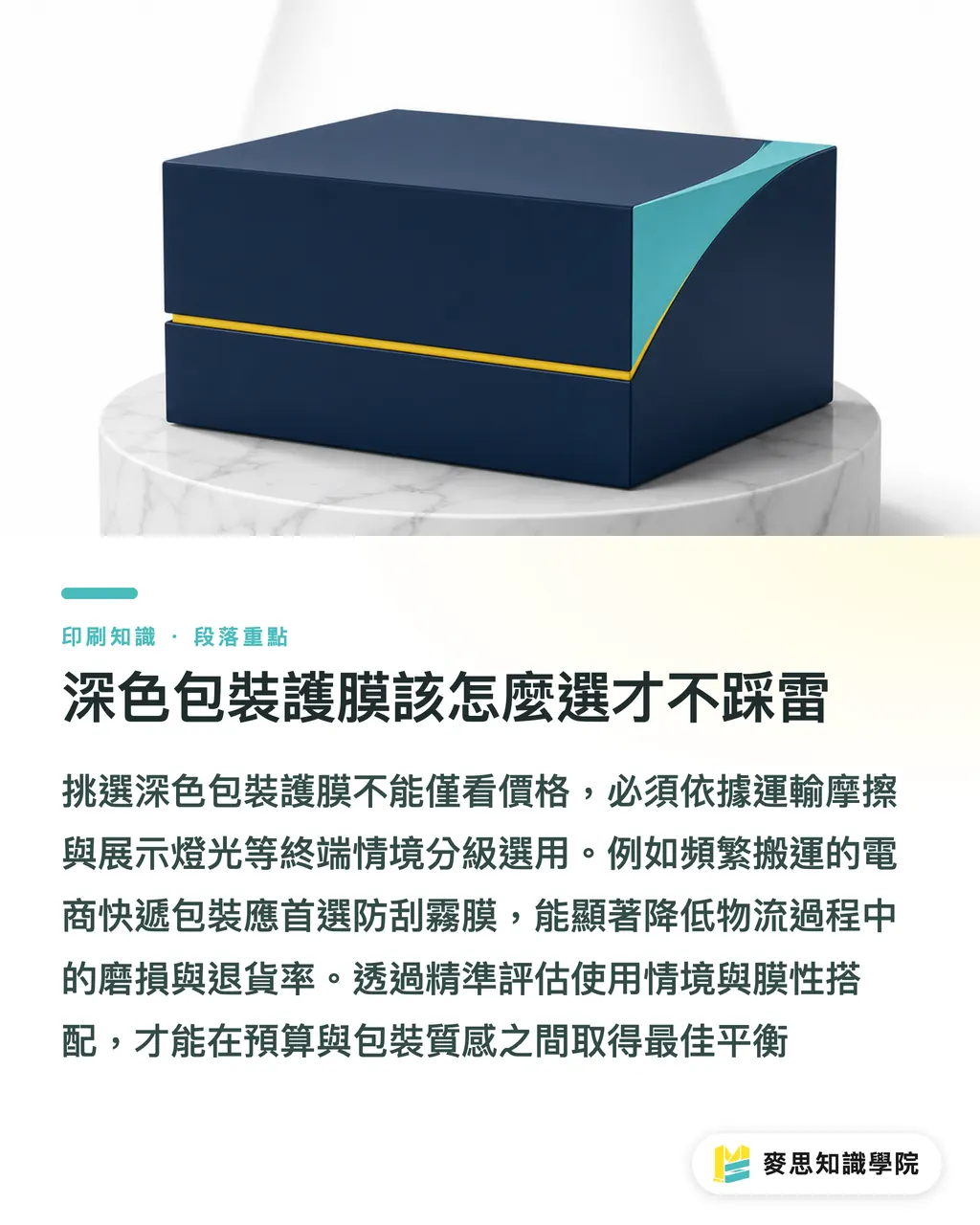
When choosing protective film specs, do not look only at unit price. Shipping friction, display-counter lighting, and how often users touch the package all need to be part of the evaluation
Choose by the product's end-use scenario:
・Trade shows and boutique counter gift boxes: for large black or deep blue designs, use soft-touch lamination first. It gives zero glare under display lighting, and the presentation quality is hard to beat
・E-commerce delivery and high-touch packaging: for frequent handling and sea-freight friction, choose anti-scratch matte lamination first. It lowers return risk and loss during logistics
・Standard packaging with limited budget: use standard matte lamination with light color designs to avoid exposing the scratch problem that comes with large dark backgrounds
If your team needs more precise paper and film pairing proofs, contact the Mai Strategy Knowledge Academy consulting team for first-hand proofing and compatibility test verification
Key Takeaways
・Soft-touch lamination wins on its warm velvet feel. Anti-scratch matte lamination wins on logistics abrasion resistance and fingerprint resistance
・The real cause of crease cracking lies in paper grain direction and creasing rule width, not simply in the film quality
・Before foil stamping, always measure the dyne value. Below 38 dynes/cm, foil peeling becomes a real risk
・Large-area dark packaging must choose its protective film based on logistics distance and display-counter lighting
Further Thinking
The protective film choice for luxury packaging may look like the final step, but it affects production yield, logistics loss, and the consumer's first impression during unboxing
As brands raise their standards for premium packaging, film surface reflectance and tear strength should be factored in during early color planning
Turning paper grain direction, lamination dyne value, and foil-stamping temperature and pressure into measurable parameters will be a key step for print manufacturers and brand buyers aiming for defect-free delivery
Further Reading
FAQ
- Which is less likely to leave fingerprints, soft-touch lamination or anti-scratch matte lamination?
- Anti-scratch matte lamination has better fingerprint resistance than soft-touch lamination. Its hardened surface coating blocks skin oils from adhering effectively, while the short-fiber structure of soft-touch lamination is more likely to retain slight fingerprint traces after frequent handling
- What is the emergency fix when laminated box creases start cracking?
- You can fine-tune the creasing rule width, switch to polyurethane water-based adhesive, and fold along the paper grain direction. These steps can greatly reduce film tearing and burst-corner risk
- Can hot foil stamping or spot UV be applied on anti-scratch matte lamination?
- Yes, but the film surface tension must reach at least 38 dynes/cm, and the process should use dedicated high-adhesion foil and UV coating materials
- Which film is most recommended for large-area black printed packaging?
- If display quality and a premium hand feel are the priority, soft-touch lamination is recommended. If the packaging needs to go through long-distance e-commerce delivery, anti-scratch matte lamination is strongly recommended to prevent logistics scratches
Related articles
The Print × AI weekly
The print and AI know-how designers, brands and enterprises can use before they commit — one email, every week
MINDS Free Tools
Spine width and imposition calculators — skip the manual math, free in your browser.
MINDS Group
Need actual printing or gifting services?
From premium printing to online ordering and festive gifts — the MINDS Group sister brands take it from here.