

Why Do More AI Agents at a Print Shop Actually Make Deadlines Worse?
Independent goals with no lateral coordination, that's what makes multi-node automation systems collapse. There's been a lot of buzz lately about print shops handing quoting, scheduling, prepress, and even customer service to separate AI agents. It sounds modern. But over the past month or two, I've been watching this approach turn into a deadline disaster
An AI agent isn't a macro script. It's more like a new hire who's never been trained on how the whole company works. The quoting agent wants to win jobs with discounts. The scheduling agent wants to max out capacity. The paper procurement agent wants to cut inventory costs. In a traditional print shop, an experienced plant manager steps in to mediate these conflicts. In a hastily deployed system, there's no one filling that role
The math is blunt. Ten independent agents generate 45 potential communication links. A hundred agents push that number toward 5,000. Most shops only monitor whether each individual agent hit its own target, nobody's watching whether the system just scheduled two six-figure jobs heavy on spot colors into the same time slot on the same four-color press. For buyers, a shop without that coordination layer is actually less trustworthy on deadlines than one running manual scheduling

What Is AI Agent Orchestration, and Why Does It Matter So Much for Deadlines?
AI Agent Orchestration means building a command layer on top of multiple independently operating AI systems, one with the ability to coordinate resources and resolve goal conflicts across nodes, so orders actually get out the door. Without it, every piece of the workflow is chasing its own local optimization, and the risk of deadline delays spikes
Here's the most common scenario. The paper procurement agent pushes back the delivery date on an imported coated stock by two days to save on freight, switching to sea shipping, perfectly within its mandate. But the scheduling agent doesn't know the paper hasn't arrived yet, and books your rush catalog job onto Press A for tomorrow. Tomorrow the press sits idle. Your job gets pushed
In every case I've seen where a print team actually holds its deadlines tight, they've put serious work into this orchestration layer. They're not chasing a headcount of AI deployments, they're defining strict handoff standards and conflict-resolution protocols between nodes. If a vendor tells you their whole shop is automated, ask them directly what mechanism handles conflicts between agents. If they can't answer, their deadline forecasts are mostly buzzword theater
How Should Procurement Choose a Print Shop That's Deployed AI?
The clearest test: does this shop have cross-agent error fallback mechanisms and a defined list of decisions that go to a human? As a procurement buyer, you're no longer dealing with a sales rep and a calculator, you're dealing with a system running several decision models behind the scenes. Listening to them brag about predictive accuracy isn't enough
You need to ask the right questions. Next time you're getting quotes, go beyond unit prices and paper specs, find out how they handle deadline exceptions. Use these dimensions to evaluate your vendors:
・Alert conditions: most shops only watch the countdown to deadline. A reliable shop ties alerts to paper stock levels, ink consumption, and press availability
・When humans step in: when scheduling and procurement goals conflict, does the system just barrel through, or is there a defined gate that hands the decision to a person?
・Basis for rush decisions: when something comes up, is the sales rep making promises on gut feel, or is there a decision checklist generated from historical deadline risk scores?
The shops that can clearly explain when their system predictions break down and humans have to take over, those are the ones who actually understand where automation ends. This directly affects whether your rush jobs get quietly pushed back because some agent's default priority weighting was too low

Mai Strategy's Three-Gate Print Checklist: How Procurement Protects Itself
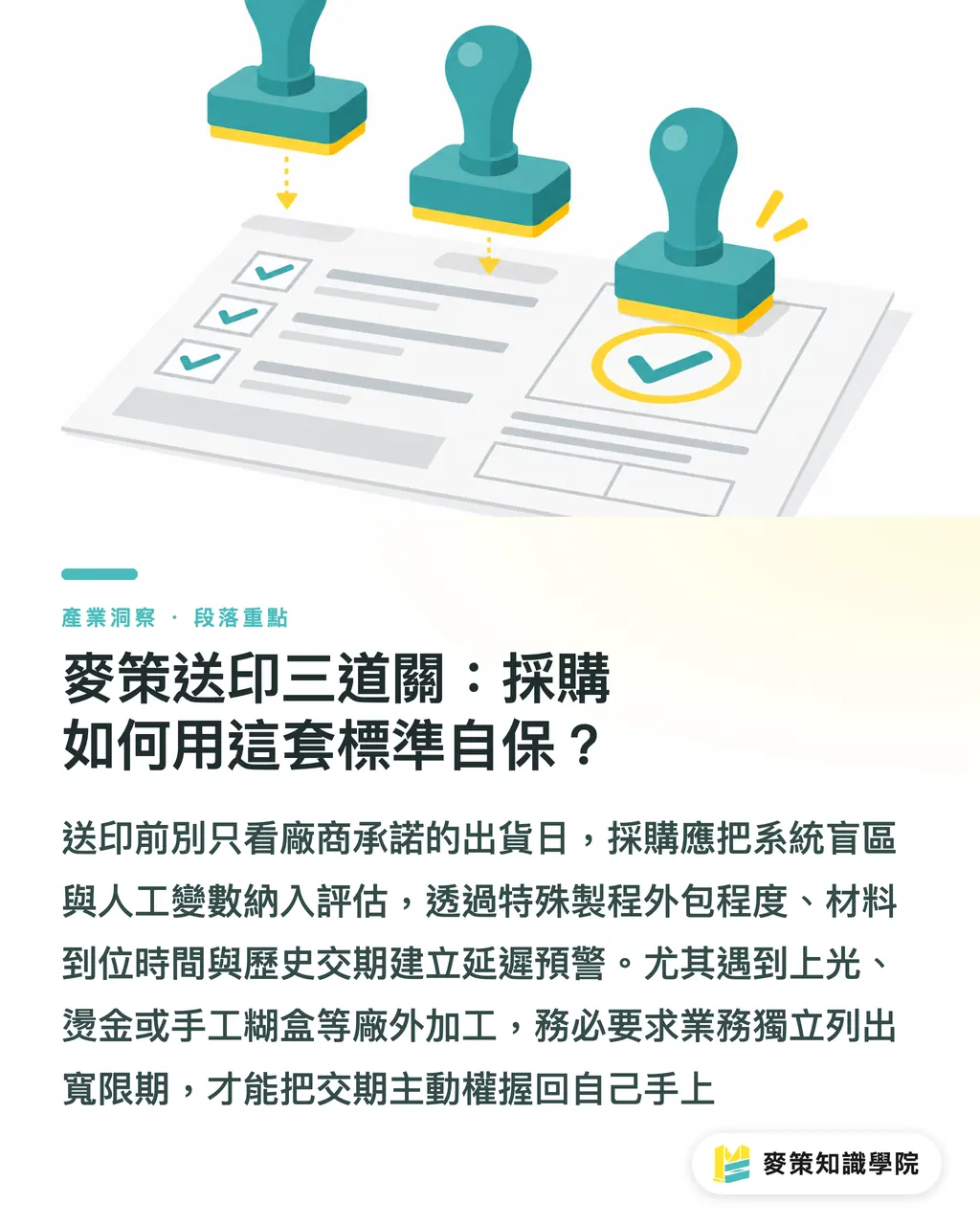
This is a risk-check process built from historical deadline data and known system blind spots. It helps you factor a vendor's system variables into your sourcing decisions. To keep an immature scheduling system from dragging you down, work through these three steps before you send anything to print
With more vendors throwing tech buzzwords around as sales hooks, the Mai Strategy Knowledge Academy consulting team has recently helped several large corporate procurement teams redesign their vendor evaluation forms. If your project is time-sensitive trade show materials or seasonal packaging, here's what to do:
1. Clarify how much of the vendor's specialty processes are outsourced. Scheduling systems typically only manage in-house presses. The moment you need UV coating, die-cutting, foil stamping, or hand gluing sent out, those are blind spots in the system. Ask your sales contact to break out the lead time buffer for any off-site processes separately
2. Get the exact date materials are confirmed on-site. Don't just look at the final ship date, find out when the paper and specialty inks are actually locked in. If materials arrive late, that's your signal to start the rush negotiation immediately
3. Build your own delay early-warning list. Assign a risk score based on this vendor's actual delivery times on similar jobs in the past. The higher the score, the more lead time buffer you build into your sourcing timeline
Make system integration and human review mechanisms official scoring items. Manage variables with strict criteria, and the deadline commitments you get back will actually mean something. Simple. Keep the guardrails in your own hands
Key Takeaways
・The more AI agents a print shop deploys, the more the potential for errors grows exponentially with every connected node
・Single-agent monitoring can't catch cross-goal conflicts. Deadline failures usually happen in the handoff gaps between agents
・Smart buyers don't count how many AI tools a vendor uses. They ask how the vendor handles conflicts between agents and what the human fallback looks like
・Add system integration to your vendor evaluation criteria. Set tracking checkpoints specifically for specialty processes and material arrival dates
Further Thinking
For corporate buyers and procurement managers, this is a good time to take a hard look at your print vendors' fundamentals. Don't get taken in by sales reps who can't stop name-dropping the latest tech. The vendors worth a long-term relationship are the ones willing to acknowledge their system's limits and draw a clear line around where human review kicks in. Go through your main vendors' intake processes and ask them directly at the next meeting how they handle internal scheduling and materials conflicts. That's a solid stress test
Further Reading
FAQ
- What does AI scheduling at a print shop actually do for my deadlines?
- A mature scheduling system can predict delivery dates from historical data in ways that cut out human bias and memory errors. But that's only true if the system has a unified command layer. Without one, siloed nodes create more scheduling conflicts, not fewer
- How do I tell whether a vendor's system is sitting on a hidden problem?
- Watch how they handle rush jobs. If the sales rep says yes fast but progress updates are all over the place and every explanation involves a different department, that usually means their internal decision systems aren't talking to each other
- The quote is cheaper, but their system looks shaky. Should I place the order?
- It's a risk calculation. For internal documents or routine print runs with no hard deadline, saving the money is fine. For product launch packaging or catalogs, one system failure that causes a delay will cost you far more in marketing fallout than you saved on printing
- Small shops don't have any of this. Are they actually more reliable?
- Small shops with simple processes running on an experienced scheduler's judgment do have a certain stability. But once order volume grows or specs get complicated, that human capacity becomes the new bottleneck. At that point, a shop that's brought in targeted alert mechanisms has the edge
Related articles





The Print × AI weekly
The print and AI know-how designers, brands and enterprises can use before they commit — one email, every week
MINDS Free Tools
AI background removal, brand stamping, and a LINE sticker maker — free design tools, right in your browser, no upload.
MINDS Group
Need actual printing or gifting services?
From premium printing to online ordering and festive gifts — the MINDS Group sister brands take it from here.