

Why Are Client-Supplied AI-Perfect Mockups Often a Ticking Time Bomb for Commercial Printing?
These files often focus only on visual impact on screen and cannot withstand the test of physical materials and color management. Recently, clear fatigue with "AI-generated content at speed" has emerged in Western business communities such as Reddit. When every brand can produce website graphics and copy with one click, the market fills with soulless visual sameness
I have personally handled several projects lately where clients arrived excitedly with polished AI-generated files and asked to send them straight to commercial packaging production. It looked like they had saved on upfront design fees, but in practice the work got stuck on the gap between the file's maximum resolution and the required output, or on extreme color shifts after converting RGB to CMYK. Here is a real scenario: a client wanted a formal quote within two hours for a 3 m × 8 m outdoor vinyl banner, and every image file had been AI-generated. At that size, the original detail in an AI image simply cannot hold up. Jagged edges and noise from forcing it larger are invisible on screen, but become a joke once the banner is hanging outdoors. Sending a file to press without FOGRA-based standard color management and verification against physical specifications is asking for disaster

How Can Corporate Buyers Escape the Cheap, Template-Like Feel of AI Design?
The core rule is to move acceptance criteria away from "visual spectacle" and back to "brand fit and post-production retouching hours." Many corporate clients assume that if a designer used AI, the job takes zero hours, so they keep pushing quotes down using traditional per-piece or size-based pricing. In practice, that often traps both sides in an endless revision nightmare
AI generation is highly random. Fine-tuning it to meet a specific brand's visual standards takes a great deal of manual post-production. To judge whether a design proposal has a real competitive edge, you cannot look only at how flashy the first draft is. You need to see whether the designer can precisely control the details of the AI output and turn it into a standard final artwork file that meets dieline, bleed, and copyright requirements. Hold on. First confirm that the proposer can handle these physical-printing details before moving forward. Otherwise, all you have bought is an unusable digital file
How Should Printers and Designers Build Defensive Quoting and Acceptance Standards?
We need to abandon the old habit of pricing by gut instinct and use file-processing hours and production difficulty as new pricing safeguards. I often say 2026 will be a dividing line for print-industry gross margins. Faced with files that are produced quickly but vary wildly in quality, if printers keep accepting them as-is, thin margins will be eaten up just by retouching and color matching for clients
I strongly recommend that printers and corporate procurement teams adopt the "Mai Strategy Three-Gate Prepress Framework" that the Mai Strategy Knowledge Academy consulting team often uses when guiding clients, so landmines are intercepted at the start of accepting a job or commissioning work. The safeguards are:
・First gate (copyright and compliance review): Require clarification of the commercial licensing scope and originality of the AI artwork. Many AI outputs still occupy a gray area when used for commercial printing. If an infringement claim erupts after tens of thousands of packages have been printed, nobody can afford to carry that bill
・Second gate (hard verification of physical specifications): Do not be distracted by how beautiful the image looks. First use software to check that it meets the 300dpi resolution floor for commercial printing, along with correct color settings such as four-color black
・Third gate (physical proofing and material matching): Require a partial physical proof and confirm in practice how the AI image absorbs ink on the specified paper or specialty material and how it ultimately renders in color
The Real Commercial Value Lies in the Physical Details AI Cannot Calculate
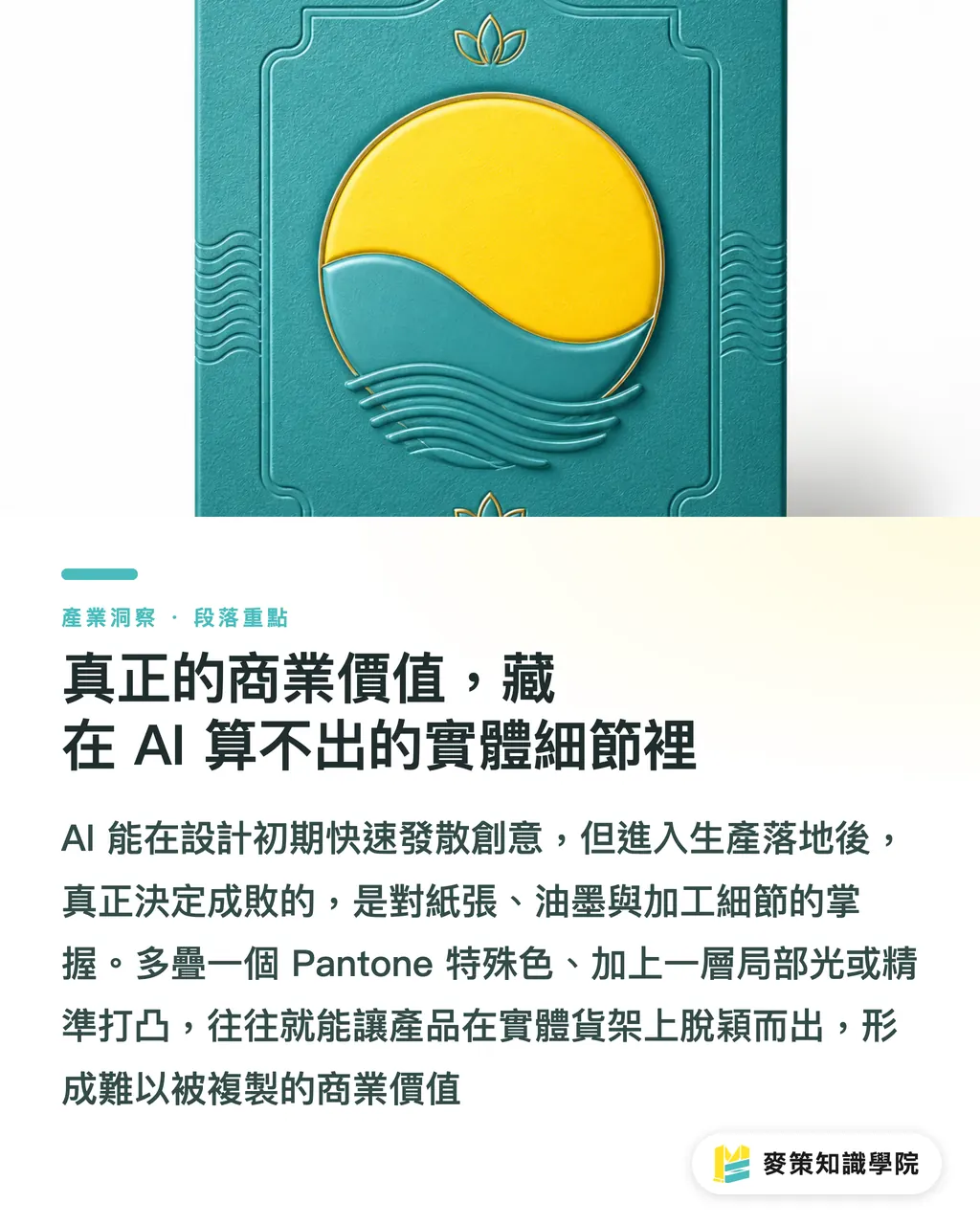
AI really is a tireless creative assistant in the early stages of design, helping us branch out ideas quickly and explore styles. But once a design moves into production, bringing it down to earth takes an old hand who understands paper texture and ink behavior. Often, adding one more Pantone spot color, applying a spot gloss layer, or using precisely executed embossing is what helps a product stand out on a physical shelf
That is where a printer like MINDS continues to pull away from the pack in a sea of sameness, with its focus on mid- to high-end, fully customized commercial printing. No matter how the tools used for generation up front change, if you push the tactile quality and detail precision of physical printing to the limit, your proposal will naturally have a strength no one else can take from you. That is enough
Key Takeaways
・Reject per-piece pricing and instead base quotes for AI projects on post-production retouching hours and production difficulty
・Put the three-gate prepress check into practice. Require checks of resolution, CMYK color shifts, and commercial-use rights, keeping landmines out before anything reaches press
・Build a competitive edge through physical finishing and paper tactility, escaping the visual sameness of the screen
A Further Thought
For small and mid-sized printers and designers in Taiwan, rather than follow the market into a race to the bottom on AI-generated images, return to the professional barriers of physical production. Focus on material recommendations, specialty finishing, and precise color management, the areas AI cannot step into, and position yourself as the technical gatekeeper who can bring digital creativity perfectly into the physical world. That is the kind of commercial value that will not be easily replaced over the next ten years
Further Reading
FAQ
- Can AI-generated images be sent directly to a printer for production?
- No. Most AI images only have RGB color intended for screen display and relatively low resolution. Sending them straight to print can cause severe color shifts and pixelation. A designer must first convert them to CMYK, bring the resolution up to spec, and set the bleed dimensions
- Why hasn't project pricing become cheaper after introducing an AI design workflow?
- Because handling AI's randomness carries a very high hidden cost. Fine-tuning a randomly generated image to match brand guidelines and a print dieline depends on extensive manual post-production and revision hours. That takes far longer than traditional typesetting
- How can a company make sure its AI artwork is free of copyright risk?
- Rigorously review the commercial licensing terms of the generation tool, and use AI primarily as a supporting source of assets rather than as the final artwork whenever possible. Before mass production, always have the design partner sign a compliance warranty to avoid sitting on an infringement time bomb
Related articles




The Print × AI weekly
The print and AI know-how designers, brands and enterprises can use before they commit — one email, every week
MINDS Free Tools
AI background removal, brand stamping, and a LINE sticker maker — free design tools, right in your browser, no upload.
MINDS Group
Need actual printing or gifting services?
From premium printing to online ordering and festive gifts — the MINDS Group sister brands take it from here.