

Where AI Speeds Up Quoting, and What Extra Responsibility Does Procurement Carry
AI speeds up product discovery, spec combinations, and price estimates. Procurement, in turn, has to turn the conversation into an order that can actually be produced and checked on delivery
On September 9, 2026, Print.com announced a print-platform plug-in for ChatGPT. Customers can search the catalog with prompts, get instant quotes and lead times, then use a share link to return to the web app and place an order. The plug-in is available with both free and paid ChatGPT plans
The biggest adjustment, in my view, is where procurement draws the line. AI is good at turning "an outdoor event, needs to be waterproof, would prefer recycled materials, and must arrive by a specified date" into several options. But it should not assume the finished size, printing method, or file requirements for procurement. A quote page can look complete without the request actually being complete
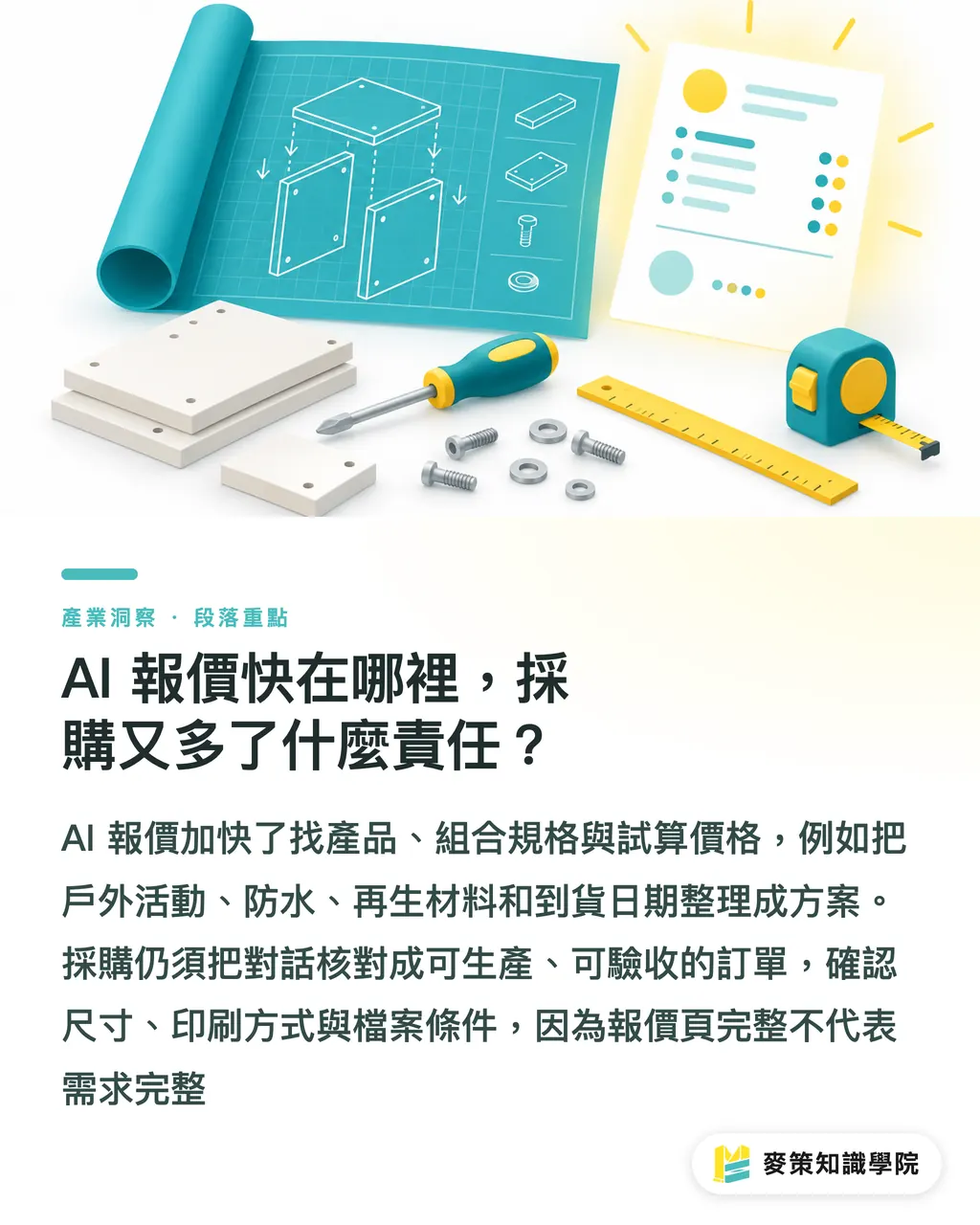
What Counts as Specification Verification, and Which Fields Should Procurement Check?
Specification verification means checking the size, paper stock, number of colors, quantity, finishing, delivery date, and file requirements against the request one by one, to confirm that the quoted job can be produced and accepted
・Size: Spell out the finished size, orientation, fold lines, or flat size, and confirm that the quoted specifications match the print-ready files
・Materials and printing: Do not just write "eco-friendly" or "waterproof." Confirm the actual stock, surface treatment, and production method
・Quantity and finishing: Include cutting, folding, binding, packaging, and split deliveries in the same quote
・Delivery and files: Confirm the arrival date, shipping destination, file format, and prepress check requirements
Print.com uses "weatherproof products for an outdoor festival" and "recycled materials for a sustainable event" as search scenarios. This is exactly where procurement tends to miss follow-up questions. I would ask whether the waterproofing comes from the stock, lamination, or printing method, and whether the recycled materials require a particular paper type or certification
When a Quote Comes Fast, How Should You Conduct a Human Review?
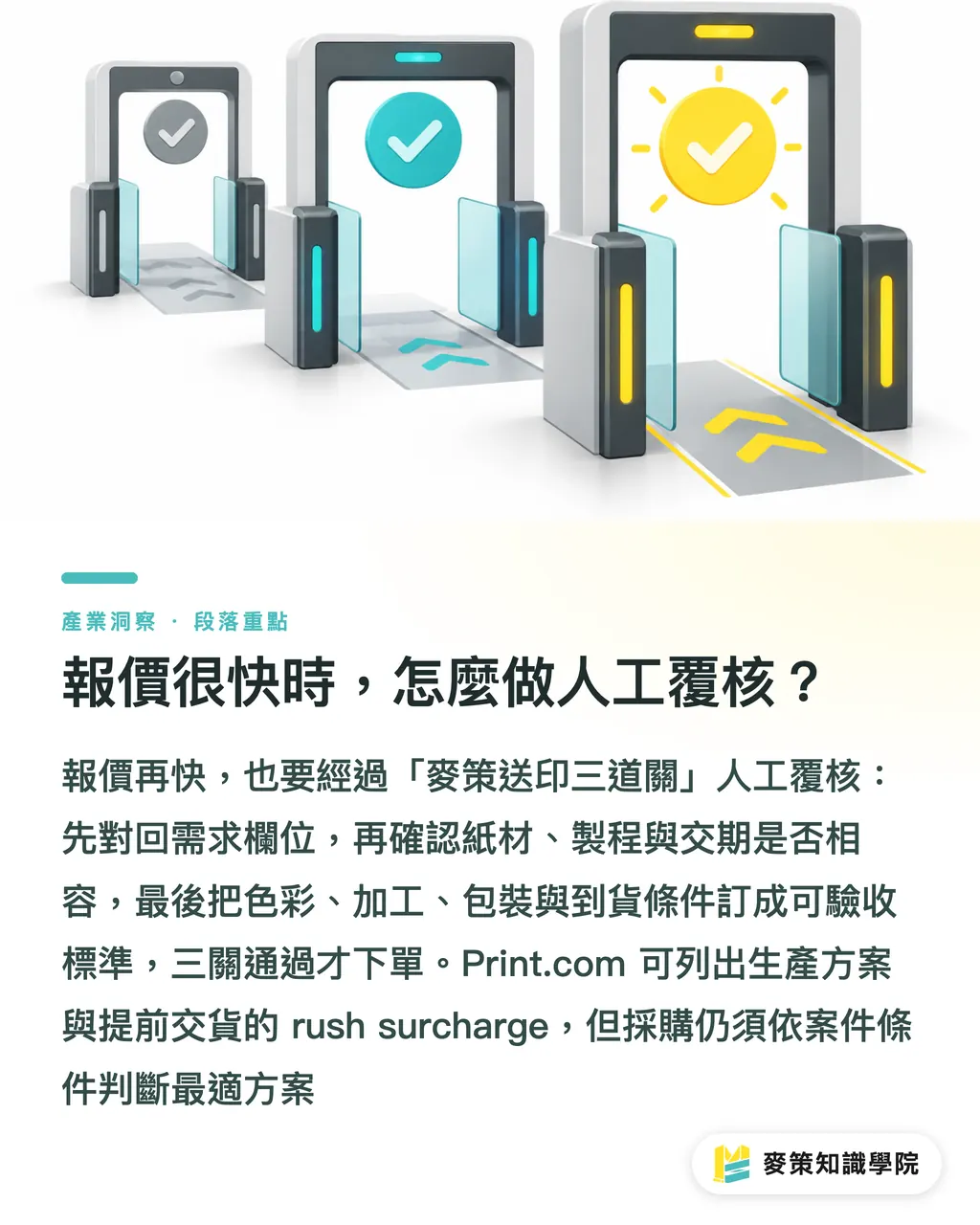
When a quote comes back quickly, I use Mai Strategy's three-gate print-order check for human review. The request gate, production gate, and acceptance gate all have to pass before the quote moves to ordering
・1. Request gate: Map the original brief back to the quote fields. If the size, quantity, delivery date, or file requirements are missing, ask follow-up questions first
・2. Production gate: Confirm that the stock, printing method, finishing, and delivery schedule work together. If you need an earlier delivery, check the rush surcharge day by day
・3. Acceptance gate: Turn color, finish appearance, packaging, and arrival conditions into clear acceptance criteria. Keep a record of the version and share link
The Print.com plug-in provides production methods that meet the deadline and lists the rush surcharge for each day delivery is brought forward. That helps procurement compare options faster, but it cannot decide which conditions suit a particular project
How Can Corporate Procurement Compare Quotes Without Letting a Low Price Call the Shots?
When comparing print quotes, corporate procurement should align the delivery terms first and then bring unit price into the comparison. The lowest price across different specifications is not a useful basis for a decision
・Quote contents: Check whether the total includes finishing, packaging, shipping, and rush fees. A low price may simply mean some fields were left out
・Delivery timing: Compare the actual arrival date and production method, not just the stated number of business days
・Finished quality: Check the stock, color, surface treatment, and proofing or acceptance method so design requirements carry through to production
・Change responsibility: Confirm who can approve specifications, who handles file changes, and how the price and delivery date will be recalculated after revisions
The reminder I give procurement most often is simple: compare specs first, then price. Even if two quotes list the same item, if one spells out finishing, packaging, and rush fees while the other leaves them in the notes, you cannot rank them directly by the headline total
How Should Printers and SaaS Teams Respond to This Shift?
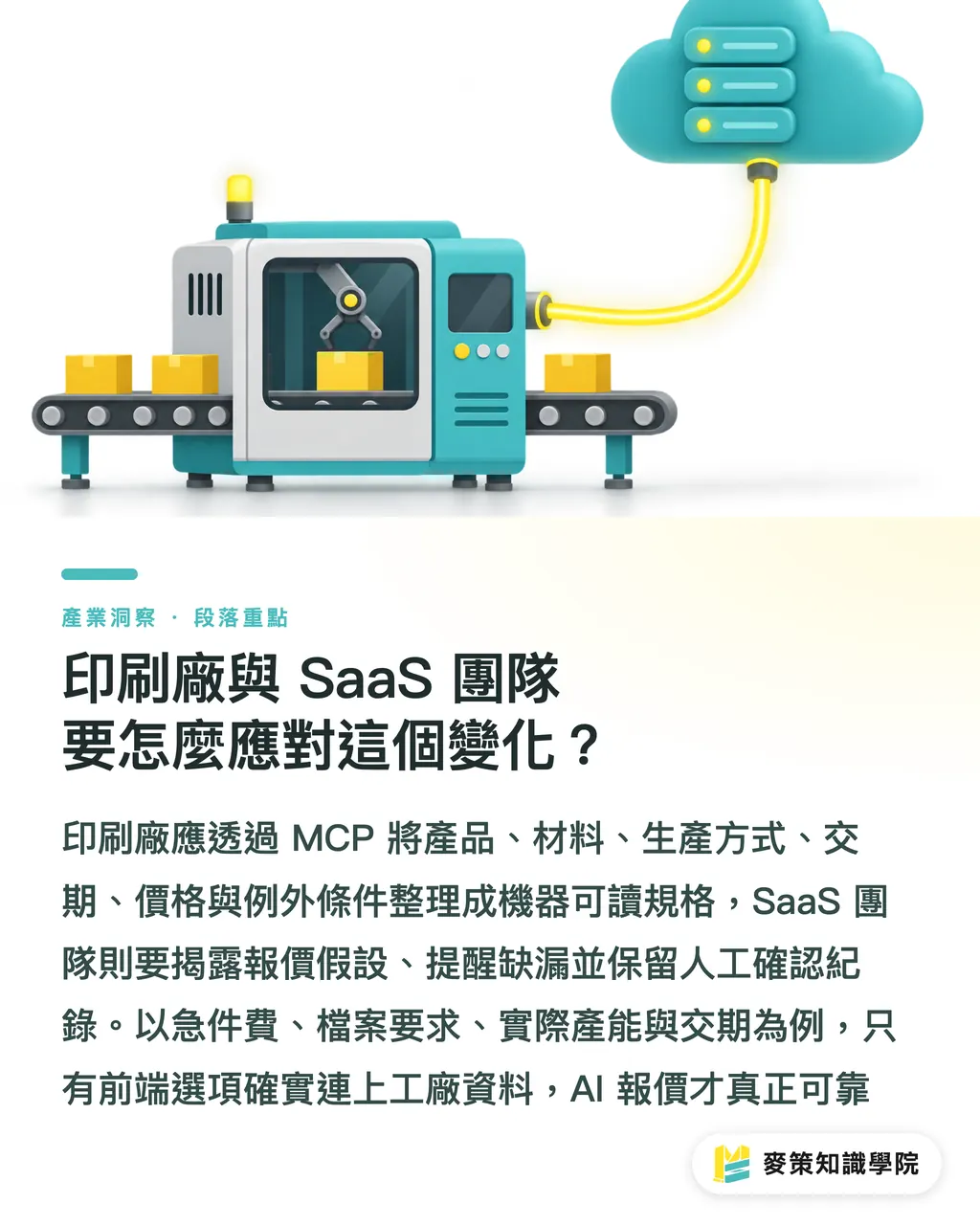
Printers need to express producible conditions as machine-readable specifications, while SaaS teams need to make every quote assumption verifiable and confirmable by people
MCP (Model Context Protocol, an open standard that lets AI assistants connect to external services) allows print platforms to make catalogs, paper stocks, production methods, lead times, prices, and exception conditions available for different AI tools to read. Print.com says it has organized billions of possible configurations into content that AI can read, and a similar plug-in for Claude is also under review
・Printers: Organize product fields, available materials, lead times, rush fees, and file requirements into consistent data
・SaaS teams: Flag missing requirements, show quote assumptions, and retain version histories and human approval records
・Procurement teams: Require quotes to be shareable, traceable, and clear about the production conditions behind each price
Print.com also mentions its own production facilities and more than 200 print partners. That is a direct reminder for small and midsize Taiwanese print shops: for AI to be useful, every selectable option on the front end must connect to real production capacity and lead times behind it
Key Takeaways
・AI organizes the request first, while procurement gives the final approval on specifications
・Instant quotes shorten the wait, but they cannot eliminate vague requirements
・Align the size, materials, finishing, delivery date, and files before looking at the total
・An order-ready link still needs traceable human confirmation
Further Thought
For its next quote request, I suggest that a company's procurement team first break the requirements into a one-page spec sheet, then have AI generate two or three configurations, and finally sign off on each item using Mai Strategy's three-gate print-order check. If the team wants to build this quote-verification method into its everyday request-for-quote, design handoff, and acceptance workflows, it can discuss the approach with the Mai Strategy Knowledge Academy consulting team. The point is to spell out the production conditions behind every price, not to make the button faster
Further Reading
FAQ
- If AI directly provides an order-ready quote, does procurement still need human confirmation?
- Yes. A person still needs to check the size, materials, finishing, delivery date, and file requirements, and confirm that the quoted conditions can be produced and accepted
- What should you look at first when comparing print quotes?
- First align the product specifications, finishing, arrival date, shipping, and rush fees, then compare the total and unit prices
- Which print conditions are AI quotes most likely to miss?
- The usual omissions are the finished size, actual paper stock, finishing method, quantity, delivery date, file requirements, and acceptance criteria
- What practical use does MCP have for printers?
- MCP lets AI tools read a printer's product, material, production-method, and delivery-date data. But first, the printer has to organize its producible conditions into clear fields
Related articles




The Print × AI weekly
The print and AI know-how designers, brands and enterprises can use before they commit — one email, every week
MINDS Free Tools
AI background removal, brand stamping, and a LINE sticker maker — free design tools, right in your browser, no upload.
MINDS Group
Need actual printing or gifting services?
From premium printing to online ordering and festive gifts — the MINDS Group sister brands take it from here.