

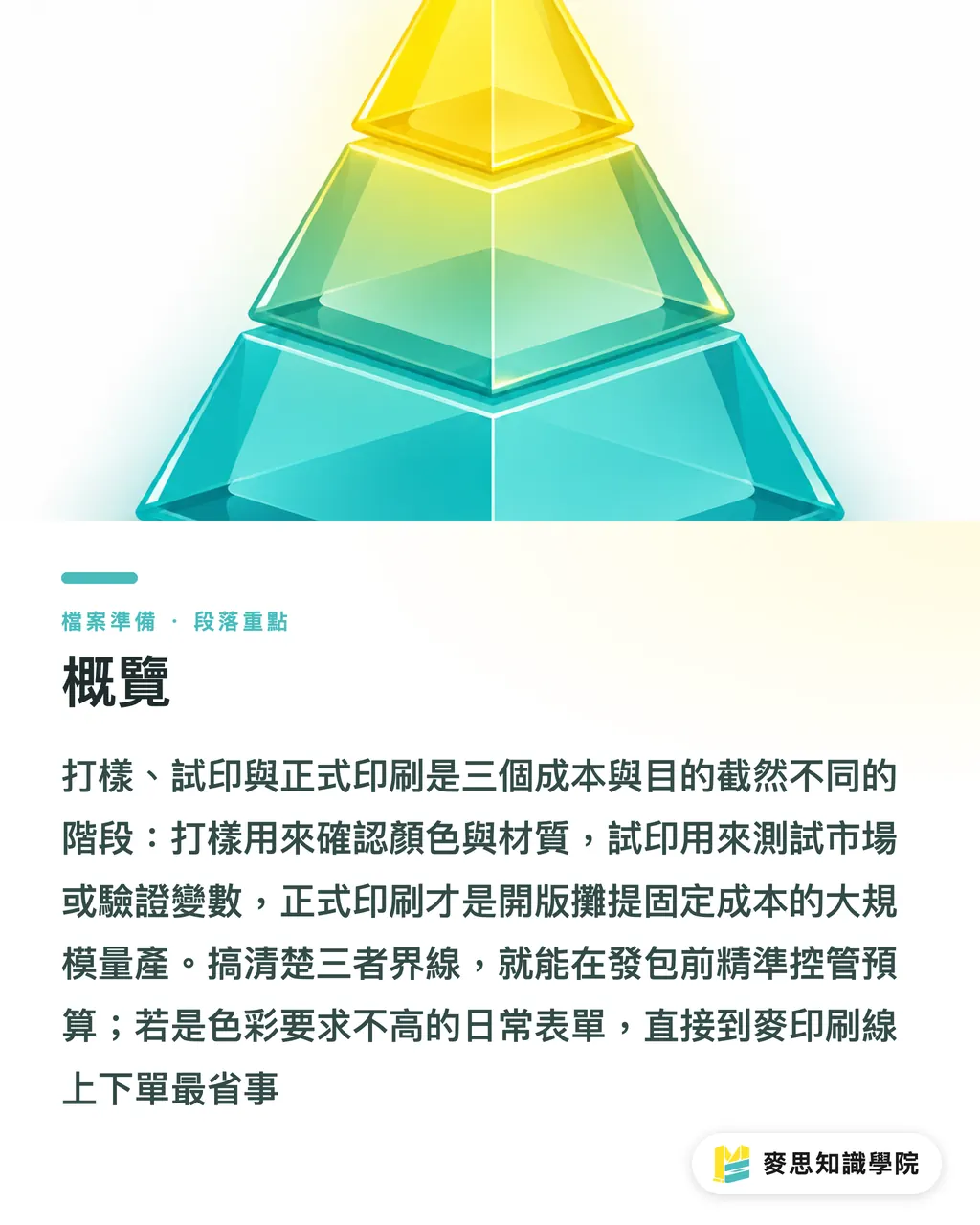
Overview
Proofing means producing a single sample or tiny batch at minimal cost before mass production to verify that colors, materials, and structure match expectations
Short-run test printing involves producing a small physical batch of the final product, mainly used for market testing, A/B testing, or validating variable data
Mass production is large-scale printing after approval, using plates or bulk reproduction to amortize fixed costs and drive down unit prices
Understanding the boundaries between these three allows you to apply my signature 'MINDS (MS, mid-to-high-end custom commercial printing) 3-Gate Submission' framework to strictly control your budget before placing orders
For routine jobs with no strict color requirements, like daily administrative forms, ordering directly online at MINDS Print is the most efficient choice
Why Screen Approvals Still Fail
Screens emit light while paper reflects it. Because their physical properties are entirely different, a PDF can never show 100% how your design will look on paper
Even with convenient cloud AI markup tools catching missing typos or shifted layers, they can't tell you how much detail the paper texture will swallow
Over the years, I often tell designers one key concept: online proofing checks content and layout, while physical proofing tests physical and chemical reactions
When your design involves spot colors, heavy ink coverage, or uncoated paper, nodding along on screen is never enough
What Are You Actually Inspecting in a Proof?
Many people think proofing is only for checking color. That's only half true
In sustainable packaging projects, proofing actually checks whether folded boxes tear during mass assembly, or whether eco-friendly inks rub off on kraft paper
And the most fatal risk: whether store scanners can actually read printed barcodes
This is Gate 1 of the MINDS 3-Gate Submission: catch fatal structural and finishing errors using digital proofs or unprinted prototypes. Spending a few thousand on a proof buys insurance against tens of thousands in scrapped production
When to Choose Short-Run Test Prints
Proofing confirms whether it prints right; short-run testing confirms whether it sells
When launching a new product, printing 10,000 units at once is too risky. You can print 500 first for A/B testing on store shelves
Digital printing has matured in recent years. Projects like this don't require traditional plates or screen setups, making them perfect for testing market traction across three different SKUs
If you have variable data like serial numbers or branch addresses, a short test run is the best way to verify that your database integration matches real printed output
MINDS 3-Gate Submission: Calculating Real ROI
When buyers hesitate to pay for proofing, use this simple formula: reprint cost multiplied by error probability
If reprinting 10,000 boxes costs $50,000 and there is a 20% chance of error, spending $2,000 on a precise physical proof is a smart investment
Gate 2 evaluates communication costs. Shipping proofs back and forth for a week only to have clients ask for another version is an exhausting, wasteful cycle
For high-end custom projects with strict color standards, bring your files to meet directly with print consultants at MINDS Printing to resolve disputes on the spot
Gate 3 inspects the end-use environment. Whether packaging goes into refrigerated displays or room-temperature shelves, your materials and proofing tests must match real-world conditions

Key Takeaways
・Proofing buys risk insurance; short-run testing buys market data
・Screen markups check content accuracy; physical proofs test physical and chemical reactions
・Sustainable packaging proofs must test structural strength, ink adhesion, and barcode readability
・If reprint cost times error probability exceeds proofing fees, spend the money
Final Thoughts
Bring this decision logic into your design and procurement process instead of blindly guessing every time you outsource
SaaS tools and online proofing systems solve information sync and comparison problems, but physical print products end up in human hands
Digital and physical review processes are not mutually exclusive. They act as gatekeepers at different project stages, offering the shortest path to reducing reprints and customer complaints
FAQ
- Can I go straight to mass production with only a PDF file?
- If your design is simple, lacks special finishes, and you can accept screen color variations, you can go straight to production
- Can cloud-based online proofing completely replace physical samples?
- For text proofreading and layout checks, yes. But when material texture, structural load, or spot color rendering matter, you must inspect a physical proof
- Why is the unit price for short-run test prints so much higher than mass production?
- Because baseline setup and manual calibration involve fixed time costs. Smaller print runs mean those fixed costs are divided across fewer units
Related articles


The Print × AI weekly
The print and AI know-how designers, brands and enterprises can use before they commit — one email, every week
MINDS Free Tools
Spine width and imposition calculators — skip the manual math, free in your browser.
MINDS Group
Need actual printing or gifting services?
From premium printing to online ordering and festive gifts — the MINDS Group sister brands take it from here.