

How far along is this joint venture?
As of September 11, 2026, the joint venture has reached the stage of nominating its leadership team, but the transaction has not been completed. UPM and Sappi have conditionally nominated Gunnar Eberhardt as CEO and Stephen Blyth as CFO
Eberhardt has served as Executive Vice President of UPM Communication Papers since October 2024, while Blyth has served as CFO of Sappi Europe SA since July 2014. The ThePackagingPortal original article points to both sides beginning to arrange the future management structure. It does not mean the new company has already taken over orders
Regulatory approval and closing remain prerequisites. Before closing, the two companies will continue to operate independently, and both nominees will remain in their current roles. The purchasing side can start taking stock now, but it must not describe the planned joint venture as a completed integration

Why would an executive nomination affect print purchasing?
It affects print purchasing because if the graphic paper supply base becomes more concentrated, negotiations over paper sources, substitutes, and lead times need to start earlier. Graphic paper is used for books, catalogs, reports, and commercial print. When selecting it, surface finish, basis weight, brightness, and printability all matter, affecting color, feel, folding, and delivery time
The source frames the joint venture within the structural challenges facing Europe's graphic paper industry and customers' need for supply security. That is more useful than viewing it as just a partnership between two companies. From what I have seen over years on production lines and with clients, the first on-the-ground response to supplier consolidation is often not an immediate change in pricing. It is having to reconfirm whether familiar paper grades are still available
If a printer only asks how much each ream costs today and waits until a specified paper is short before looking for a substitute, both design and purchasing will be forced to start over
How should designers prepare for specified paper?
The most important thing for designers to do now is upgrade paper from a layout note to a production condition that can be checked. I use Mai Strategy's three-gate print-submission process to handle paper requirements, substitute approval, and finished-product verification. A four-line pre-delivery self-check could look like this:
・1. Fill in the paper fields completely, including the paper mill or brand, paper type, finish, basis weight, and finished size. Do not write only "same as last time."
・2. Write an acceptable substitute beside the specified paper. If a substitute is used, reconfirm color, show-through, stiffness, fold lines, and binding results
・3. After revisions, recheck linked images, the black plate, bleeds, transparency, and PDF export. A paper change is not a reason to assume the file is unchanged
・4. After proof approval, place the approved paper, version, and notes in the same production record (job record). Do not leave the decision only in a chat window
What should small and midsize printers do first?
Small and midsize printers and brand clients should start with a paper inventory and backup list now. There is no need to wait until the transaction is complete. The September 11, 2026 announcement still lists regulatory approval and closing as conditions. The most practical move is to identify specified papers that are likely to cause bottlenecks
・Printers should divide commonly used graphic papers into three categories: specified, replaceable, and confirm-before-accepting-the-job. Record the source, the most recent confirmation date, and the person who approved the substitute
・Brand purchasing teams should state acceptable substitute papers and reproofing conditions in the production brief (a project specification summary). Do not wait until the design is finished to ask about paper for the first time
・Design teams should put paper requirements for catalogs, booklets, and long-form DM into the brief. Do not just write "same as last time."
Whenever specified paper, proofs, and lead times need to be confirmed together, contact MINDS to align the specification sheet with prepress checks. Confirming deliverability upfront saves more rework than asking about paper availability after the artwork is finished
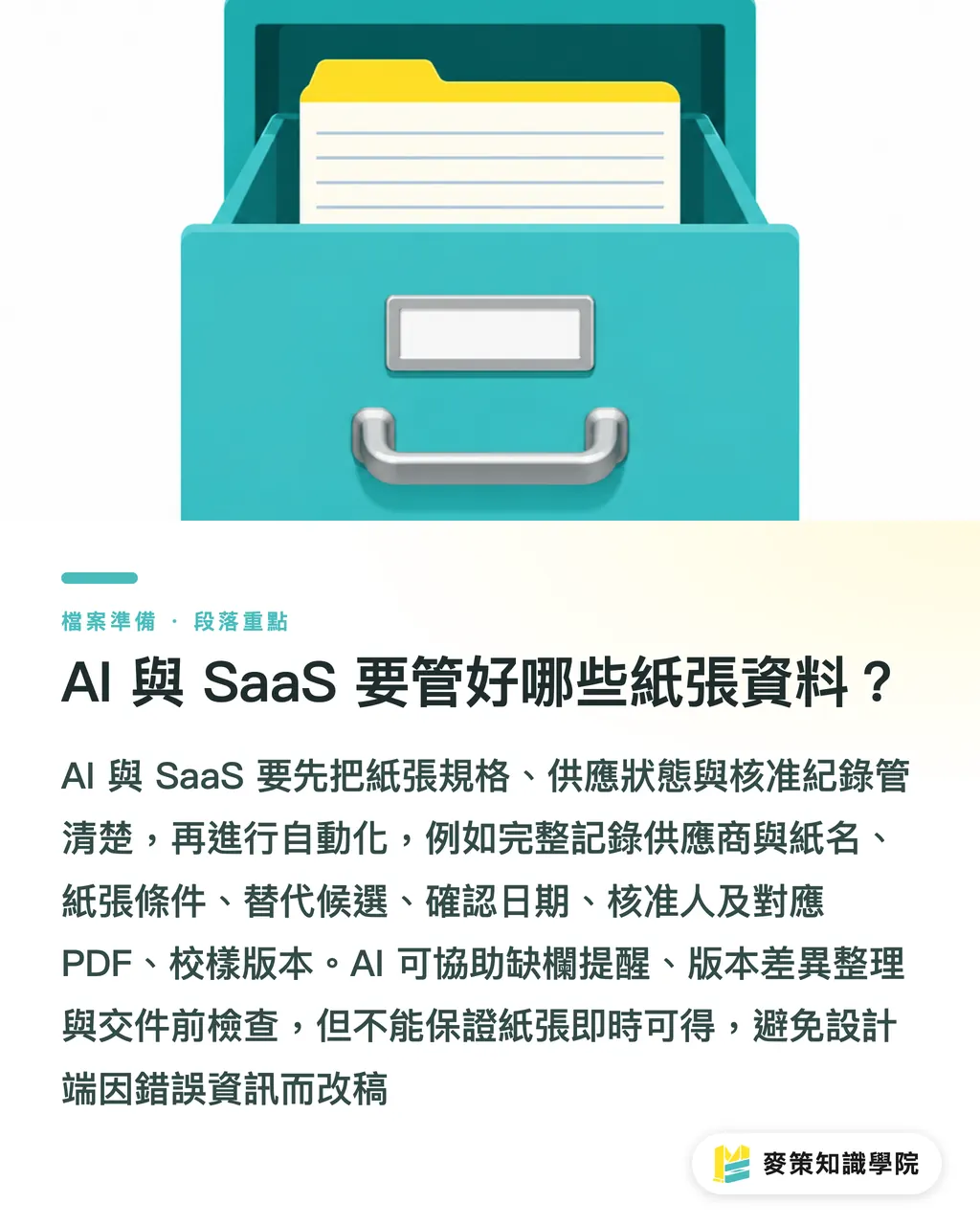
What paper data should AI and SaaS manage?
To support this change, AI and SaaS should manage paper specifications, status, and approval records before adding automation. At a minimum, the system should record the supplier and paper name, paper requirements, the original specified paper or substitute candidates, the last confirmation date, the approver, and the corresponding PDF and proof versions
The UPM and Sappi example also shows why data fields need a status. The transaction is still awaiting regulatory approval, and the two sides will operate independently before closing. SaaS therefore must not label a planned joint venture as a completed integration
AI is well suited to flagging missing fields, organizing version differences, and checking work before delivery. It is not suited to guaranteeing that a particular sheet will definitely be available to a printer today. Once this boundary is clear, the design team will not be pushed into revisions by incorrect availability information
Key takeaways
・The joint venture is still awaiting approval, but purchasing preparations should already be underway
・The more complete the paper specifications, the less likely a substitute paper is to reveal a problem only at proofing
・Designers should tie the paper, files, and approved version to the same production record
・AI and SaaS should manage statuses and evidence first. Do not write a conditional transaction as an accomplished fact
Further thoughts
I recommend that the team create a paper contingency sheet this week, starting with catalogs, booklets, and long-form DM pieces already on the schedule. Designers can fill in the specifications and substitute conditions, purchasing can mark the confirmation date, printers can write the proof results back into the record, and AI can start with missing-item alerts and version comparisons before SaaS connects the approval workflow. Even before the paper-mill integration is complete, this approach can reduce rework caused by discovering only after revisions that the paper is unavailable
Further reading
FAQ
- Has UPM and Sappi's graphic paper joint venture been completed?
- No. As of September 11, 2026, the two sides have only conditionally nominated a CEO and CFO. The transaction still awaits regulatory approval and closing, and they will operate independently before closing
- What does this have to do with designers?
- Specified paper may need an earlier substitute plan. Designers should put the paper type, finish, basis weight, size, color requirements, and substitute approval conditions into the production brief
- Should printers switch suppliers right away?
- No. The news alone is not a reason to switch immediately, but printers should inventory commonly used graphic papers, backup papers, and lead times, and clarify in advance which substitutes the brand client will accept
- How can AI or SaaS help?
- Start by managing specification fields, status, confirmation dates, approvers, and file versions. Then use AI for missing-item alerts and difference summaries. Do not treat a planned joint venture as a completed supply consolidation
Related articles




The Print × AI weekly
The print and AI know-how designers, brands and enterprises can use before they commit — one email, every week
MINDS Free Tools
Spine width and imposition calculators — skip the manual math, free in your browser.
MINDS Group
Need actual printing or gifting services?
From premium printing to online ordering and festive gifts — the MINDS Group sister brands take it from here.