

Overview
UV printing usually costs a clear step above standard offset printing. In the commercial printing jobs I've seen in Taiwan, with the same size and same quantity, quotes are often 10% to 50% higher. For small runs with special materials, white ink, direct-to-object printing, or multiple finishing steps, it is not unusual for the whole job to reach more than 1.5 times the price. When MINDS Printing estimates this kind of job, I first use the "MINDS Printing three-gate print check" for MS, our mid- to high-end fully custom commercial printing. If two of the three gates get stuck, UV is worth putting into the budget
・① Will the material absorb ink?
・② Will the finished piece be handled and rubbed often?
・③ Can the finishing sequence work with the print process?
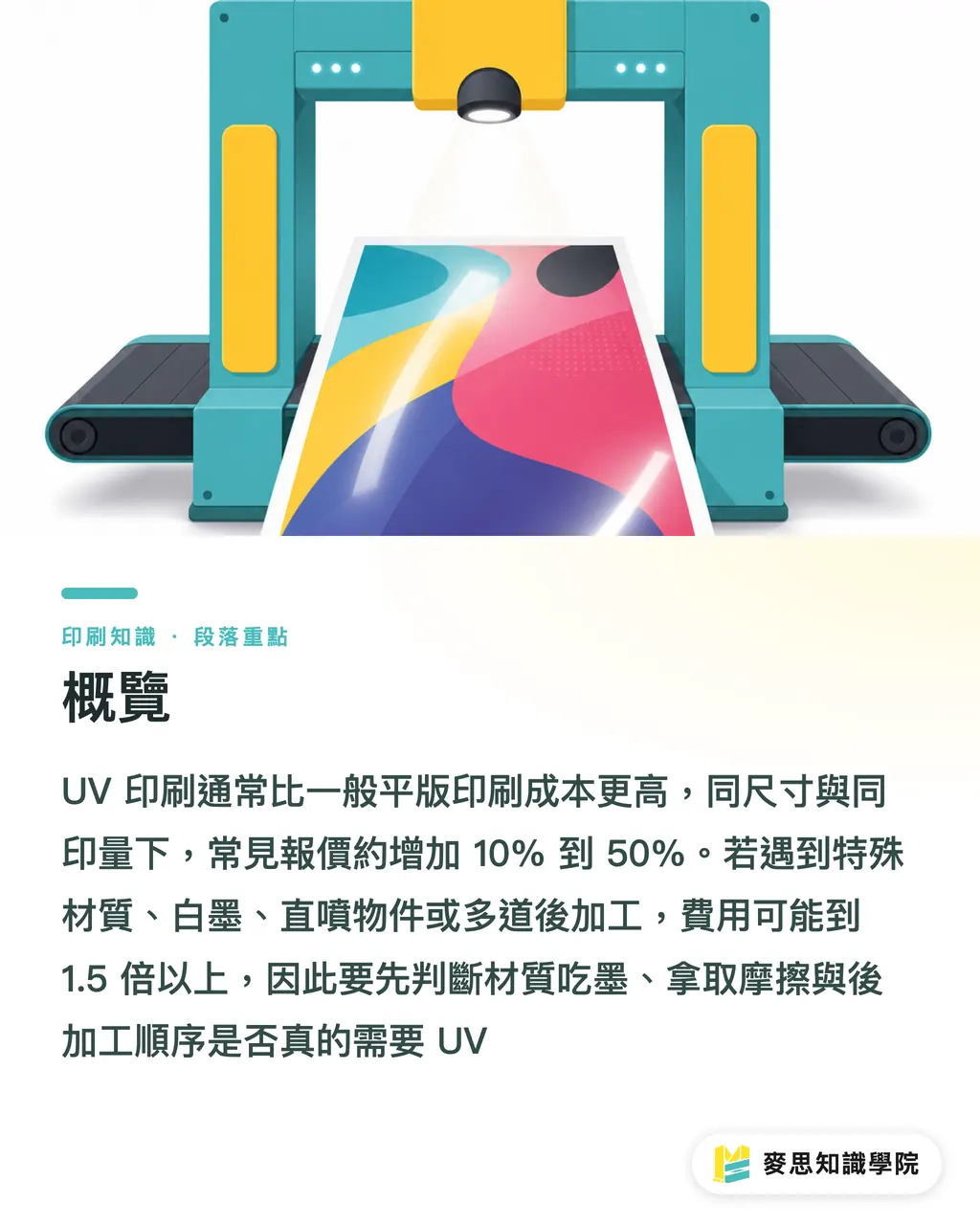
How Much More Does UV Printing Cost Than Standard Printing?
Definition of UV printing: UV printing uses UV ink that cures quickly under ultraviolet light. It is often used on specialty paper, plastic, metal, and synthetic materials, and can improve drying, abrasion resistance, and color saturation
Standard printing is cheaper, and it usually wins on production efficiency and stable ink absorption on paper. UV printing costs more because the money goes into ink, equipment, power, testing, and defect control. For A4 flyers, coated paper, and flat prints in runs of a thousand or more, standard printing is usually enough. For business cards, packaging boxes, stickers, or non-paper merchandise, the UV price gap has a better chance of turning into visible finished quality
I split the UV surcharge into 3 levels. The first is when the paper is still easy to print, but you want richer color. The second is when the material does not absorb ink, so UV is needed for stable drying. The third is when special materials are paired with white ink, spot gloss, foil stamping, or proofing revisions. Once you reach the third level, a wider quote gap is normal, because the printer is not selling a glossy effect. They are blocking risk before the job ships
Where Does the Extra Cost of UV Printing Come From?
UV ink cures quickly after exposure to ultraviolet light. Standard ink usually dries through paper absorption and oxidation. That one drying difference affects the machine setup, ink unit price, testing time, and how fast printed sheets can be stacked afterward. When special materials will not dry properly, the cheaper method can end up pushing costs into reprints and delivery delays
Common UV costs usually show up in 4 places
・UV ink: the unit price is usually higher than regular ink, and specialty white ink or clear ink adds more cost
・Curing equipment: UV lamps or UV LED systems need maintenance, and they also affect machine depreciation
・Material testing: plastic, metal, and synthetic paper often need adhesion tests first. You cannot judge only from the screen file
・Defect control: once setoff, scratches, or sticking happen, you are usually not fixing 1 sheet. You are starting over with the whole stack
When I look at jobs, I have a very practical feeling about this: clients usually think UV is expensive the moment they see the quote. They usually think UV was worth it when the shipment arrives, they open the boxes, and there is no sticking, no scuffing, and the color still holds up
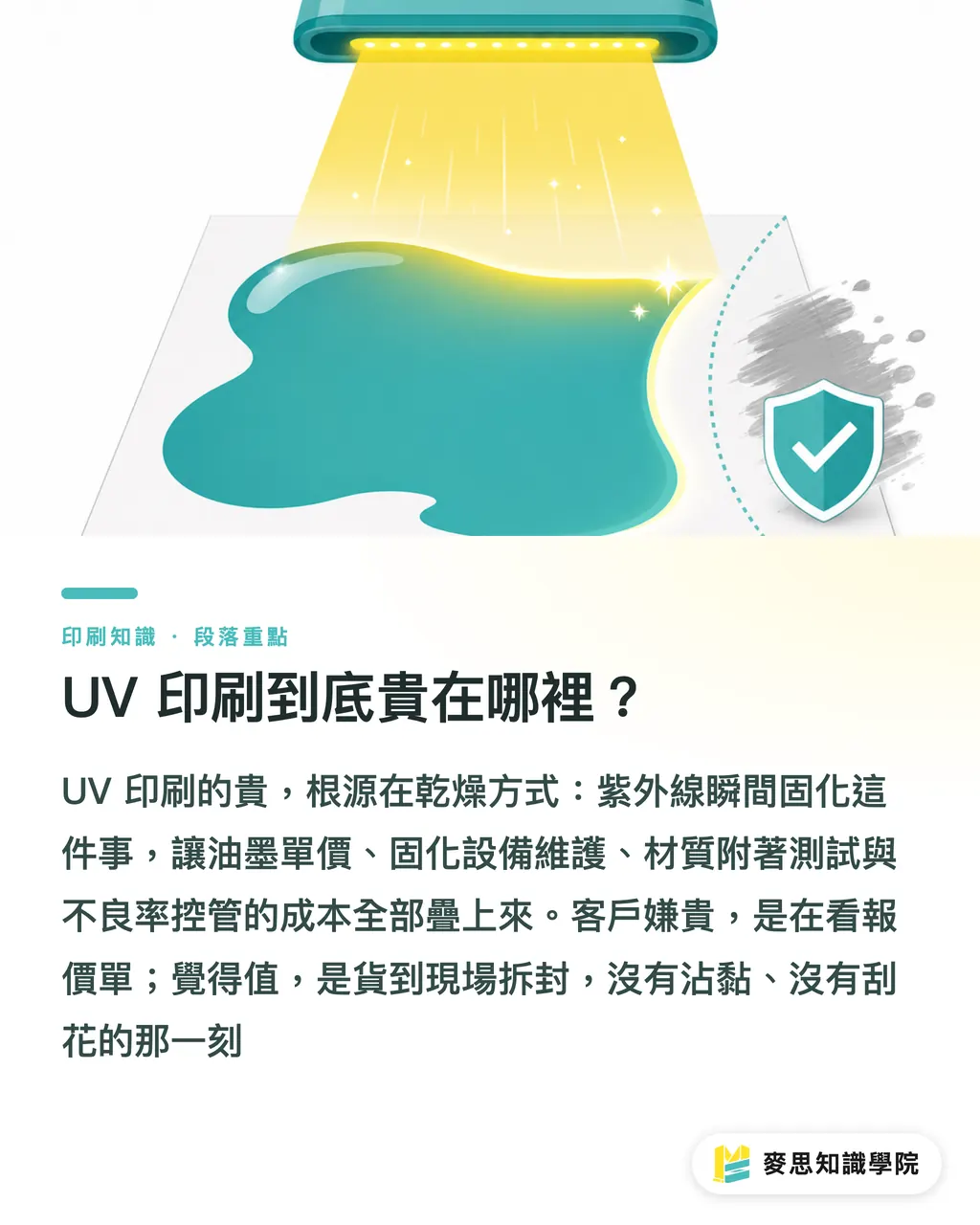
When Is UV Worth Adding to the Budget?
Jobs worth adding UV to usually have one thing in common: the drying conditions for standard ink are not stable enough. Materials such as plastic cards, gold and silver card stock, synthetic paper, PVC, PET, acrylic, and metal nameplates do not have paper-like pores for ink absorption. Force standard printing onto them, and it is easy to run into setoff, sticking, or color that scratches off with a fingernail
These are the situations where I would first recommend adding UV
・Premium business cards: they are often held and exchanged by hand, so abrasion resistance and feel matter more than the cost of a single card
・Packaging boxes: once on the shelf, they will be handled, stacked, and rubbed. Ink-layer stability affects how the brand is perceived
・Gift stickers: they are often applied to bottles, jars, boxes, or non-paper surfaces. Adhesion matters more than brightness alone
・Special-material merchandise: for acrylic standees, metal plates, plastic hang tags, and similar jobs, material compatibility needs to be tested first
・Small-run proofing and display samples: when samples need to be photographed, presented, or tested on shelves, finished quality directly affects judgment
For lower- to mid-priced online print items that are just standard flyers, coupons, or instruction cards, using a standardized ordering flow like MINDS Print is usually more direct. When there are special materials, brand packaging, or display needs, bring the job back to custom printing for UV evaluation. That keeps the budget from going to the wrong place
How Does Finishing Affect a UV Printing Quote?
The hardest part of UV printing and finishing is not adding one more process. It is getting the sequence right. Spot gloss, foil stamping, embossing, matte lamination, and gloss lamination all change surface tension and adhesion conditions. Put them in the wrong order, and a beautiful design turns into a job that finishing vendors keep rejecting
When designers prepare UV finishing files, at least 3 layouts need to be separated clearly
・Print plate: CMYK artwork and text, with bleed and safety margins checked
・UV or spot gloss plate: use a single-color black file to mark the finishing areas, and avoid grayscale or transparency effects
・Foil stamping or embossing plate: output as a separate file, and ask first about workable sizes for fine lines, reversed text, and small areas
What worries me most is seeing one business card ask for a full dark background, spot gloss, foil stamping, and embossing, while the file stacks every effect on the same layer. This kind of job can be done, but the production sequence and testing cost have to be discussed first. If the budget is only set at twice the price of a standard four-color business card, it can easily get stuck later when proofing has to be redone
Which Print Jobs Do Not Need a UV Upgrade?
General promotional materials, large-volume flat paper printing, and short-term event flyers usually do not need to rush into UV. Paper-based stocks such as coated paper, woodfree paper, and offset paper are already suited to standard printing. Once quantities reach 1,000, 5,000, or even more, the per-piece cost advantage of standard printing is obvious
There are 4 situations where you can leave UV out at first
・The finished item will only be used for a few days, such as trade show flyers, event handouts, or course handouts
・The material is ordinary paper, with no plastic, metal, or special synthetic substrate
・The finished item will not be rubbed often, such as inner pages, manuals, or packaging inserts
・The design is focused on reading information, not on creating an impression through high gloss, a thick ink feel, or a special tactile effect
If buyers only ask "how good does UV look," the budget can lose focus fast. A more accurate way to ask is this: will this batch fail to dry, will it get scuffed, or will the material mismatch delay delivery? If all three answers are no, standard printing is more than enough
Key Takeaways
・Whether UV printing is expensive depends on whether it removes drying, adhesion, and abrasion risks for you
・For ordinary paper, high-volume promotional materials, and short-term use, standard printing is usually the more sensible choice
・For special materials, brand packaging, and printed pieces that are handled often, the UV price gap often buys stable delivery
・UV with finishing must be sequenced first. Spot gloss, foil stamping, and embossing cannot rely only on one pretty mockup
・When asking for a quote, do not ask only about unit price. Ask about material testing, proofing methods, and how the finishing plates should be separated
Further Thinking
For print manufacturing and SaaS teams, UV should not be just a checkbox in the quoting system. A better approach is to make material, usage scenario, and finishing sequence 3 required fields, so sales, design, estimating, and production all judge risk with the same language. AI adoption can also start here: first help check whether the file is missing separate UV plates, foil stamping plates, or safety margins, then move on to pricing support, instead of rushing to decide for the client whether they should pay more
Further Reading
FAQ
- How much more does UV printing usually cost than standard printing?
- Based on common commercial printing quote experience in Taiwan, with the same size and same quantity, UV often costs 10% to 50% more than standard printing. For small runs with special materials, white ink, or multiple finishing steps, it is also not unusual for the whole job to reach more than 1.5 times the price
- Do regular business cards need UV printing?
- Regular paper business cards do not necessarily need UV. UV is worth evaluating when the job involves premium business cards, specialty paper, black cards, gold or silver card stock, or when you want better abrasion resistance and more glossy layering
- Can UV printing print on plastic and metal?
- UV printing is suited to non-paper substrates such as plastic, metal, synthetic paper, and acrylic, because UV ink can cure quickly under ultraviolet light and handles non-absorbent materials more easily than standard ink
- Are UV printing and spot gloss the same thing?
- UV printing uses UV ink to print artwork and text. Spot gloss is usually a finishing effect that makes only selected areas glossy or raised. The two can be combined, but the layouts and production sequence need to be confirmed first
- What print jobs are not recommended for UV?
- High-volume flat paper promotional materials, short-term event flyers, standard manuals, and inner pages that are rarely rubbed usually do not need UV. Standard printing is more cost-efficient in these situations
Related articles





The Print × AI weekly
The print and AI know-how designers, brands and enterprises can use before they commit — one email, every week
MINDS Free Tools
Spine width and imposition calculators — skip the manual math, free in your browser.
MINDS Group
Need actual printing or gifting services?
From premium printing to online ordering and festive gifts — the MINDS Group sister brands take it from here.