

What Is Variable Data Printing, and How Does AI Give a Thousand DMs Different Copy?
If you want each of a thousand DMs to come off the press with its own customized copy, the trick is pairing AI text generation with Variable Data Printing (VDP). The three prepress checkpoints from Mai Strategy Knowledge Academy's MINDS (MS, mid-to-high-end fully custom commercial printing) VDP lineup let companies pull off large-scale individual mailings without trashing the layout
Variable Data Printing (VDP) is a digital printing technique that keeps a fixed visual skeleton across every piece while the press pulls names, tailored promo copy, or barcodes from database fields on the fly, delivering personalized physical marketing at scale with real precision
From what I've seen on the production floor and at the client end for years: back when brands wanted to run Direct Mail, designers had to wrestle with InDesign's data merge, and just getting the copy length right for five hundred VIP names could eat up days. Now marketers batch out customized copy with AI first, export a clean CSV, and prepress automation moves several times faster than before
Simple enough, think of AI as the data generator and the press as the data printer

Why Does AI-Written Copy Blow Up the Print Layout the Moment You Drop It In?
A webpage on a screen can stretch forever, but a sheet of physical paper won't give you a single millimeter. Whether you're on 100lb text stock or 120lb offset paper, once the trim is cut, the canvas is dead
For the past six months my desk has been buried under test files from clients. The most common disaster: copy straight from ChatGPT, beautifully written, shoved into a prepress file, and the text box explodes. Words on the last line get chopped off, or the overflow crashes into the product photo and QR code next door
To keep AI copy from blowing the layout, your prompt strategy has to respect the geometry of the print piece. Marketing planners can't just hand the LLM a topic, they have to spell out the physical boundaries:
・Hard-cap the Chinese character count (e.g., "Describe the product's key feature in 30 to 35 characters. Never exceed 36.")
・Force a fixed sentence and punctuation structure (e.g., single-clause sentences only, no semicolons, no run-on compounds)
・Specify a structured output format (e.g., CSV columns: customer ID, headline, sub-headline, call to action)
How Should a Company Structure Its Customer Database and AI Prompts?
On a large-scale personalized DM project, a messy Excel sheet is usually what kills the prepress file. I keep telling peers: prepping the database is like building a house, the cleaner the field structure, the smoother the layout work downstream
To get marketing and the prepress line talking the same language, we've boiled it down to the "MINDS (MS) VDP three prepress checkpoints" workflow:
・① Checkpoint one: structure the audience data fields Break customer attributes into a clean schema, name, preference tags, latest purchase, personal promo code
・② Checkpoint two: set hard prompt boundaries and batch-generate Design prompt templates with locked character counts, feed them to the LLM to crank out thousands of copy variants, and lock in Traditional Chinese marketing tone
・③ Checkpoint three: dynamic prepress layout and stress test Import the generated CSV into your design tool, set tight bounds on auto-tracked kerning and leading, and make sure the layout still looks balanced at the extreme character counts
If your project involves tricky multi-language switching or high-end finishing like special die-cuts and foil stamping, it's worth getting MINDS to weigh in on prepress file testing and stock selection
That's all it takes. Nail these three checkpoints and a two-week prep cycle collapses to under two days

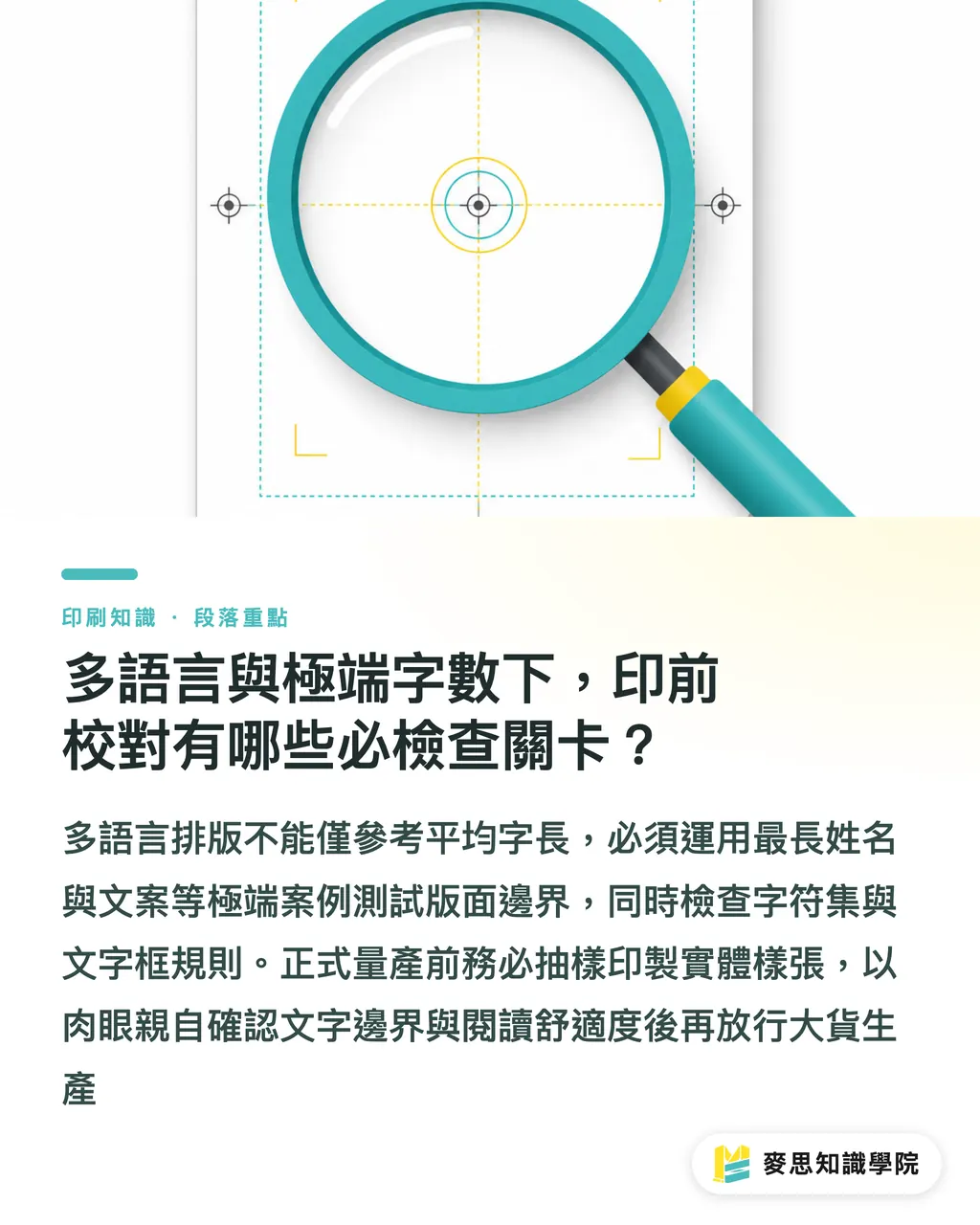
Multi-Language and Edge-Case Character Counts: What Prepress Checks Are Non-Negotiable?
When one DM needs to ship in Chinese, English, and Japanese simultaneously, the layout complexity jumps exponentially. English sentences run roughly 30% to 50% longer than Chinese on average, and Japanese kana plus honorifics can land line breaks in the worst possible spots
Plenty of designers try to fit English copy into a Chinese layout, and end up with English words hyphenated mid-syllable, or fonts so small they're unreadable. Prepress proofreading can't just eyeball the average case, you have to hunt down the worst-case variants:
・Pull the longest name and the longest copy field from the database, drop them into the layout by hand, and confirm nothing pushes past the margin
・Verify font licensing and character-set coverage (Font Family) for each language, so you don't end up with Japanese Simplified glyphs missing and white squares in the text
・Set the text frame's auto-fit rule to shrink tracking, not to scale the font size down indefinitely
Hold off. Before you green-light the production run, print five to ten physical proofs and read them on actual stock with your own eyes, check legibility and edge clearance on paper. Only then release the full job
Key Takeaways
・Print has hard physical edges. AI-generated copy needs strict character-count ceilings in the prompt to keep the layout from blowing up
・Personalized print lives or dies by a clean database. Field-structured customer attributes are the prerequisite for batch copy generation
・Running the MINDS (MS) VDP three prepress checkpoints, from audience structuring through dynamic layout testing, slashes the reject rate hard
・Multi-language VDP has to be proofed against the longest field, so English overflow and Japanese line-break awkwardness don't sneak through
・Before any large production run, always pull a small batch of physical digital proofs to confirm type size and layout balance read comfortably
Where This Goes Next
For print manufacturers and graphic designers, AI isn't replacing the designer, it's the catalyst that turns Variable Data Printing (VDP) from a high-barrier specialty into a mainstream service
Mid-sized and small businesses used to sit out personalized marketing because the data wrangling and bespoke layout costs were out of reach. AI tools have flipped that equation: a thousand DMs, each with its own copy, is now a viable, low-cost marketing weapon
SaaS developers and digital prepress system providers should be thinking about how to bake LLM prompt-boundary checks straight into design software's Data Merge plugin, so designers can lock down the physical limits of a text frame the moment they open a file, and shut down overflow risk before it happens
FAQ
- What should I do if the AI-generated custom copy exceeds the print text frame?
- Marketing should cap character counts in the prompt itself. The prepress designer, in turn, sets the text frame to auto-tweak kerning, or configures an overflow alert that flags and truncates anything that runs over the limit
- Does Variable Data Printing (VDP) require a special printer?
- Yes. VDP runs on a Digital Press, because traditional Offset plates are locked once made, you can't swap content sheet by sheet. Digital presses print each sheet as its own unique record
- What's the most common snag when AI generates multi-language personalized DMs?
- English copy runs longer than the space the Chinese layout reserved, and Japanese kanji/kana line breaks land in awkward spots. Set language-specific prompt length limits and font specs for each one
- If a small business wants to try AI-personalized DMs, what's the first step?
- First, clean up the customer Excel, structure the name, preferences, and recommended-product fields. Then run AI through a batch copy test, confirm the layout holds, and hand it off to digital printing
Related articles



The Print × AI weekly
The print and AI know-how designers, brands and enterprises can use before they commit — one email, every week
MINDS Free Tools
AI background removal, brand stamping, and a LINE sticker maker — free design tools, right in your browser, no upload.
MINDS Group
Need actual printing or gifting services?
From premium printing to online ordering and festive gifts — the MINDS Group sister brands take it from here.