

Overview
The real question for an AI print factory is not "which AI should we use" but "do our job tickets, presses, prepress, and ERP all speak the same language." That's the first thing the Mai Strategy Knowledge Academy advisory team checks on-site: whether this data layer can be read by systems, traced by people, and used by the workflow to make decisions
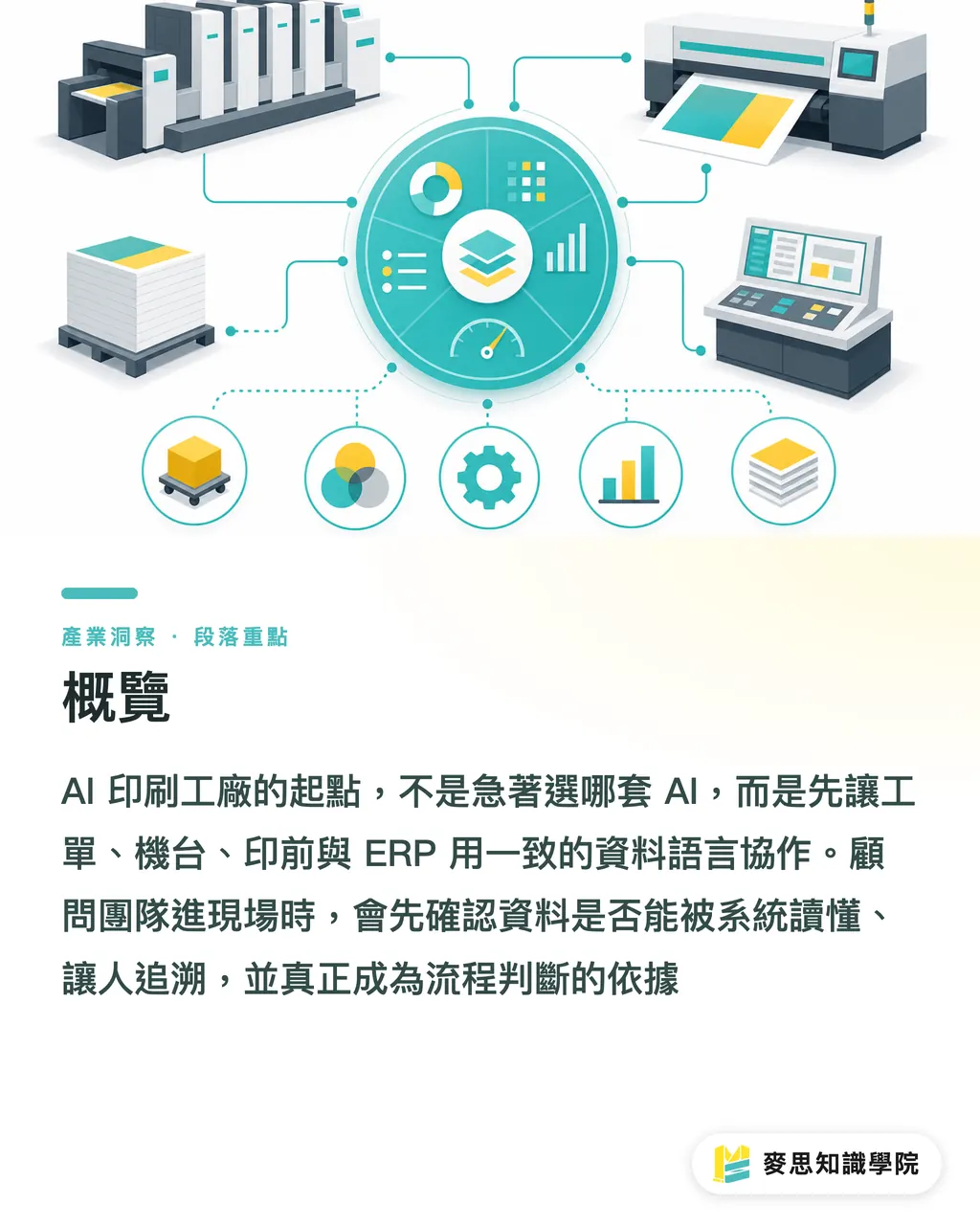
Why the first step of an AI print factory is not AI?
On July 16, 2026, Durst announced a majority stake in Triple C Labs GmbH, the company behind CoCoCo Platform. On the surface it looks like a software investment; I'd say it's closer to a press maker admitting a reality: no matter how fast a single machine runs, if the line doesn't know the job's status, efficiency still stalls at the handoff
The point of CoCoCo Platform is to connect presses, prepress, and shop-floor software via JDF/JMF. Durst folds it into the Kyveris industrial software and AI stack, and one line in the official statement is spot on: there has always been a gap between what the machine does and how much the shop floor knows about it
What JDF/JMF actually is: JDF is a format for print job and process data; JMF is a messaging format for machines and systems to report status. Together they let prepress, the press, and MIS/ERP exchange job, progress, and resource status
I've seen this pattern too many times in Taiwan's small and mid-size print shops: sales quotes use one set of fields, prepress breaking down the job uses another vocabulary, and the floor schedules by a group chat message that just says "squeeze this one in first." When the delivery date blows up, everyone starts scrolling back through the chat history
AI isn't afraid of too much data, it's afraid of data without a shared definition. If every system reads Job, Product, and Resource differently, the prettiest dashboard just paints the chaos more clearly
How do the press, prepress, and ERP speak the same language?
The CoCoCo Platform that Durst has its eye on has one critical design choice: a typed, event-driven data model that uses standardized entities to define Job, Product, and Resource. That's not tech jargon piled up, it's the "shared vocabulary" the print floor has been missing most
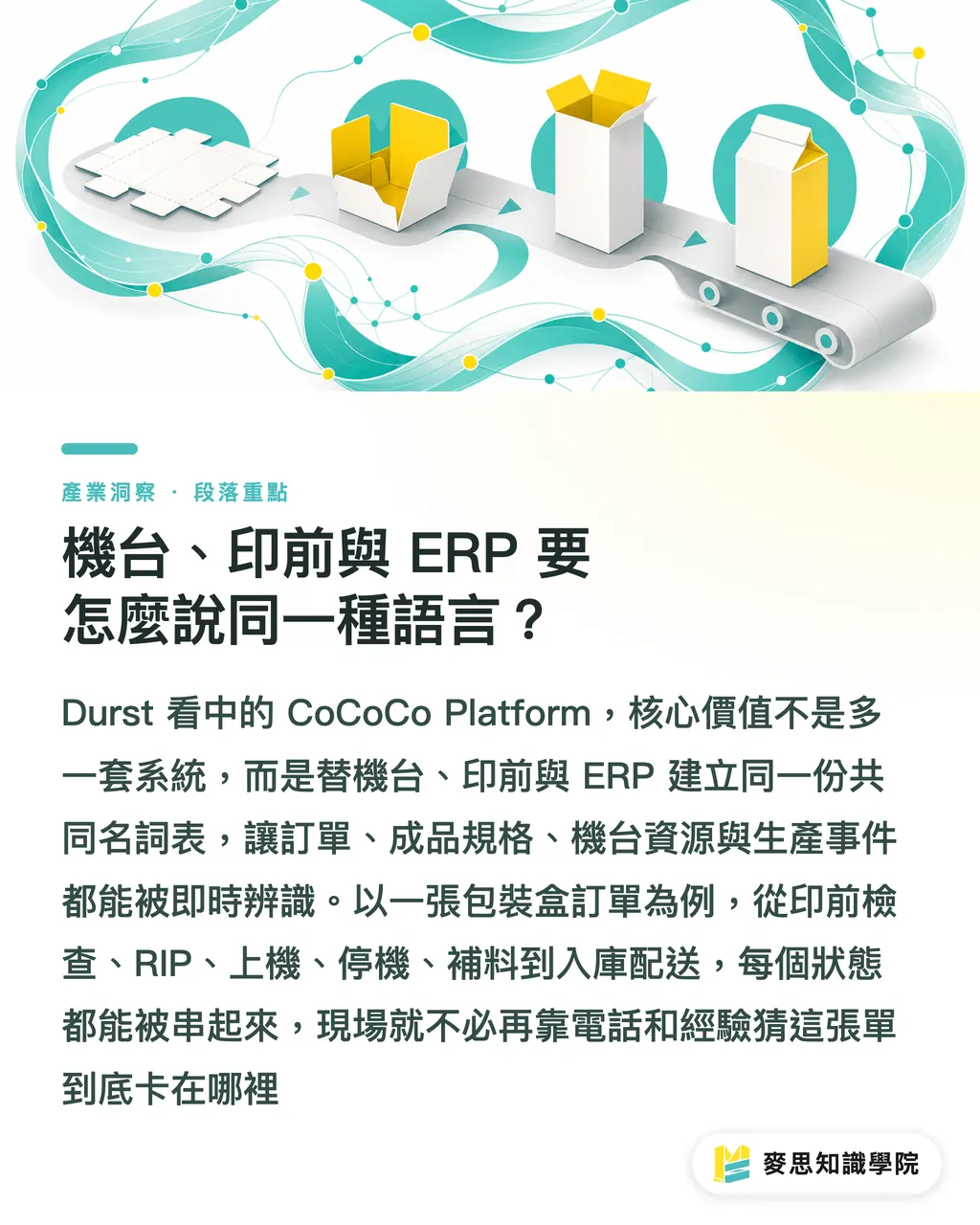
Take a packaging box order: what actually needs to be linked isn't a single PDF, but a chain of changing states
・Job: the order's customer, delivery date, quantity, version, proof status, and production priority
・Product: finished specs, paper stock, die-cut, color count, coating, foil stamping, gluing, and finishing needs
・Resource: presses, plates, ink, paper, dies, people, and available time slots
・Event: prepress check complete, RIP done, on press, stopped, restocking, reprinting, warehousing, shipping
CoCoCo's value is letting the press, prepress, and shop-floor software recognize this data in real time. Durst calls it a JDF/JMF-based data fabric. In shop-floor language: nobody has to guess where the same job is stuck
This also connects to the Cumberland Packaging case choosing Amtech Encore ERP, the materials say the goal is end-to-end visibility across production, inventory, and shipping. This isn't a problem only the big players run into. Taiwan's small and mid-size shops hit the same wall with paper stock, outsourced finishing, and rush deliveries; they used to just muscle through with favors and phone calls
What does this mean for Taiwan's small and mid-size print shops?
The common pain for Taiwan's small and mid-size print shops isn't a lack of equipment, it's that data doesn't get where it needs to go. Quotes sit on the sales rep's PC, prepress notes sit in LINE, color settings sit in the RIP, inventory sits in ERP, and the real machine status sits in the shift lead's head. All the owner ends up seeing is "we slipped two jobs again today."
Durst stresses that CoCoCo Platform will keep its independent brand, existing team, and customer commitments, and stay open to third-party OEMs, software vendors, and print production customers. That matters for the industry because a print shop rarely runs on a single brand, a real factory usually has three presses from different eras, two software stacks, and a handful of outside finishing partners all running at once
Taiwanese shops shouldn't copy Durst's architecture; they should start with five inventory checks
・Job fields: do quoting, prepress, scheduling, and shipping use the same order number and item definitions?
・Press status: can going on press, stopping, plate change, waiting for material, and completion be logged by the system instead of just a verbal shift handoff?
・Color data: can ICC profiles, spot colors, customer standards, and historical proof records be looked up later?
・Inventory data: are paper, plates, consumables, and outsourced finishing progress tied to the order?
・Delivery data: does the delivery date in ERP reflect prepress holds, restocks, reprints, and finishing queues?
When the Mai Strategy Knowledge Academy advisory team guides AI or SaaS adoption, it usually starts with a quick check using the "MINDS (MS) Three Print Gates": ① consistent job fields, ② traceable prepress checks, ③ reportable press and inventory status. If those three gates don't pass, layering AI scheduling on top mostly just wraps old hands-on experience in a new UI
How should designers and brand clients respond?
For designers and brand clients, this isn't the factory's internal IT problem. Once a shop starts getting prepress, ERP, and presses to share one data language, the file handoff from the design side gets new requirements: file names, versions, die-cuts, color, bleed, substrates, and finishing all shift from "humans can read it" to "systems can read it too."
One very real change: the design file is no longer just a visual, it becomes the entry point for production data. If a brand client has 12 SKUs in the same line, with similar packaging sizes but different languages, barcodes, and ingredient labels, manual one-by-one checks used to be the norm and missing a version was the worst-case scenario. With clear data structures, prepress checklists, version comparison, and duplicate-error alerts can finally be automated reliably
Designers can take four steps first
・Standardize file names: put the client, item, size, version, and date into a fixed naming rule
・Turn specs into data: write substrate, color count, finishing, and die number into copyable fields, not just inside email bodies
・Make versions traceable: every revision keeps its version number, change reason, and approval time
・Fix the prepress checklist: bleed, fonts, image resolution, spot colors, black-plate settings, and barcode position all need a check record
For brands with mid- to high-end fully custom commercial print needs, a supplier like MINDS (MS) — one that can turn prepress communication, spec confirmation, and production feedback into an actual process, belongs on the procurement shortlist more than a pure price comparison. Price still matters, but the cost of misprints, reprints, and late deliveries usually stings more than a few percentage points on the quote
What can small and mid-size shops do before bringing in AI?
I'd tell small and mid-size print shops to break AI adoption into checks doable within 90 days, not start with a full-plant auto-scheduling pitch. The Durst and CoCoCo case is big, but the lesson for small shops is plain: AI runs on clean, real-time, well-defined process data
Don't aim for completeness in phase one. Pick one product line, one set of common orders, and one prepress checklist, and get those working. For example, pick one of business cards, catalogs, stickers, or paper boxes, and link the quote fields, prepress check, RIP status, press time, consumables deduction, and shipping status into a single chain. You'll see problems faster than by talking about a smart factory in the abstract
A workable order looks like this:
・Week 1: list the current job fields, delete duplicates, and add delivery date, substrate, finishing, and version fields
・Weeks 2–4: turn the prepress checklist into a fixed form so every job has a pass, return, or revision record
・Weeks 5–8: get the press to report at least four events, on press, stopped, done, exception
・Weeks 9–12: wire ERP's inventory and delivery data back into the job ticket, starting with the items that run out or slip most often
Where AI tends to pay off earliest in a print shop is quote-request extraction, prepress checklists, complaint summaries, proposal material prep, and follow-up reminders. None of those need a fully automated plant to work, but they all need clean fields and steady workflows, otherwise AI is just tidying up a pile of inconsistently worded data

Key takeaways
・An AI print factory fixes the shared data language first, then talks about automated decisions
・The value of JDF/JMF is letting jobs, presses, and systems exchange status using one common set of states
・If ERP only handles the books and doesn't connect to prepress, inventory, presses, and shipping, it can't see real delivery risk
・Design files shift from visual assets to production data entry points, versions, dies, color, and finishing all need to be traceable
・A small shop's first AI step is getting one product type, one workflow, and one checklist running smoothly
Further thinking
For print manufacturing, the next step isn't rushing to buy AI tools, it's pulling job fields, prepress checks, press events, inventory, and shipping status into one shared data language. For designers, files going to print need to be managed like production data, with versions, specs, and approval records. For SaaS teams, the most valuable product isn't a pretty dashboard but a process layer that defines Job, Product, Resource, and Event clearly. If the Mai Strategy Knowledge Academy advisory team is walking a small or mid-size shop through the first round of inventory, I'd start with the order type that gets reprinted most, delayed most, and chased by phone most, that's where the data language breaks down most visibly
Further reading
FAQ
- Should an AI print factory's first step be buying AI software?
- I'd say no. Print shops should first clean up the data across jobs, prepress, presses, ERP, inventory, and delivery dates, so systems can read the same order's status
- What does JDF/JMF do for a print shop?
- JDF describes print job and process data, and JMF handles status messaging between machines and systems. Together they give prepress, the press, and ERP a way to sync job, progress, and resource status
- Can small and mid-size print shops without a big-plant budget still do data integration?
- Yes, start with one product line, like business cards, stickers, catalogs, or paper boxes. Linking quote fields, the prepress checklist, press status, and shipping status is more practical than rolling out a plant-wide system at once
- Why should designers care about ERP and press data?
- Once a design file enters the print workflow, the file name, version, die, color, and finishing all affect quoting, prepress checks, and production scheduling. The clearer the design-side data, the fewer rejections, misprints, and reprints the shop has to deal with
- What does Durst's investment in CoCoCo Platform signal to Taiwan's print industry?
- On July 16, 2026, Durst took a majority stake in Triple C Labs and strengthened the link between Kyveris and CoCoCo. It tells Taiwan's print industry that the foundation for AI is open, real-time, standardized production data
Related articles


The Print × AI weekly
The print and AI know-how designers, brands and enterprises can use before they commit — one email, every week
MINDS Free Tools
AI background removal, brand stamping, and a LINE sticker maker — free design tools, right in your browser, no upload.
MINDS Group
Need actual printing or gifting services?
From premium printing to online ordering and festive gifts — the MINDS Group sister brands take it from here.