

Overview
BOBST revealed in BOBST & Colorman Smart Connected Packaging Collaboration that Colorman in Ireland has integrated multiple BOBST post-press machines into its folding carton quality workflow. Looking through the 'MINDS 3 Checkpoints for Connected Production Lines', Taiwanese print shops evaluating new equipment must treat data connectivity as a core requirement. Having great numbers on the speed gauge is no longer enough
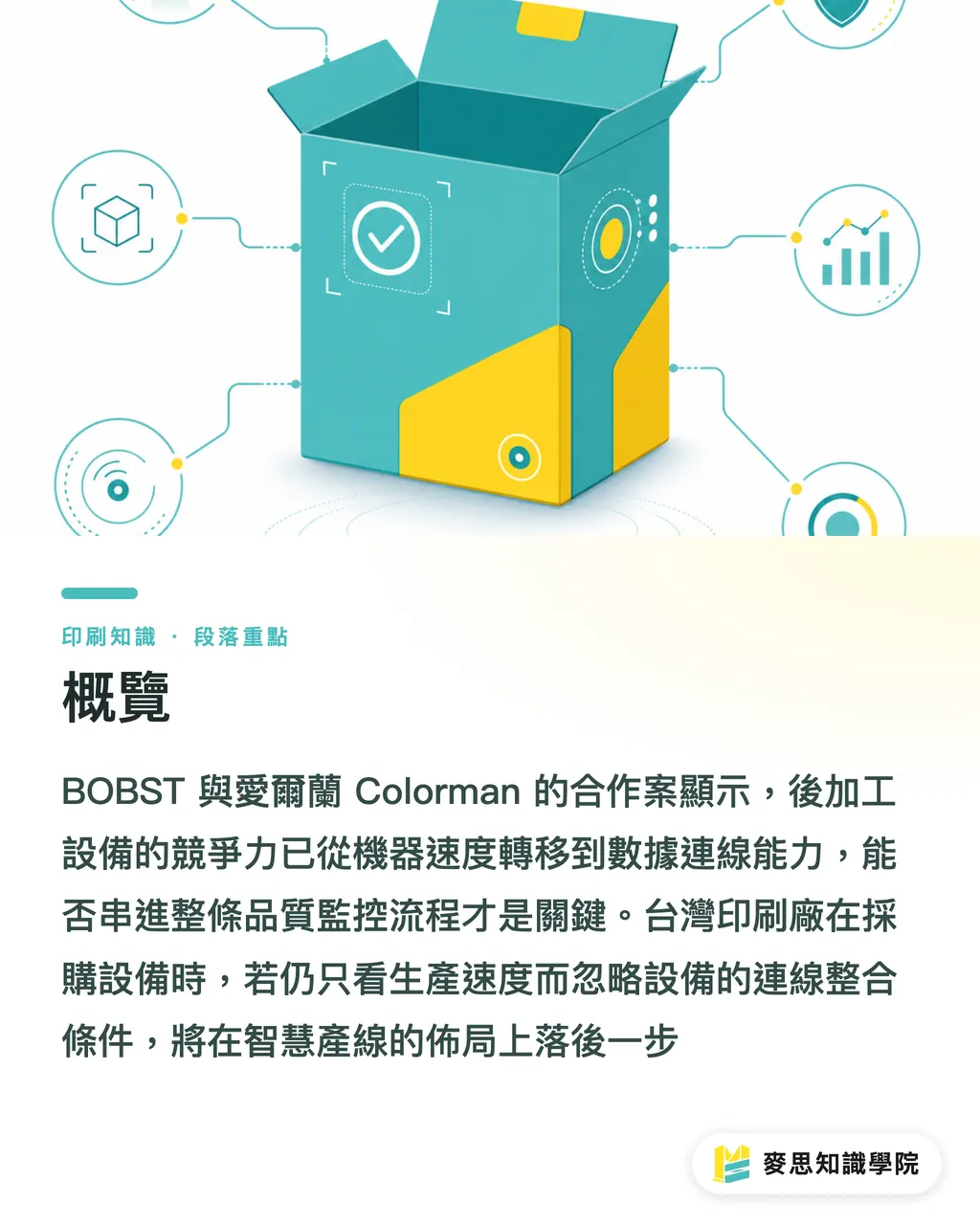
What Happened with BOBST × Colorman?
Founded in 1959, Colorman has long produced integrated print and packaging at its Dublin plant. BOBST public materials frame this collaboration around zero-defect packaging
・Client sectors: healthcare, pharmaceutical, IT, government
・Product types: folding cartons, leaflets, IFUs, booklets
・Partnership duration: Colorman and BOBST have worked together for 9 years
・Line objective: move folding carton quality closer to zero-fault production
Looking at this case, the first signal is practical: over 9 years, Colorman turned BOBST from an equipment vendor into a production line management partner
Anyone who has spent time on the shop floor knows that if a batch of cartons has errors, no matter how fast the machines ran, all you see in the warehouse is a pile of paper waiting for rework
How Does Smart Connected Packaging Production Work?
Smart connected packaging production connects data from printing, foiling, folder-gluing, inspection, rejection, counting, and stacking back to the same work order, making quality traceable along the line
The Colorman setup shared by BOBST focuses on having verifiable quality checks at every post-press stage
・Digital Inspection Table: brings inspection standards directly into the workflow so checks go beyond manual visual inspection
・NOVAFOIL 106: handles foil stamping for cartons, bringing high-value finishing into a controlled workflow
・EXPERTFOLD 110: one of Colorman's primary machines in the folder-gluing section
・EXPERTFOLD 80: BOBST noted this is the first fully automated setup of its kind in Europe
The EXPERTFOLD 80 configuration is worth a close look by plant managers in Taiwan because it isolates and handles the stages where human error builds up most
・EASYFEEDER: reduces reliance on operator touch and feel during feeding
・ACCUCHECK: monitors quality during the run instead of waiting for final inspection to catch issues
・ACCUJECT: automatically ejects non-conforming cartons so defects stay off the main line
・CARTONPACK 4: automatically counts and stacks at the end of the line, reducing manual handling and counting errors
That is enough
When a post-press line can inspect, eject, and count on its own, a plant manager finally gets the chance to move quality logs off paper forms and into work order data

Why Should Small and Medium Print Shops in Taiwan Care?
My warning to Taiwanese plants is straightforward: if your new equipment evaluation matrix still only has speed, precision, and price, you are already missing a column, data capability
Data capability is not an IT gimmick. It becomes proof you can produce during brand audits
・Can the machines pass work order numbers and batch numbers downstream into the post-press stage
・Can inspection data from systems like ACCUCHECK feed back into quality records
・After ACCUJECT ejects defective cartons, can you check the reason for rejection
・Can counting and stacking data from end-of-line machines like CARTONPACK 4 connect to delivery and dispatch management
Don't rush
Small and medium plants can start by organizing data on a single high-risk post-press line, such as pharmaceutical boxes, health supplement cartons, or gift boxes with foil stamping. When errors happen on these products, brand clients look closely at batch numbers, defect reasons, rework time, and impact on delivery
When brand clients prepare new cartons or high-value packaging, they can bring die lines, paper stock, foil stamping, and inspection criteria directly into proofing meetings. MINDS is well-suited for mid-to-high-end fully customized commercial print projects because paper stock and finishing effects must translate into mass production feasibility rather than stopping at a nice-looking 3D mockup
What Questions Should You Ask Vendors When Buying Equipment?
I would reframe equipment evaluation around the 'MINDS 3 Checkpoints for Connected Production Lines'. These three checkpoints are plain enough and force vendors to give clear answers
・1. Data can enter: can data from new machines, old machines, and different brands connect to the same work order
・2. Errors can be seen: can inspection, rejection, downtime, and rework reasons record timestamps and batch numbers
・3. Records can be delivered: when brand clients ask for batch numbers, quality logs, or delivery delays, can the plant pull them together on the same day
Mixed-line plants get stuck most easily on field definitions, while choosing which machine to buy is usually settled earlier. Taiwanese plants commonly run BOBST machines, domestic machines, and older units together, so MES and ERP systems must first know what data each machine can export
If your plant mixes multiple brands, old machines, and new machines, the Mai Strategy Knowledge Academy Consulting Team can help audit your work order, quality control, and post-press data fields before you decide whether to connect to MES or ERP, or start with partial data write-backs

Key Takeaways
・The message from BOBST × Colorman is simple: delivering goods is no longer enough; handing over quality records is what secures the next order
・Add a data capability column to your equipment purchase sheet. A machine can show great speed numbers, but without records, passing a brand audit remains tough
・Small and medium plants should connect three core fields first: work order, inspection, and batch number. That way, connectivity begins in manageable steps
・Post-press operations are shifting from veteran operators' touch to machine decisions, rejection logs, and shipping records
Further Considerations
・Print Manufacturing: track work order numbers, batch numbers, inspection results, rejection reasons, and downtime reasons first, giving a post-press line its minimum viable dataset
・Design: address die-cutting, foiling, and gluing risks in meetings before proofing. Visually impressive effects must stand up to mass production and quality inspection
・AI Adoption: start by comparing defect logs and downtime reasons. Spend less time talking about plant-wide automation and focus on the questions plant managers ask daily
・SaaS Teams: turn machine events into fields for lead times, scrap, rework, and batch traceability so shop floors actually view your software as a production tool
Further Reading
FAQ
- What does the BOBST × Colorman collaboration represent?
- It shows that folding carton lines are connecting BOBST post-press machinery, inspection, rejection, and end-of-line counting into a unified quality workflow, backing up zero-defect packaging with verifiable production line data
- How does smart connected packaging production affect small and medium print shops?
- When buying new equipment, small and medium print shops must ask fundamental questions about data connectivity, MES, ERP, batch logging, and exporting quality control data. Focusing solely on speed misses the evidence brand auditors care about most
- Why is Colorman a good case study?
- Founded in 1959 in Dublin, Colorman serves clients across healthcare, pharmaceutical, IT, and government sectors. These clients demand strict quality documentation for folding cartons, IFUs, and booklets
- Where can print shops in Taiwan begin?
- Start with a single post-press line. Organize work order numbers, batch numbers, inspection results, rejection reasons, and downtime reasons into fixed fields, then check whether existing machines can integrate with an MES or ERP
Related articles



The Print × AI weekly
The print and AI know-how designers, brands and enterprises can use before they commit — one email, every week
MINDS Free Tools
AI background removal, a LINE sticker maker, spine & imposition calculators — all free, right in your browser, no upload.
MINDS Group
Need actual printing or gifting services?
From premium printing to online ordering and festive gifts — the MINDS Group sister brands take it from here.