

What Is the Fight Over California's SB 54 Really About?
The battle over California's SB 54 is a wake-up call for Taiwan's supply chain. EPR has shifted from a legal question for US brands into a practical procurement problem that directly hits materials, printing, proofing, and shipping documents. When reviewing North American packaging projects like this, MINDS starts by checking three things: material declarations, recycled content ratios, and design for recyclability
EPR (Extended Producer Responsibility) shifts post-consumer packaging recycling, processing, and cost burdens away from local waste management and onto brands and producers. End-of-life costs now have to be built into packaging design from day one
In a July 20, 2026 report on the California agriculture coalition call to repeal SB 54, Packaging Insights noted that Californians for Affordable Packaging (CAP) is demanding a full repeal of SB 54, formally known as the Plastic Pollution Prevention and Packaging Producer Responsibility Act. Their reasons include crushing fees and compliance costs, lagging recycling infrastructure, and the risk of agricultural packaging being flattened under a one-size-fits-all rule
SB 54 sets rigid targets: a 25% reduction in packaging waste, a 65% recycling rate for single-use plastic packaging and foodware, and shifting all single-use packaging and foodware waste toward recyclable or compostable materials
It's simple
From a printer's perspective, this isn't just legal text for corporate lawyers. For the exact same bag or box, the ink, film layers, barrier coatings, label adhesives, and recycled content can completely alter a client's compliance declaration
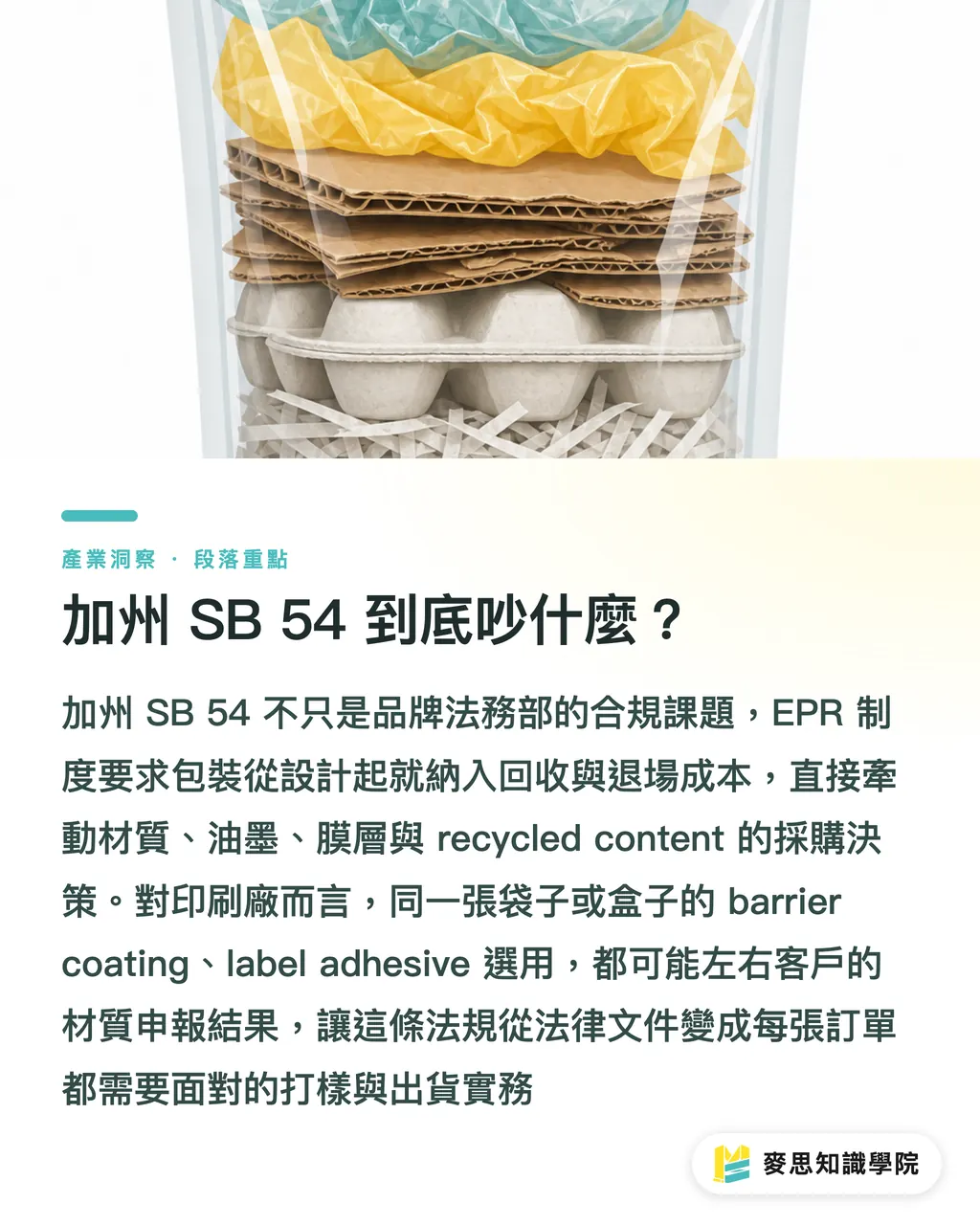
Why Are Farmers Clashing With Brands?
CAP called out dairy cartons, jugs, clamshell packs, corrugated boxes, plastic films, bags, wraps, and glass containers as potentially affected items. Covering paper, plastic, glass, and corrugated board, this goes way beyond a niche issue for plastic films
Agricultural anxieties center on a few real-world operating conditions
・ Packaging needs to block contamination. The Packaging Insights report mentions that CalRecycle provides an exemption pathway for certain packaging bound by FDA and USDA food safety requirements
・ Certain oxygen or moisture-control layers exist strictly for shelf life, so they cannot be judged solely through standard recycling categories
・ Small components like seals, liners, and caps are easy to overlook, but in practice they determine whether a crate of produce arrives safely
CalRecycle's exemption logic also gives Taiwan's supply chain a clear warning: if a brand claims a packaging element is required for food safety or preservation, it must prove there is no reasonable alternative. Simply saying 'the client specified it' won't cut it
For Taiwan's supply chain, this fight is useful because it lays out the questions buyers will be asking tomorrow
・ What substrates did you use in your packaging?
・ Does it contain recycled content?
・ Can you justify why alternative materials aren't viable?
・ Which artwork version corresponds to which BOM version?
How Will the US EPR Patchwork Hit Taiwan?
With states like CA, OR, ME, WA, and CO already in the mix, Taiwanese brands face a patchwork of state laws. A single California specification will not cover you nationwide
The same Packaging Insights report noted that related legislation in New York failed for the third consecutive year in June, and Oregon's EPR implementation hit a preliminary injunction. Yet on the flip side, roughly one-fifth of US residents already live in EPR states
My assessment is simple: supply chains betting on the wrong horse put their hopes on regulatory delays. The practical move is assuming client procurement sheets will change ahead of schedule
The most common problem I see on packaging proofing tables isn't a printing failure. It's having material specs, film thickness, ink, labeling, and outer cartons split across five separate files, leaving no one sure which version is the actual final shipment
Do one thing first
Link a single SKU's material, film thickness, ink, adhesive layer, outer carton, and label into a single traceable record. If North American clients are already asking for material specs alongside short-run samples, you can let MINDS help place proofing, color management, and spec sheets under one print submission point, cutting out endless rounds of back-and-forth emails
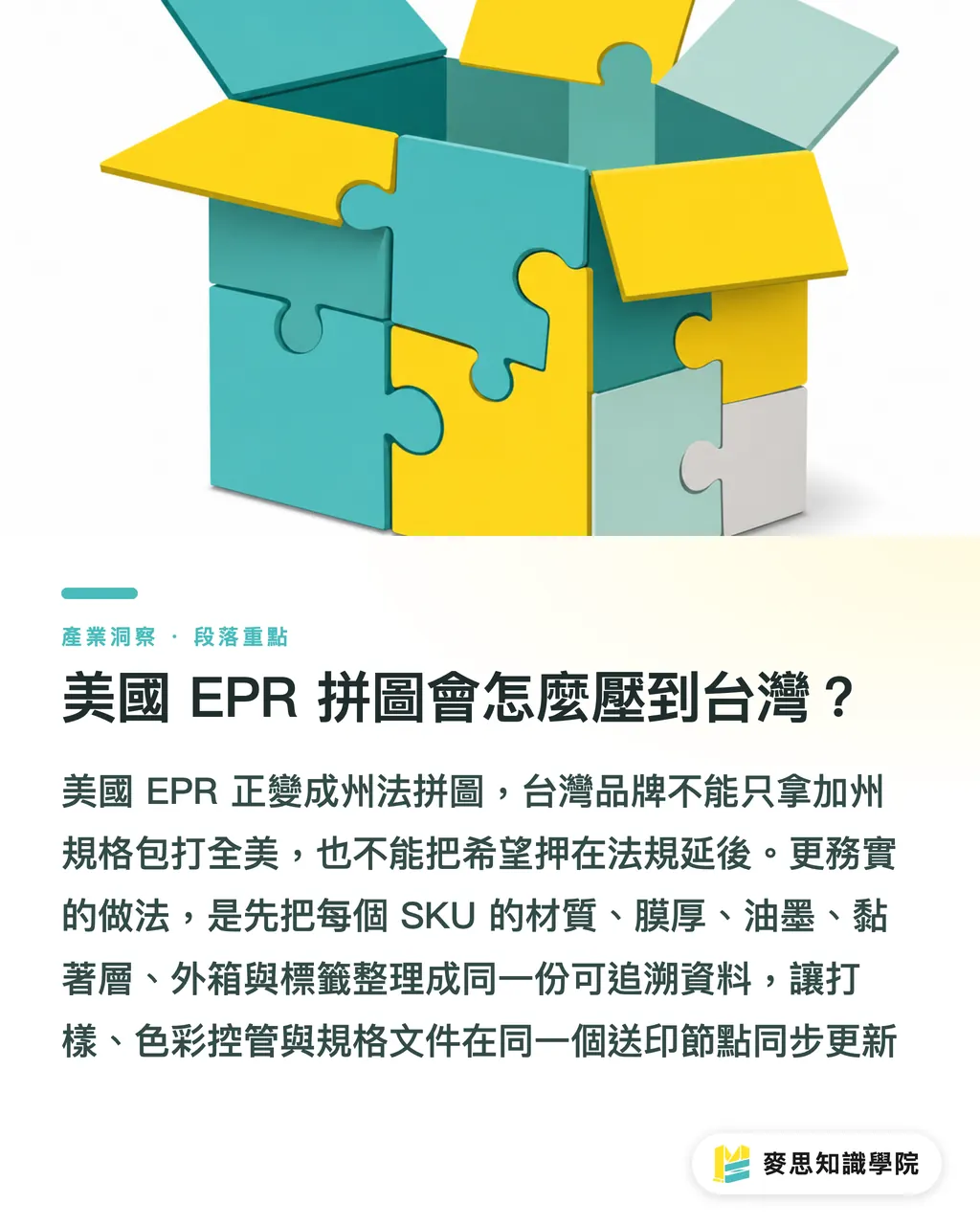
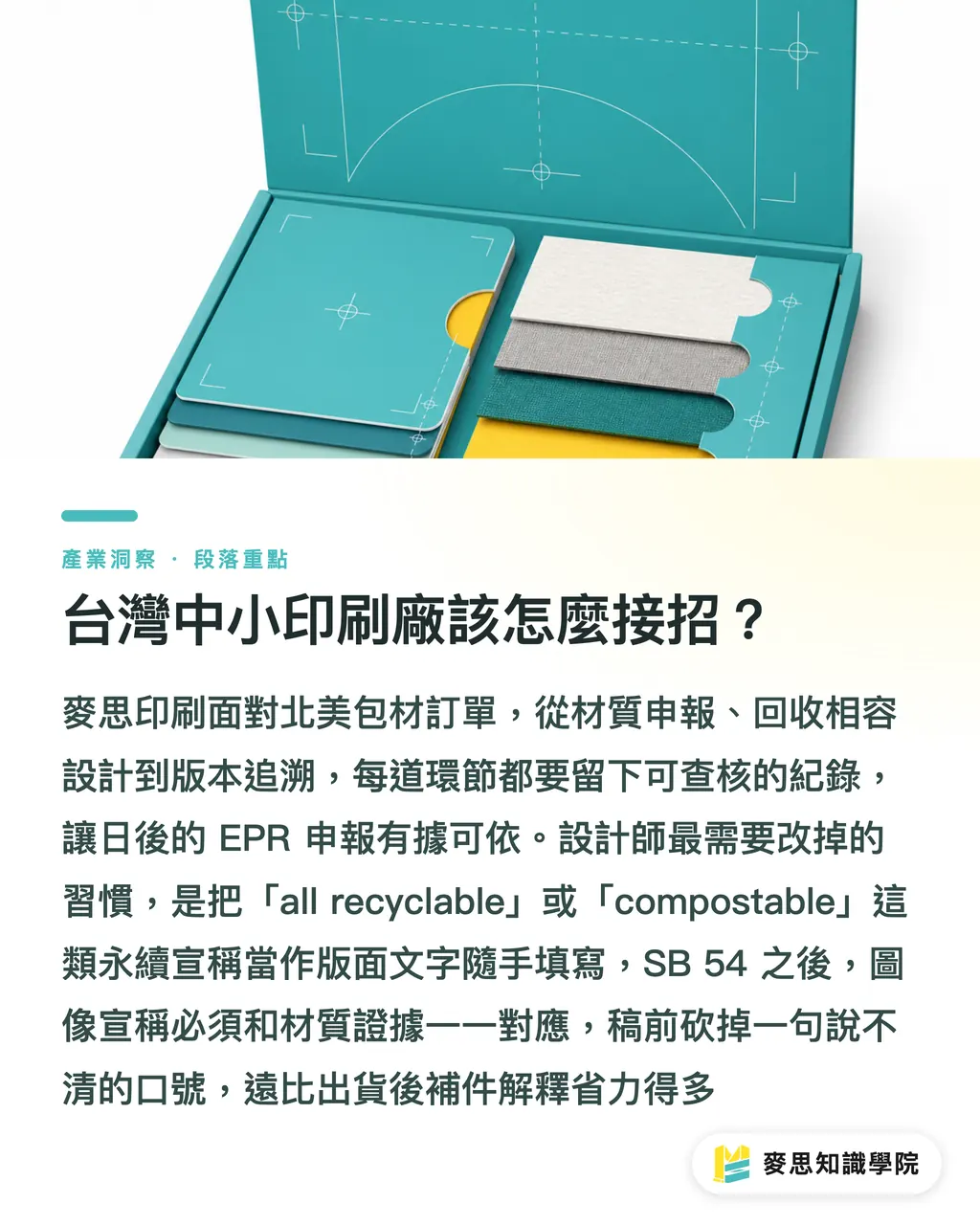
How Should Small and Mid-Sized Taiwanese Printers Respond?
I look at North American packaging projects through the 'MINDS (MS, mid-to-high-end bespoke commercial printing) Three-Gate Checklist'
・ 1. Declarable Materials: Maintain at least these 6 fields for every SKU, substrate, film layer, ink, adhesive, label, and outer carton, so responsibility boundaries remain clear when clients update designs
・ 2. Design for Recyclability: Beyond colors and shelf impact, verify whether the label, lamination, or barrier layer complicates the recycling stream
・ 3. Traceable Revisions: For the same packaging, v 1, v 2, and v3 must log the reasons for each update, so you aren't digging through old emails when clients ask about EPR fees or exemptions down the line
For designers, the habit that needs to change most is treating sustainability claims as mere layout copy
In the past, when a client asked for something eco-friendly, you might have just swapped in a recycle icon or added a sustainability claim. After SB 54, visual claims must match material proof, especially terms like all recyclable, compostable, and PCR
I'd rather cut a catchy slogan before printing than scramble after shipment to produce an explanation I can't back up
Key Takeaways
・ The SB 54 debate centers on how to calculate the 25% reduction, the 65% recycling rate, and food safety packaging exemptions
・ EPR will change procurement spec sheets first, artwork next, and finally the printer's BOM and version control
・ Taiwan's supply chain needs to catch up on 3 core items first: material declarations, recycled content ratios, and design for recyclability
・ For export packaging, recyclable design without supporting documentation will quickly become nothing more than a pretty design with zero procurement value
Further Considerations
Extending this to print manufacturing, design, AI adoption, and SaaS, I'd start with one simple step: digitizing packaging specs into a database so every SKU clearly links its substrate, ink, film layers, version, target client states, and compliance documents. AI can help spot revision differences, aggregate buyer questionnaires, and flag missing fields, while SaaS handles permissions, version control, and sign-offs. If your team is sorting out North American EPR packaging workflows, reach out to the Mai Strategy Knowledge Academy consulting team to align your material specs, print files, and procurement questionnaires upfront, and avoid turning compliance into a last-minute rush redesign
Further Reading
FAQ
- What is California's SB 54?
- SB 54 is California's EPR law for packaging and single-use plastic foodware. As reported by Packaging Insights, it mandates a 25% packaging waste reduction, a 65% recycling rate for single-use plastic packaging and foodware, and a shift toward 100% recyclable or compostable materials
- Why do agricultural groups want SB 54 repealed?
- Californians for Affordable Packaging argues that the current design of SB 54 inflates costs for farmers, food producers, and businesses, while threatening packaging essential for food safety, shelf life, and transit protection
- Will Taiwanese printers face direct fines under SB 54?
- Most Taiwanese printers are not classified as producers directly liable under California law. However, brand clients will embed material declarations, recycled content requirements, and recyclable design criteria into procurement terms, passing the pressure right back down the supply chain through purchase orders
- Should we immediately switch to mono-materials right now?
- Don't sacrifice food safety or product protection just to rush into mono-materials. The right sequence is to audit your substrates and functional layers first, then evaluate alternative materials, recycling pathways, and the specific states your clients operate in
- How can designers avoid last-minute EPR artwork revisions?
- Designers must align recycling claims, material callouts, label adhesives, and lamination with the actual BOM. Before submitting artwork, confirm whether the client requires compliance documentation for states like CA, OR, ME, WA, and CO
Related articles

The Print × AI weekly
The print and AI know-how designers, brands and enterprises can use before they commit — one email, every week
MINDS Free Tools
AI background removal, a LINE sticker maker, spine & imposition calculators — all free, right in your browser, no upload.
MINDS Group
Need actual printing or gifting services?
From premium printing to online ordering and festive gifts — the MINDS Group sister brands take it from here.